How Hot Is the Sun? From Core to Corona
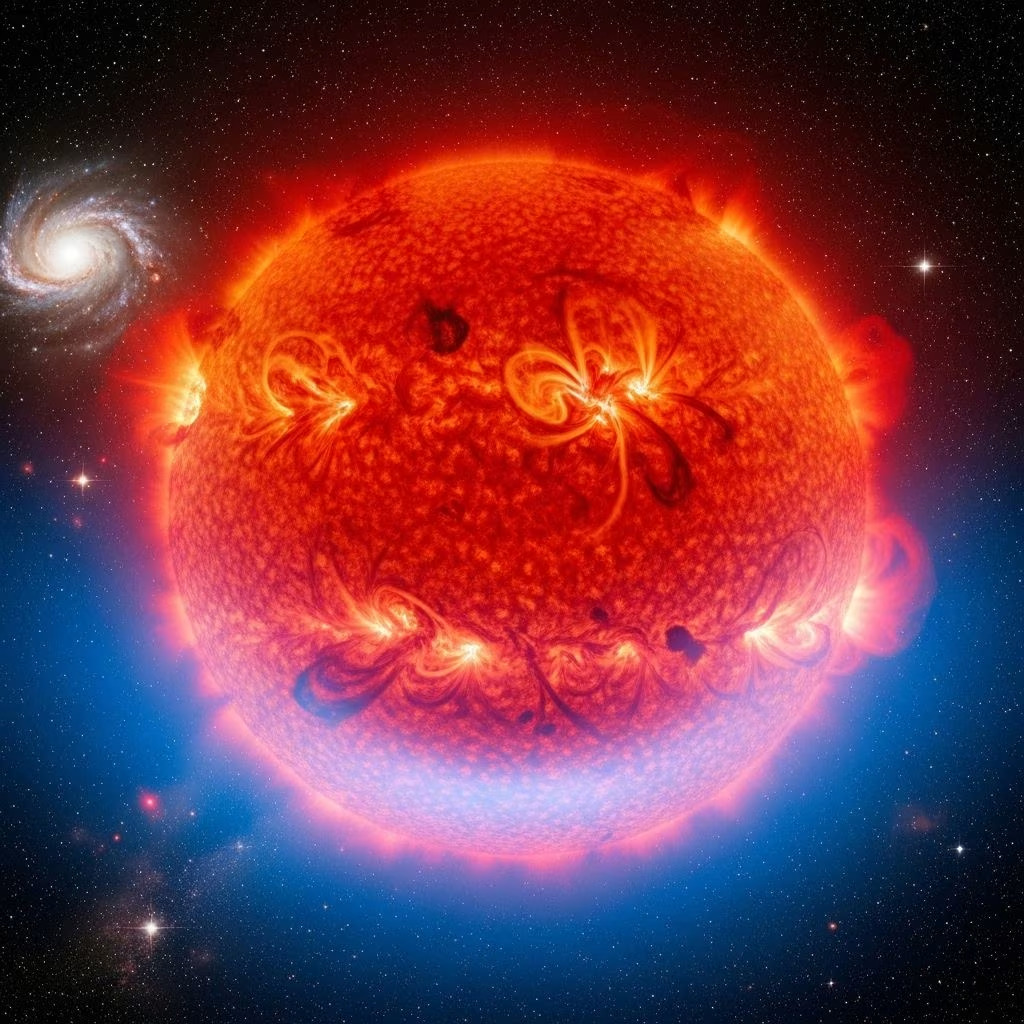
The Sun, our life-sustaining star, is an astonishingly powerful ball of plasma whose heat and energy drive everything from planetary climates to the very possibility of life on Earth. Yet, despite its proximity and importance, the question remains: just how hot is the Sun? To truly answer this, we need to unravel the Sun’s various layers, each with dramatically different temperatures and fascinating physical processes.
Table: Temperatures of the Sun’s Layers
| Layer | Approximate Temperature (Kelvin) | Approximate Temperature (°C) | Approximate Temperature (°F) |
|---|---|---|---|
| Core | 15,000,000 K | 15,000,000°C | 27,000,000°F |
| Radiative Zone | 7,000,000 K | 7,000,000°C | 12,600,000°F |
| Convective Zone | 2,000,000 K | 2,000,000°C | 3,600,000°F |
| Photosphere (Surface) | 5,800 K | 5,500°C | 10,000°F |
| Chromosphere | 20,000 K | 20,000°C | 36,000°F |
| Corona (Outer Atmosphere) | 1,000,000–2,000,000 K | 1,000,000–2,000,000°C | 1,800,000–3,600,000°F |
Understanding the Sun’s Fiery Heart: Nuclear Fusion in the Core
The Sun’s core is the engine room fueling its entire existence. Here, temperatures soar to about 15 million Kelvin (27 million °F). Under this staggering heat and immense pressure, hydrogen atoms are fused into helium through nuclear fusion, releasing colossal amounts of energy in the process. This energy then radiates outward, gradually making its way through different layers before escaping into space as sunlight and heat.
- Nuclear fusion at the core maintains the Sun’s heat and essential luminosity.
- The pressure exists due to the Sun’s vast mass compressing everything at the center.
- This process began approximately 4.6 billion years ago and will continue for billions more.
The Radiative and Convective Zones: Energy’s Long Journey Outward
Above the core lies the radiative zone, where temperatures are still hot—about 7 million Kelvin (12.6 million °F). In this layer, energy moves outward slowly, transported primarily by radiation. It can take up to a million years for energy to traverse the radiative zone due to the sheer density of solar material.
Next is the convective zone, where temperatures dip closer to 2 million Kelvin (3.6 million °F). Here, much like boiling water, hot plasma rises, cools as it nears the surface, and sinks again, creating convective cells often responsible for the Sun’s surface granulation patterns.
The Photosphere: The Sun’s Perceived Surface
The photosphere is the layer visible to the naked eye, commonly considered the Sun’s surface even though the Sun, being a ball of plasma, doesn’t have a solid surface. Temperatures at the photosphere are about 5,500°C (approximately 5,800 K or 10,000°F).
- This layer is where most of the Sun’s visible light is emitted;
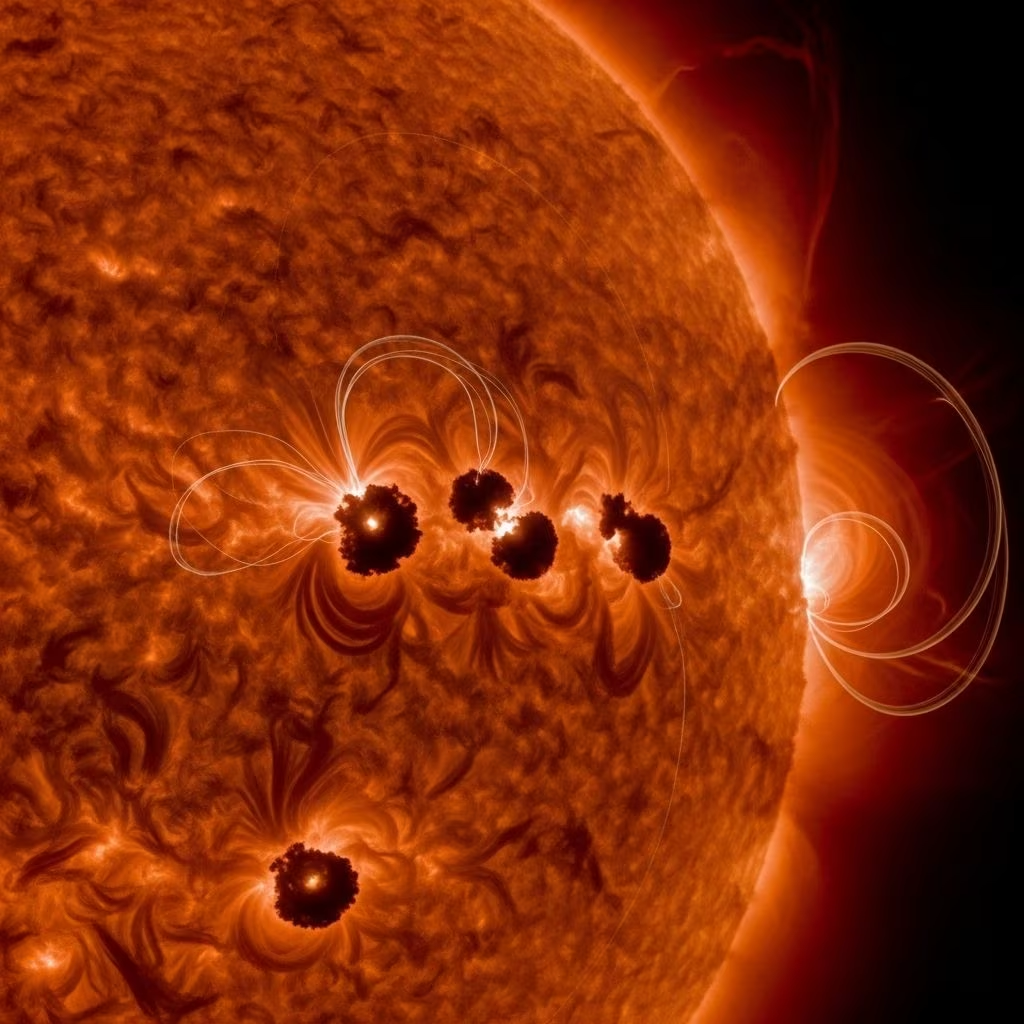
- Sunspots—cooler, darker regions—are also found here, typically about 3,500°C (6,332°F), showing dramatic temperature contrast relative to their surroundings.
The photosphere defines the boundary where photons can escape freely into space, marking the transition between the Sun’s interior and outer atmosphere.
The Chromosphere: A Colorful Shell
Above the photosphere is the chromosphere, a layer recognized by its reddish hue during solar eclipses. This atmospheric shell grows much hotter with altitude, ranging up to 20,000 K (36,000°F). The dramatic increase is due in part to the complex interactions between plasma, radiation, and the Sun’s magnetic field.
The Solar Corona: The Outer Atmosphere Mystery
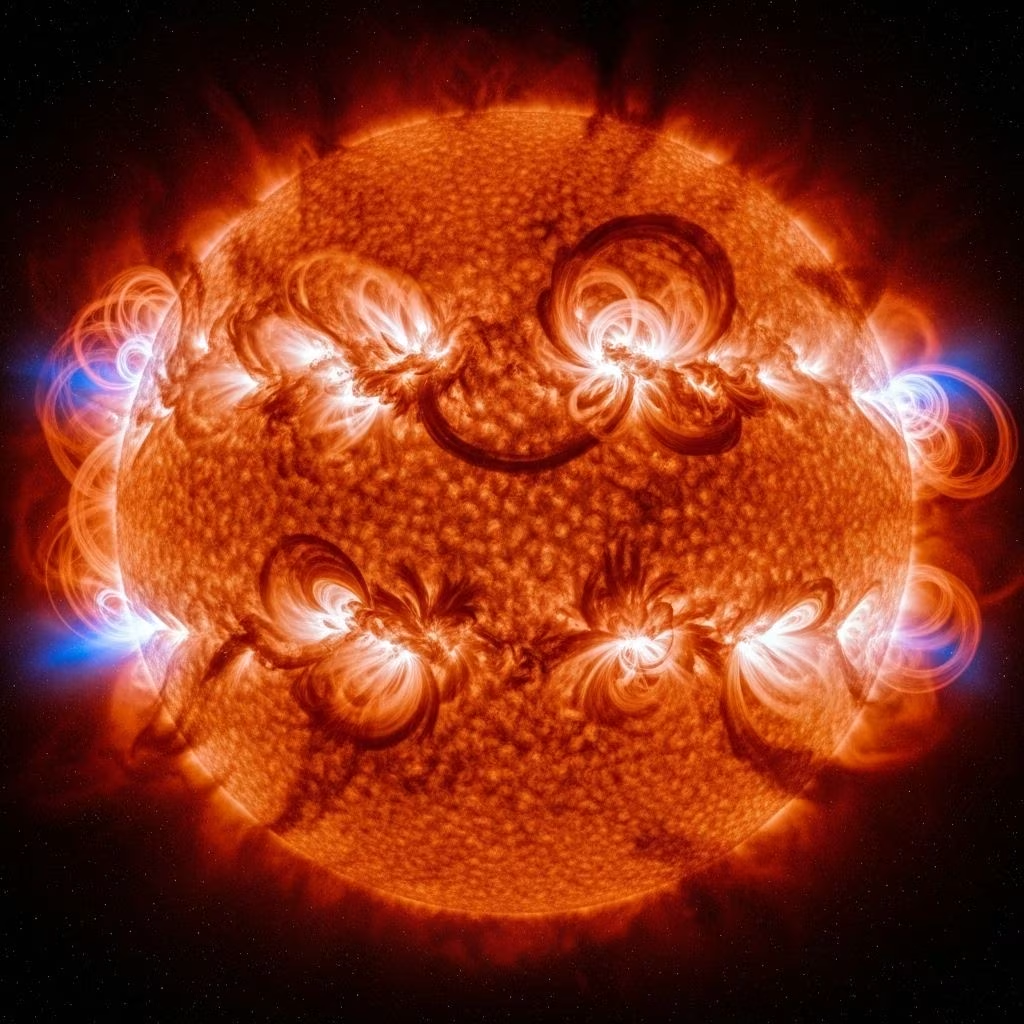
The Sun’s corona is the thin, ghostly outermost layer of the solar atmosphere. Astonishingly, the corona’s temperature greatly exceeds that of the photosphere, fluctuating between 1 million and 2 million Kelvin (up to 3.5 million °F). Some flaring regions can get even hotter—over 20 million °C in certain events.
- Why is the corona hotter than lower layers? This is a longstanding scientific mystery. Some leading theories attribute this phenomenon to wave heating, magnetic reconnection, and explosive releases of magnetic energy.
- The corona’s ineffable heat is a primary research target for NASA’s Parker Solar Probe and similar solar missions.
The corona gives rise to the solar wind: a fast-moving stream of charged particles that extends throughout the solar system, affecting planetary magnetospheres and interplanetary conditions.
Measuring the Sun’s Heat: Methods and Insights
How do scientists determine such high and varied Sun temperatures?
- Spectroscopy is crucial: By splitting sunlight into its constituent wavelengths, researchers can infer temperature based on the color and intensity of light the Sun emits at different layers.
- Real-world data from both ground and space-based telescopes (like ESA’s Hubble, NASA’s Solar Dynamics Observatory, and others) continually refine our knowledge.
- Mathematical modeling of nuclear fusion and plasma physics serves as another pillar of our understanding, especially in predicting core conditions inaccessible to direct measurement.
These combined methods ensure our measurements are robust, even as instruments continue to advance.
Why Is the Sun So Hot? The Physics Behind the Inferno
The Sun’s tremendous heat stems from the interplay between nuclear fusion and the workings of gravity. Here’s how the process unfolds:
- Intense gravity at the Sun’s center compresses hydrogen atoms, raising temperatures until fusion becomes possible.
- During fusion, hydrogen nuclei combine to form helium, releasing energy according to Einstein’s equation
E=mc^2. - This energy spreads outward, keeping the star from collapsing under its immense gravity and heating the Sun’s layers.
The result is a dynamic equilibrium: fusion pressure balances gravity, producing stable, sustained heat.
Why Is Space Cold If the Sun Is So Hot?
It may seem paradoxical that the Sun, capable of heating objects to searing temperatures, exists in the midst of the frigid vacuum of space. However, the explanation lies in the nature of temperature and heat transfer:
- Space itself is nearly a vacuum, with very few particles to conduct or convect heat. This is why space is extremely cold—average temperature is about 2.7 Kelvin (−270.45°C or −454.8°F).
- The heat we feel from the Sun comes not from conduction but via electromagnetic radiation—mainly visible and infrared light.
- An object in space absorbs energy from sunlight and heats up, but objects in the shadow remain frigid.
A vivid example: When in direct sunlight, the International Space Station can reach temperatures as high as 121°C (250°F) but plummets to -157°C (-250°F) on its dark side.
What Happens to Spacecraft Near the Sun?
Spacecraft traveling closer to the Sun experience extreme heat due to direct exposure to its radiation. They require special materials and engineering solutions to survive:
- NASA’s Parker Solar Probe uses a carbon-composite heat shield to survive temperatures up to 1,400°C (2,600°F) as it traverses the hot corona.
- Behind these shields, sensitive instruments are kept at near room temperature, allowing precise measurements without damage.
- The challenge isn’t the ambient temperature of ‘space’ but the intensity of radiation when directly confronting solar rays.
The Sun’s Heat and Life on Earth
Earth lives in the Sun’s ‘Goldilocks zone’—not too hot, not too cold—which allows for liquid water and life as we know it. The Sun’s energy drives all weather, determines climates, and is at the root of virtually every ecosystem.
- Sunlight powers photosynthesis in plants, forming the base of the food web.
- The atmosphere and magnetic field protect us from the Sun’s harmful radiation, allowing mostly visible light and warmth to reach the surface.
- Solar phenomena like flares, sunspots, and coronal mass ejections can impact satellites, communications, and power grids on Earth.
Frequently Asked Questions (FAQs)
Q: Why is the Sun’s corona hotter than the surface?
A: Theories include magnetic reconnection, wave heating, and energy transfer through magnetic fields. These processes convert magnetic energy into heat, but the full explanation is still a subject of active research.
Q: How do scientists measure the temperature of the Sun?
A: By analyzing the spectrum of sunlight (spectroscopy) and using mathematical models of the Sun’s structure. Space probes and solar telescopes provide additional data, especially for the outer layers.
Q: Why is space so cold when the Sun is so hot?
A: Space lacks particles to conduct or convect heat. Only radiation (light) transfers energy. Unless an object absorbs sunlight, it remains at the background temperature of space, which is close to absolute zero.
Q: What is the hottest part of the Sun?
A: The core is the Sun’s hottest region, at about 15 million Kelvin. Some brief and localized solar flares in the corona can exceed even these temperatures for short periods.
Q: How does the Sun’s heat affect technology and life on Earth?
A: Besides powering life and driving climate, solar storms and bursts of charged particles can disrupt electronics, satellites, and power grids. Study and forecasting of solar activity help protect these vital systems.
References
- https://www.space.com/how-cold-is-space
- https://www.space.com/14719-spacekids-temperature-outer-space.html
- https://science.nasa.gov/solar-system/temperatures-across-our-solar-system/
- https://www.iflscience.com/if-the-sun-heats-the-earth-why-is-space-cold-72058
- https://www.sciencefocus.com/space/how-hot-is-the-sun
- https://biologyinsights.com/how-hot-is-the-sun-in-space-and-why-is-space-cold/
- https://cosmicopia.gsfc.nasa.gov/qa_sp_ht.html
- https://www.amu.apus.edu/area-of-study/science/resources/why-is-space-not-always-cold/
- https://www.accuweather.com/en/space-news/what-is-the-temperature-in-space-and-why/686238
- https://en.wikipedia.org/wiki/Sun
- https://www.livescience.com/coldest-place-in-solar-system
- https://www.popsci.com/why-is-space-cold-sun-hot/
- https://explee.com/media/how-cold-is-space
- https://en.wikipedia.org/wiki/Effective_temperature
- http://imartinez.etsiae.upm.es/~isidoro/tc3/Space%20environment.pdf
- https://www.urban-astronomer.com/astronomy/what-is-the-temperature-of-space/
- https://www.skyatnightmagazine.com/space-science/how-hot-is-the-sun