What is UTC?
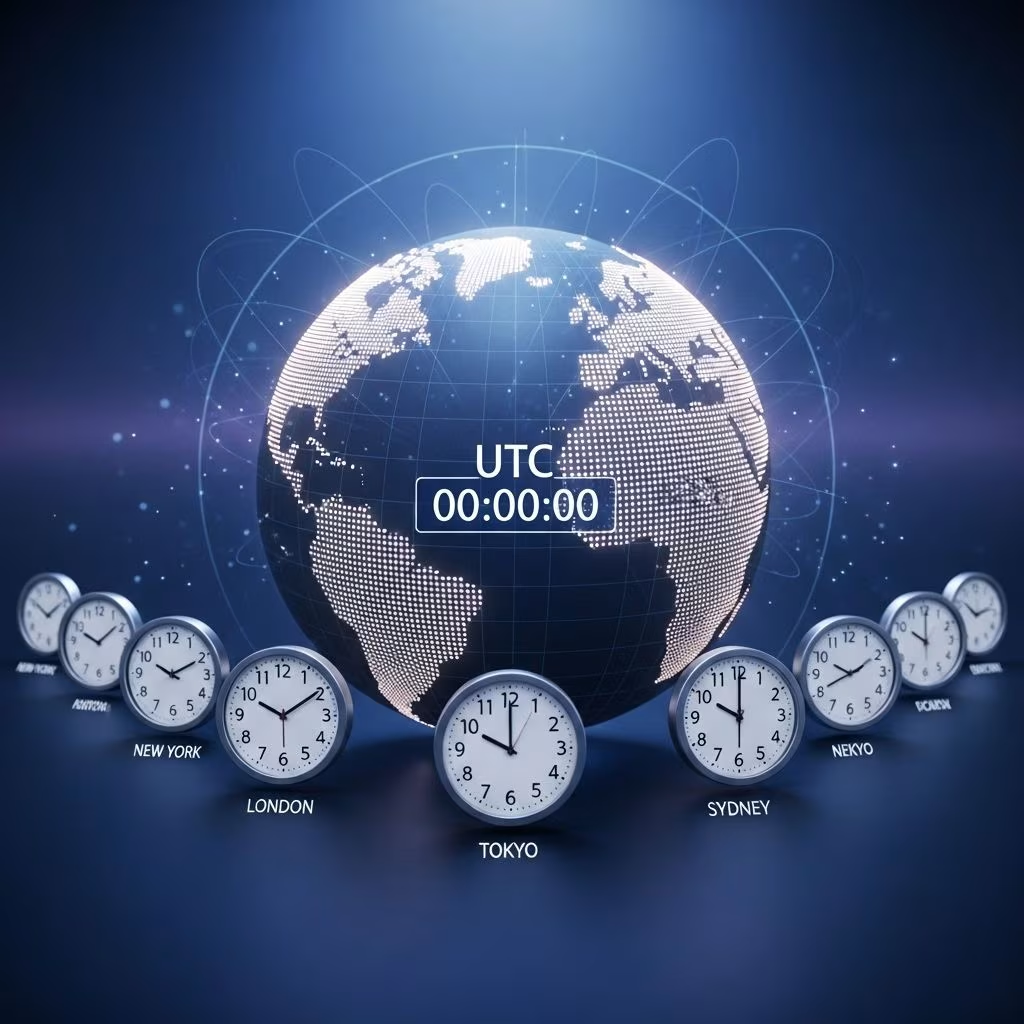
Coordinated Universal Time (UTC) is the internationally agreed time standard used to regulate clocks and time zones worldwide. It serves as the backbone for civil timekeeping, facilitating global synchronization for navigation, science, commerce, and daily use[12]. For example, major cities like New York City refer to UTC’s offset (UTC-5), ensuring consistency across nations and industries.
Why Do We Need a Universal Time Standard?
As technology united the globe for communication and travel, a common time reference became essential. UTC enables:
- International communication
- Navigation systems and GPS
- Scientific research
- Commerce and financial transactions
- Precise scheduling for global events
UTC and the History of Timekeeping
Before UTC, time was regulated by Greenwich Mean Time (GMT). However, GMT depends on the Earth’s rotation, which varies slightly and made precise coordination difficult. As atomic clocks grew more accurate, the world required a system that combined astronomical observations with atomic precision[12].
- 1960: Worldwide coordination of timekeeping and frequency began.
- 1963: UTC was officially adopted as a standard.
- 1967: “UTC” became the official abbreviation of Coordinated Universal Time[12].
- 1972: Leap seconds were introduced to keep UTC aligned with mean solar time.
- 2035 (planned): Leap seconds are slated for retirement to further simplify systems.
How is UTC Calculated?
UTC is based on International Atomic Time (TAI), which aggregates the output of hundreds of atomic clocks globally. TAI itself measures the passage of time with atomic transitions, which are extremely stable. UTC periodically adds or removes leap seconds to keep atomic time closely aligned with the average solar day[12].
| Standard | Basis | Precision | Usage |
|---|---|---|---|
| UTC | TAI + leap seconds | Seconds | Global civil time, navigation |
| TAI | Atomic clocks | Fractional seconds | Scientific time scale |
| GMT | Mean solar time | Seconds | Historical/civil time |
| UT1 | Earth’s rotation | Milliseconds | Astronomy, geodesy |
The Structure of UTC: Days, Hours, Minutes, Seconds
UTC divides time as follows:
- Days use the Gregorian calendar. Julian day numbers are also used in science.
- Each day has 24 hours
- Each hour has 60 minutes
- Each minute usually has 60 seconds, but with leap seconds may have 61 or 59
- SI second is the constant unit (defined by atomic transition)
Usually, a UTC day comprises exactly 86,400 SI seconds. However, due to the Earth’s irregular rotation, an extra second (called a leap second) is occasionally added to keep UTC within one second of mean solar time.
What are Leap Seconds?
Leap seconds are extra seconds occasionally inserted into UTC to account for variations in Earth’s rotation and to keep civil time synced with astronomical time.[12]
- Introduced in 1972
- Can be added or, in theory, subtracted (though subtraction has not occurred yet)
- Occur typically at the end of June or December, but could happen at the end of March or September if needed
- Announced at least six months in advance, usually by the International Earth Rotation and Reference Systems Service (IERS)
- To date, no minute has contained 59 seconds—only 60 or 61
- Leap seconds can disrupt computer systems, navigation, and scheduling, prompting discussions to eliminate them by 2035
UTC and Other Time Systems
Although UTC is the main standard, other systems exist and serve specialized purposes:
- International Atomic Time (TAI): Pure atomic-clock based, no leap seconds[12]
- Universal Time (UT1): Based on actual Earth rotation, used for astronomy and geodesy
- Local Time Zones: Defined as UTC plus or minus a number of hours (e.g., UTC-5 is New York)
| Time System | Main Use | Relation to UTC |
|---|---|---|
| TAI | Scientific standards | UTC = TAI minus leap seconds |
| UT1 | Astronomical observations | UTC is kept within 0.9s of UT1 |
| Local Time | Civil time, daily schedules | UTC plus offset (e.g., UTC+1) |
Who Governs UTC?
UTC is defined and maintained by several international bodies:
- International Bureau of Weights and Measures (BIPM): Oversees official atomic standards
- International Telecommunication Union (ITU): Defines UTC globally
- International Earth Rotation and Reference Systems Service (IERS): Monitors Earth’s rotation and announces leap seconds
How Do We Use UTC In Everyday Life?
UTC is used to set clocks, devices, and online systems worldwide. For most people:
- All time zones are referenced as an offset from UTC (e.g., UTC+2 for Paris)
- Time servers use UTC to synchronize computers
- Airlines and international organizations schedule meetings using UTC to avoid confusion
- Global navigation systems (GPS, satellites) require UTC for precise position calculation
- Broadcast and trading platforms (stock exchanges, news) set timestamps with UTC
Dissemination and Real-Time Approximations
UTC is calculated retrospectively for the highest accuracy but distributed in real time via:
- GPS satellite signals
- Dedicated radio time signals
- Internet time servers (NTP)
- National time laboratories (usually indicated as UTC(k), with k designating the institution)
Recent Developments and the Future of UTC
In recent years, leap seconds have become an issue for critical infrastructure because they can cause software errors, disrupt time-dependent systems, and complicate synchronization. The General Conference on Weights and Measures has resolved to phase out leap seconds by 2035, intending to make UTC simpler and less prone to disruption[12].
UTC in Modern Technology and Science
Accurate timekeeping is crucial for:
- Satellite navigation and space exploration
- Global telecommunications
- Internet data transfer and security
- Precision scientific experiments
Any deviation in UTC propagation can disrupt these systems, making consensus and reliability key.
Frequently Asked Questions (FAQs)
Q: What does UTC stand for?
A: UTC stands for Coordinated Universal Time. It is the global standard for regulating clocks and time zones[12].
Q: How is UTC different from GMT?
A: While both standards serve as time zone references, UTC incorporates atomic time and leap seconds for precision, whereas GMT is based on Earth’s rotational period without adjustments for atomic precision[12].
Q: What is a leap second and why are they used?
A: A leap second is a one-second adjustment periodically added to keep UTC in sync with Earth’s irregular rotation. This maintains UTC’s alignment with mean solar time[12].
Q: Will leap seconds always be part of UTC?
A: No. A worldwide initiative is underway to eliminate leap seconds by 2035 due to challenges they cause in time-sensitive systems[12].
Q: How do I convert my local time to UTC?
A: Determine your time zone’s offset from UTC (e.g., UTC+5 or UTC-7). Add/subtract this value from your local time to obtain the UTC equivalent.
Q: How does UTC benefit global navigation and science?
A: UTC ensures all measurements and systems operate on a unified timeline, allowing accurate positioning, navigation, communication, and experiment synchronization worldwide[12].
Key Takeaways About UTC
- UTC is the primary civil time standard for the world, serving as the basis for time zones.
- It is based on ultra-precise atomic clocks, regularly adjusted to match Earth’s rotation with leap seconds as necessary[12].
- Most global infrastructure, from spacecraft to your smartphone, relies on UTC for coordinated operation.
- Upcoming changes are set to further stabilize UTC and make it even more reliable by eliminating leap seconds.
Glossary of Timekeeping Terms
- UTC: Coordinated Universal Time, main world time standard
- GMT: Greenwich Mean Time, historical time standard
- TAI: International Atomic Time, atomic clock-based time scale
- Leap Second: Occasional extra second inserted to keep UTC close to mean solar time
- SI Second: The base International System of Units (SI) unit for time, defined by transitions in atomic cesium
- DUT1: Difference between UT1 (Earth rotation) and UTC, kept within ±0.9 seconds
- Time Lab: Institution measuring and distributing time, referenced as UTC(k)
References
- https://www.space.com/what-is-utc.html
- https://www.space.com/20634-yuris-night-spaceflight-anniversaries-party.html
- https://www.space.com/world-clock
- https://www.space.com/news/archive
- https://www.space.com/24870-what-is-space.html
- https://en.wikipedia.org/wiki/UTC
- https://www.space.com
- https://www.linqto.com/unicorn-news/unicorn-news-the-latest-in-space-spacex-launches-polaris-dawn-for-first-private-spacewalk/
- https://www.space.com/sun-geomagnetic-storm-equinox-exploding-sunspot-september-25
- https://militarytimechart.com/coordinated-universal-time-utc/
- https://www.spaceweather.com
- https://en.wikipedia.org/wiki/Coordinated_Universal_Time
- https://github.com/TheSpaceDevs
- http://www.spacetoday.org/Time/UTC.html
- https://science.nasa.gov/learn/basics-of-space-flight/chapter2-3/
- https://spacepolicyonline.com/news/weekly-roundup-for-spacepolicyonline-com-october-28-november-3-2024/
- https://techcrunch.com/2024/06/24/techcrunch-space-building-and-testing-for-the-future/
- https://science.nasa.gov/solar-system/resources/faq/what-time-is-it-in-space/
- https://space.fandom.com/wiki/Coordinated_Universal_Time
- https://shortyawards.com/12th/above-and-beyond-utc-in-space-2