How Big Is Jupiter?
Jupiter is widely recognized as the king of planets in our solar system, dominating both size and mass by a remarkable margin. This gas giant is so colossal that it outstrips all other planets combined in terms of volume and mass, earning it the title of the solar system’s largest planet.
Jupiter at a Glance
- Diameter: About 143,000 kilometers (88,700 miles) at the equator
- Mass: Around 318 times that of Earth [11]
- Volume: Over 1,300 times the volume of Earth
- Gravity: 24.8 m/s² – more than twice Earth’s gravity
- Planet Type: Gas giant (composed mostly of hydrogen and helium)
Jupiter’s Dimensions Compared to Other Planets
To truly appreciate Jupiter’s massive scale, comparison is essential. Not only is it the largest planet by diameter, but its volume and mass far outstrip all others.
| Planet | Diameter (km) | Diameter (Earth = 1) | Mass (Earth = 1) | Volume (Earth = 1) |
|---|---|---|---|---|
| Jupiter | 143,000 | 11.2 | 318 | ~1,300 |
| Saturn | 120,536 | 9.45 | 95 | 764 |
| Earth | 12,742 | 1 | 1 | 1 |
| Neptune | 49,528 | 3.88 | 17 | 57.7 |
| Mars | 6,792 | 0.53 | 0.11 | 0.15 |
Jupiter stands out as the only planet that could fit every other planet inside of it, with room to spare [11]. Its gravity even influences the orbits of objects far beyond its own realm .
Jupiter’s Volume and Capacity
Volume is often a revealing measure for planetary size. Jupiter’s volume is so vast that over 1,300 Earths could fit within it . To visualize:
- If Jupiter were hollow, Earth would look like a marble inside a bowling ball.
- Its enormous mass contributes profoundly to its powerful gravitational field, a force felt throughout the solar system.
Mass and Gravitational Power
Jupiter’s mass is an astronomical 1.898 × 1027 kg, or roughly 318 times greater than Earth’s [11]. This mass is so dominant that it accounts for two and a half times the mass of all other planets combined.
- Gravitational Pull: Jupiter’s gravity shapes the orbits of asteroids and comets and can even eject objects from the solar system .
- Influence on Solar System: Its gravitational presence affects the formation and stability of planetary orbits.
Jupiter’s Radius and Diameter
Across the equator, Jupiter’s diameter is approximately 143,000 kilometers (88,700 miles) . This measurement is so immense that it is over 11 times the diameter of Earth.
- Jupiter’s polar diameter is slightly less due to its rapid rotation, which causes it to bulge at the equator.
- The rapid spin produces an “oblate spheroid” shape, meaning it is not a perfect sphere.
Physical Composition and Structure
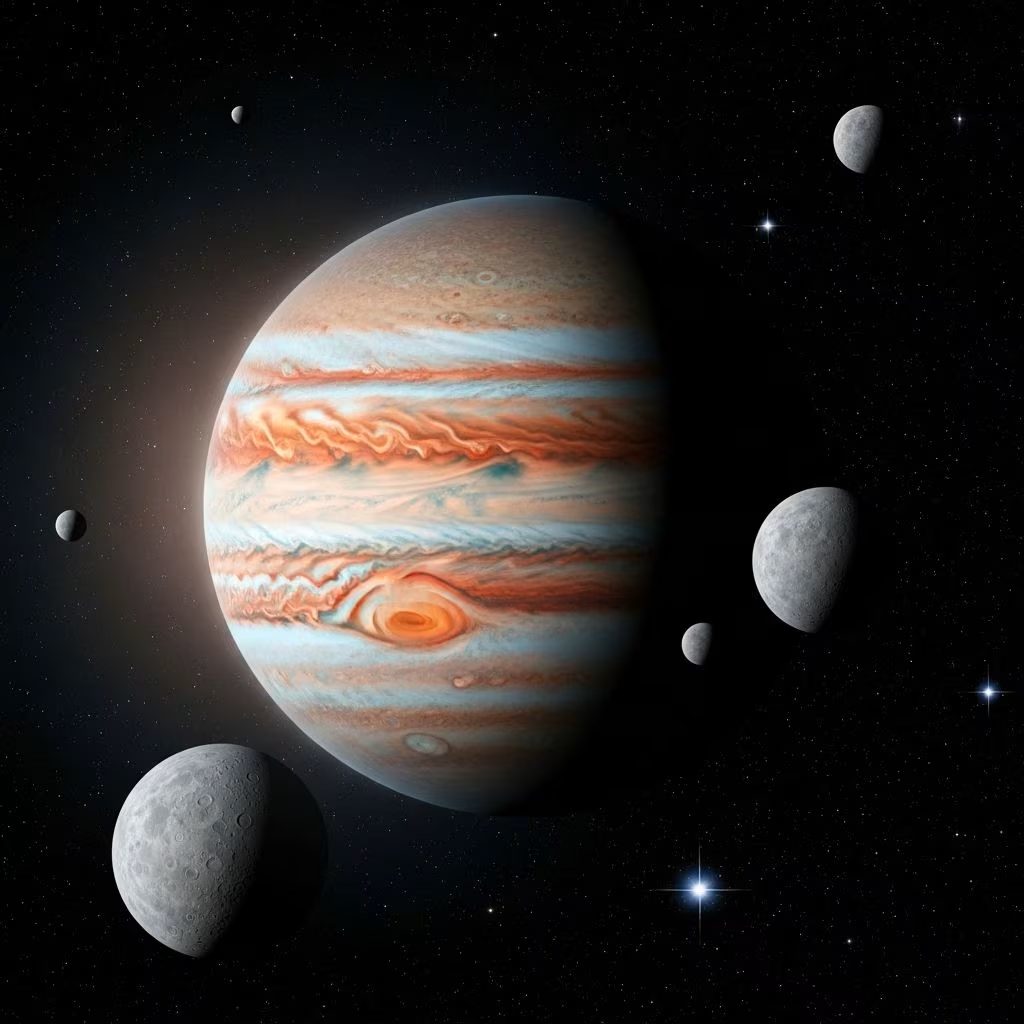
Unlike terrestrial planets such as Earth and Mars, Jupiter is a gas giant composed predominantly of hydrogen (approx. 76%) and helium (approx. 24%) by mass . It lacks a solid surface, with its visible “surface” consisting of thick cloud bands and storms.
- At its core, theories suggest a rocky or metallic center enveloped by layers of liquid metallic hydrogen.
- Systems of colorful cloud belts and the swirling Great Red Spot showcase Jupiter’s dynamic atmosphere.
- Trace elements include ammonia, water vapor, methane, and phosphine.
Jupiter Compared to the Sun
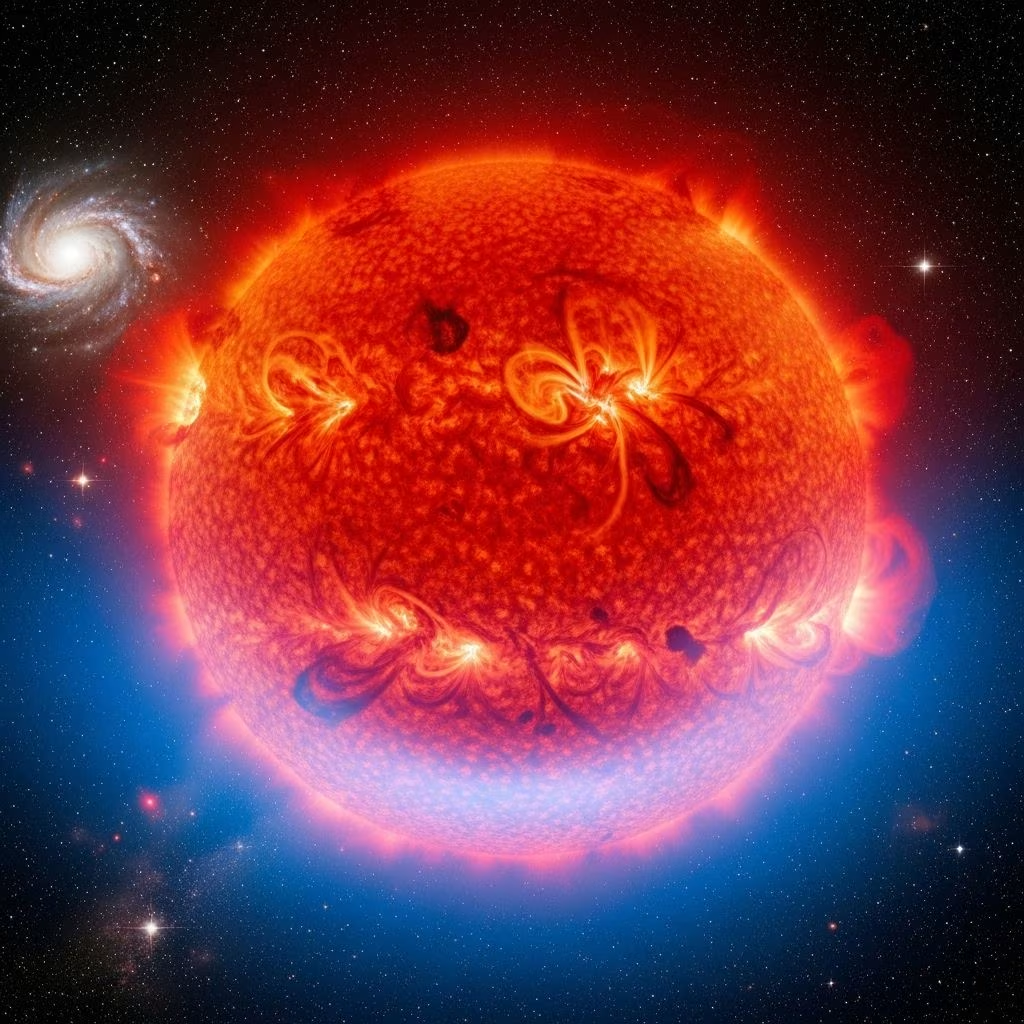
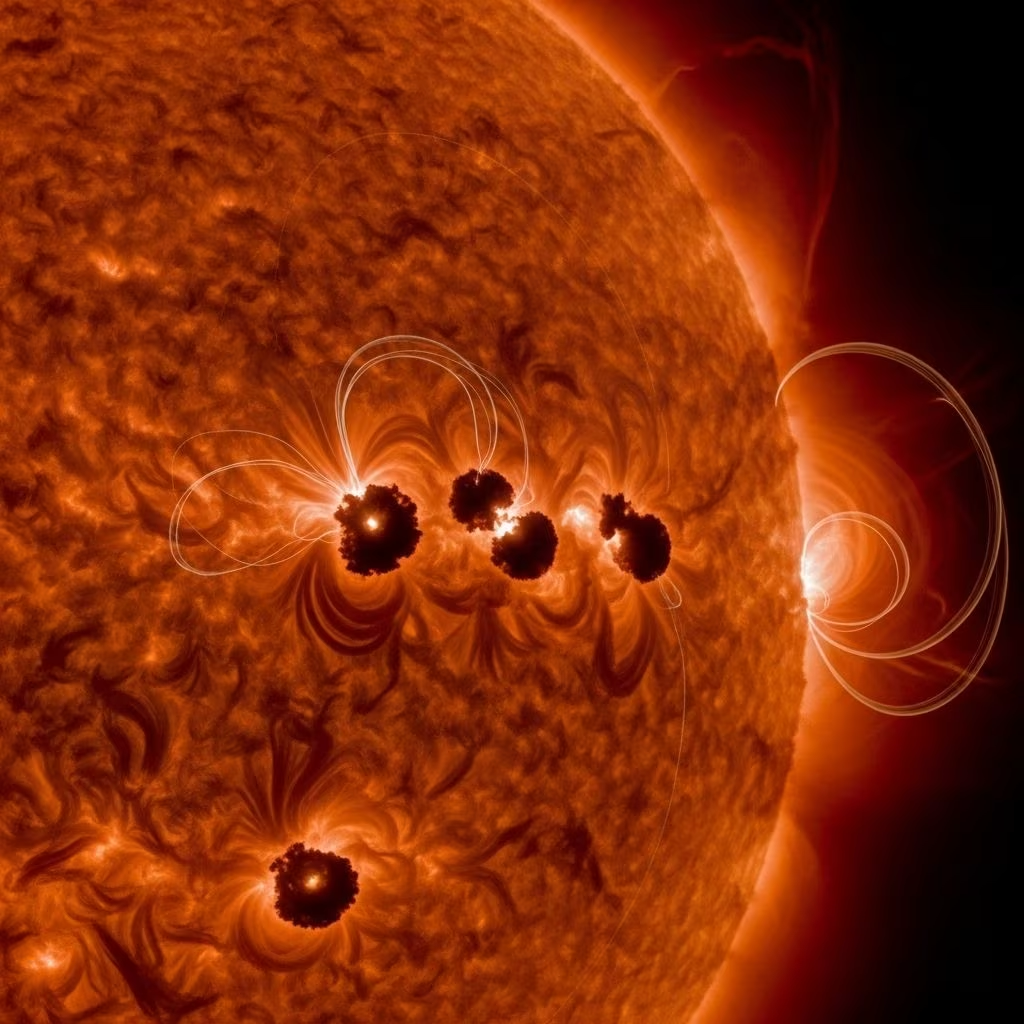
Though Jupiter dwarfs all the planets, it is still far smaller than the Sun. Jupiter’s diameter is about one-tenth the Sun’s, and its mass is less than one-thousandth that of our parent star .
| Object | Diameter (km) | Mass (kg) |
|---|---|---|
| Sun | 1,391,000 | 1.99 × 1030 |
| Jupiter | 143,000 | 1.898 × 1027 |
| Earth | 12,742 | 5.97 × 1024 |
Jupiter is, therefore, truly a giant among planets, but only a minuscule fraction compared to the Sun’s overwhelming scale.
Internal Pressure and Formation
Jupiter’s mass presses its interior so tightly that, if a planet with Jupiter’s composition had more than 40% additional mass, its diameter would actually decrease due to immense compression . If Jupiter had 75 times its current mass, it could shine as a star, but as it stands, it remains a planet, albeit a very massive one.
- Jupiter radiates more heat than it receives from the Sun, a legacy of residual heat from formation and the Kelvin–Helmholtz mechanism.
- In its infancy, Jupiter may have been twice as large, shrinking as it cooled over billions of years.
Jupiter’s Distance and Orbit
- Average Distance from Sun: About 778 million kilometers (484 million miles) or 5.2 astronomical units .
- Orbital Period: Approximately 11.86 Earth years to complete one orbit around the Sun.
This distant orbit keeps Jupiter beyond the asteroid belt, creating a distinct boundary between the inner and outer solar system.
Jupiter’s Notable Features
- The Great Red Spot: A gigantic storm system larger than Earth itself.
- Numerous Moons: Jupiter boasts at least 95 known moons, the most of any planet .
- Faint Ring System: Unlike Saturn, Jupiter’s rings are thin and difficult to observe from Earth.
Why Is Jupiter Important?
Jupiter’s gravitational might has helped shape the formation of the solar system since its birth about 4.5 billion years ago . Its influence:
- Protects inner planets from comets and asteroids.
- Establishes orbital resonances in the asteroid belt.
- Serves as a laboratory for planetary science and extrasolar planet studies.
Jupiter in Perspective: Fun Size Comparisons
- If Jupiter were the size of a basketball, Earth would be the size of a grape.
- All other planets could fit inside Jupiter with room to spare [11].
- The smallest star, a red dwarf, is only slightly larger in diameter than Jupiter.
Frequently Asked Questions (FAQs)
Q: How many times bigger is Jupiter than Earth?
A: Jupiter is over 11 times the diameter of Earth and more than 1,300 times as voluminous. Its mass is about 318 times that of Earth .
Q: Could Jupiter become a star?
A: Jupiter would need to be about 75 times more massive to ignite nuclear fusion and become a star. Its current size is at the upper limit for planets of its kind .
Q: How does Jupiter’s gravity affect the solar system?
A: Jupiter’s gravity controls the movement of many asteroids and comets, creating orbital resonances and even ejecting or capturing objects .
Q: How many moons does Jupiter have?
A: Jupiter currently has at least 95 known moons, including the four Galilean moons—Io, Europa, Ganymede, and Callisto—which are among the largest in the solar system .
Q: What are Jupiter’s rings like?
A: Jupiter’s rings are faint and composed mainly of dust, unlike the bright, icy rings of Saturn. They were discovered by spacecraft in the late 20th century.
Key Takeaways
- Jupiter is the solar system’s largest and most massive planet.
- Its diameter is more than 11 times, and its mass more than 318 times, that of Earth.
- Jupiter’s gravitational dominance shapes the orbits of countless objects throughout the solar system.
- Its formation and ongoing influence make it central to the study of planetary science.
References
- https://science.nasa.gov/jupiter/jupiter-facts/
- https://en.wikipedia.org/wiki/Jupiter
- https://www.britannica.com/science/How-Big-Is-Jupiter
- https://www.astronomy.com/science/jupiter/
- https://nssdc.gsfc.nasa.gov/planetary/factsheet/jupiterfact.html
- https://www.britannica.com/place/Jupiter-planet
- https://www.asc-csa.gc.ca/eng/astronomy/solar-system/jupiter.asp
- https://coolcosmos.ipac.caltech.edu/ask/92-How-large-is-Jupiter-compared-to-Earth-
- https://lco.global/spacebook/solar-system/jupiter/
- https://www.universetoday.com/articles/diameter-of-jupiter
- https://www.worldatlas.com/space/how-big-is-jupiter.html
- https://en.wikipedia.org/wiki/Jupiter_radius
- https://study.com/academy/lesson/facts-about-jupiter-atmosphere-temperature-mass.html
- https://historyinnumbers.com/places/space/solar-system/planet-jupiter/
- https://www.universetoday.com/articles/how-big-is-jupiter
- https://www.skyatnightmagazine.com/astrophotography/planets/jupiter
- https://scaleofuniverse.com/en/universe/jupiter