


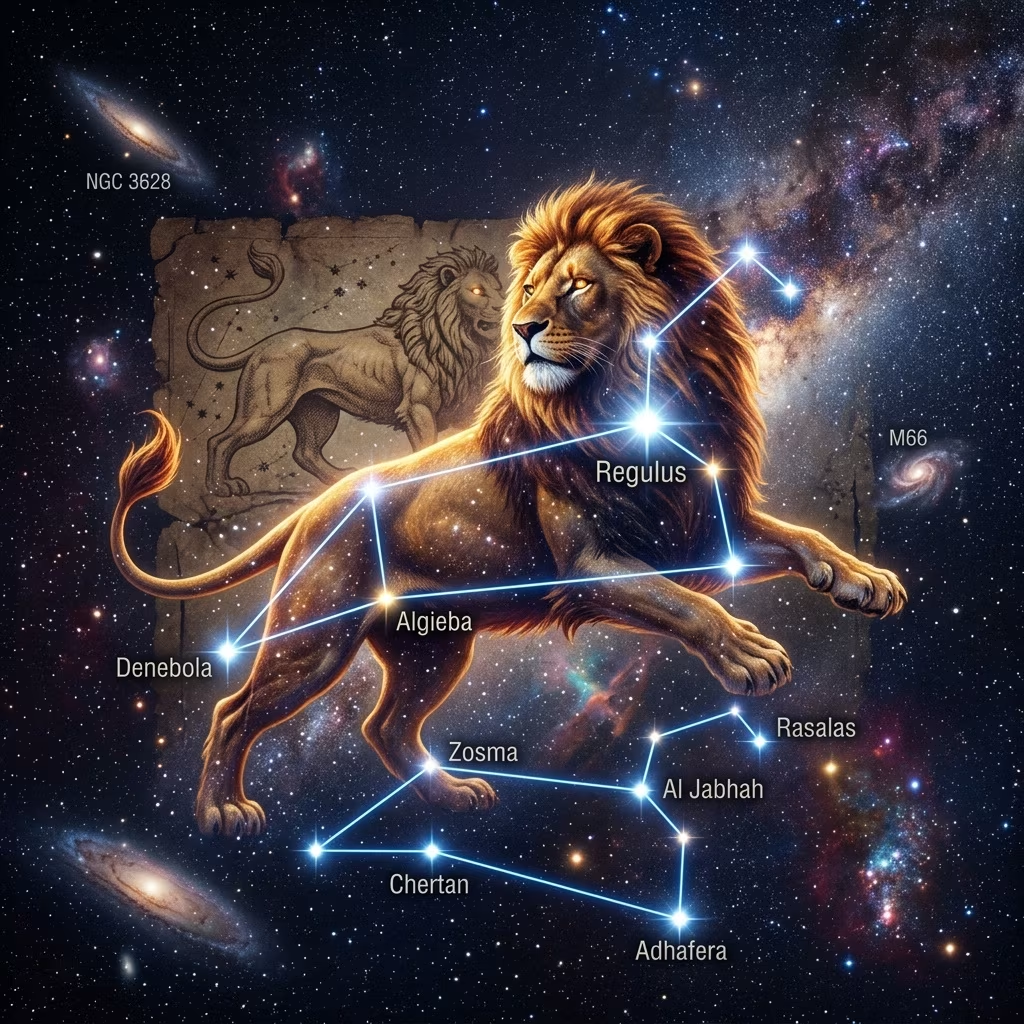
Leo Constellation: The Lion’s Legacy in Astronomy and Myth
The Leo constellation stands out as one of the most recognizable and storied formations in the night sky. Marked by a distinct pattern reminiscent of a lion, Leo has been cherished across civilizations for millennia, celebrated in myths, poetry, and scientific discovery. From its luminous stars to its deep-sky treasures, Leo offers both amateur stargazers and seasoned astronomers a window into the wonders of our universe.
Overview of Leo Constellation
Leo, Latin for “Lion,” is a zodiac constellation located in the Northern Hemisphere. Recognizable by a pattern that resembles a crouching lion, Leo is one of the oldest documented star groups, with references dating back to ancient Mesopotamia and Egypt.
- Location: Northern celestial hemisphere
- Zodiac Sign: Leo is the zodiac sign for those born between July 23 and August 22
- Abbreviation: Leo
- Symbol: A stylized lion
- Sky Area: Approximately 947 square degrees, making it the 12th largest constellation
Leo stands prominent between Cancer and Virgo, bordered by constellations like Ursa Major, Leo Minor, Lynx, Hydra, Sextans, and Crater.
Leo in Mythology and History
Throughout history, Leo has been woven into stories of royalty, heroism, and cosmic order:
- Greek Mythology: Leo is immortalized as the Nemean Lion, slain by Hercules in his first labor. The lion’s impenetrable hide made it a formidable foe; after Hercules triumphed, he wore its skin as armor.
- Egyptian Lore: Ancient Egyptians associated Leo with the flooding of the Nile—its appearance at sunrise marked the start of the flood season, vital for crop growth.
- Babylonian Astronomy: Early Babylonian records referred to this star pattern as the “Great Lion.”
- Roman and Medieval Traditions: Leo symbolized nobility and regal strength, often depicted in heraldry and literature as the king of beasts.
Leo’s stars form a shape resembling a backwards question mark, nicknamed the “Sickle,” that outlines the lion’s mane and chest, with a triangle forming the hindquarters. This vivid imagery explains why Leo has captured imaginations for thousands of years.
Major Stars of Leo
Leo is home to several notable stars, each contributing to its distinctive shape and brilliance:
| Star Name | Bayer Designation | Apparent Magnitude | Distance (ly) | Notable Features |
|---|---|---|---|---|
| Regulus | Alpha Leonis | 1.40 | 79 | Brightest star in Leo; forms the base of the “Sickle” |
| Denebola | Beta Leonis | 2.14 | 36 | Marks the lion’s tail |
| Algieba | Gamma Leonis | 2.01 | 130 | Binary star with golden-yellow color |
| Zosma | Delta Leonis | 2.56 | 58 | Located at the lion’s back |
| Adhafera | Xi Leonis | 3.35 | 248 | Forms part of the lion’s mane |
- Regulus is not only the brightest in Leo, but one of the most luminous stars visible from Earth. It is a multiple star system with at least four companions.
- Denebola sits at the tip of Leo’s tail and is a hot, rapidly rotating star.
- Algieba is a celebrated double star, observable in small telescopes as two golden-yellow giants.
- Zosma and Adhafera help trace Leo’s back and mane, respectively.
Deep-Sky Objects in Leo
Beyond its twinkling stars, Leo hosts remarkable deep-sky wonders:
- Leo Triplet: A group of three spiral galaxies—Messier 65 (M65), Messier 66 (M66), and NGC 3628—rich in dust lanes and star-forming regions. They are located about 35 million light-years away.
- Messier 95 (M95): A barred spiral galaxy approximately 38 million light years distant, known for its vivid dust lanes.
- Messier 96 (M96): Another spiral galaxy, slightly brighter than M95, featuring an asymmetrical core.
- Messier 105 (M105): An elliptical galaxy numbering among the brighter members of the Leo I group.
These galaxies are favorites among amateur astronomers and can be glimpsed with mid-sized telescopes under dark skies. Leo’s location away from the crowded regions of the Milky Way makes it an excellent hunting ground for extragalactic discoveries.
Viewing Leo in the Night Sky
Leo’s placement makes it a vibrant feature of spring nights in the Northern Hemisphere and autumn in the Southern Hemisphere:
- Best Viewing Months: March through May, with Leo highest around midnight.
- Latitudinal Range: Visible between latitudes +90° and –65°.
- Finding Leo: To locate Leo, first identify the Big Dipper (Ursa Major); a line drawn from its “pointer” stars leads to Regulus, Leo’s brightest star. The “Sickle” asterism creates a familiar backwards question mark shape rising from Regulus, while the right-angled triangle to the east marks the hindquarters.
- Southern Observers: Those in the Southern Hemisphere can spot Leo during autumn, though the constellation appears oriented differently.
- Light Pollution Impact: Urban observers may spot only Regulus and Denebola, but traveling to dark sites reveals Leo’s full outline.
Leo’s Place in Modern Astronomy
Leo remains integral to both professional and amateur astronomical research:
- Zodiac Importance: Leo is a zodiacal constellation, meaning the Sun, Moon, and planets periodically pass through its boundaries on their apparent paths across the sky (the ecliptic).
- Astrophysical Studies: Leo’s galaxies, particularly the Leo Triplet and Leo I Group, are often studied for star formation processes and galactic interactions.
- Variable Stars: Leo hosts several variable stars, presenting opportunities to study stellar evolution.
- Meteor Showers: The Leonids meteor shower, which peaks each November, appears to radiate from Leo. These meteors are remnants of Comet Tempel-Tuttle.
Leo’s presence along the ecliptic also makes it a frequent backdrop in solar system studies, such as planetary transits and occultation events.
Quick Facts about Leo
- Rank: 12th largest of the 88 modern constellations
- Number of Stars with Planets: At least 15 stars in Leo are known to host exoplanets
- Brightest Star: Regulus
- Notable Asterism: The Sickle
- Historical Record: Leo has appeared in the star charts of Ptolemy’s Almagest (2nd century AD)
Frequently Asked Questions (FAQs)
Q: What is the best time of year to see Leo?
A: Leo is best viewed from March to May in the Northern Hemisphere and from September to November in the Southern Hemisphere.
Q: How do I recognize Leo among other constellations?
A: Look for the “Sickle”—a backwards question mark of bright stars starting with Regulus. This pattern resembles a lion’s mane and heart, with a triangle to the east marking the rest of the body and tail.
Q: How far away is Regulus, Leo’s brightest star?
A: Regulus is about 79 light-years from Earth.
Q: What deep-sky objects can I find in Leo?
A: Leo is rich in galaxies, including the Leo Triplet (M65, M66, NGC 3628), as well as Messier 95, Messier 96, and Messier 105.
Q: What myth is associated with the Leo constellation?
A: Leo is most famously linked with the Nemean Lion from Greek mythology, slain by Hercules as part of his twelve labors.
Further Reading and Resources
- Star Charts: Consult digital sky maps or smartphone apps for locating Leo in your environment.
- Museums and Observatories: Several public planetariums offer guided stargazing nights with Leo in focus during spring months.
- Books: “The Stars: A New Way to See Them” by H.A. Rey offers accessible guides to Leo and other constellations for beginners.
Whether you are an enthusiast of myth, science, or simply the night sky, Leo’s brilliant stars and captivating heritage invite you to look upward and discover the historic lion sitting among the cosmos.
References
- https://en.wikipedia.org/wiki/Satellite_constellation
- https://en.wikipedia.org/wiki/Satellite_internet_constellation
- https://www.itu.int/hub/2025/02/space-connect-the-rise-of-leo-satellite-constellations/
- https://itp.nyu.edu/networks/explanations/low-earth-orbit-leo-satellite-constellations-and-their-role-in-internet-connectivity/
- https://www.kratosdefense.com/constellations/articles/low-earth-orbit-satellites-let-you-connect-anywhere-at-any-time-with-anyone
- https://airbusus.com/leo-constellations/
- https://www.panasonic.aero/blog/blog-post/what-is-low-earth-orbit-leo-and-how-does-it-benefit-airline-connectivity
- https://www.spoc.spaceforce.mil/News/Article-Display/Article/3462529/leo-meo-or-geo-diversifying-orbits-is-not-a-one-size-fits-all-mission-part-1-of
- https://www.telesat.com/leo-satellites/
- https://www.gogoair.com/resources/blogs/what-is-low-earth-orbit-(leo)-satellite-internet
- https://basecampconnect.com/leo-satellite-systems/
- https://www.weforum.org/stories/2022/02/explainer-how-low-earth-orbit-satellite-technology-can-connect-the-unconnected/
- https://eos.com/blog/satellite-constellation/
- https://patents.google.com/patent/WO2017192727A1/en
- https://www.mckinsey.com/industries/aerospace-and-defense/our-insights/large-leo-satellite-constellations-will-it-be-different-this-time
- https://www.spacerl.com/wp-content/uploads/2020/09/The-new-age-of-Large-Low-Earth-Orbit-Satellite-Constellations.pdf
- https://www.youtube.com/watch?v=fqur6NzzodA
- https://www.techtarget.com/whatis/definition/low-earth-orbit-LEO-satellite


