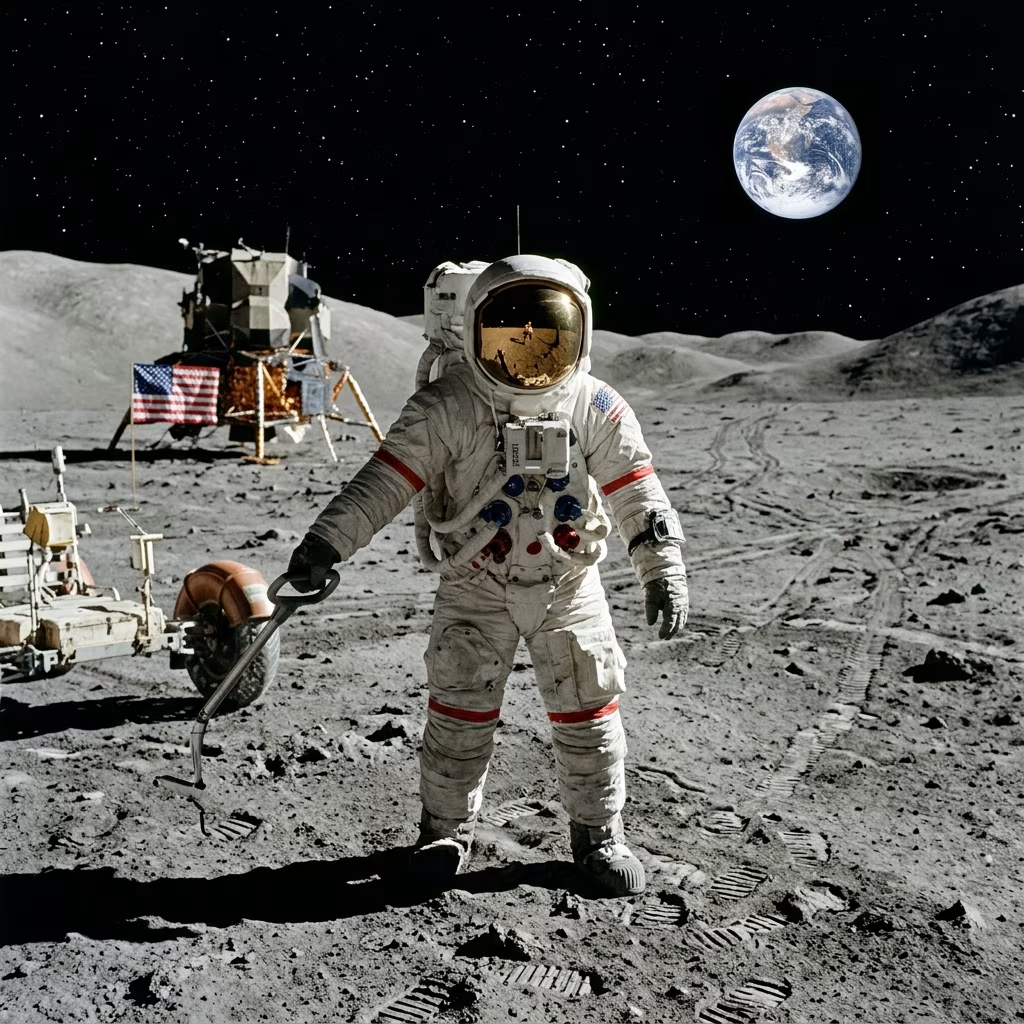
The Moon has long held humanity’s fascination, and during a short but remarkable period between 1969 and 1972, only 12 people—all American astronauts—have set foot on its surface. This article delves deeply into who these explorers were, the missions that brought them there, and the legacy their footsteps left for science and culture around the world.
Introduction: Humanity’s Giant Leap
On July 20, 1969, millions watched as a grainy broadcast beamed Neil Armstrong’s historic words across the globe. That moment marked not just the first step on another world, but the culmination of the intense, decade-long race for technological dominance known as the Space Race. The Apollo moonwalkers remain a rare and legendary group, with only twelve individuals in all of history having experienced another celestial body firsthand[12].
The Numbers: Who Went, Who Walked
- 24 astronauts traveled from Earth to lunar orbit or the lunar surface during nine Apollo missions (Apollo 8–17).
- 12 astronauts actually walked on the Moon during six missions (Apollo 11, 12, 14, 15, 16, and 17).
- All moonwalkers were American men, and all missions were part of the Apollo program (1968–1972)[12].
Why Go to the Moon? The Space Race’s Fierce Drive
The United States’ push to reach the Moon was fueled by the Cold War rivalry with the Soviet Union. After the USSR launched the first human into space in 1961, President John F. Kennedy set the bold goal of landing an American astronaut on the lunar surface before the decade’s end. This challenge ignited the Apollo program and captured the world’s imagination[12].
The Apollo Program: Pioneers of Lunar Exploration
The Apollo program was a monumental undertaking in science, engineering, and logistics. It sent astronauts to orbit, land, and explore the Moon, forever changing humanity’s understanding of its nearest neighbor.
- Apollo 8 (1968): First humans to orbit the Moon, but did not land.
- Apollo 11–17 (1969–1972): Lunar landing missions; Apollo 13 famously experienced an emergency and returned without landing.
- Six Apollo missions achieved successful landings, with two astronauts each conducting moonwalks per mission[12].
The Timeline of Moonwalkers
| Mission | Lunar Landing Date | Astronauts Who Walked |
|---|---|---|
| Apollo 11 | July 20, 1969 | Neil Armstrong, Buzz Aldrin |
| Apollo 12 | November 19, 1969 | Pete Conrad, Alan Bean |
| Apollo 14 | February 5, 1971 | Alan Shepard, Edgar Mitchell |
| Apollo 15 | July 31, 1971 | David Scott, James Irwin |
| Apollo 16 | April 21, 1972 | John Young, Charles Duke |
| Apollo 17 | December 11, 1972 | Gene Cernan, Harrison Schmitt |
The Twelve Moonwalkers: Legendary Explorers
Let’s look closer at each astronaut who has walked on the Moon, highlighting their missions, achievements, and unique moments on the lunar surface:
- Neil Armstrong (Apollo 11)
The first person to step onto the Moon. Armstrong’s words—“That’s one small step for man, one giant leap for mankind”—are among the most iconic in human history[12]. - Buzz Aldrin (Apollo 11)
The second man on the Moon, Aldrin joined Armstrong about 20 minutes after the first step. They conducted experiments, collected samples, and planted the US flag. - Pete Conrad (Apollo 12)
Famous for his playful first words: “Whoopee! Man, that may have been a small one for Neil, but that’s a long one for me.” - Alan Bean (Apollo 12)
A skilled pilot, he later became a celebrated space artist, translating his lunar experiences into paintings. - Alan Shepard (Apollo 14)
The first American in space (1961), Shepard made headlines again by hitting two golf balls on the lunar surface. - Edgar Mitchell (Apollo 14)
Conducted lunar experiments and became a strong proponent for space research after his mission. - David Scott (Apollo 15)
Commander of the first mission to use the Lunar Roving Vehicle (LRV or moon buggy) on the surface. - James Irwin (Apollo 15)
Focused on scientific investigations, including collecting the “Genesis Rock,” believed to be one of the Moon’s oldest rocks. - John Young (Apollo 16)
Veteran astronaut who later commanded the first Space Shuttle mission; spent nearly three days exploring the lunar surface. - Charles Duke (Apollo 16)
Youngest person to walk on the Moon (age 36). Left a photo of his family on the lunar surface. - Gene Cernan (Apollo 17)
The last person (to date) to leave the lunar surface, Cernan famously declared: “We leave as we came and, God willing, as we shall return, with peace and hope for all mankind.” - Harrison Schmitt (Apollo 17)
The only professional scientist-geologist among the Apollo moonwalkers; helped collect important rock samples unlocking secrets of the Moon’s history.
Achievements and Science: What Did the Moonwalkers Do?
The Apollo missions were not just technological showpieces; they fundamentally changed lunar science and provided invaluable data about the early solar system. Here are the key activities moonwalkers undertook:
- Sample collection: Over 800 pounds (almost 400 kg) of lunar rocks and soil were returned to Earth.
- Surface experiments: Deployed seismic detectors, lasers, and other experiments to study lunar geology and environment.
- Lunar mobility: Later missions (Apollo 15–17) employed a lunar rover, allowing astronauts to range miles from their landing site.
- Cultural symbols: Planted American flags, left mementos, and unveiled plaques commemorating the human achievement.
Iconic Moments on the Moon
- First words: Neil Armstrong’s declaration has become history’s shorthand for exploration.
- Golf on the Moon: Alan Shepard’s playful swings demonstrated lunar gravity’s effects in an unforgettable way.
- The Lunar Rover: New explorations began with the introduction of the moon buggy, starting on Apollo 15.
- Human connection: Astronauts left personal objects on the Moon, from photographs to a tiny sculpture honoring fallen astronauts (“Fallen Astronaut” on Apollo 15).
Who Stayed in the Spacecraft?
Each Apollo landing mission included three astronauts: two who landed, and one who remained in the Command Module orbiting the Moon. These command module pilots, though crucial to the mission’s success, never set foot on the lunar surface. For example, Michael Collins kept Apollo 11’s Columbia flying solo while Armstrong and Aldrin explored below[12].
Why No One Has Been Back Since 1972
After Apollo 17’s return in December 1972, the era of human lunar exploration seemingly ended as quickly as it began. Factors include:
- Cost: Lunar missions were enormously expensive.
- Risks: Apollo 13 highlighted the inherent dangers in such endeavors.
- Changing priorities: Shifting public interest and US government focus drew funding and attention elsewhere (e.g., Skylab, Shuttle, unmanned exploration).
Still, the legacy of Apollo continues to drive current and future lunar efforts, such as NASA’s Artemis program—with goals to return humans, including the first woman and first person of color, to the Moon in the 2020s and 2030s.
Fun Facts About the Apollo Moonwalkers
- As of today, all twelve moonwalkers were American and white men; their median age during their lunar walks was in their late 30s to early 40s.
- Some moonwalkers, like Alan Shepard and John Young, had flown in space decades earlier on pioneering Mercury and Gemini missions.
- Harrison Schmitt, a geologist, was the only trained scientist to walk on the Moon; most others trained as test pilots.
- The Moon’s lower gravity (about 1/6th that of Earth) allowed astronauts to perform unique movements—hops, long strides, and even leaping experiments.
- The lunar surface preserves the astronauts’ footprints, which may last millions of years due to the Moon’s lack of atmosphere and weather.
Frequently Asked Questions (FAQs)
Q: How many people have walked on the Moon?
A: Twelve people, all American men, walked on the Moon between 1969 and 1972 during six Apollo missions.
Q: Who was the first person to walk on the Moon?
A: Neil Armstrong, during Apollo 11 on July 20, 1969, was the first person to set foot on the Moon.
Q: Who was the last person on the Moon?
A: Eugene “Gene” Cernan, commander of Apollo 17, was the last person to leave the lunar surface, in December 1972.
Q: Did any women or non-Americans walk on the Moon?
A: No. All lunar walkers have been American men, but future NASA missions aim to break this precedent.
Q: What did the Apollo astronauts bring back from the Moon?
A: Over 800 pounds (about 380 kilograms) of lunar rocks, soil, and core samples, which continue to be studied by scientists.
Q: Will humans return to the Moon?
A: Yes—NASA’s Artemis program is planning to send the next generation of astronauts to the Moon within the next decade.
Legacy: The Moonwalkers’ Enduring Inspiration
The moonwalkers’ achievements continue to inspire generations of scientists, engineers, dreamers, and explorers. The Apollo program showed what humanity could accomplish with vision, collaboration, and determination. As new missions set their sights on lunar return and beyond, those famous footprints remain a powerful symbol of our species’ quest to explore the cosmos.
References
- https://science.nasa.gov/moon/moon-walkers/
- https://www.rmg.co.uk/stories/space-astronomy/how-many-people-have-walked-on-moon
- https://www.britannica.com/story/how-many-people-have-been-to-the-moon
- https://www.skyatnightmagazine.com/space-missions/how-many-people-walked-on-moon
- https://en.wikipedia.org/wiki/Category:People_who_have_walked_on_the_Moon
- https://en.wikipedia.org/wiki/Moon_landing
- https://www.discovery.com/science/apollo-50th-anniversary/only-12-people-have-been-on-the-moon
- https://www.iop.org/explore-physics/moon/how-do-we-know-we-went-to-the-moon
- https://moon.nasa.gov/overlay-who-has-been-to-the-moon/
- https://www.universetoday.com/articles/how-many-people-have-walked-on-the-moon
- https://airandspace.si.edu/explore/stories/apollo-11-moon-landing
- https://www.worldatlas.com/space/how-many-humans-have-been-to-the-moon.html
- https://pilgrimage.space/12-people-walked-moon/
- https://orbitalxploration.com/how-many-humans-have-walked-on-the-moon-names-missions-and-dates-2025-update
- https://orbitaltoday.com/2022/09/12/how-many-people-have-walked-on-the-moon/
- https://www.gmanetwork.com/news/scitech/science/851798/how-many-humans-have-walked-on-the-moon-kuya-kim-answers/story/
- https://starlust.org/how-many-people-have-walked-on-the-moon/
- https://nineplanets.org/questions/how-many-people-have-walked-on-the-moon/