The Milky Way Galaxy: Our Home Among the Stars
The Milky Way Galaxy is a vast spiral formation of stars, gas, dust, and dark matter. As our cosmic address, it not only hosts our Solar System but more than 100 billion stars, stretching across mind-boggling distances. Its grandeur and complexity make it a prime subject for scientific inquiry and a source of wonder for skywatchers and astronomers alike.
Anatomy of the Milky Way
The Milky Way is classified as a barred spiral galaxy. Its structure is composed of several distinct regions, each with unique properties. Scientists estimate the Milky Way is about 100,000 light-years in diameter and roughly 1,000 light-years thick at the disk, with a central bulge measuring approximately 10,000 light-years across.
- Stars: Over 100 billion, possibly 400 billion, stars spread across its disk and bulge.
- Gas and Dust: Raw material for new stars, mostly found within the galactic disk.
- Dark Matter: Comprises much of the galaxy’s total mass, though invisible and detected only by its gravitational influence.
Structure and Size
The main parts of the Milky Way Galaxy are as follows:
- Nucleus: The very center, harboring a supermassive black hole.
- Central Bulge: A densely packed region of old stars surrounding the nucleus.
- Galactic Disk: Thin and thick stellar disks containing most of the stars, including our Sun, with substantial gas and dust allowing for ongoing star formation.
- Spiral Arms: Curved regions within the disk where star formation is most active.
- Spherical Component: Includes the central bulge and random orbits of older stars.
- Massive Halo: An extended, diffuse region containing older stars, globular clusters, and significant amounts of mysterious dark matter.
Table: Key Structural Features of the Milky Way
| Component | Characteristics |
|---|---|
| Nucleus | Contains Sagittarius A*, a supermassive black hole, and high-temperature gas |
| Central Bulge | Dense concentration of older stars; low star formation |
| Disk | Region of active star formation; hosts vast populations of younger stars and gas/dust |
| Spiral Arms | Sites of intense star formation, populated by young, bright stars |
| Halo | Contains old stars, globular clusters, and most of the Milky Way’s dark matter |
The Mysterious Galactic Center
The core of the Milky Way hosts Sagittarius A* (pronounced “A-star”), a supermassive black hole more than four million times the mass of our Sun. This region is shrouded in dust, rendering it invisible at optical wavelengths, but it radiates strongly in radio, infrared, and X-ray wavelengths. The existence and mass of Sagittarius A* were confirmed through detailed observations of the orbits of stars around it — a breakthrough recognized by the Nobel Prize in Physics in 2020.
- Accretion Disk: Surrounding the black hole is a disk of extremely hot, luminous gas that is being pulled inward.
- Star Motions: Scientists have tracked high-speed stellar orbits around Sagittarius A*, confirming the black hole’s extreme gravity.
Spiral Arms and Galactic Features
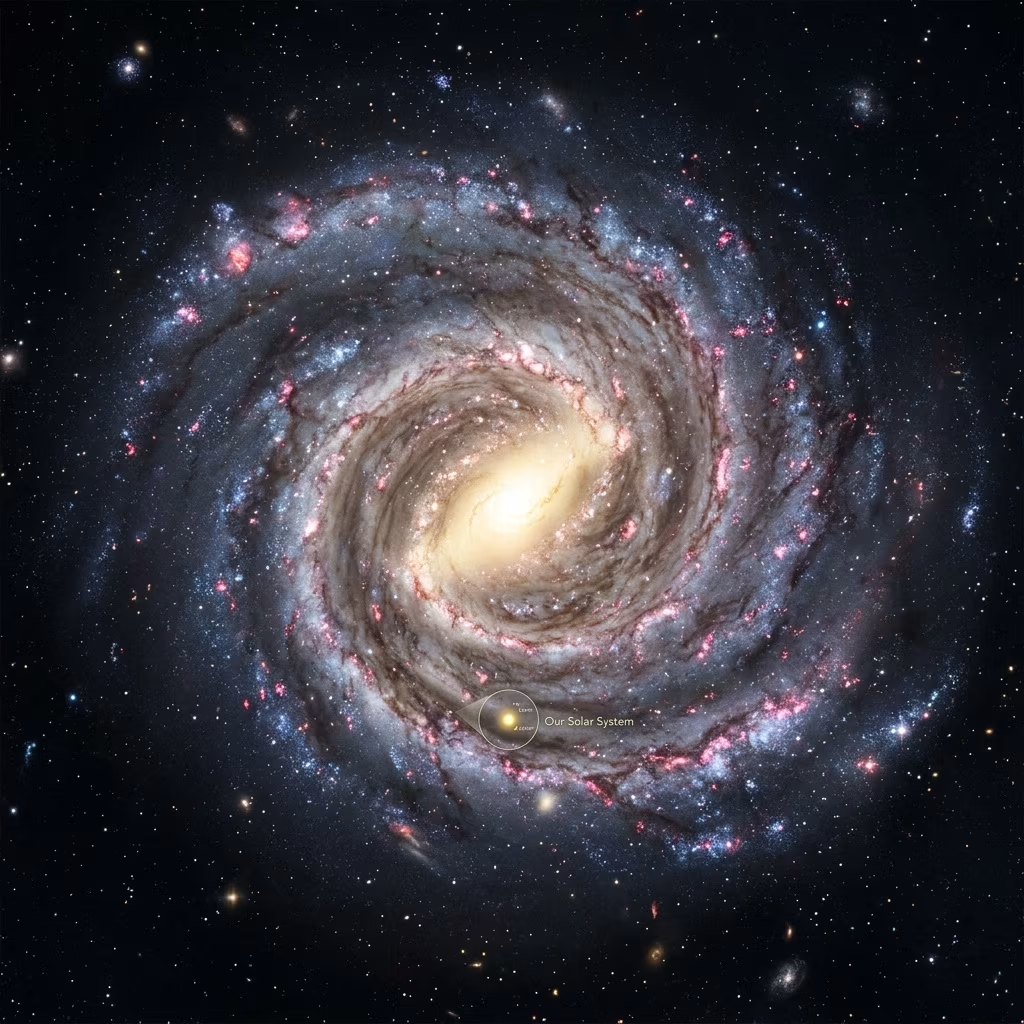
The spiral arms are defining features of the Milky Way, giving the galaxy its famous “pinwheel” structure when viewed from above. These arms are regions of higher density, filled with bright, young stars, nebulae, and star-forming regions.
- Main Spiral Arms: The Milky Way has several major spiral arms, including the Perseus Arm, Sagittarius Arm, and Scutum-Centaurus Arm, among others. The Orion Spur is a minor arm segment where our Solar System is located.
- Ongoing Star Formation: The spiral arms are rich in gas and dust, making them the main regions for the birth of new stars (Population I).
- Star Clusters and Nebulae: Open clusters, emission nebulae, planetary nebulae, and supernova remnants are all found within the arms, contributing to the galaxy’s ongoing evolution and recycling of material.
Our Solar System’s Location
Earth, the Sun, and the entire Solar System reside within the Orion Spur — a smaller segment branching off one of the major spiral arms. We are about 27,000 light-years from the Galactic Center and approximately a third of the way from the core to the observable edge of the Milky Way.
- Disk Positioning: The Solar System is embedded in the thin disk, only about 95 light-years from the galactic plane.
- Night Sky Appearance: From Earth, the Milky Way appears as a ghostly, milky band arching across the night sky. This glowing band is caused by the combined light of countless distant stars along the disk’s plane.
Stellar Populations and Key Components
The Milky Way is a dynamic mix of populations at various stages of evolution:
- Population I Stars: Younger, metal-rich stars mainly found in the disk and spiral arms. These power much of the galaxy’s current star-forming activity.
- Population II Stars: Older, metal-poor stars. Many reside in the central bulge, halo, and in ancient globular clusters orbiting the galaxy.
- Star Clusters: There are open clusters (younger, looser groups) in the disk, and globular clusters (ancient, densely packed groups) in the halo and bulge.
- Interstellar Medium: Gas and dust clouds between stars provide the material for future stellar generations.
- High-Velocity Stars: Some halo stars zip through the galaxy at much higher speeds than typical stars, sometimes even being ejected entirely.
Rotation, Mass, and Galactic Motion
The Milky Way is constantly in motion. The disk and spiral arms rotate around the center at speeds of up to 220 kilometers per second (km/s). The entire galaxy is estimated to complete a full rotation every 225–250 million years—a period known as a cosmic year. This rotation helped reveal the galaxy’s true structure and the presence of unseen mass, now attributed to dark matter.
- Mass: Including visible matter (stars, gas, dust) and dark matter, the total mass is estimated to be between 800 billion and 1.5 trillion times that of the Sun.
- Magnetic Field: The Milky Way has a weak but pervasive magnetic field entwined with its spiral structure.
Companion Galaxies and the Milky Way’s Neighborhood
The Milky Way is not isolated; it’s part of a group of galaxies known as the Local Group. Two notable nearby companions are:
- Large Magellanic Cloud (LMC): A small, irregular galaxy orbiting the Milky Way at about 163,000 light-years away.
- Small Magellanic Cloud (SMC): Another smaller companion at about 200,000 light-years away.
The Local Group contains more than 50 galaxies, including the Milky Way, the Andromeda Galaxy (the nearest spiral giant, heading for a distant collision with us), and dozens of dwarf galaxies.
Unsolved Mysteries and Ongoing Research
Despite centuries of observation, the Milky Way holds many mysteries:
- Dark Matter: Most of the galaxy’s mass is dark and undetectable except through its gravitational effects.
- Spiral Arm Formation: Exactly how the arms maintain their shape over time remains an active topic of research.
- History and Collisions: The Milky Way has absorbed many smaller galaxies in the past. Evidence of these mergers remains imprinted in stellar streams and structures.
- Future: In about 4 to 5 billion years, the Milky Way and Andromeda galaxies are expected to merge, forming a new galaxy and dramatically altering their structures.
Space missions like ESA’s Gaia observatory are providing the most detailed maps and surveys of the galaxy ever achieved, revolutionizing our understanding of its structure, individual stars, and history.
Frequently Asked Questions (FAQs)
Q: Why is it called the “Milky Way”?
A: The name comes from the Greek word “galaxias,” which refers to its milky appearance in the sky caused by the collective glow of billions of densely packed stars along the disk.
Q: Can we see the entire Milky Way from Earth?
A: No, dust and gas within the disk block our view of many galactic regions. We only see the part of the galaxy where less material is in the way, mostly as a band across the sky.
Q: What is at the center of the Milky Way?
A: The center houses Sagittarius A*, a supermassive black hole with a mass over 4 million times that of the Sun. Its presence is proven by the rapid orbits of nearby stars.
Q: Has our Solar System always been in its current spiral arm?
A: No. Over hundreds of millions of years, the Solar System’s position relative to the galaxy’s arms can change due to orbital movements.
Q: Will the Milky Way always look the same?
A: No. The Milky Way is in constant flux, forming stars, devouring smaller galaxies, and eventually, it will merge with the Andromeda Galaxy in several billion years, fundamentally altering its appearance.
References
- https://lco.global/spacebook/galaxies/the-milky-way-galaxy/
- https://www.britannica.com/place/Milky-Way-Galaxy/The-structure-and-dynamics-of-the-Milky-Way-Galaxy
- https://en.wikipedia.org/wiki/Milky_Way
- https://science.nasa.gov/resource/the-milky-way-galaxy/
- https://www.britannica.com/summary/Milky-Way-Galaxy
- https://cosmosatyourdoorstep.com/2023/01/11/structure-of-the-milky-way/
- http://spiff.rit.edu/classes/phys230/lectures/mw_struct/mw_struct.html
- https://sci.esa.int/web/gaia/-/58206-anatomy-of-the-milky-way
- https://imagine.gsfc.nasa.gov/science/objects/milkyway1.html
- http://spiff.rit.edu/classes/phys372/lectures/mw_struct/mw_struct.html
- https://wardsworld.wardsci.com/geology-earth-science/students-get-starstruck-with-these-facts-about-the-milky-way-galaxy
- https://www.cfa.harvard.edu/news/skeleton-milky-way
- https://ethz.ch/content/dam/ethz/special-interest/phys/particle-physics/quanz-group-dam/documents-old-s-and-p/Courses/Astrophysics_III_FS17/A3C2comp.pdf
- https://library.fiveable.me/astrophysics-ii/unit-7/milky-components-morphology/study-guide/gV4MQq2gFlhAr7bs
- https://en.wikipedia.org/wiki/Galaxy
- https://www.cfa.harvard.edu/research/science-field/milky-way-galaxy
- https://cosmosatyourdoorstep.com/2023/02/16/the-composition-of-the-milky-way/
- https://study.com/learn/lesson/milky-way-galaxy-overview-facts-stars.html
- https://www.ebsco.com/research-starters/astronomy-and-astrophysics/milky-way
- https://cosmicdawn.astro.ucla.edu/our_galaxy.html