


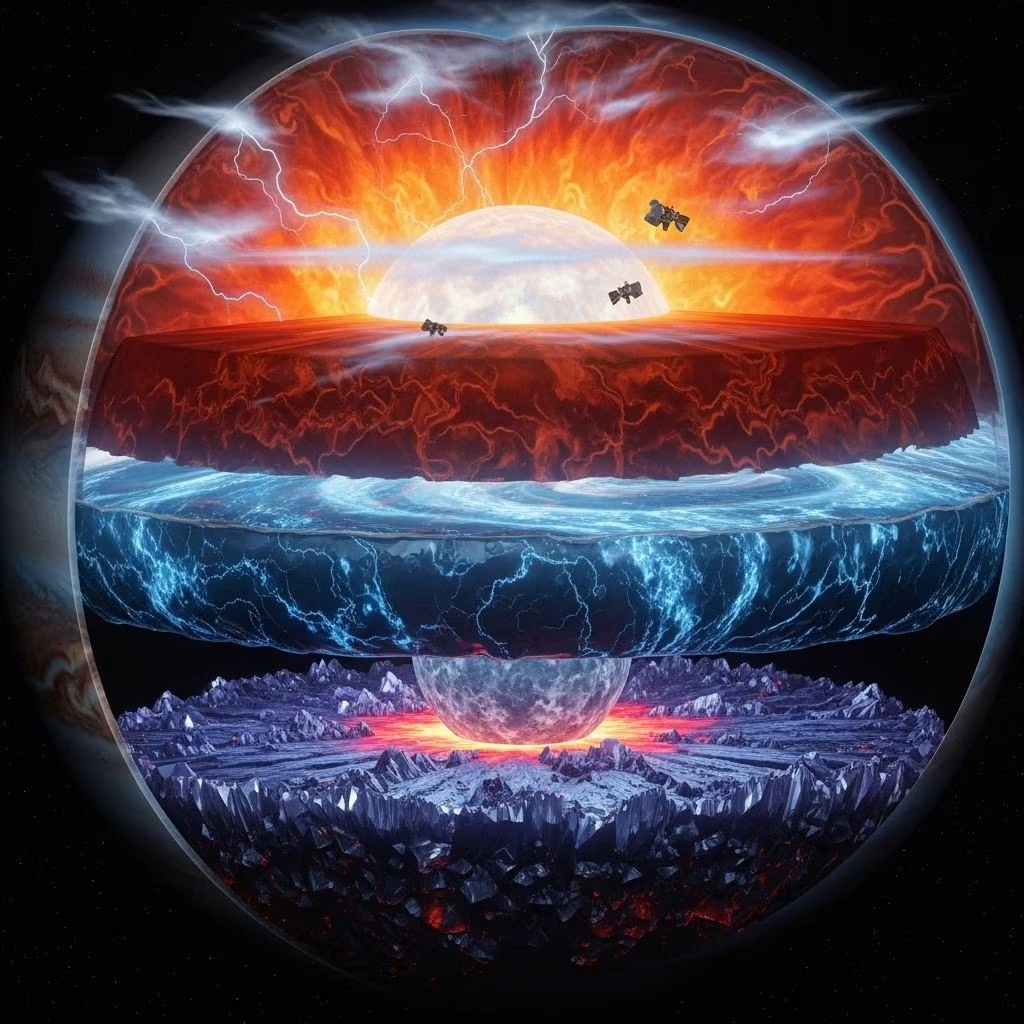
Jupiter’s Invisible Surface: Diving into the Solar System’s Giant
Jupiter—the Solar System’s largest planet—stands apart from the terrestrial worlds like Earth, Mars, Venus, or Mercury in a fundamental way: it has no true surface. This gas giant, with its massive swirling clouds and powerful atmospheric storms, not only dwarfs every other planet, but also challenges our conventional ideas about what it means for a world to have a ‘surface.’ If you were to parachute into Jupiter, you would never land; instead, you’d descend deeper through layers of cloud and gas, encountering ever-increasing pressure and temperature, with no solid ground anywhere in sight.
How Big is Jupiter?
Jupiter’s sheer size is one of its most compelling features. Its diameter stretches 142,984 km (88,846 miles) at the equator—a distance more than eleven times that of Earth. The planet’s volume could contain more than 1,321 Earths, and its mass amounts to nearly two and a half times the combined mass of all other bodies in the Solar System, excluding the Sun.
- Diameter: 142,984 km (88,846 mi)
- Volume: Over 1,000 Earths
- Mass: 2.5 × combined masses of all other planets
- Average density: 1.326 g/cm³ (lower than Earth’s)
Jupiter’s atmospheric grandeur is matched only by its gravitational might. The pull of gravity at what scientists define as the ‘surface’ is 2.5 times stronger than Earth’s—yet it is not so powerful as to initiate nuclear fusion, the process that powers stars like our Sun.
Why Doesn’t Jupiter Have a Surface?
Unlike rocky planets, Jupiter is a gas giant. Its physical and chemical makeup reveals the secret behind its lack of a surface:
- Composition: About 76% hydrogen and 24% helium by mass
- Atmosphere: No abrupt transition from atmosphere to core—just increasing density and pressure
- State transitions: Gas and liquid phases blend into a ‘supercritical fluid’ as you descend
- Surface definition: The ‘surface’ is defined by atmospheric pressure equaling Earth standard, not by solid ground
Because Jupiter’s hydrogen and helium are gases under Earth conditions, and because pressure and temperature increase steadily toward the core, the change from gaseous to liquid is gradual, with no definitive ‘surface’ to stand on.
What Happens If You Descend Into Jupiter?
If an astronaut or probe were to enter Jupiter, here’s what they’d experience:
- Entry into upper atmosphere: Thick clouds of ammonia crystals, descending into bands of hydrogen and helium.
- Increasing pressure: As depth increases, atmospheric pressure quickly rises, challenging any probe’s structural integrity.
- No solid ground: Even the ‘surface’ defined by pressure is just more dense gas.
- Transition to liquid: Deeper layers become like an ocean of liquid hydrogen and other supercritical fluids.
- Extreme temperature and density: Approaching the core, temperatures soar and hydrogen transitions into exotic forms (metallic hydrogen).
Any spacecraft would be crushed and vaporized long before reaching Jupiter’s elusive core.
The Layers of Jupiter
| Layer Name | Main Composition | Key Features |
|---|---|---|
| Upper Atmosphere | Hydrogen (90%) & Helium (10%) by volume | Ammonia ice clouds; rapid winds; colorful banding |
| Lower Atmosphere | Hydrogen & Helium + trace gases | Increasing pressure; temperature rises; more opaque clouds |
| Supercritical Fluids Region | Hydrogen & Helium (supercritical) | No distinction between liquid and gas; acts like an ocean |
| Metallic Hydrogen Layer | Metallic Hydrogen | Electrical conductivity; source of Jupiter’s magnetic field |
| Core (Diffuse) | Heavy elements (rock, ice); possibly molten or partially solid | May be 7–25 Earth masses; intensely hot and dense |
Jupiter’s Core: Mystery at the Heart
The core of Jupiter is one of planetary science’s enduring enigmas:
- Diffuse, not solid: Latest Juno mission data reveals a ‘fuzzy’ core, blending into the mantle, extending up to half Jupiter’s radius.
- Mass: Estimated at 7–25 times Earth’s mass, made of heavy elements.
- State: May be partially solid, molten, or even melting due to evolutionary history.
- Temperature: Core temperature estimated at about 35,000°C (63,000°F).
Some theories suggest Jupiter accreted its core early from rocks and ice, then enveloped itself in gases. Others propose core disruption from a massive impact in its formative years.
What Defines a “Surface” on a Gas Giant?
Since gas giants like Jupiter and Saturn lack true surfaces, planetary scientists use the ‘surface’ level where the atmospheric pressure matches Earth’s—about 1 bar—as a benchmark:
- This level is arbitrarily chosen for consistency and scientific calculations.
- There’s absolutely no hard ground—just a change in density and gas composition.
- Stellar-size planets and brown dwarfs share similar transitions from one phase to another, further complicating any definition of ‘surface.’
Jupiter vs. Stars: Why Not a Second Sun?
Jupiter’s structure is reminiscent of stars, and indeed, its composition matches our Sun—predominantly hydrogen and helium.
- Key difference: Jupiter is not massive enough to launch or sustain nuclear fusion; it would need to be 75–80 times heavier.
- Fusion threshold: Only objects like the Sun (or brown dwarfs) cross this mass boundary.
Even if Jupiter swallowed all the other planets, it would still be far short of the mass required to shine like a true star.
Jupiter’s Formation and Impact on the Solar System
Jupiter’s early formation played a major role in shaping our solar system:
- As the first planet to form, Jupiter’s gravitational influence sculpted the orbits and sizes of neighboring worlds, potentially preventing the formation of a super-Earth or pulling rocky material inward and outward.
- The inward migration of Jupiter in its youth is believed to have redistributed material that ultimately shaped the inner solar system’s composition and the asteroid belt.
- Jupiter’s mass and rotation generate an enormous magnetic field, influencing radiation belts and protecting inner planets from many comet and asteroid impacts.
Atmospheric Wonders of Jupiter
Jupiter’s atmosphere is renowned for its immense storms, vivid bands, and rapid winds:
- Great Red Spot: The most famous storm, a massive anticyclonic vortex, has raged for centuries.
- Banded Appearance: Fast east-west winds split the atmosphere into light zones and darker belts, constantly swirling and changing.
- Clouds: Upper clouds consist of ammonia ice, while lower layers contain varying compounds, including water vapor and other ices.
- Dynamics: Lightning, auroras, and high-energy phenomena are frequent, driven by rapidly moving storms and intense electromagnetic fields.
Jupiter Compared with Other Gas Giants
| Planet | Primary Composition | Surface? | Distinguishing Feature |
|---|---|---|---|
| Jupiter | Hydrogen & Helium | No | Largest; intense magnetic field; Great Red Spot |
| Saturn | Hydrogen & Helium | No | Elegant ring system; less dense |
| Uranus & Neptune | Hydrogen, helium, much more water, ammonia, methane | No | Classified as ‘ice giants’; higher proportion of heavy elements |
Frequently Asked Questions (FAQs)
Q: Can you stand anywhere on Jupiter?
A: No. Jupiter has no solid surface; descending into the planet means facing only gas and supercritical fluids, with increasing pressure and temperature.
Q: What is Jupiter’s ‘surface’?
A: Scientists arbitrarily define Jupiter’s ‘surface’ as the altitude where the atmospheric pressure equals Earth’s standard (1 bar). There’s no physical surface.
Q: Does Jupiter have a solid core?
A: Jupiter may have a core composed of heavy elements, possibly partially solid or molten, but new data suggests it is diffuse and blends into the rest of the planet.
Q: Could Jupiter ever become a star?
A: Not naturally. Jupiter would need at least 75–80 times its current mass to trigger nuclear fusion and shine like a star.
Q: How does Jupiter influence the solar system?
A: Jupiter’s immense mass shapes the orbits of planets, influences the asteroid belt, and serves as a shield against some comet and asteroid impacts.
Conclusion: The Depths of a Giant
Jupiter stands as an awe-inspiring monument to the diversity of planets in our solar system. Its lack of a solid surface, stunning atmospheric phenomena, colossal size, and hidden core make it not just the largest planet in the solar neighborhood, but also one of its most mysterious. Continuing research—including NASA’s Juno mission—is only beginning to reveal the secrets hidden beneath Jupiter’s cloud tops, reminding us how much is left to discover about the universe’s giants.
References
- https://en.wikipedia.org/wiki/Jupiter
- https://en.wikipedia.org/wiki/Gas_giant
- https://science.nasa.gov/exoplanets/gas-giant/
- https://science.nasa.gov/resource/gas-giant-interiors-2003/
- https://www.dlr.de/en/research-and-transfer/projects-and-missions/juice/jupiter-gas-giant-and-ringed-planet
- https://www.missionjuno.swri.edu/jupiter/the-interior?show=hs_jupiter_the-interior_story_jupiters-structure
- https://www.space.com/18388-what-is-jupiter-made-of.html
- https://www.missionjuno.swri.edu/jupiter/atmosphere?show=hs_jupiter_atmosphere_story_what-is-jupiters-atmosphere-made-of
- https://www.rmg.co.uk/stories/space-astronomy/planet-jupiter-gas-giant-king-planets
- https://www.teachastronomy.com/textbook/The-Giant-Planets-and-Their-Moons/Internal-Structure-of-the-Gas-Giant-Planets/
- https://science.howstuffworks.com/46003-jupiter-explained.htm
- https://lasp.colorado.edu/outerplanets/giantplanets_whatandwhere.php
- https://www.britannica.com/place/Jupiter-planet/Basic-astronomical-data
- https://www.space.com/59-inside-gas-giant-jupiter-infographic.html
- https://www.aeronomie.be/en/encyclopedia/jupiter-gas-giant-planetary-facts
- https://courses.lumenlearning.com/suny-astronomy/chapter/atmospheres-of-the-giant-planets/
- https://phys.org/news/2015-08-gas-giant-jupiter.html


