


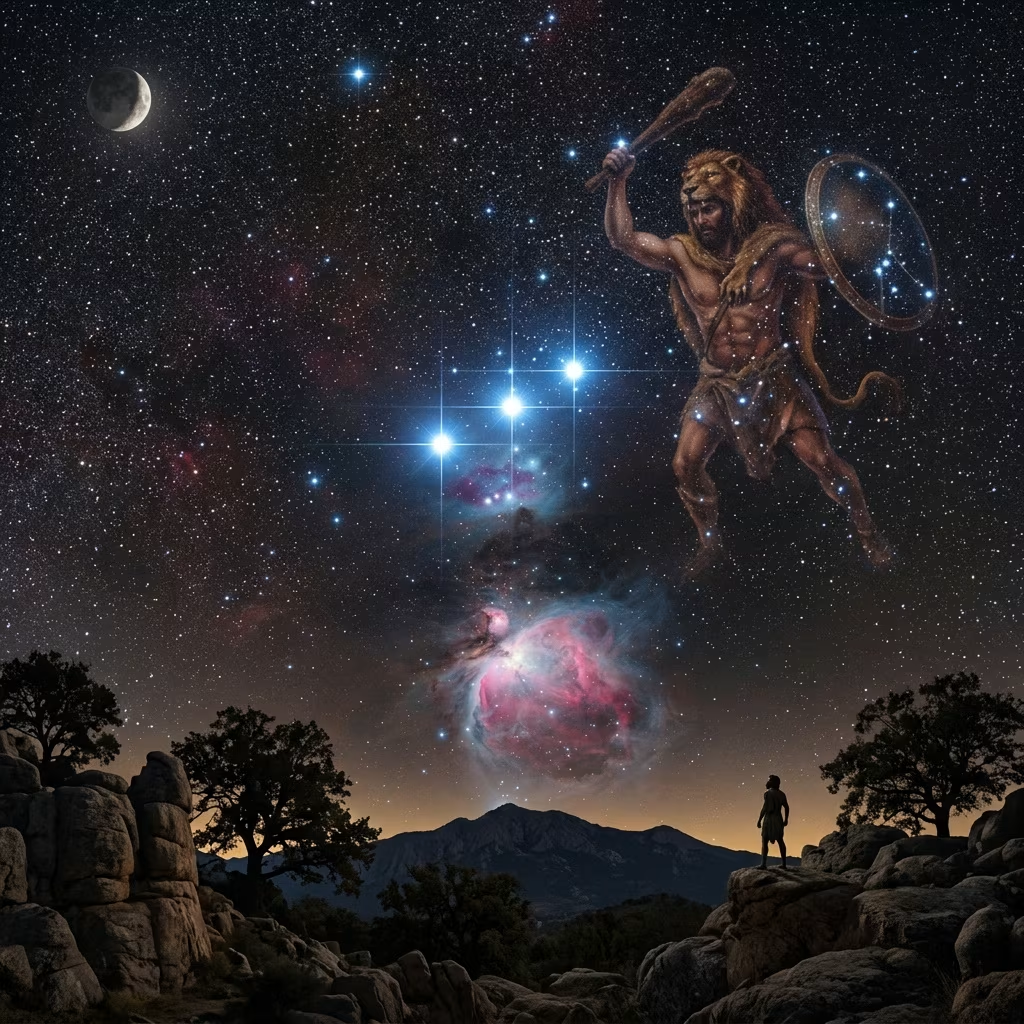
Orion’s Belt: The Iconic Trio of the Night Sky
Few features in the night sky are as instantly recognizable or captivating as Orion’s Belt. For millennia, these three radiant stars have captivated astronomers, navigators, storytellers, and stargazers across cultures and continents. Located in the heart of the constellation Orion—the Hunter—the Belt forms a brilliant, straight line that draws the eye and sparks the imagination.
What Is Orion’s Belt?
Orion’s Belt is an asterism—an easily identified pattern of stars—that sits at the center of the constellation Orion. Its three main stars, Alnitak, Alnilam, and Mintaka, are nearly equally spaced, forming a distinct line in the night sky that spans about 2.3 degrees. Though just a small part of Orion, the Belt is its most famous feature, visible from almost every inhabited part of Earth at the right time of year.
The Belt’s importance stretches far beyond simple recognition. Throughout history, it has inspired wonder, enabled navigation, and fueled stories in cultures worldwide. Even today, it’s one of the most accessible ways for beginners to start exploring the night sky.
Meet the Belt: Alnitak, Alnilam, Mintaka
The stars of Orion’s Belt are not just striking to the naked eye—they are also fascinating objects scientifically, each with unique attributes and astronomical intrigue.
| Star | Type | Distance from Earth | Apparent Magnitude | Summary |
|---|---|---|---|---|
| Alnitak | Triple star system (Blue Supergiant, B-subgiant, Main sequence) | ~1,260 light-years | 1.74 | Located at the eastern end, includes a massive supergiant; brightest O-class star in the night sky. |
| Alnilam | Single Blue Supergiant (B0) | ~2,000 light-years | 1.69 | Sits in the middle; one of the brightest stars in Orion, a vital classification anchor for stellar spectra. |
| Mintaka | Sextuple star system (Three spectroscopic binary pairs) | ~1,200 light-years | 2.25 | Westernmost star, near the celestial equator; complex system with eclipsing binaries. |
Star Details and Features
- Alnitak (ζ Orionis): Found at the Belt’s eastern end, Alnitak is both dramatic and complex, comprising a blue supergiant, a B-type subgiant, and a 4th-magnitude companion. Its blue-white light is characteristic of hot, massive stars, with the primary member (Alnitak Aa) about 28 times the mass and 20 times the diameter of our Sun. It is the brightest known O-type star visible to the naked eye.
- Alnilam (ε Orionis): The central star, Alnilam, shines with a magnitude of 1.69 and lies approximately 2,000 light-years from Earth. It is a solitary blue supergiant, radiating with a luminosity 375,000 times greater than our Sun, and its light helps astronomers calibrate the spectra of other stars.
- Mintaka (δ Orionis): At the western edge, Mintaka is the most complex system of the three, a sextuple (six-star) system with three close pairs. Its primary star is an O9.5 II blue giant. Mintaka’s eclipsing binaries cause periodic dips in its observed light as seen from Earth.
Despite their apparent proximity in the sky, the Belt stars are hundreds of light-years apart and physically unconnected, only appearing as a straight line because of our vantage point on Earth.
Orion: The Constellation Behind the Belt
Orion is perhaps the most prominent and storied constellation of all. Found on the celestial equator, it straddles the boundary between the northern and southern sky, making it visible to stargazers almost everywhere on the planet.
- Major Stars: Orion’s Belt forms the constellation’s midsection, while Rigel and Betelgeuse create its corners, and Saiph and Bellatrix fill out the shoulders and legs.
- Other Features: Orion houses not only bright stars but also notable deep sky objects, including the Orion Nebula (M42), one of the most observed and photographed stellar nurseries.
Orion was one of the first 48 constellations listed by Ptolemy and is now one of the 88 official modern constellations recognized by the International Astronomical Union. Its abbreviation is “Ori.”
Visibility and Seasons
- Northern Hemisphere: Orion reaches its highest point in the winter sky, best viewed from January to April. In summer months, Orion is lost in the Sun’s glare.
- Equatorial Regions: The constellation passes almost directly overhead at certain times, making the Belt an even more dramatic sight.
- Southern Hemisphere: Orion appears in the summer sky and is still one of the “must-see” constellations.
Finding and Observing Orion’s Belt
Orion’s Belt is often a gateway for beginners wishing to learn the art of stargazing. Its distinct alignment and brightness make it effortless to find by eye.
- Spot the Belt: Look for three bright, almost evenly spaced stars in a straight line. Though famous in winter, Orion’s Belt is visible from nearly everywhere on Earth except the polar extremes during summer months.
- Star-Hopping: Draw an imaginary line through the Belt:
- Following the line northeast points towards the bright red star Aldebaran in the constellation Taurus.
- Follow in the opposite direction (southwest), and you’ll reach Sirius, the brightest star in the night sky, in Canis Major.
- Best Viewing Times:
- Best seen during winter evenings in the Northern Hemisphere (December through early spring).
- Appears high overhead in tropical regions around midnight in December and in the evening sky by February.
- From May to July, Orion (including the Belt) is usually not visible due to solar conjunction.
- For Observers in the City: Orion’s Belt can often be seen even with light pollution, thanks to the stars’ high brightness.
Orion’s Belt is an invaluable stargazing reference point, linking observers to the broader patterns of the night sky.
Orion’s Belt in Myth and Culture
Across time and cultures, Orion’s Belt has borne many names and powerful meanings. Known as the “Three Kings,” “Three Sisters,” or “String of Pearls” in different traditions, it has become a touchstone in both myth and practical navigation.
- In Ancient Egypt: The Belt stars were associated with Osiris, the god of the afterlife, and may have guided the layout of the Giza pyramids.
- Arabic Astronomy: The traditional names for the Belt’s stars derive from Arabic, referencing a string of pearls or a girdle.
- Greek and Roman: Orion, the hunter, wears the Belt in his celestial depiction, cementing its association with mythology and seasonal change.
- Indigenous Cultures: Australian Aboriginal and Native American peoples wove Orion’s Belt into their own stories and sky lore, often as ancestral figures or signals for seasonal activities.
- Navigation: The nearly perfect alignment of the Belt’s stars helped early navigators and travelers determine direction and measure time during the night.
The stories and associations are as numerous as the cultures that observed them, making Orion’s Belt a universal symbol of wonder and guidance.
Astronomical Insights & Belt Features
Despite their historical and mythological significance, the Belt stars are, above all, objects of profound astrophysical interest. Here are some key scientific facts and features:
- Star Composition:
- Alnitak: A triple system, with the main star (O9.7 supergiant) radiating tremendous energy and driving strong stellar winds.
- Alnilam: A solitary blue supergiant, famous as an anchor point for star classification, and among the most luminous stars visible to the naked eye.
- Mintaka: A sextuple system, with at least three spectroscopic pairs, including a massive O-type blue giant and regular eclipses from our perspective.
- Distance and Alignment: All three are hundreds of light-years apart and not gravitationally bound. Their line-like appearance is a coincidence of perspective from Earth.
- Luminosity: Combined, the stars are nearly a million times more luminous than the Sun, casting their blue-white light across vast interstellar distances.
- Nearby Celestial Objects:
- The Flame Nebula (NGC 2024) and the famous Horsehead Nebula are both close to Alnitak.
- The Orion Nebula (M42), one of the brightest nebulae, is just below the Belt, forming Orion’s sword.
- Sky Events: The Orionids meteor shower, visible each October, appears to radiate near Orion’s Belt as Earth crosses debris left by Halley’s Comet.
Quick Facts Table
| Fact | Detail |
|---|---|
| Alternate Names | The Three Kings, The Three Sisters, Belt of Orion |
| Color | Blue-white, due to high temperature |
| Angular Width | About 2.3° across the sky |
| Visibility | From most inhabited places, best in winter |
| Nearest Celestial Equator | Mintaka sits closest to the celestial equator |
| Modern Astronomical Use | Alnilam’s spectrum is a reference for spectral classification |
Frequently Asked Questions (FAQs)
Q: When is the best time to see Orion’s Belt?
A: The best time to observe Orion’s Belt is during winter evenings in the Northern Hemisphere (December to March). It appears in the late evening sky in the tropics around December, and during the Southern Hemisphere’s summer.
Q: Are the Belt stars physically related or just a line-of-sight effect?
A: The stars of Orion’s Belt are not physically bound to one another; their seemingly straight alignment is a coincidence of perspective from Earth. Each star system is hundreds of light-years apart.
Q: Why are these stars so blue and bright?
A: Their blue color comes from extremely high surface temperatures, characteristic of young, massive stars that burn their fuel rapidly and shine intensely in the blue-white part of the spectrum.
Q: What is the mythological significance of Orion’s Belt?
A: Orion’s Belt appears in countless myths — from representing the hunter’s belt in Greek mythology to the “Three Kings” in Christian lore, and even marking seasonal events in Indigenous traditions worldwide.
Q: How can I use Orion’s Belt to find other stars?
A: Drawing an imaginary line through Orion’s Belt to the northeast points to Aldebaran in Taurus, while following southwest leads to Sirius in Canis Major—the brightest star in the night sky. This makes Orion’s Belt a useful tool for navigating the winter sky.
Conclusion
Orion’s Belt stands as a crossroads of science, navigation, art, and myth. Its beauty and rich cultural heritage have spanned the ages, connecting the questions of our ancestors to the curiosity of today’s astronomers, and ensuring that these three bright jewels will continue to inspire all who look skyward.
References
- https://en.wikipedia.org/wiki/Orion’s_Belt
- https://www.constellation-guide.com/orions-belt/
- https://science.howstuffworks.com/orions-belt.htm
- https://www.gb.nrao.edu/~rmaddale/Education/OrionTourCenter/belt.html
- https://science.nasa.gov/universe/discovering-the-universe-through-the-constellation-orion/
- https://www.glyphweb.com/esky/constellations/orionsbelt.html
- https://en.wikipedia.org/wiki/Orion_(constellation)
- https://study.com/academy/lesson/orion-constellation-stars-belt-quiz.html
- https://www.astronomy.com/science/the-belt-of-orion/
- https://www.astro.com/astrowiki/en/Orion’s_Belt
- https://astrobackyard.com/orions-belt/
- https://starwalk.space/en/news/orion-constellation-guide
- https://www.ebsco.com/research-starters/astronomy-and-astrophysics/orion-constellation
- https://www.uyir.at/explore-learn/aswajith/what-is-orion-s-belt
- https://handwiki.org/wiki/Astronomy:Orion’s_Belt


