What Is a Wormhole?
Wormholes—sometimes called Einstein-Rosen bridges—are theoretical passageways through space-time, predicted by Albert Einstein’s general theory of relativity. If they exist, wormholes could act as shortcuts connecting two distant points in the universe—potentially enabling faster-than-light journeys or even time travel. Despite their prevalence in science fiction, wormholes remain strictly theoretical, bringing with them profound questions and formidable dangers, from sudden collapse to high radiation and exposure to exotic matter.
Where Do Wormholes Come From?
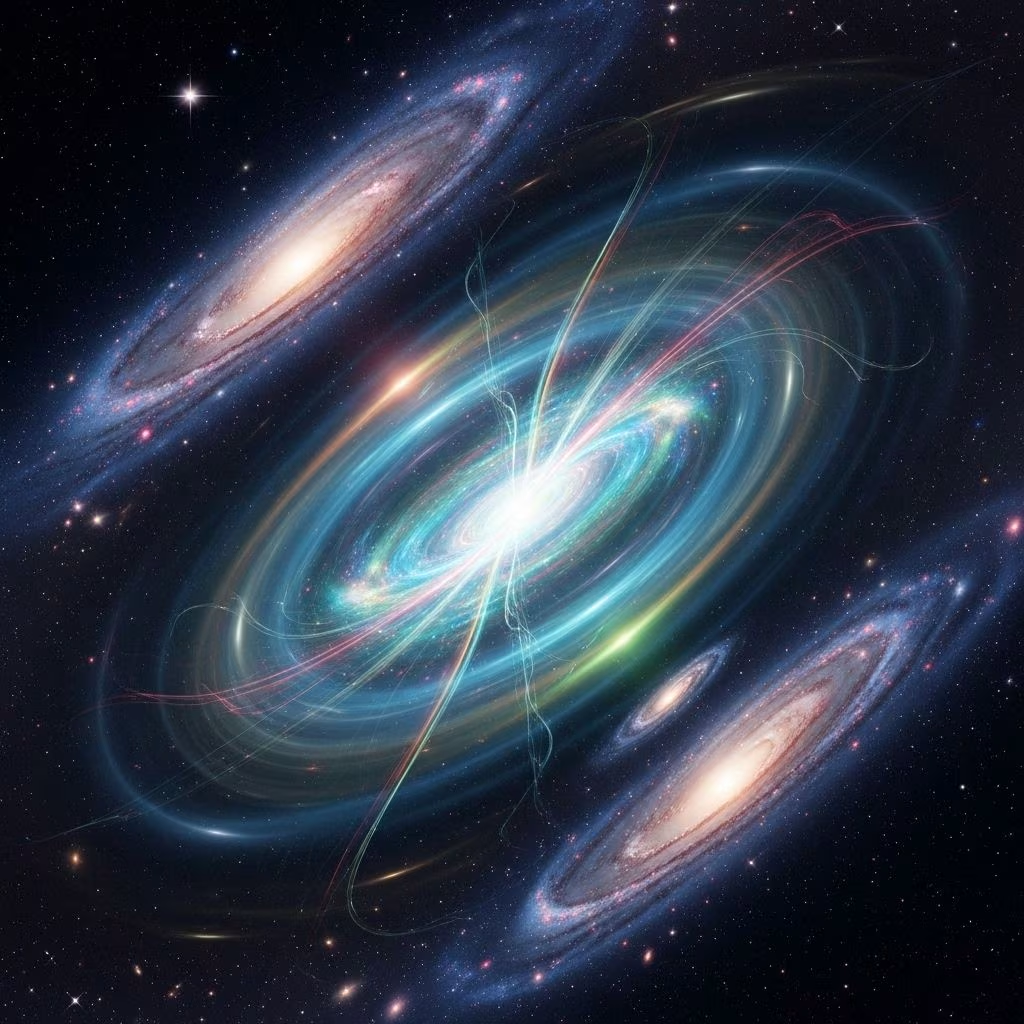
The concept of wormholes arises directly from Einstein’s general relativity, which describes gravity as the warping of space and time by mass and energy. Just as a massive object causes a dip in space-time, an extreme configuration of mass and gravity might produce a tunnel connecting two separate regions. Wormholes therefore trace their origins not to fanciful imaginings, but to well-established mathematics and physics.
- Einstein-Rosen bridges: First described in 1935 by Albert Einstein and Nathan Rosen as a solution to Einstein’s field equations.
- Black holes: Extreme examples of space-time curvature, forming when gravity overwhelms every other force.
- Wormhole analogy: Picture a folded piece of paper with two dots: a wormhole would be a tunnel directly linking them, bypassing the space in between.
Types of Wormholes
General relativity allows for several theoretical varieties of wormholes, each with different properties and implications for travel and physics. The two principal categories are:
| Type | Description | Traversability |
|---|---|---|
| Non-traversable Wormholes | Tunnels exist only for a fleeting instant, closing before anything (even light) can cross. | Impractical for transport |
| Traversable Wormholes | Remain open long enough to permit particles or (perhaps) spacecraft to travel through. | Theoretically possible, but require exotic matter to stabilize |
- Inter-universe wormholes: Hypothetical connections between separate universes (sometimes called “multiversal bridges”).
- Time-like wormholes: May link different times as well as different places, introducing the possibility of causality paradoxes.
Expert Insights: Wormhole Q&A
To provide clarity on commonly asked questions about wormholes, physicist Robert Kehoe—an expert in the accelerating expansion of the universe and a collaborator on the Dark Energy Spectroscopic Instrument—offers informed answers:
Are wormholes theoretically possible?
According to Kehoe, “A wormhole is essentially a tunnel from one place in space to another… theoretical physics allows for the possibility that extreme spacetime curvature caused by massive objects could connect to something analogous somewhere else in spacetime.” While this is possible within the mathematics of general relativity, there is no experimental evidence so far.
Has a wormhole ever been found?
No wormhole has ever been detected. While there is abundant evidence for the existence of black holes, wormholes remain a theoretical concept awaiting observational support.
Are there different types of wormholes?
Yes. Different models derived from general relativity permit different properties, most notably traversability. Some wormholes could be stable enough to potentially allow passage between distant points; others exist only briefly and cannot be crossed at all.
The Physics Behind Wormholes
At the heart of the wormhole concept are the peculiar consequences of warping space and time. Theories make several profound predictions about wormhole behavior:
- Extremely curved space-time: Like black holes, wormholes represent regions where the fabric of the universe is dramatically bent.
- Exotic matter: Stability of a traversable wormhole likely requires ‘exotic matter’—material with negative energy density that can repel rather than attract gravitationally. No known substance displays these properties at macroscopic scales.
- Dangers inherent to wormholes:
- Sudden collapse: Without stabilization, a wormhole may collapse quickly, trapping or destroying anything inside.
- High radiation: Enormous gravitational gradients could generate intense radiation, threatening any travelers or nearby matter.
- Quantum instabilities: Even small disturbances may make a wormhole highly unstable.
Wormholes in Modern Astrophysics
Wormholes reside primarily in the world of theoretical astrophysics, but ongoing research explores whether they might also play a role in actual cosmic phenomena—possibly as explanations for mysterious observations or even as contributors to the universe’s accelerating expansion.
- Microscopic wormholes: Recent research speculates that tiny, short-lived wormholes could appear everywhere at subatomic scales, potentially relating to dark energy, which is thought to drive cosmic acceleration.
- Observational challenges: Wormholes would appear similar to black holes from a distance, but might differ in their effects on light, energy, and matter in exotic ways. Many proposed tests are so far beyond current technology.
- Theoretical implications: Even if never observed directly, wormholes force physicists to confront the boundaries (and sometimes the contradictions) of their core theories.
Wormholes vs Black Holes: Key Differences
| Feature | Black Hole | Wormhole |
|---|---|---|
| Definition | Region where gravity is so strong even light can’t escape | Theoretical tunnel connecting distant points in space-time |
| Observational status | Confirmed via multiple lines of evidence | Theoretical, no direct detection |
| Stability for travel | Unavailable—would destroy travelers | Requires stabilization by exotic matter |
| Shape in space-time | Singularity surrounded by an event horizon | Tunnel with two mouths, each potentially resembling a black hole |
Fiction vs. Fact: Wormholes in Science & Culture
Wormholes have captivated the human imagination, inspiring a vast body of science fiction literature, movies, and television. Their seductive promise: instant travel to distant galaxies or even backward in time. In reality, the formidable obstacles posed by physics and engineering remain unsolved.
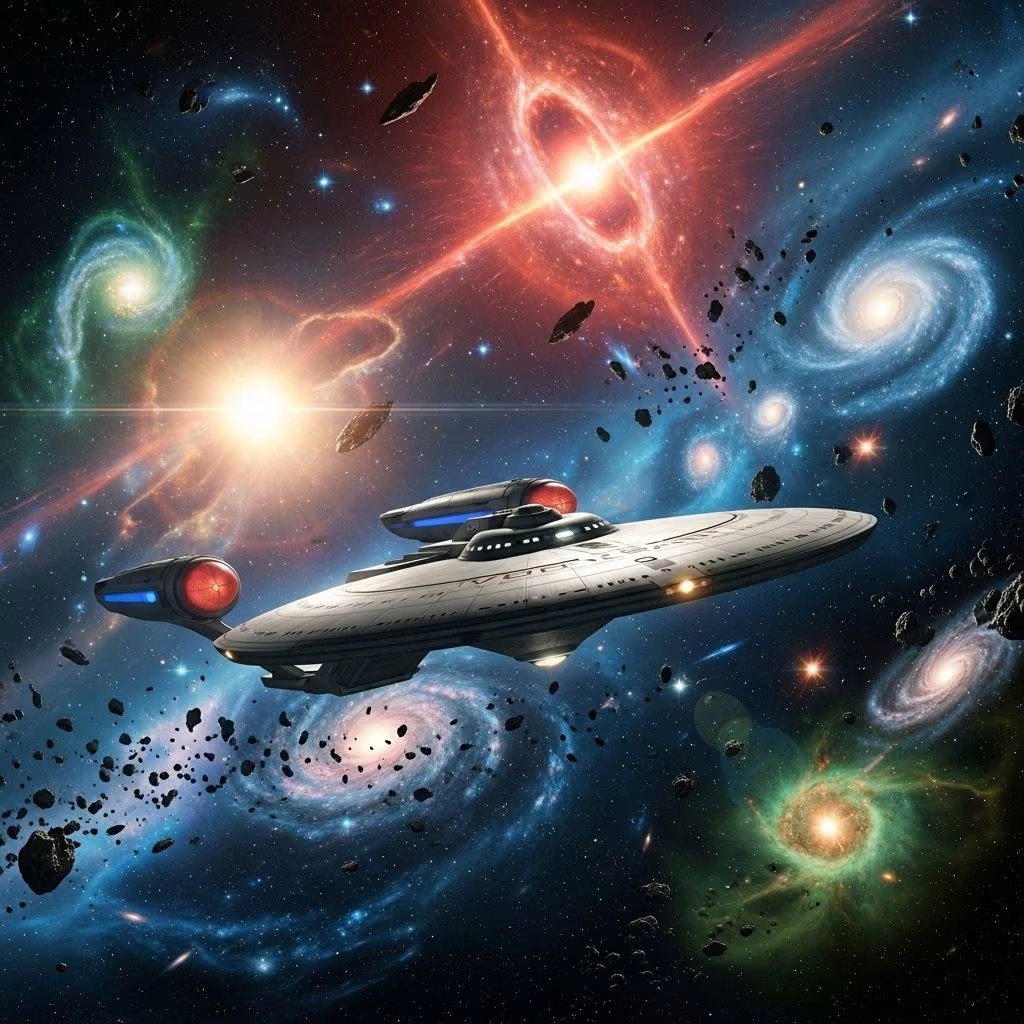
- Fictional portrayals: “Star Trek,” “Stargate,” “Interstellar,” and countless other works use wormholes as dramatic plot devices.
- Scientific reality: Theoretical physics allows for wormholes only under extremely restrictive (and as yet unachievable) conditions.
- Public fascination: Wormholes reflect our deepest wish—to explore the stars, transcend the limits of space and time, and maybe one day rewrite the laws of the cosmos.
Key Challenges to Making Wormholes Practical
- Exotic matter requirement: Stable, traversable wormholes need material with negative energy density—never observed at large scales.
- Quantum instability: Calculations suggest even minuscule perturbations could close or destroy a wormhole, possibly catastrophically.
- Violation of known laws: Some wormhole solutions lead to paradoxes, including time travel and violations of causality.
- Radiation danger: Powerful tidal forces and energetic processes could annihilate anything entering a wormhole throat.
- No observational evidence: Despite extensive searches, no wormhole signatures have yet been found in astronomical data.
Potential Astrophysical Significance
Even if wormholes prove impossible to stabilize for travel, they may have profound consequences for cosmology and fundamental physics:
- Dark Energy Hypothesis: Some theories propose that vast numbers of microscopic wormholes popping in and out of existence might help explain the mysterious force—dark energy—driving the universe’s accelerated expansion.
- Testing quantum gravity: Wormholes could hold clues for unifying general relativity with quantum mechanics—currently one of the great problems in physics.
- Expanding our understanding: Even if never observed directly, wormhole mathematics reveals new connections between space, time, and the fabric of the universe.
Frequently Asked Questions (FAQs) About Wormholes
Q: What is a wormhole?
A: A wormhole is a theoretical tunnel in space-time, potentially connecting distant regions or even different universes, based on solutions to Einstein’s equations.
Q: Has anyone ever discovered a wormhole?
A: No wormhole has ever been detected or confirmed in astronomical observations. Their existence remains strictly theoretical.
Q: Could you travel through a wormhole?
A: In theory, some types of wormholes might be traversable if stabilized with exotic matter. However, no known process or material would allow this, making wormhole travel impossible with current science.
Q: What are the main dangers if wormholes exist?
A: Hypothetical dangers include sudden collapse, intense radiation from powerful tidal forces, contact with exotic matter, and severe space-time distortions—any of which could be catastrophic to anything passing through.
Q: Are wormholes related to black holes?
A: Wormholes and black holes both derive from extreme space-time curvature in general relativity. Some theories picture a black hole as one “mouth” of a wormhole, though black holes as observed do not currently show evidence of such connections.
Q: Can wormholes explain dark energy?
A: Recent theories propose that vast numbers of subatomic wormholes could contribute to the acceleration of the universe—a hypothesis under active research.
Wormholes: The Ongoing Mystery
Wormholes remain among the most tantalizing and mysterious concepts in modern physics. They straddle the boundary between the possible and the fantastic, illustrating both the power and the limits of current scientific knowledge. Until direct evidence is found, wormholes serve as windows into the boldest questions we can ask about the universe, space, time, and the ultimate fate of everything that exists.
References
- https://www.space.com/20881-wormholes.html
- https://www.space.com/hunt-for-wormholes
- https://en.wikipedia.org/wiki/Wormhole
- https://byjus.com/physics/wormhole/
- https://www.astronomy.com/science/what-are-wormholes-an-astrophysicist-explains-these-shortcuts-through-space/
- https://www.youtube.com/watch?v=Kb1-rDrVAhs
- https://nasaspacenews.com/2024/08/punching-through-space-time-how-wormholes-might-drive-cosmic-expansion/
- https://www.popularmechanics.com/space/deep-space/a61018392/wormhole-physics/
- https://www.youtube.com/watch?v=o_Sw79TPP5Q
- https://arxiv.org/html/2308.03815v3
- https://darkensky.com/2022/05/04/wormholes-gateway-to-multiple-universes/
- https://timequiver.com/blog/time-travel-theories/wormholes/wormholes-key-unlocking-secrets-universe
- https://astronomyexplained.com/what-is-a-wormhole-your-ultimate-guide-to-wormholes/
- https://www.skyatnightmagazine.com/space-science/wormholes