Orionid Meteor Shower 2025: Complete Guide for Skywatchers
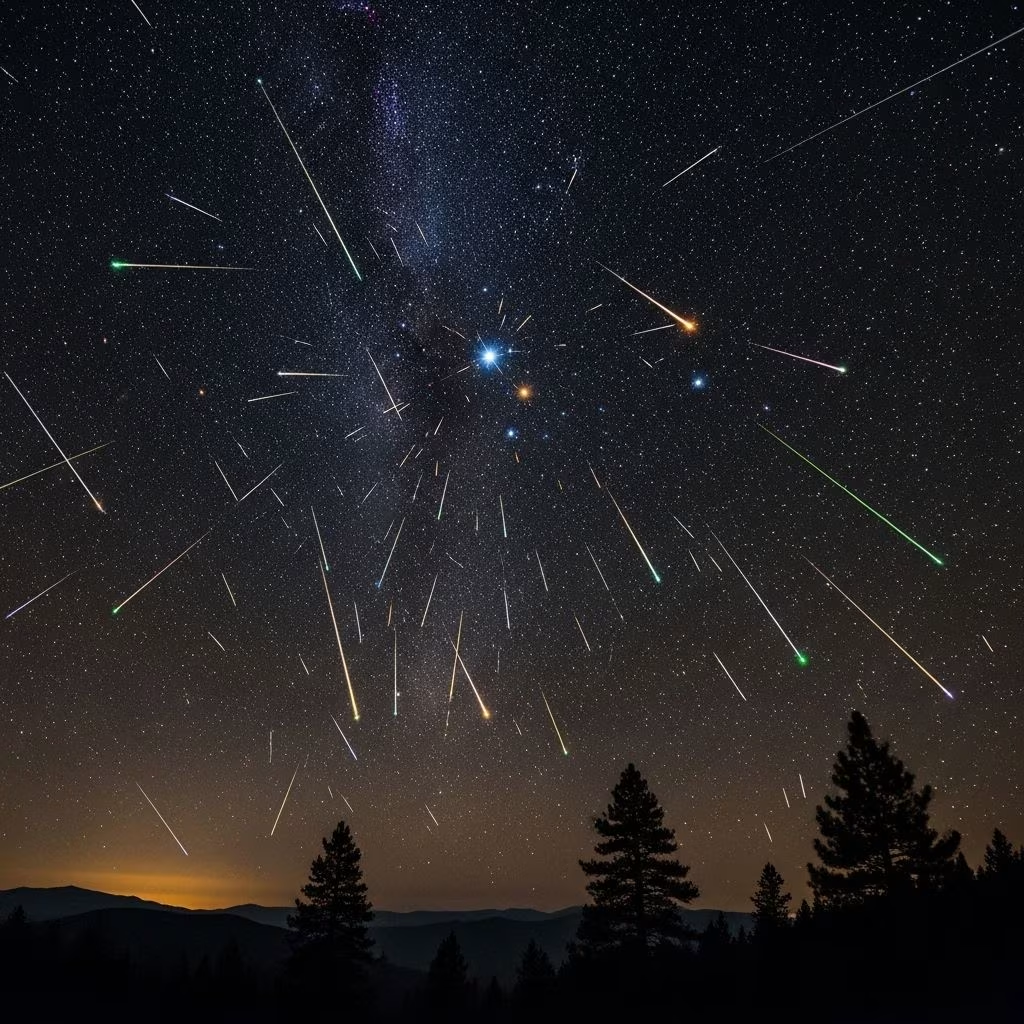
The Orionid meteor shower is one of the most celebrated annual astronomical events, offering stargazers the chance to witness bright shooting stars originating from the legendary Halley’s Comet. In 2025, this meteor shower promises exceptional viewing conditions, peaking between October 21–22, with debris streaking across the sky at breathtaking speeds.
This comprehensive guide covers the science behind the Orionids, how to spot them, the history of their cosmic origins, and tips to get the most out of your meteor shower experience.
Quick Facts Table
| Shower Name | Date of Maximum | Active Dates | Meteors per Hour | Associated Comet |
|---|---|---|---|---|
| Orionids | October 21–22, 2025 | October 2 – November 7, 2025 | 10–30 (peak) | Halley’s Comet (1P/Halley) |
What are the Orionids?
The Orionid meteor shower occurs every October as the Earth passes through a stream of debris shed by Halley’s Comet. The Orionids are named for the apparent source of the meteors, the radiant point near the constellation Orion, particularly close to Orion’s upraised club on the Orion-Gemini border.
While Halley’s Comet only passes by Earth about every 75–76 years, the Orionid meteor shower offers an annual opportunity to see fragments of this iconic comet burn up in our atmosphere, creating fast-moving, bright “shooting stars.”
The particles enter our planet’s atmosphere at speeds up to 41 miles per second (about 66 kilometers per second), vaporizing from friction and glowing brightly as streaks of light. Orionids are known for their swift movement and can create persistent trains—lasting ionized trails—visible against the night sky.
Why are They Called “Orionids”?
- Radiant Point: The meteors appear to originate (radiate) from a point near the constellation Orion—hence the name.
- Location: The radiant is found between the stars Betelgeuse (α Orionis) and Gamma Geminorum (Alhena), in the club of Orion. This region is about two-thirds up from the southern horizon as dawn approaches.
Origins: The Link to Halley’s Comet
The Orionids and their spring counterpart, the Eta Aquarids, are composed of particles ejected by Halley’s Comet during its many passages through the inner solar system.
Each time Halley’s Comet approaches the Sun, it sheds dust and rocky fragments. These remnants linger along Halley’s orbital path. When the Earth crosses this path every October, the leftover material collides with our atmosphere and gives rise to the Orionid display.
Though Halley’s Comet last visited Earth in 1986 and will not return until 2061, we encounter its remnants annually with these meteors.
When and Where to See the Orionids in 2025
The 2025 Orionid meteor shower will be active from October 2 through November 7, with its peak in the early hours of October 21–22. Skywatchers can expect heightened meteor activity during this week, though meteors may be seen on adjacent nights.
Experts recommend observing between midnight and dawn (1 a.m. to 5 a.m. local time) for optimal viewing. Facing south, orient your gaze toward Orion’s club for the best chance to catch streaking meteors.
In 2025, the Moon will have minimal interference, offering dark skies and potentially excellent conditions for meteor counting.
Best Practices for Observing Orionids
- Find a Dark Location: The farther you are from city lights, the greater your chance to view faint meteors.
- Allow Time for Night Vision: Spend at least 20–30 minutes letting your eyes adjust to the darkness.
- Use a Reclining Chair or Blanket: Lie back with a full view of the sky—no need for telescopes or binoculars.
- Dress Warmly: October nights can be chilly; layer clothing as needed.
- Face South: Orion will be low in the east in late evening, rising higher through the early hours. Look for meteors emerging from the Orion-Gemini border.
- Be Patient: Meteor rates vary; the shower is unpredictable, and streaks can occur in bursts or lulls.
Why are Orionid Meteors Special?
- Speed: Orionids are among the fastest meteor showers, entering the atmosphere at over 66 km/second (41 miles/second).
- Glow: Due to their high velocity, Orionid meteors often leave glowing ionization trails or “trains” that can persist for seconds.
- Reliability: While not as prolific as the Perseids or Geminids, Orionids are consistent, typically yielding 10–30 meteors
per hour at their peak.
- Origin: Each meteor is a cosmic fragment torn from Halley’s Comet—viewers witness direct remnants of one of history’s most iconic astronomical bodies.
Other Meteor Showers in October
While the Orionids are the highlight, October also features the Draconid meteor shower earlier in the month. Orionids follow and surpass the Draconids in intensity and reliability. The Orionid display is second only to the Perseids (August) or Geminids (December) for many observers in mid-northern latitudes.
Differences Between Meteors, Comets, Asteroids, and Meteorites
- Meteor: The streak of light produced when a meteoroid enters the atmosphere—also known as a “shooting star.”
- Meteoroid: A rocky or metallic body traveling through space; smaller than an asteroid.
- Meteorite: A meteoroid that survives atmospheric entry and lands on Earth.
- Comet: An icy body orbiting the Sun, which forms a coma and tail when heated near the Sun; Halley’s Comet is the parent body of the Orionids.
- Asteroid: A larger rocky body, typically found in the asteroid belt between Mars and Jupiter.
Scientific Importance of Orionids
Studying the Orionids allows astronomers to:
- Learn about the physical properties of Halley’s Comet through the composition and behaviour of its debris.
- Track orbital dynamics of cometary streams and how they interact with Earth’s atmosphere.
- Refine meteor shower predictions for future years based on observed activity and rate.
- Engage citizen scientists in collecting meteor counts, times, and features for global databases.
How to Photograph the Orionids
- Use a Wide-Angle Lens: Capture the maximum portion of the sky.
- Long Exposures: Typical exposure times range from 15 to 30 seconds. Set ISO between 800–3200 depending on sky brightness.
- Tripod Required: Steady your camera to avoid blurring during long exposures.
- Manual Focus: Focus at infinity for crisp stars and meteors.
- Remote Shutter: Minimize vibration by using a cable release or timer.
Tips for Families and First-Time Meteor Watchers
- Make a Night of It: Bring snacks, games, and a star chart. Meteor showers are best enjoyed with company and patience.
- Use Apps: Star maps and astronomy apps can help locate Orion and predict meteor shower activity.
- Log Observations: Keep a notebook or use a phone to record how many meteors you see, their brightness, and whether any leave a train.
- Stay Safe: Dress appropriately for local weather and ensure your viewing spot is secure.
Global Visibility of Orionids
The Orionid meteor shower can be observed from both hemispheres. Orion rises higher in the sky for observers in mid-northern latitudes, but meteors may be seen anywhere with clear, dark skies. The radiant is best placed between midnight and the beginning of morning twilight. In southern latitudes, viewing is possible but the radiant remains lower in the sky.
Frequently Asked Questions (FAQs)
Q: When is the best time to see the Orionid meteor shower in 2025?
A: The shower peaks in the pre-dawn hours of October 21–22, 2025, with activity visible from midnight until dawn. Maximum meteor rates are typically observed between 1 a.m. and 5 a.m.
Look for meteors on several nights before and after the peak for additional sightings.
Q: How many Orionid meteors can I expect to see?
A: On the peak night under ideal conditions, you can expect anywhere from 10 to 30 meteors per hour. Some years may outperform expectations if the debris stream is dense or the sky is especially dark.
Q: Do I need a telescope or special equipment?
A: No equipment is required to observe the Orionids! The naked eye, dark skies, and patience are all you need. Telescopes and binoculars actually limit your field of view and are not helpful for meteor showers.
Q: Where in the sky do Orionid meteors appear?
A: Meteors will appear to radiate outward from a point near the constellation Orion, but can streak across any part of the sky. Keep Orion’s club near the center of your view for maximum meteor sightings.
Q: Are Orionids dangerous?
A: Orionid meteors are harmless to observers. The tiny debris burns up high in the atmosphere, posing no threat to the ground or people.
Q: What causes the Orionid meteor shower?
A: The shower is produced by debris from Halley’s Comet entering Earth’s atmosphere and vaporizing from friction, producing visible streaks of light or “shooting stars”.
Q: Will the Moon affect viewing in 2025?
A: The Moon will be largely out of the way during the peak nights, meaning darker skies and better viewing conditions for Orionid meteors in 2025.
Expert Resources and Further Reading
- American Meteor Society: Meteor shower calendars and global observation programs.
- NASA Science: Research insights and educational guides about meteor showers and comets.
- Farmers’ Almanac & Royal Museums Greenwich: Seasonal skywatching tips and meteor shower schedules.
- Astronomy Apps: Interactive tools for locating Orion’s radiant, timing meteor rises, and more.
Summary & Final Observing Tips
- Locate a dark site with an unobstructed view of the southern sky.
- Face southeast to south toward Orion between midnight and dawn.
- Dress comfortably and prepare supplies for a long viewing session.
- Enjoy the spectacle—each shooting star is an ancient fragment of Halley’s Comet!
References
- https://www.amsmeteors.org/meteor-showers/meteor-shower-calendar/
- https://science.nasa.gov/solar-system/meteors-meteorites/orionids/
- https://www.timeanddate.com/astronomy/meteor-shower/orionid.html
- https://www.nhm.ac.uk/discover/meteor-shower-lyrids-perseids-geminids-leonids-orionids.html
- https://in-the-sky.org/news.php?id=20251021_10_100
- https://www.rmg.co.uk/stories/space-astronomy/orionid-meteor-shower-2025-when-where-see-it-uk
- https://www.space.com/34373-orionid-meteor-shower-guide.html
- https://www.farmersalmanac.com/orionid-meteor-shower
- https://www.rmg.co.uk/stories/space-astronomy/meteor-shower-guide-2025
- https://www.imo.net/resources/calendar/
- https://in-the-sky.org/news.php?id=20251128_10_100
- https://starwalk.space/en/news/orionid-meteor-shower-how-and-when-to-see
- https://www.amsmeteors.org/meteor-showers/2020-meteor-shower-list/
- https://sf.funcheap.com/orionid-meteor-shower-halleys-comets-debris/
- https://www.timeanddate.com/astronomy/meteor-shower/list.html
- https://starwalk.space/en/news/meteor-shower-calendar
- https://www.photopills.com/articles/meteor-shower-photography-guide
- https://www.space.com/454-guide-orionid-meteor-shower.html