Saturn’s Moons: Wonders Among the Rings
Saturn is renowned for its stunning rings, yet it harbors an equally impressive collection of moons. With over 146 known moons orbiting the planet, Saturn’s satellites display incredible diversity in size, composition, and character. Ranging from giant, planet-like bodies to tiny rock fragments locked within its rings, these moons offer insights into planetary formation, geology, and even the potential for life beyond Earth.
Saturn’s moons are commonly grouped as regular and irregular satellites, depending on their formation and orbital characteristics. Here, we journey through their attributes, histories, and scientific significance, spotlighting the most captivating members of Saturn’s complex family.
Overview: Saturn’s Moon System
- Largest Number of Moons: Saturn has the most moons of any planet in the solar system, currently numbering at least 146 identified satellites.
- Diversity: The moons range from massive objects like Titan—the second largest moon in the solar system—to minuscule fragments embedded in the rings.
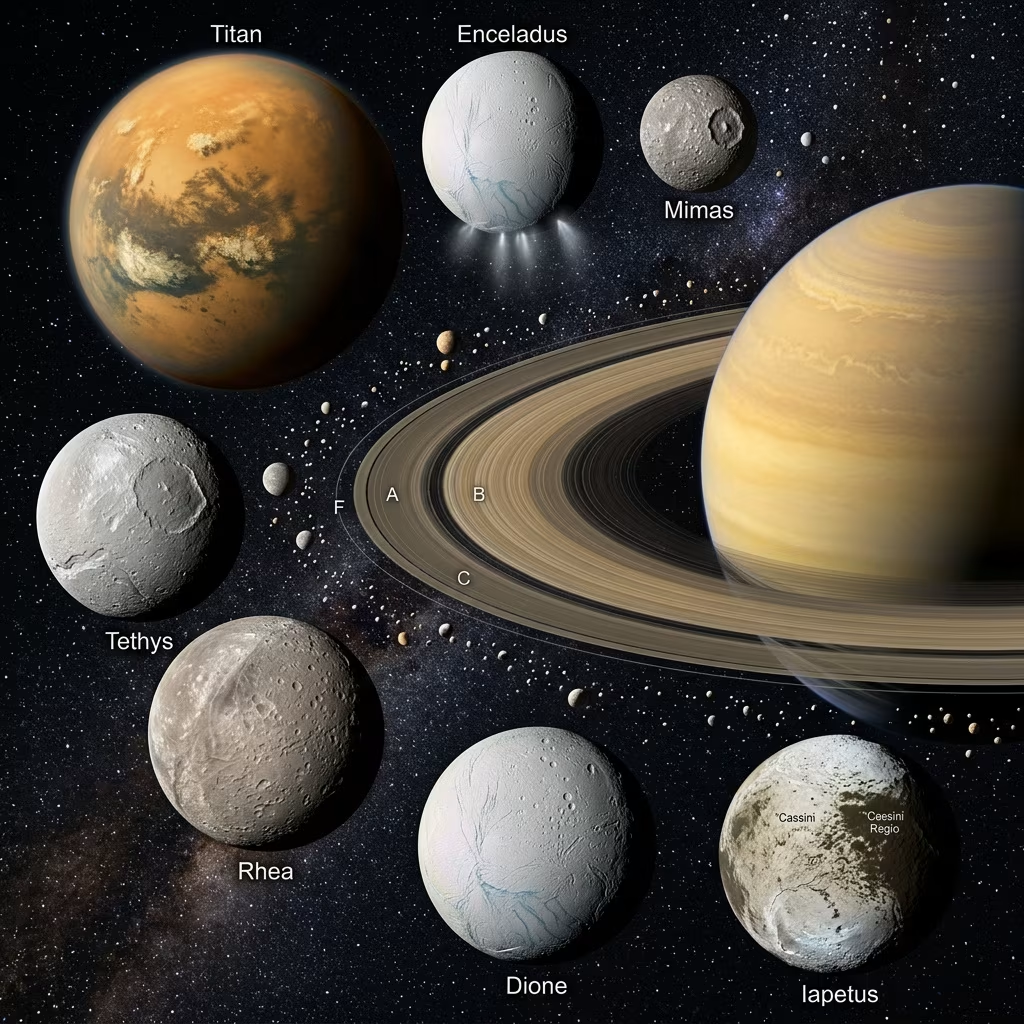
- Major Moons: Eight are considered major moons due to their size and spherical shape: Mimas, Enceladus, Tethys, Dione, Rhea, Titan, Hyperion, and Iapetus.
- Ring Moonlets: Many smaller moons and moonlets are located within, or shepherd, Saturn’s iconic ring system.
- Irregular Moons: Far-flung, odd-shaped companions captured by Saturn’s gravity long after its formation.
Table: Major Moons of Saturn
| Name | Diameter (km) | Discovery Year | Notable Features |
|---|---|---|---|
| Titan | 5,150 | 1655 | Dense atmosphere, lakes of methane/ethane, largest moon |
| Rhea | 1,528 | 1672 | Icy surface, possible rings |
| Iapetus | 1,470 | 1671 | Two-toned coloration, equatorial ridge |
| Dione | 1,123 | 1684 | Cratered with bright ice cliffs, wispy terrain |
| Tethys | 1,062 | 1684 | Large chasm, heavily cratered |
| Enceladus | 504 | 1789 | Active geysers, subsurface ocean |
| Mimas | 396 | 1789 | Herschel crater (“Death Star” appearance) |
| Hyperion | 270 | 1848 | Sponge-like, irregular shape, chaotic rotation |
Regular vs. Irregular Moons
Regular moons typically formed out of the disk of material surrounding Saturn after its birth and orbit in the planet’s equatorial plane in the same (prograde) direction as Saturn’s rotation. They tend to be spherical due to gravity, with the main eight classified in this group.
Irregular moons are smaller, have distant, eccentric, often inclined orbits, and were likely captured by Saturn’s gravity long after the planet’s formation. Their shapes and movement patterns are diverse, ranging from highly elongated orbits to retrograde motion.
Distribution of Mass
- Titan alone contains more than 96% of the total mass of all Saturn’s moons.
- The next seven largest moons together account for nearly all of the remaining 4%.
- The vast majority—over 120 moons and countless fragments—make up less than 0.03% of the moon system’s mass.
Titan: Saturn’s Giant Among Moons
Titan is Saturn’s largest moon and the second largest in the solar system, even bigger than Mercury. Discovered by Christiaan Huygens in 1655, Titan boasts several features unique among moons:
- Dense Atmosphere: Composed mainly of nitrogen, it’s the only large moon with a thick, weather-forming atmosphere.
- Surface Liquids: Titan hosts liquid lakes, rivers, and seas made primarily of methane and ethane—the only place beyond Earth where stable surface liquids have been found.
- Planet-like Processes: Weather cycles, storms, and dune fields formed by hydrocarbon winds.
- Research Interest: Titan’s chemistry and organic material make it a major focus for astrobiological research and future missions.
Enceladus: The Active Icy Moon
Enceladus may be small (about 504 km diameter), but it is geologically dynamic:
- Geysers and Plumes: Powerful eruptions blast water vapor, ice, and organic materials from subsurface oceans through fissures at its south pole.
- Reflective Surface: Fresh water ice makes Enceladus one of the brightest bodies in the solar system.
- Potential for Life: Its hidden ocean, chemical energy sources, and organic molecules draw intense interest for astrobiology and space missions.
Mimas: The “Death Star” Moon
Mimas, Saturn’s smallest major moon (396 km diameter), is famous for its massive Herschel Crater, giving it a striking resemblance to the Death Star from Star Wars.
- Distinctive Crater: Herschel is one-third the moon’s diameter.
- Rounded Shape: Mimas is the smallest object known to be rounded by its own gravity.
- Heavily Cratered Surface: Along with Herschel, the surface is covered in lighter craters indicating a history of impacts.
Iapetus: The Two-Toned Mystery
Iapetus is noted for its dramatic contrast: one hemisphere is as dark as asphalt, while the other is bright and icy.
- Dark and Light Hemispheres: Its “leading” side is dark, possibly due to material from another moon, Phoebe, while its “trailing” side is highly reflective.
- Equatorial Ridge: A massive 20 km high ridge wraps around its equator—the origin remains debated.
- Slow Rotation: Iapetus takes 79 days to rotate, and its unusual coloration provides clues to the orbital dynamics of Saturn’s outer moon system.
Other Major Moons: Dione, Rhea, Tethys and Hyperion
- Dione: Composed largely of water ice, with distinct bright ice cliffs and wispy terrain, Dione orbits Saturn every 2.7 days and reveals cracks from ancient tectonic activity.
- Rhea: The second-largest moon, resembling a “dirty snowball” due to its icy, cratered surface. There’s evidence suggesting Rhea could have its own rings.
- Tethys: Known for its exceptionally low density and prominent chasms, Tethys’ surface features mysterious red streaks amid craters.
- Hyperion: This irregular, non-spherical, sponge-like moon is chaotic in rotation (not tidally locked) and is pockmarked by deep craters.
Interesting Minor Moons
- Methone: A tiny, egg-shaped moonlet known for its smooth, nearly craterless surface.
- Pan and Atlas: Shaped like flying saucers, these moons help sculpt Saturn’s ring gaps.
- Prometheus and Pandora: “Shepherd moons,” maintaining the sharp edges of Saturn’s F ring through gravitational interactions.
- Epimetheus and Janus: Co-orbital moons that periodically swap positions in a unique orbital dance.
Saturn’s Smallest Moons and Moonlets
Most of Saturn’s moons are less than 40 km wide, not counting the countless ring particles. These small irregular satellites and moonlets provide clues to the planet’s history and to the processes governing the formation of moons and rings.
Additionally, impacts, fragmentation, and gravitational influences have produced dozens of irregular, often temporary satellites.
- Irregular satellites: Orbits often retrograde, highly inclined, with diverse origins.
- Ring moonlets: Small fragments shepherding and shaping Saturn’s rings.
Formation and History
Saturn’s regular moons likely formed from material in the planet’s primordial disk, similar to the process that built Saturn’s rings. The irregular moons, meanwhile, are thought to be asteroids or comet-like objects captured by Saturn’s gravity well.
The great diversity among Saturn’s moons—sizes, shapes, geologies—stems from their varied origins and complex interactions over billions of years.
Historical Highlights
- Titan discovered in 1655 by Christiaan Huygens.
- Iapetus discovered in 1671; Rhea in 1672; Dione and Tethys in 1684.
- Enceladus and Mimas found in 1789; Hyperion in 1848.
- More than 100 small moons and moonlets discovered in the 20th and 21st centuries, especially with the advent of the Cassini mission.
Exploration and Science Missions
- Voyager 1 & 2: Provided the first close-up views of Saturn’s moons in the early 1980s.
- Cassini-Huygens: Arrived at Saturn in 2004, directly studied Titan (Huygens probe landed on its surface), Enceladus’ geysers, and imaged numerous other moons, revolutionizing our understanding.
- Future Missions: The Dragonfly mission plans to study Titan in detail, while ongoing telescope surveys continue to find new, smaller moons.
Scientific Importance
Saturn’s moons are not just planetary curiosities—they are windows into the processes of solar system formation, planetary system evolution, and the prebiotic chemistry possible beyond Earth. Titan’s thick, organic-rich atmosphere and Enceladus’ subsurface ocean especially fuel speculation about habitable environments in unexpected places.
Frequently Asked Questions (FAQs)
How many moons does Saturn have?
Saturn is known to host over 146 moons, with more being discovered as telescopes and spacecraft capabilities improve.
Which is Saturn’s largest moon?
Titan is Saturn’s largest moon, making up the majority of the system’s total moon mass.
Why are some of Saturn’s moons irregularly shaped?
The irregular moons, such as Hyperion, did not form from Saturn’s disk and are likely captured objects, resulting in odd shapes and chaotic rotations.
Does Titan have an atmosphere and surface lakes?
Yes, Titan has a thick nitrogen atmosphere and liquid methane and ethane lakes and rivers—unique in our solar system.
What makes Enceladus scientifically exciting?
Enceladus jets icy plumes from a subsurface ocean containing organic compounds, raising the possibility of microbial life beyond Earth.
Are Saturn’s moons found only within its rings?
No, the major moons (e.g., Titan, Rhea, Iapetus) orbit outside the rings, while many inner moons and moonlets help shape and maintain the ring system.
Conclusion
Saturn’s moons represent one of the solar system’s most varied and fascinating collections. From planet-sized worlds with atmospheres to tiny shepherds patrolling Saturn’s iconic rings, every moon adds a new chapter to the story of planetary science. With ongoing missions and discoveries, Saturn’s family of moons continues to expand and inspire—reminding us of both the grandeur and the complexity of our solar neighborhood.
References
- https://en.wikipedia.org/wiki/Moons_of_Saturn
- https://science.nasa.gov/saturn/moons/
- https://www.britannica.com/place/moons-of-Saturn-2237282
- https://www.bobthealien.co.uk/saturn/moons.htm
- https://en.wikipedia.org/wiki/Moons_of_saturn
- https://science.nasa.gov/saturn/moons/facts/
- https://www.britannica.com/place/Saturn-planet/Moons
- https://www.go-astronomy.com/moons-of-saturn.htm
- https://theplanets.org/moons-of-saturn/
- http://www.spaceopedia.com/solar-system/moons/saturn-moons/
- https://heliomtech.com/saturn-moons/
- https://www.spacestationinfo.com/saturn-moons.htm
- https://myspacemuseum.com/moons-of-saturn
- https://planetfacts.org/moons-of-saturn/
- https://www.jameswebbdiscovery.com/universe/moons-of-saturn-100-fascinating-facts-you-need-to-know
- https://www.skyatnightmagazine.com/advice/skills/how-observe-saturn-moons
- https://trace.scad.edu/americas-evolving/saturns-celestial-wonders-the-moons-of-saturn.html