The Nearest Stars to Earth: Exploring Our Stellar Neighborhood
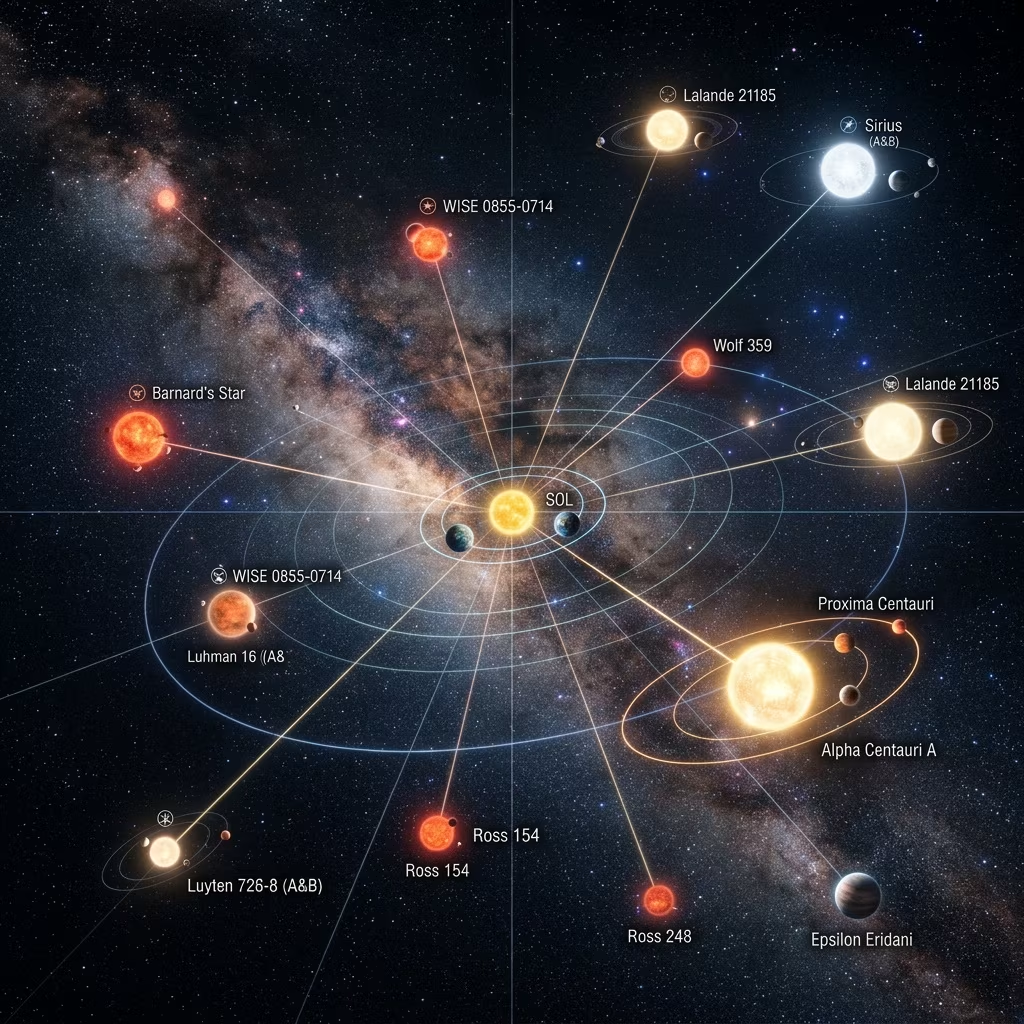
The universe is vast, but our cosmic neighborhood, the immediate region of stars surrounding our solar system, offers a rich landscape full of intriguing objects. The closest stars to Earth, spanning just a few light-years away, form a remarkable portrait of stellar diversity. While many stars we see in the night sky are thousands of light-years away, our nearest neighbors provide a unique opportunity to study stars both similar and very different from our Sun.
Understanding Stellar Distances: The Cosmic Yardstick
Distances to the closest stars are measured in light-years—the distance light travels in one year, about 9.46 trillion kilometers (5.88 trillion miles). The night sky may appear crowded, but even the closest stars lie so far away that it takes years for their light to reach us. Astronomers use techniques like parallax (watching how a star’s position shifts as Earth orbits the Sun) to determine these distances with remarkable precision.
Our Solar System: The Ultimate Home Star
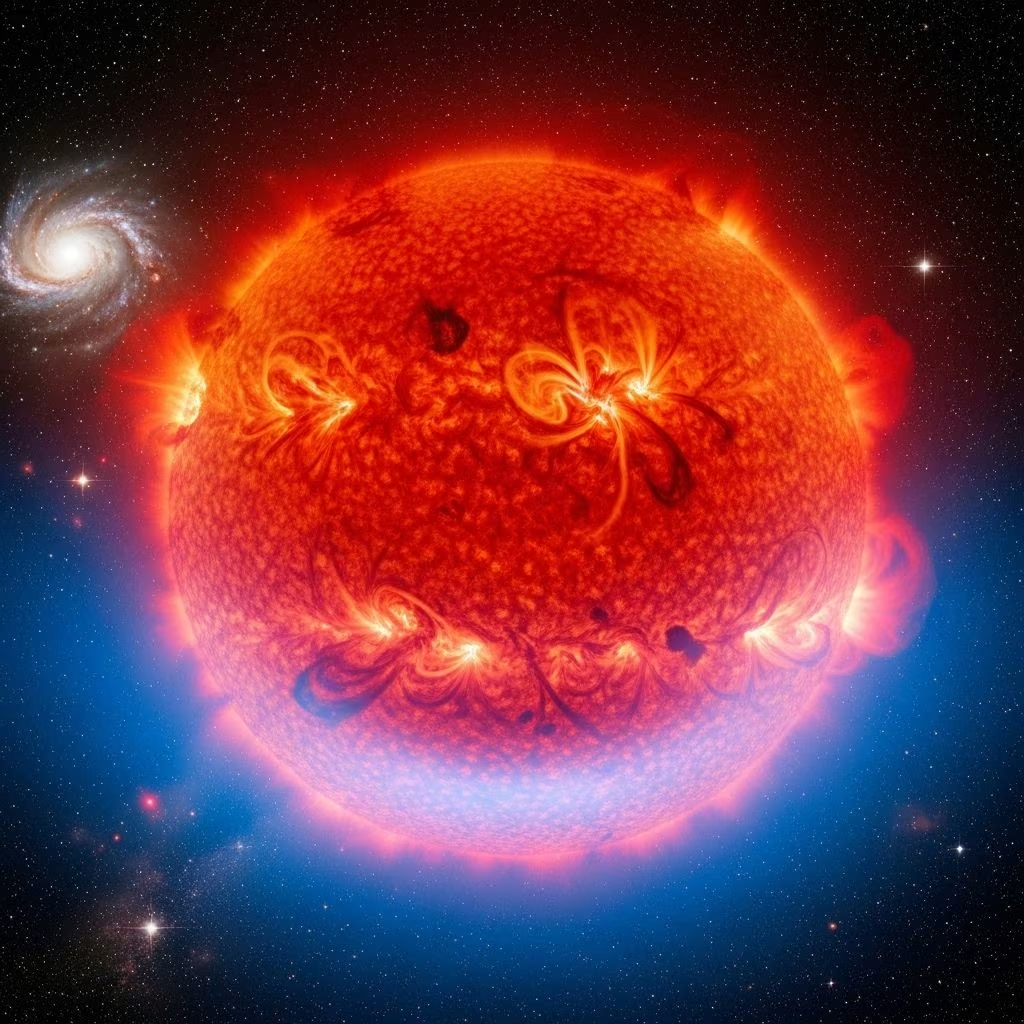
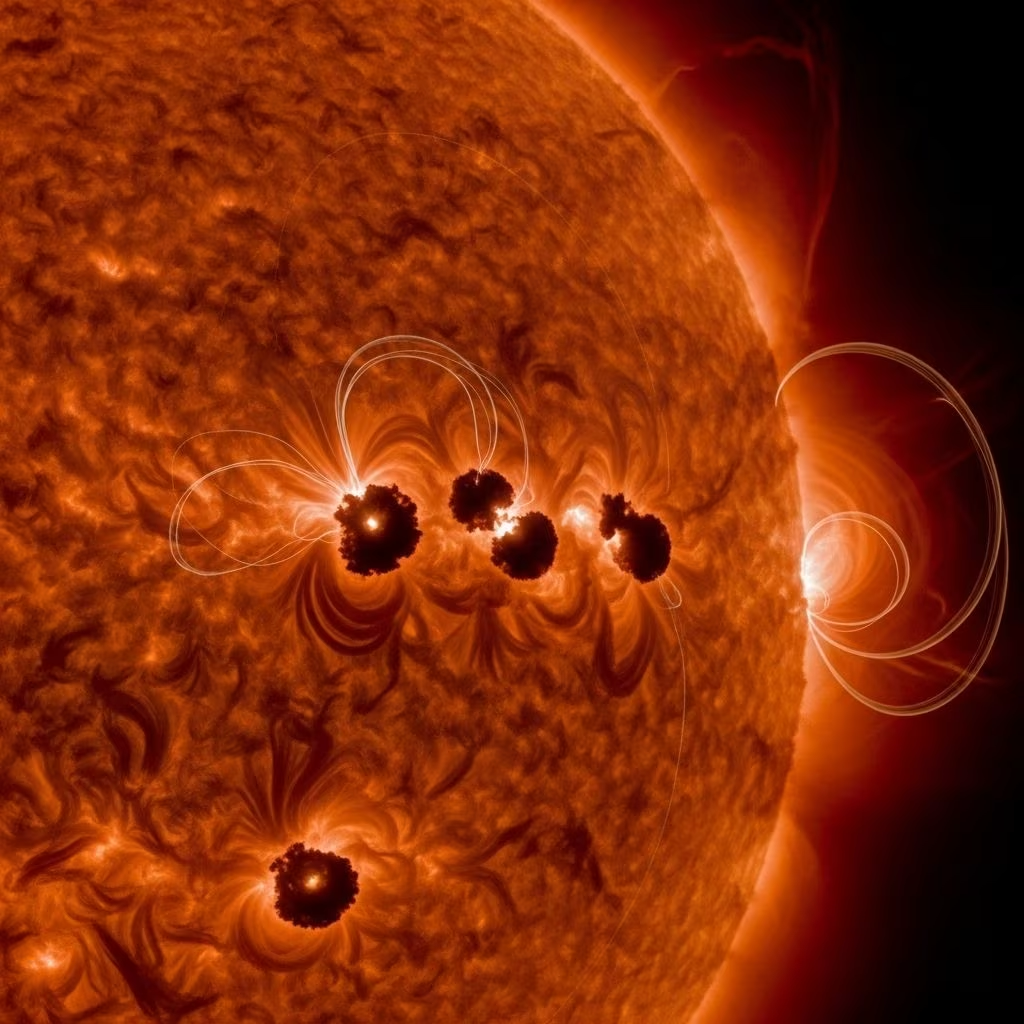
By definition, the closest star to Earth is our own Sun.
- Distance: 8 light-minutes (about 150 million km or 93 million miles)
- Spectral Type: G2V main-sequence dwarf
- Key Features: The Sun’s energy is essential for life on Earth, driving processes from climate to photosynthesis.
- Planets: 8, including Earth, plus a diverse family of dwarf planets, asteroids, and comets.
Proxima Centauri: The Closest Evening Star
Proxima Centauri holds the distinction of being the closest star to our solar system beyond the Sun. Located just 4.24 light-years away in the constellation Centaurus, this M-class red dwarf star is not visible to the naked eye but has captivated astronomers since its discovery in 1915 by Robert Innes.
| Property | Details |
|---|---|
| Distance | 4.24 light-years |
| Spectral Type | M5.5Ve (red dwarf) |
| Apparent Magnitude | 11.13 |
| Notable | Flare star; part of Alpha Centauri system |
| Planets | 2 confirmed: Proxima b (Earth-size, habitable zone), Proxima d (sub-Earth size) |
Despite being a red dwarf with only 12.5% the Sun’s mass and exceedingly faint, Proxima Centauri’s proximity makes it invaluable for studying stellar atmospheres and planetary formation. Its high rate of magnetic activity leads to frequent stellar flares, making its planets’ habitability an area of active research.
Alpha Centauri System: Triple Star Complexity
The Alpha Centauri system, just a little farther than Proxima, is a triple star system composed of Alpha Centauri A, Alpha Centauri B, and Proxima Centauri (Alpha Centauri C). The bright binary pair, Alpha Centauri A and B, sits 4.37 light-years away and dominates the southern sky. Together with Proxima, they form the nearest star system to the Sun.
| Star | Type | Distance (ly) | Magnitude |
|---|---|---|---|
| Alpha Centauri A | G2V (sunlike) | 4.37 | –0.01 |
| Alpha Centauri B | K1V (orange dwarf) | 4.37 | 1.33 |
| Proxima Centauri (C) | M5.5Ve (red dwarf) | 4.24 | 11.13 |
- Alpha Centauri A & B: Orbit each other every 79.91 years.
- Exoplanets: Alpha Centauri A has at least one unconfirmed planet candidate; Proxima hosts two confirmed exoplanets.
This triple system is especially important due to the similarities between Alpha Centauri A and the Sun, making it a high-value target in the search for alien life and future interstellar probes.
Barnard’s Star: The High-Speed Loner
Barnard’s Star is a red dwarf in Ophiuchus and the closest single star, located about 5.96 light-years away. Famous for its large proper motion (the fastest apparent movement across Earth’s sky of any star outside our solar system), Barnard’s Star has been studied extensively in the quest for planets and insight into stellar aging.
- Distance: 5.96 light-years
- Spectral Type: M4Ve (red dwarf)
- Apparent Magnitude: 9.54
- Exoplanets: An unconfirmed candidate for a super-Earth in the habitable zone.
- Notable: Extremely old and dim, among the oldest known stars in the Milky Way’s neighborhood.
Wolf 359: The Dim Little Giant
Located in the constellation Leo, Wolf 359 is just 7.78 light-years from Earth. As one of the faintest and lowest-mass stars known within a 10-light-year radius, Wolf 359 is invisible to the naked eye—but an important object for stellar research due to its close proximity and the fact that it, too, is a red dwarf. It also appears in several works of science fiction.
- Distance: 7.78 light-years
- Spectral Type: M6Ve (red dwarf)
- Apparent Magnitude: 13.54
- Planets: None confirmed.
Lalande 21185: Solar Twin or Not?
Lalande 21185 is another red dwarf located at a distance of around 8.31 light-years in the constellation Ursa Major. While it’s not visible without a telescope, it is one of the brightest red dwarfs observable through amateur telescopes, making it popular among stargazing enthusiasts.
- Distance: 8.31 light-years
- Spectral Type: M2V (red dwarf)
- Apparent Magnitude: 7.5
- Planets: Possible planetary candidates, none confirmed.
- Notable: The fourth brightest red dwarf in the sky.
Sirius System: The Dog Star and Its White Dwarf Companion
Among the most instantly recognizable stars, Sirius is the brightest star in Earth’s night sky. In reality, Sirius is a binary star system consisting of Sirius A and Sirius B.
| Component | Type | Distance (ly) | Magnitude |
|---|---|---|---|
| Sirius A | A1V (main-sequence white) | 8.6 | –1.46 |
| Sirius B | DA2 (white dwarf) | 8.6 | 8.44 |
- Location: Canis Major
- Notes: Sirius A is about twice as massive as the Sun. Sirius B, once a massive star, is now a dense white dwarf.
Luyten’s Star (GJ 273): The Near but Faint Red Dwarf
Luyten’s Star, also called GJ 273, is another red dwarf located about 12.2 light-years away in Canis Minor.
- Distance: 12.2 light-years
- Spectral Type: M3.5V (red dwarf)
- Magnitude: 9.87
- Planets: Two confirmed planets, one (GJ 273b) in the habitable zone and potentially rocky.
Luyten’s Star is of particular interest because of its exoplanets, ranked among the nearest potentially habitable world candidates.
The Ross Stars: Ross 154, Ross 248 and Ross 128
- Ross 154: Located 9.693 light-years away in Sagittarius, a flare star with occasional sudden brightening due to magnetic activity. No planets have been confirmed.
- Ross 248: About 10.3 light-years away in Andromeda, one of the nearest stars moving closer to the Sun. It may eventually become our closest neighbor in more than 30,000 years.
- Ross 128: At a distance of 11.007 light-years, known for its proximity and low luminosity; it hosts one confirmed exoplanet, Ross 128b, which may lie in its habitable zone.
Epsilon Eridani: Young Sun-like Star
Epsilon Eridani is one of the younger, Sun-like stars in our close neighborhood, lying about 10.5 light-years away in the constellation Eridanus. With a spectral type of K2V, it is a slightly smaller and cooler cousin of our Sun and is often a target in studies concerning planetary system formation and evolution.
- Distance: 10.5 light-years
- Spectral Type: K2V
- Magnitude: 3.73
- Planets: At least one confirmed planet, Epsilon Eridani b, with indications of a debris disk resembling a young asteroid belt.
- Notable: Popular in science fiction, such as the star of the Vulcan homeworld in “Star Trek” lore.
Table: 10 Closest Star Systems to Earth (excluding the Sun)
| Star / System | Type | Distance (ly) | Magnitude | Confirmed Planets |
|---|---|---|---|---|
| Proxima Centauri | Red dwarf | 4.24 | 11.13 | 2 |
| Alpha Centauri A | Sun-like | 4.37 | –0.01 | Candidate |
| Alpha Centauri B | Orange dwarf | 4.37 | 1.33 | None |
| Barnard’s Star | Red dwarf | 5.96 | 9.54 | Candidate |
| Wolf 359 | Red dwarf | 7.78 | 13.54 | None |
| Lalande 21185 | Red dwarf | 8.31 | 7.5 | Candidate |
| Sirius A & B | Binary (main + white dwarf) | 8.60 | –1.46/8.44 | None |
| Ross 154 | Red dwarf | 9.69 | 10.44 | None |
| Ross 248 | Red dwarf | 10.32 | 12.3 | None |
| Procyon A & B | Binary (main + white dwarf) | 11.41 | 0.34/10.7 | None |
Fascinating Facts About the Closest Stars
- Most nearby stars are red dwarfs—small, dim, and long-lived; only a handful (like Sirius or Procyon) are bright enough to be easily visible.
- Sirius is the brightest star in the night sky despite not being the closest; its brightness comes from its intrinsic luminosity, not proximity alone.
- Several of our nearest neighbors are multi-star systems (binaries or triples), such as Alpha Centauri and Sirius.
- Red dwarfs can exhibit dramatic flare activity, releasing X-rays and ultraviolet radiation.
- Exoplanet discovery is common in our neighborhood—more than a half-dozen planets have been found in habitable zones of nearby stars.
- The Sun will always be our nearest star, but on timescales of tens of thousands of years, proper motion can shift the next closest neighbor (e.g., Ross 248 is moving closer and will overtake Proxima Centauri in about 33,000 years).
Why Study the Nearest Stars?
The stars around us allow astronomers to:
- Test models of stellar evolution and aging by observing stars of different types and ages close by.
- Investigate conditions required for planetary formation and habitability.
- Map the structure and motion of the Milky Way’s local arm.
- Potentially develop interstellar exploration targets.
Further studies of these stars may one day answer questions about the likelihood of life beyond Earth and lay the groundwork for humanity’s first steps to the stars.
Frequently Asked Questions (FAQs)
Q: What is the closest star to Earth after the Sun?
A: Proxima Centauri is the nearest known star to Earth after the Sun, at 4.24 light-years away in the constellation Centaurus.
Q: Which star system is the closest to the Solar System?
A: The Alpha Centauri system is the closest star system. It includes Alpha Centauri A and B (a binary pair) and Proxima Centauri (the closest component overall).
Q: Can any of the nearby stars be seen with the naked eye?
A: Sirius and Alpha Centauri A/B are prominent naked-eye stars, while most red dwarfs and white dwarfs among the closest stars are only visible with telescopes.
Q: How do we measure the distance to stars?
A: The most reliable method is parallax—observing a star’s apparent shift against the background as Earth orbits the Sun, then using geometry to determine its distance.
Q: Are there planets in our nearest star systems?
A: Yes. Several nearby stars, including Proxima Centauri, Luyten’s Star, and Ross 128, are confirmed to have exoplanets. Some of these planets may reside in the habitable zone.
Q: Will any star come closer to Earth than Proxima Centauri?
A: Due to proper motions, Ross 248 is gradually moving closer and will become our closest neighbor in about 33,000 years, temporarily overtaking Proxima Centauri.
Q: What type of stars are most common among the closest stars?
A: Red dwarfs are the most common type of star among our closest neighbors. They are less massive, cooler, and dimmer than the Sun, but extremely long-lived.
References
- https://www.space.com/18964-the-nearest-stars-to-earth-infographic.html
- https://en.wikipedia.org/wiki/Proxima_Centauri
- https://en.wikipedia.org/wiki/List_of_nearest_stars
- https://imagine.gsfc.nasa.gov/features/cosmic/nearest_star_info.html
- https://www.astronomy.com/science/explore-the-10-nearest-stars/
- https://newspaceeconomy.ca/2024/09/15/the-10-closest-stars-to-earth/
- https://www.skyatnightmagazine.com/space-science/closest-stars-to-earth
- https://www.space.com/20197-third-closest-star-system-discovery.html
- https://www.youtube.com/watch?v=VcIUJ8GYHpM
- https://science.nasa.gov/universe/exoplanets/eso-discovers-earth-size-planet-in-habitable-zone-of-nearest-star/
- https://www.youtube.com/watch?v=jzevcxasR-M
- https://www.cosmos.esa.int/web/hipparcos/closest-stars
- https://space.fandom.com/wiki/Nearest_stars_to_earth
- https://coolinfographics.com/blog/2013/6/27/the-nearest-stars.html
- https://www.astronomyforbeginners.com/astronomy/closest-stars-to-earth/
- https://www.star-facts.com/nearest-stars/
- https://www.astronomy.com/wp/https:/explore-the-10-nearest-stars/