The Andromeda Galaxy (M31): An In-Depth Guide
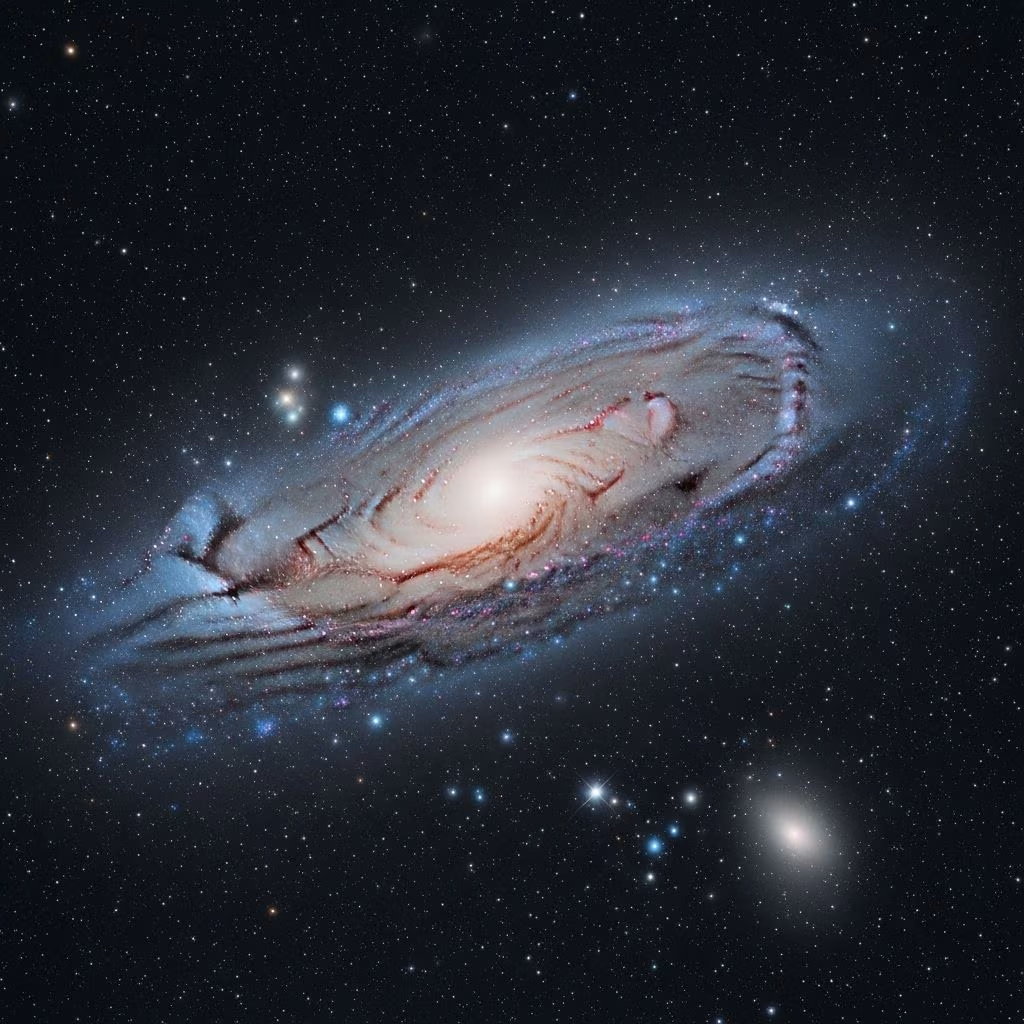
The Andromeda Galaxy, also known as Messier 31 or M31, is the nearest major spiral galaxy to the Milky Way and a centerpiece of astronomical observation and research. Visible to the naked eye from Earth, it has captivated stargazers for centuries due to its size, brightness, and cosmic significance. This article explores every essential aspect of Andromeda, including its discovery, physical characteristics, structure, constituent stars and clusters, and its future role in galactic evolution.
Quick Facts About Andromeda
- Designation: Messier 31 (M31), NGC 224
- Type: Spiral galaxy (SA(s)b)
- Distance: ~2.54 million light-years from Earth
- Apparent Magnitude: 3.1 (naked-eye visible)
- Location: Constellation Andromeda
- Diameter: ~220,000 light-years
- Star Count: Estimated 1 trillion stars
The Discovery of Andromeda
The Andromeda Galaxy has been visible to the unaided eye for millennia, making its exact date of discovery impossible to determine. The earliest known reference dates back to 964 A.D. in Persian astronomer Abd al-Rahman al-Sufi‘s work, The Book of Fixed Stars, where he described a ‘small cloud’ in the constellation Andromeda. Western observation of this ‘nebula’ increased during the Renaissance, but it was not until 1924 that Edwin Hubble definitively identified Andromeda as a galaxy outside our own, radically expanding humanity’s view of the universe.
Andromeda in Mythology and Naming
The galaxy’s name is rooted deeply in Greek mythology. It occupies the region of the sky associated with Andromeda, a princess chained to a rock as a sacrifice to the sea monster Cetus. The story is intertwined with the constellations Perseus (her savior), Cassiopeia (her mother), and Cepheus (her father), all of which can be found nearby in the night sky. The galaxy’s various designations today—M31, NGC 224—reflect centuries of cataloguing as telescopic technology advanced.
Locating Andromeda in the Sky
Andromeda is found in the Andromeda constellation, near the prominent autumn asterisms:
- The Great Square of Pegasus: Its north-eastern star, Alpheratz, marks a key starting point for locating M31.
- Cassiopeia’s W-shape: Points toward Andromeda, providing another visual aid.
The galaxy is best observed in November in the Northern Hemisphere, where it appears as a faint, elongated smudge. In urban settings with moderate light pollution, Andromeda can still be seen on clear nights due to its brightness—one of the very few galaxies visible without binoculars or a telescope.
Physical Structure and Composition
Andromeda is a classic spiral galaxy, similar in many respects to the Milky Way but larger and more massive. Its structure consists of a bright core (bulge), surrounded by expansive spiral arms rich in stars, gas, and dust. Key structural features include:
- Bulge: The central region densely packed with older, red-yellow stars.
- Spiral Arms: Sweeping lanes of blue, younger stars, dust, and nebulae, forming distinct arms that wrap outward from the core.
- Halo: A sparse, outer region containing very old, metal-poor stars and numerous globular clusters.
- Rings and Bar Structures: Infrared observations reveal ring-like patterns, possibly the result of historic galactic interactions.
Table: Milky Way vs. Andromeda Galaxy
| Feature | Andromeda (M31) | Milky Way |
|---|---|---|
| Diameter | ~220,000 light-years | ~100,000–120,000 light-years |
| Estimated Stars | ~1 trillion | ~200–400 billion |
| Distance from Earth | ~2.54 million light-years | — (we live inside it) |
| Apparent Magnitude | 3.1–3.4 (naked-eye visible) | — |
| Number of Satellite Galaxies | ~14 major, dozens total | ~14 major, dozens total |
Components of the Andromeda Galaxy
Stellar Content
M31 contains an estimated 1 trillion stars, ranging from ancient, red giants in its halo and bulge to hot, blue stars forming in its spiral arms. The central nucleus harbors a dense star cluster, with two concentrations labeled P1 and P2 separated by about 4.9 light-years. These dense clusters may be evidence of past mergers with smaller galaxies or remnants of massive star-forming events.
Star Clusters and Nebulae
- Globular Clusters: Andromeda hosts at least 400 globular clusters, far more than the Milky Way, some of which are among the largest known in the universe.
- Open Clusters: These lie within the spiral arms and contain young, loose groups of stars born from the galaxy’s plentiful interstellar clouds.
- Nebulae: Active star-forming regions are visible in the infrared and ultraviolet, with hydrogen gas clouds fueling new stellar birth.
Gas, Dust, and Dark Matter
The interstellar medium in Andromeda comprises:
- Hydrogen Gas: Both atomic and molecular forms, concentrated along the spiral arms and fueling star formation.
- Dust Lanes: These dark bands trace out the intricate structure of the spiral arms, visible in optical and infrared observations.
- Dark Matter: As with other spirals, observations indicate Andromeda is surrounded by a massive halo of invisible dark matter, greatly exceeding the mass of its visible stars and gas.
Satellite Galaxies and Group Membership
Andromeda is the largest member of the Local Group of galaxies, which also includes the Milky Way, the Triangulum Galaxy (M33), and dozens of smaller galaxies. Major satellites include:
- M32: A compact elliptical galaxy, likely influenced by interaction with Andromeda’s disk.
- M110: A large elliptical satellite, marked by its faint luminosity.
- Additional dwarf spheroidal and irregular galaxies orbiting as part of Andromeda’s extended system.
Past and Future Interactions
Past Collisions and Stellar Streams
Andromeda’s extended halo is littered with tidal streams—arcs of stars torn from smaller galaxies consumed over billions of years. Infrared imagery suggests ring-like features and disruptions within Andromeda were caused by close interactions, notably with the companion galaxy M32 about 200 million years ago. Such events leave behind streams of stars and may alter the distribution of dust and gas.
The Impending Collision With the Milky Way
Andromeda is on a direct collision course with the Milky Way. Traveling at about 110 kilometers per second toward our galaxy, Andromeda will meet the Milky Way in an estimated 4–5 billion years. This dramatic event will reshape both galaxies, likely forming a single, giant elliptical or lenticular galaxy over the span of several billion years. Despite the enormity of the collision, the vast distances between individual stars mean most will not physically collide, but their orbits and positions will be drastically altered.
Observing Andromeda: How to See M31
Observing Andromeda is a rewarding experience for amateur astronomers:
- Unaided Eye: From a dark location, Andromeda appears as a small, dim, elongated blur.
- Binoculars: Reveal the elongated profile and some brightness in the core.
- Telescopes: Allow observation of structure, satellite galaxies, and high magnification views of its star-laden nucleus.
November offers the best viewing opportunities from the Northern Hemisphere, when Andromeda is highest above the horizon after nightfall. The galaxy is positioned northwestward from the Great Square of Pegasus and forms a long, subtle streak.
Notable Images and Scientific Achievements
- Hubble Space Telescope: Created a 1.5-billion-pixel mosaic of the Andromeda Galaxy, revealing over 100 million stars and thousands of clusters in unprecedented clarity.
- Infrared Telescopes (Spitzer, ISO): Revealed the presence of multiple spiral arms, ring-like features, and ongoing star formation in dusty regions otherwise hidden from visible light observations.
- Astronomical Surveys: Unveiled the galaxy’s metal-poor halo, stellar streams, and the aftermath of significant mergers.
Andromeda in the Context of Galactic Evolution
Studies of Andromeda shed light on how large spiral galaxies evolve:
- Mass Accretion: Both the Milky Way and Andromeda have grown by consuming smaller galaxies, explained by the discovery of streams and globular clusters in their halos.
- Star Formation: Observations inform models of how spiral arms and galactic bars drive the birth of new stars and the movement of interstellar gas.
- Future Galactic Mergers: The upcoming collision with the Milky Way provides astronomers with a preview of cosmic evolution on grand scales.
Frequently Asked Questions (FAQs)
Q: Can you see the Andromeda Galaxy without a telescope?
A: Yes, under sufficiently dark sky conditions, Andromeda is visible as a faint smudge to the naked eye. Binoculars or small telescopes enhance its brightness and reveal its elongated structure.
Q: How long will it take for Andromeda to collide with the Milky Way?
A: Current estimates indicate the two galaxies will begin to merge in about 4–5 billion years, completing a new combined structure over the subsequent billions of years.
Q: Why is Andromeda important for astronomers?
A: It serves as a close analog for understanding spiral galaxy structure, star formation, interactions, and the processes shaping the Local Group of galaxies, enhancing our knowledge of the universe’s evolution.
Q: How many stars are in the Andromeda Galaxy?
A: An estimated 1 trillion stars inhabit Andromeda—about 2–5 times the number in the Milky Way.
Q: What will the new galaxy formed from Andromeda and the Milky Way be called?
A: While no official name has been given, astronomers sometimes use terms like “Milkomeda” or “Milkdromeda” for the future merged galaxy.
References
- https://www.space.com/15590-andromeda-galaxy-m31.html
- https://science.nasa.gov/mission/hubble/science/explore-the-night-sky/hubble-messier-catalog/messier-31/
- https://en.wikipedia.org/wiki/Andromeda_Galaxy
- https://science.nasa.gov/image-detail/m31-2/
- https://www.space.com/21854-andromeda-galaxy-m31-photos-gallery.html
- https://www.britannica.com/place/Andromeda-Galaxy
- https://www.messier-objects.com/messier-31-andromeda-galaxy/
- http://www.messier.seds.org/m/m031.html
- https://esahubble.org/images/heic1502a/
- https://astropixels.com/galaxies/M31-01.html
- https://www.skyatnightmagazine.com/astrophotography/galaxies/andromeda-galaxy
- https://www.astronomy.com/science/the-star-that-changed-the-cosmos-m31-v1/
- https://www.galactic-hunter.com/post/m31-the-andromeda-galaxy
- https://telescope.live/gallery/andromeda-galaxy-m31-5
- https://astrography.com/blogs/space-exploration/m-31-a-star-that-changed-the-universe
- https://sky-tonight.com/object/nebula/M31
- https://www.astronomy.com/science/getting-to-know-the-andromeda-galaxy/