


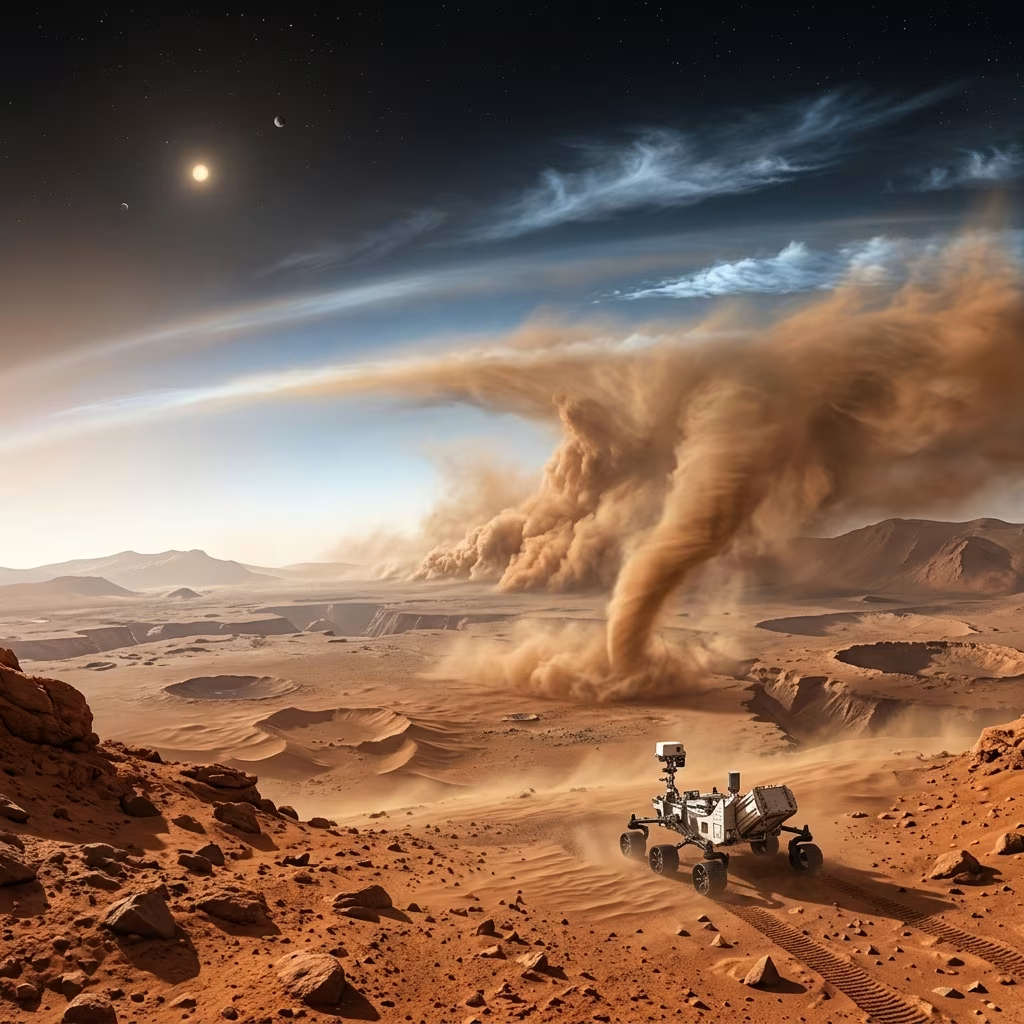
Mars has fascinated scientists and dreamers alike for centuries. Known as the Red Planet, Mars is Earth’s closest planetary neighbor and is often considered the most Earth-like planet in our solar system. Yet, the Martian atmosphere, climate, and weather reveal an alien world as beautiful as it is hostile—a world where thin air, frigid temperatures, and epic dust storms shape a dramatic and dynamic planet.
Introduction: Why Study Mars’ Atmosphere and Climate?
Mars is the only other solar system body where humans hope to walk in the near future. Understanding its atmosphere and climate is vital for both scientific discovery and the safety of future explorers. Studying Mars helps scientists:
- Trace the history of water and potential life beyond Earth.
- Compare planetary climates and atmospheric evolution across the solar system.
- Assess prospects for human settlement and terraformability.
- Understand hazards, from dust storms to radiation, facing landers and astronauts.
Atmospheric Composition: What Is the Martian Air Made Of?
Mars has an extremely thin atmosphere. Its surface pressure is about 610 pascals—less than 1% of Earth’s (nearly equivalent to the pressure found 35 km above Earth’s surface). Breathable air is absent, and the Martian sky is tinted by pervasive dust. The principal ingredients of the Martian atmosphere are:
| Gas | Percentage (%) |
|---|---|
| Carbon dioxide (CO₂) | 95–96 |
| Nitrogen (N₂) | ~2–2.85 |
| Argon (Ar) | ~2 |
| Oxygen (O₂) | 0.13 |
| Carbon monoxide (CO) | 0.07 |
| Water vapor (H₂O) | Trace |
| Methane (CH₄) | Trace |
This composition is hostile to terrestrial life: humans could not breathe unassisted, and the atmospheric pressure is so low that liquid water quickly boils and evaporates.
Thin and Alien: Why Is Mars’ Atmosphere So Different from Earth’s?
Several factors have led to Mars’ tenuous atmosphere:
- Gravity: Mars is smaller and less massive than Earth, making it harder to hold onto light atmospheric gases.
- No Global Magnetic Field: Without a protective magnetic field, the solar wind gradually stripped away Mars’ atmosphere over billions of years, especially after the planet’s core cooled and its magnetic dynamo ceased functioning.
- Climate History: Geological evidence suggests that ancient Mars had a much thicker atmosphere and surface water, but most of this was lost through atmospheric escape and sequestration in rocks and polar ice.
Surface Pressure: Extreme at Both Ends
The atmospheric pressure on Mars averages about 0.6% of Earth’s atmospheric pressure at sea level. This fluctuates significantly by location and season:
- Lowest at high elevations (like Olympus Mons, the tallest volcano in the solar system).
- Highest in the deepest basins, such as Hellas Planitia.
- Seasonal changes cause pressure variations up to 25% as carbon dioxide freezes and sublimates at the poles.
Such low pressure means liquid water is unstable on the surface, even when temperatures rise above freezing.
The Greenhouse Effect on Mars
Although dominated by carbon dioxide, Mars’ atmosphere cannot trap much heat. Its greenhouse effect boosts the global average temperature by just 5°C, compared to about 33°C on Earth. Reasons for this weak warming include:
- Low overall atmospheric mass means less CO₂ available for trapping heat.
- Minimal water vapor, another strong greenhouse gas.
- Absence of ozone, which warms Earth’s upper atmosphere.
- Strong radiative cooling by carbon dioxide at high altitudes.
Thermal Extremes: Mars’ Temperatures
Mars is a world of cold extremes. Its global average temperature is about -63°C (-80°F). Yet, localized and seasonal variation is enormous:
- Poles in winter: As cold as -125°C (-195°F).
- Daytime equator: Can briefly reach a balmy 20°C (70°F) at noon.
- Nighttime equator: Plummets below -73°C (-100°F).
Such daily and seasonal swings are driven by Mars’ thin air, which cannot hold heat, plus its tilted axis and elongated orbit around the Sun.
Seasonal Changes: Dry Ice and Atmospheric Cycling
Mars experiences pronounced seasons because its rotational axis is tilted at 25 degrees—very similar to Earth’s. The seasons are made more dramatic by Mars’ elliptical orbit:
- One Martian year is 687 Earth days
- Season lengths are uneven—southern summer is shortest and hottest.
During Martian winters, temperatures drop so low at the poles that carbon dioxide (dry ice) condenses from the atmosphere, forming polar caps that can grow or shrink by millions of square kilometers. As spring returns, this frozen CO₂ sublimates back into the air, causing the total atmospheric mass (and surface pressure) to change by as much as 25% throughout the year.
Mars Weather: A World of Extremes
The weather on Mars is shaped by its thin, cold atmosphere, abundant dust, and unpredictable storms. Important features and phenomena include:
- Dust Storms:
- Dust is ever-present, tinting the sky with an orange-pink hue.
- Local dust devils commonly snake across the surface.
- Planet-wide storms can blanket Mars for months, obscuring solar panels on rovers, disrupting science operations, and even threatening exploration missions.
- Winds: Can exceed 60 miles per hour during storms, but, due to thin air, lack the destructive force experienced on Earth.
- Frost and Snow: Mars experiences carbon dioxide “snow” and frost at the poles and sometimes rain-like falls of dry ice crystals.
Mars’ Polar Ice Caps: Water and Carbon Dioxide in a Dance
The Martian polar caps are seasonal marvels composed of water ice, layered with dry ice (carbon dioxide snow) that grows and recedes with the seasons. Key features include:
- Permanent ice: Mainly water ice, with patches as thick as 3 kilometers.
- Seasonal dry ice: Forms in winter as CO₂ freezes and disappears in summer as it sublimates.
These changing caps play a significant role in Mars’ atmospheric cycles, surface processes, and reflectivity (albedo).
Searching for Water: Traces in Air, Ground, and Ancient Riverbeds
Although liquid water is largely absent on today’s surface, Mars is home to:
- Trace water vapor in the thin atmosphere.
- Ice in the soil at higher latitudes and subterranean ice deposits detected by orbiters.
- Evidence of ancient rivers and lakes: Geological features indicate Mars once had standing and flowing water billions of years ago when the atmosphere was thicker.
Missions such as Curiosity and Perseverance rovers investigate the past climate and seek habitable conditions and biosignatures.
Climate History: From a Blue World to a Frozen Desert
Mars today is frigid and dry, but ancient Mars was likely more hospitable:
- Thicker atmosphere supported flowing surface water.
- Lakes, rivers, and possibly seas shaped the surface.
- About 3.5 billion years ago, the atmosphere began thinning—likely due to loss of magnetic field protection and ongoing gas escape to space.
Clues from meteorites, valley networks, and rover data help trace how and why Mars transformed into the arid planet we see today.
Mars’ Dust: Small Grains with Big Impact
Dust plays a central role in Martian weather and climate:
- Fine, iron-rich dust gives Mars its rust-red coloring.
- Dust absorbs sunlight, heating the atmosphere and fueling storms.
- Dust storms can block sunlight, lower surface temperatures, and reduce the effectiveness of solar-powered missions.
Weather Hazards for Exploration
Robotic and human explorers face unique challenges on Mars:
- Dust storms can reduce solar power generation and obscure navigation landmarks.
- Cold temperatures demand robust thermal protection for equipment and, eventually, astronauts.
- Thin air complicates parachute descent and landing of spacecraft.
- Ultraviolet and cosmic radiation reach the surface more easily due to the lack of a global ozone layer and weak shielding by the atmosphere.
Studying Martian Atmosphere and Weather
NASA and ESA have sent multiple orbiters and landers to characterize Mars’ environment:
- Mars Reconnaissance Orbiter maps weather and traces atmospheric composition.
- Curiosity and Perseverance Rovers monitor local temperature, humidity, and dust.
- Insight Lander probes subsurface temperatures and seismic activity.
- MAVEN orbiter studies atmospheric escape and the solar wind’s effects.
These missions provide critical data for understanding Mars’ atmosphere and preparing for future human visitors.
Mars’ Atmosphere and Climate: Lessons for the Future
Unraveling the mysteries of Mars’ atmosphere and climate is essential for:
- Understanding planetary evolution throughout the solar system.
- Searching for evidence of life, past or present, and the water that might make life possible.
<.li>Assessing the risks and opportunities for future robotic and human missions.
Frequently Asked Questions (FAQs)
Q: Can humans breathe the air on Mars?
A: No. Mars’ atmosphere is 95% carbon dioxide and contains almost no breathable oxygen. Its pressure is also far too low for survival without a pressurized suit.
Q: How cold does it get on Mars?
A: Typical temperatures range from -125°C (-195°F) at the poles during winter to, at best, 20°C (70°F) at the equator during midday. The global average is around -63°C (-80°F).
Q: What causes the red color of Mars?
A: Mars gets its signature color from fine dust rich in iron oxide (rust), which covers the surface and colors the sky pink-orange.
Q: Are Mars dust storms dangerous?
A: While Martian storms are massive—the largest in the solar system—the thin air means wind force is low compared to Earth’s hurricanes. Their biggest hazard is the reduction of sunlight, which can severely affect solar-powered landers and rovers.
Q: Did Mars ever have liquid water?
A: Yes. Geological evidence shows ancient Mars had rivers, lakes, and perhaps shallow seas. Surface water vanished as the atmosphere thinned, but liquid water may persist deep underground even today.
References and Further Reading
- Mars Atmosphere and Climate Overview – NASA, ESA, Wikipedia, and planetary science literature
- Mars Rovers and Orbiter Mission Data
- NASA Perseverance and Curiosity rover science reports
- Atmosphere and Climate of Mars (Cambridge Univ. Press)
References
- https://en.wikipedia.org/wiki/Atmosphere_of_Mars
- https://en.wikipedia.org/wiki/Climate_of_Mars
- https://science.nasa.gov/mars/facts/
- https://marsed.asu.edu/mep/atmosphere
- https://www.britannica.com/place/Mars-planet/The-atmosphere
- https://www.ebsco.com/research-starters/earth-and-atmospheric-sciences/marss-atmosphere
- https://www.cambridge.org/core/books/atmosphere-and-climate-of-mars/CA5316BF24A89891563B2E17EF185E19
- https://www.masterclass.com/articles/what-is-the-weather-like-on-mars-learn-about-the-martian-atmosphere-and-the-possibility-of-human-exploration-to-the-red-planet
- https://www.nasa.gov/missions/insight/is-there-weather-on-mars-we-asked-a-nasa-technologist-episode-4/
- https://aerospaceamerica.aiaa.org/departments/hows-the-weather-on-mars/
- http://crism.jhuapl.edu/science/themes/theme3.php
- https://www.britannica.com/place/Mars-planet/Composition-and-surface-pressure
- https://study.com/learn/lesson/mars-atmosphere-composition-surface.html
- https://ui.adsabs.harvard.edu/abs/2013cctp.book…55R/abstract
- https://marspedia.org/Atmosphere
- http://cab.inta-csic.es/rems/en/mars-atmosphere/
- https://airandspace.si.edu/stories/editorial/today-mars-warmer-earth-see-how-we-compare
- https://newspaceeconomy.ca/2023/08/15/mars-atmosphere-and-climate-an-overview/


