How Was the Moon Formed? Theories, Evidence, and Mysteries
The Moon has been a source of wonder and scientific intrigue for centuries. While its serene presence illuminates the night sky, its origin story has been the subject of intense research, debate, and discovery. Understanding how the Moon formed is crucial to unraveling the early history of Earth, the dynamics of planetary systems, and the processes that shape celestial bodies.
The Birth of the Moon
The prevailing scientific consensus is that the Moon originated from extraordinary circumstances shortly after Earth formed about 4.5 billion years ago. But what were these circumstances, and how did a moonless planet gain such a prominent satellite?
- Early Earth and Solar System: Earth was born from the solar nebula, a swirling disk of gas and dust, growing as particles clumped into larger rocks and ultimately into planet-sized bodies.
- Violent Beginnings: The early Solar System was a turbulent zone, marked by frequent planetary collisions with wandering protoplanets and planetesimals.
The Moon’s formation story is a tale of cosmic violence, blending chance, chemistry, and planetary evolution in the solar system’s most volatile era.
The Giant Impact Hypothesis: Leading Theory
The most widely supported explanation for the Moon’s origin is the giant impact hypothesis .
What Is the Giant Impact Hypothesis?
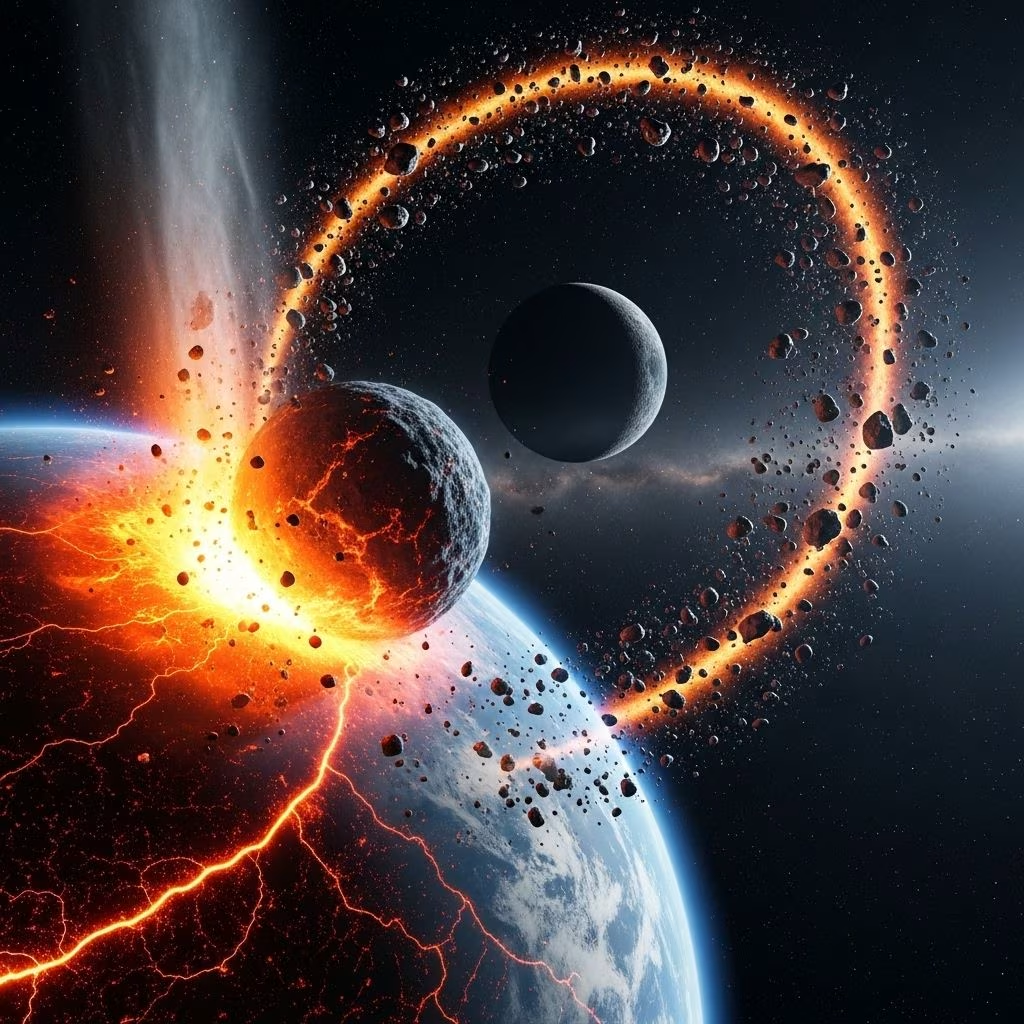
- Theia Collision: Around 4.5 billion years ago, a Mars-sized protoplanet—named Theia—collided with the proto-Earth.
- Debris Ejection: The collision vaporized part of the Earth’s mantle and much of Theia, spewing a cloud of hot, molten debris into orbit around Earth.
- Formation of a Disk: This material formed a disk around the Earth, which eventually cooled and accreted—clumping together into what would become the Moon.
Key Features of the Hypothesis
- Explains the Moon’s Size: The relatively large size of Earth’s Moon compared to Earth itself fits well with the energy and dynamics of the proposed impact scenario.
- Matches Isotopic Signatures: Earth and Moon rocks share remarkably similar isotopic compositions, especially in oxygen and some metals—the kind of mixing expected from a massive impact .
- Earth’s Tilt: The collision is believed to have tilted Earth’s axis by approximately 23.5 degrees, leading to pronounced seasons .
Modern computer simulations suggest that the Moon could have formed from this debris disk surprisingly quickly—perhaps in as little as a few hours to days . After its birth, the Moon gradually receded from Earth to its current distance over billions of years.
Alternative Theories for Moon Formation
The giant impact hypothesis holds the most support among planetary scientists, but alternative theories have been proposed over the years, each offering unique explanations and facing critical challenges [10].
- Fission Theory: Proposes that the Moon split off from a rapidly rotating young Earth, perhaps from the area now occupied by the Pacific Ocean. Lack of evidence for the required fast rotation and energy makes this unlikely.
- Capture Theory: Suggests the Moon formed elsewhere in the solar system and was later captured by Earth’s gravity. However, the similarities in composition between Earth and Moon make this explanation difficult to support.
- Co-formation (Double Planet/Accretion) Theory: Proposes that Earth and Moon formed together as neighbors in the solar nebula. The required conditions for such paired accretion are rare and would likely result in more compositional differences.
- Synestia/Planetesimal Collisions: Newer models propose that a massive, vaporous structure (a “synestia”) formed in the wake of impact, with the Moon condensing out of it, or that multiple smaller impacts contributed material.
Today, these alternatives are less favored due to their inability to consistently explain isotopic and dynamical data but remain of interest for aspects not fully addressed by the standard theory .
Key Evidence: How We Know the Moon’s Story
Lunar origin theories must account for the diverse chemical, physical, and orbital characteristics of the Moon. Critical pieces of evidence inform and constrain these theories:
- Oxygen Isotopes: Analyses of Apollo and lunar meteorite samples show Earth and Moon share nearly identical oxygen isotopic signatures; distinct from meteorites and other celestial bodies .
- Rock and Metal Composition: Both worlds are depleted in volatiles (elements that vaporize easily), but lunar rocks have less iron than Earth, suggesting the Moon came predominantly from Earth’s outer layers, not its iron-rich core.
- Angular Momentum and Orbits: The motion and distance between Earth and Moon fit well with a past giant collision followed by outward migration over time.
- Cratering and Geological History: The Moon’s ancient, heavily cratered surface preserves the record of early solar system bombardment and offers a window into solar system evolution.
- Tilt and Seasons: The apparent tilt of Earth’s axis (causing seasons) is consistent with a colossal impact event early in its history .
Advanced measurements—including isotopic ratios of titanium and tungsten—continue to refine our understanding of the Moon’s provenance, pushing the limits of laboratory analysis and planetary science.
When Did the Moon Form?
Determining the Moon’s age provides clues to planetary evolution:
- Timing: The Moon likely formed 60 to 175 million years after the birth of the solar system, placing its origin around 4.4 to 4.5 billion years ago .
- Radioactive Dating: Scientists use radioisotopes such as hafnium and tungsten in lunar and terrestrial rocks to estimate the timing of impact and differentiation between rock and metal layers .
This timeframe positions the Moon’s formation soon after Earth differentiated and while the inner solar system remained dynamic and hazardous.
Remaining Mysteries and Ongoing Questions
Despite scientific advances, several puzzles endure in the quest to fully understand the Moon’s formation:
- Isotopic Puzzles: If much of the Moon formed from Theia, why do Earth and Moon share nearly indistinguishable isotopic profiles? Did Theia and Earth have remarkably similar compositions—or did extensive mixing occur after the impact?
- Details of the Impact: Was the Moon formed from a single colossal impact, or through a series of smaller collisions and mergers?
- Lunar Asymmetries: Why does the Moon’s near side differ from its far side in composition and crust thickness?
- Lunar Magma Ocean: Evidence suggests the Moon was once covered by a global ocean of molten rock—how did this evolve, and what cooled it?
- Future Research: Continued lunar exploration, sample analysis, and computer simulations aim to resolve these and other questions—increasing our knowledge about the Moon’s birth and implications for other planetary systems.
Moon vs. Earth: A Quick Comparison
| Property | Earth | Moon |
|---|---|---|
| Diameter | 12,742 km | 3,474 km |
| Mass | 5.97 x 1024 kg | 7.35 x 10²² kg |
| Distance from Earth | N/A | 384,400 km (average) |
| Surface Gravity | 9.8 m/s2 | 1.62 m/s2 |
| Atmosphere | Nitrogen, Oxygen (thick) | None (exosphere only) |
| Surface | Liquid water, continents, diverse geology | Dry, cratered, ancient volcanic plains |
Frequently Asked Questions (FAQs)
Q: What is the leading theory for the Moon’s origin?
A: The giant impact hypothesis is most widely accepted. It suggests a Mars-sized body (Theia) struck Earth, and debris from the collision accreted to form the Moon.
Q: Why do Earth and Moon have similar chemical compositions?
A: Their similarities—especially in oxygen isotopes—imply a close connection during formation. It’s possible the debris disk formed mostly from Earth’s outer layers after the impact, with significant mixing between the two bodies.
Q: When did the Moon form?
A: The Moon likely formed about 4.5 billion years ago, slightly after Earth itself. This was during the chaotic era of planetary formation in the solar system.
Q: Did any other planets experience similar moon formation?
A: Earth’s Moon is unique due to its relative size, but giant impacts in the early solar system are thought to have been common and may have led to the formation or loss of moons elsewhere.
Q: Are there any parts of the Moon left unexplored?
A: Yes—particularly the far side, the poles, and lunar interior. Future missions aim to probe these areas for more clues about the Moon’s mysterious past.
References
- https://science.nasa.gov/moon/formation/
- https://en.wikipedia.org/wiki/Origin_of_the_Moon
- https://www.lpi.usra.edu/education/explore/marvelMoon/background/moon-formation/
- https://news.uchicago.edu/explainer/formation-earth-and-moon-explained
- https://www.nhm.ac.uk/discover/how-did-the-moon-form.html
- https://www.nasa.gov/solar-system/collision-may-have-formed-the-moon-in-mere-hours-simulations-reveal/
- https://www.space.com/25322-moon-formation-wild-theories.html
- https://www.psu.edu/news/behrend/story/what-moons-true-origin-story
- https://en.wikipedia.org/wiki/Giant-impact_hypothesis
- https://study.com/academy/lesson/formation-of-the-moon-theories.html
- https://pmc.ncbi.nlm.nih.gov/articles/PMC4128275/
- https://www.youtube.com/watch?v=kRlhlCWplqk
- https://www.youtube.com/watch?v=orpycPJKe4Q
- https://www.ucdavis.edu/news/how-moon-formed-inside-vaporized-earth-synestia
- https://www.icr.org/content/moon-formed-just-hours
- https://www.iop.org/explore-physics/moon/composition-and-origins-moon
- https://www.skyatnightmagazine.com/space-science/how-did-moon-form
- https://www.britannica.com/place/Moon/Origin-and-evolution