


The Asteroid Belt: A Window into the Solar System’s Past
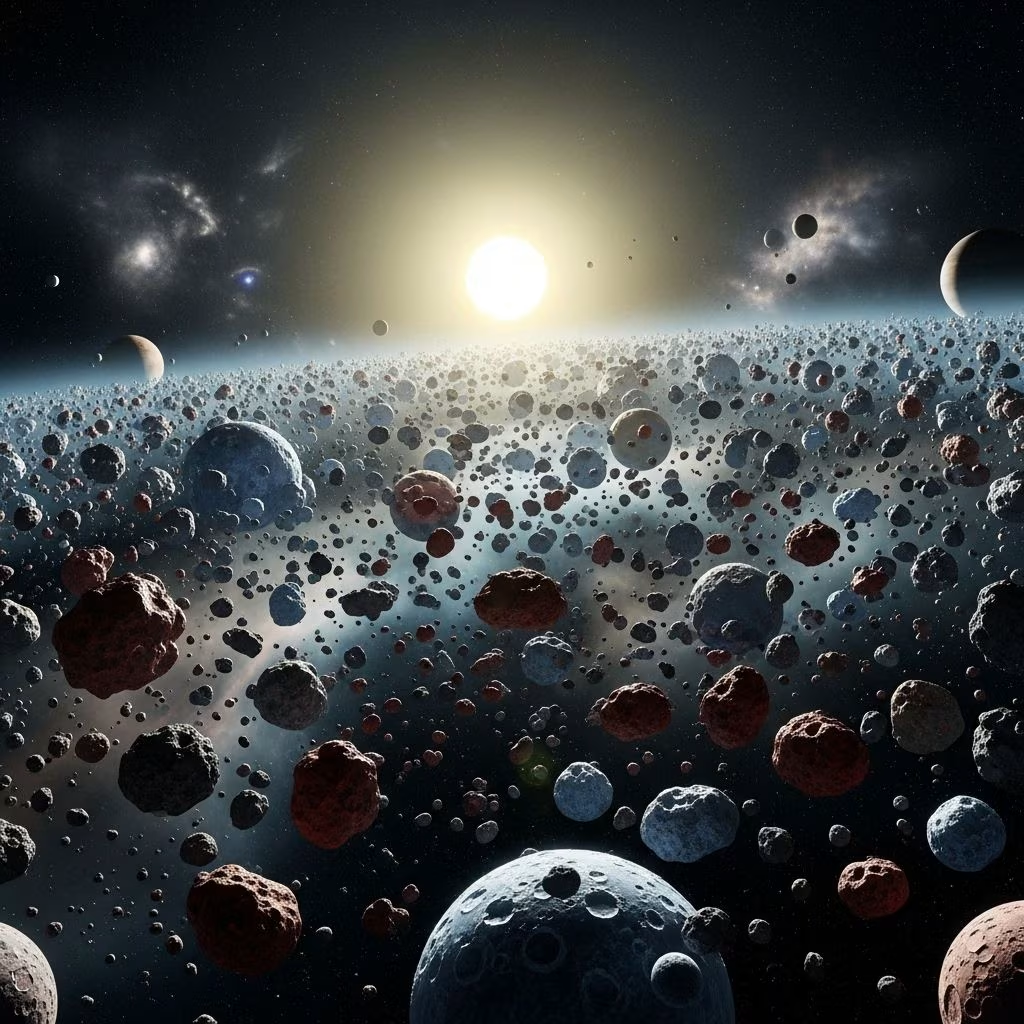
The asteroid belt is a vast, torus-shaped region of space located between the orbits of the planets Mars and Jupiter. It is filled with countless rocky remnants—asteroids and minor planets—leftover from the early formation of our solar system. While often depicted as a dense and perilous obstacle course, in reality, the asteroid belt is mostly empty space with its inhabitants separated by immense distances. This article explores the structure, composition, history, and ongoing scientific significance of the asteroid belt.
Location and Structure of the Asteroid Belt
The asteroid belt forms a distinct ring between Mars and Jupiter, occupying the region from approximately 2.2 to 3.2 astronomical units (AU) from the Sun. The innermost part of the belt (closer to Mars) starts at around 2.2 AU, and the outer edge (toward Jupiter) extends to about 3.2 AU. One astronomical unit is roughly the distance from the Earth to the Sun, or about 150 million kilometers.
- Average thickness: ~150 million km
- Average distance from Earth: 1.2–2.2 AU
- Separated Inner and Outer Solar System: The belt largely separates the inner, rocky terrestrial planets from the outer, gas giant planets.
Understanding Asteroids: Size, Types, and Distribution
The asteroid belt contains a wide variety of objects, from tiny boulders only a few meters across to the dwarf planet Ceres, which measures nearly 950 kilometers in diameter. The distribution of these bodies is uneven, with the four largest objects—Ceres, Vesta, Pallas, and Hygiea—accounting for more than half of the total mass of the belt. Scientists estimate:
- There are hundreds of thousands of known asteroids in the belt
- Between 700,000 and 1.7 million asteroids larger than 1 km are estimated to exist within the belt.
- Over 200 asteroids are larger than 100 km in diameter
| Name | Designation | Diameter (approx.) | Type |
|---|---|---|---|
| Ceres | 1 Ceres | 950 km | Dwarf planet, C-type |
| Vesta | 4 Vesta | 525 km | S-type |
| Pallas | 2 Pallas | 512 km | B-type |
| Hygiea | 10 Hygiea | 430 km | C-type |
Main Asteroid Types by Composition
- C-type (carbonaceous): Most common, dark, composed mainly of clay and silicate rocks
- S-type (silicate): Brighter, made up of silicate minerals and nickel-iron
- M-type (metallic): Composed mostly of metallic iron and nickel
Origin and Evolution of the Asteroid Belt
The current science suggests the asteroid belt originated from the primordial material left over after the Sun and planets formed about 4.5 billion years ago. Gravitational influences, particularly from Jupiter, prevented these rocky bodies from coalescing into a planet, resulting in the belt as we know it today.
- The mass of the asteroid belt is only about 3% that of the Moon
- Early models suggest the primordial asteroid population may have been as much as 200 times greater than at present
- Frequent collisions and gravitational perturbations have broken up many early asteroids, creating smaller fragments and asteroid families
Asteroid Families
Collisions between large asteroids can produce asteroid families—groups of asteroids sharing similar orbits and compositions, likely fragments of a single parent body. Notable families are associated with Vesta and Hygiea.
Is the Asteroid Belt Crowded?
Despite depictions in science fiction and popular media, the asteroid belt is mostly empty space. The average distance between objects is vast—often about a million kilometers or more. An uncrewed spacecraft traveling through the belt is unlikely to encounter an asteroid unless intentionally targeting one.
- Asteroids in the belt are typically separated by hundreds of thousands to millions of kilometers.
- The total combined mass of all the belt’s inhabitants is strikingly low compared to planets and even many moons.
- This sparse distribution explains why several spacecraft—including NASA’s Dawn, Galileo, and NEAR Shoemaker—have crossed the belt without major incident.
Discovery and History
The asteroid belt was formally discovered in 1801 by Italian astronomer Giuseppe Piazzi, who identified Ceres as the first and largest member. Within a decade, several other large asteroids, including Pallas, Juno, and Vesta, were discovered. Today, advances in telescopic and infrared surveys have identified hundreds of thousands of asteroids in the belt, with new objects still being catalogued each year.
- Ceres remains both the largest asteroid and the only dwarf planet in the belt
- Since 1980, over 500,000 new asteroid objects have been discovered across the solar system
- About 150 known asteroids have their own moons
Other Populations of Asteroids
The main asteroid belt is not the only region of the solar system containing rocky debris:
- Trojan asteroids: Share Jupiter’s orbit, occupying stable points (Lagrange points) ahead of and behind the planet
- Near-Earth objects (NEOs): Asteroids whose orbits bring them close to Earth
- Kuiper Belt: A zone beyond Neptune containing icy bodies and dwarf planets
- Centaur objects: Orbit between Jupiter and Neptune
- Scattered Disc and Oort Cloud: Farther, distant populations of icy bodies
Scientific Significance of the Asteroid Belt
The asteroid belt provides scientists with a unique window into the conditions of the early solar system:
- Asteroids preserve materials and structures unchanged for billions of years.
- By studying asteroid composition, scientists can infer details about solar system formation.
- Meteorites originating in the asteroid belt offer direct physical samples for laboratory analysis.
- Water and organic compounds in some asteroids offer clues about the sources of Earth’s water and possibly life’s ingredients.
Noteworthy Missions and Exploration
- NASA’s Dawn spacecraft: Explored Vesta (2011–2012) and Ceres (2015–2018), providing unprecedented close-up data.
- Galileo and NEAR Shoemaker: Flew through the belt and imaged several asteroids.
- ESA’s Rosetta: Imaged asteroid 2867 Steins and 21 Lutetia while en route to comet 67P/Churyumov–Gerasimenko.
As exploration missions advance, the asteroid belt remains a focus for potential future mining, understanding planetary defense, and exploring solar system origins.
Common Misconceptions About the Asteroid Belt
- Too crowded to traverse safely: In reality, spacecraft routinely travel through the belt with very little risk of collision; objects are spaced far apart.
- Formed from a destroyed planet: Scientific evidence strongly supports that the belt is made of primordial solar system material—not remains of a shattered planet.
- Asteroids are all alike: On the contrary, asteroid types vary greatly in size, shape, composition, and physical characteristics.
Frequently Asked Questions (FAQs)
Q: What is the asteroid belt?
A: The asteroid belt is a region between Mars and Jupiter where countless rocky objects, called asteroids, orbit the Sun. It separates the inner and outer planets.
Q: How many asteroids are in the asteroid belt?
A: Scientists estimate there are as many as 1.7 million asteroids 1 kilometer or larger, with likely millions of smaller objects present.
Q: Are asteroids in the belt dangerous?
A: The huge distances between asteroids make the belt relatively safe for spacecraft. However, occasionally, impacts between asteroids do occur, creating new asteroid families.
Q: Why didn’t a planet form in the asteroid belt?
A: Jupiter’s strong gravity prevented the planetesimals in the asteroid belt from merging into a single planet during the early solar system.
Q: Are asteroids only found in the asteroid belt?
A: No, asteroids can also be found as near-Earth objects, Trojan asteroids (sharing Jupiter’s orbit), and in more distant regions like the Kuiper Belt.
Key Facts About the Asteroid Belt
- The asteroid belt is a wide, sparse ring of rocky bodies orbiting between Mars and Jupiter
- The four largest objects—Ceres, Vesta, Pallas, and Hygiea—contain over half of the belt’s mass
- The total mass is just a fraction of Earth’s Moon
- Studying the belt helps scientists unravel the processes that shaped the solar system
Final Thoughts
The asteroid belt is a relic of solar system history, an ancient region holding secrets to planet formation, water delivery, and the ingredients for life. Ongoing exploration and research promise to reveal yet more about how our solar system—and perhaps others—originated and evolved.
References
- https://en.wikipedia.org/wiki/Asteroid_belt
- https://coolcosmos.ipac.caltech.edu/ask/185-what-is-the-asteroid-belt-
- https://www.merriam-webster.com/dictionary/asteroid%20belt
- https://study.com/learn/lesson/asteroid-belt-location-facts.html
- https://science.nasa.gov/solar-system/asteroids/facts/
- https://www.skyatnightmagazine.com/space-science/asteroid-belt-facts-formation
- https://fiveable.me/key-terms/intro-astronomy/asteroid-belt
- https://space-facts.com/asteroid-belt/
- https://starchild.gsfc.nasa.gov/docs/StarChild/solar_system_level2/asteroids.html
- https://www.youtube.com/watch?v=fBkOVqr-4-U
- https://dictionary.cambridge.org/us/dictionary/english/asteroid-belt
- https://engineering.purdue.edu/vossmod/asteroid.php
- https://astro4edu.org/resources/glossary/term/18/
- https://astronomy.swin.edu.au/cosmos/*/Main+Asteroid+Belt
- https://lasp.colorado.edu/outerplanets/spacejunk_asteroids.php
- https://library.fiveable.me/lists/asteroid-belt-objects
- https://en.wikipedia.org/wiki/Asteroid
- https://www.britannica.com/science/asteroid
- https://www.space.com/15948-asteroid-belt-space-rocks-infographic.html


