


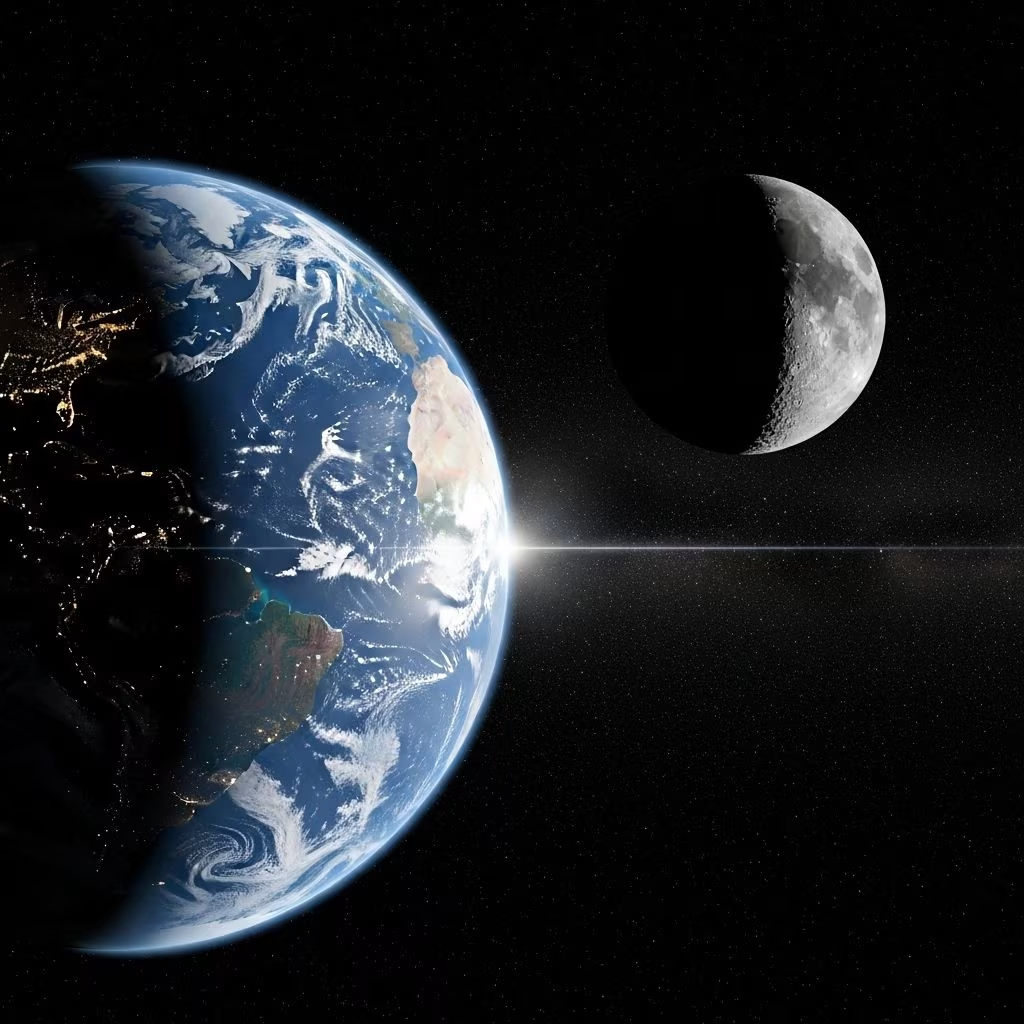
How Far Is the Moon?
The Moon is Earth’s closest and most prominent celestial companion, capturing our curiosity for millennia. But while the Moon may appear close on a crisp night, its actual distance from Earth is vast and more complex than a single number. Understanding how far the Moon is requires delving into orbital mechanics, modern measurement techniques, and some surprising comparisons that illustrate this cosmic gap.
Average Distance to the Moon
On average, the Moon is about 384,400 kilometers (238,855 miles) from Earth. This figure represents the mean distance measured from the center of our planet to the center of its natural satellite, and provides a commonly quoted reference in astronomy.
- Average distance: 384,400 kilometers (238,855 miles)
- Equivalent to: About 30 times Earth’s diameter
- Light travel time: 1.3 seconds
- By airplane: More than two weeks of non-stop flight
This astronomical distance is defined more specifically as the semi-major axis of the Moon’s geocentric orbit—the average over time as the Moon swings closer and further away due to its elliptical path.
The Moon’s Changing Distance: Perigee and Apogee
The Moon doesn’t maintain a constant separation from Earth. Instead, its orbit is slightly elliptical, causing its distance to fluctuate throughout each lunar cycle:
- Closest approach (Perigee): Around 356,470 kilometers (221,500 miles)
- Farthest point (Apogee): About 405,600 kilometers (252,000 miles)
- Average diameter of the Moon’s orbit: The variation results in notable visual and tidal effects on Earth.
When the Moon is at perigee, it appears slightly larger and brighter in the night sky—often leading to ‘supermoon’ phenomena. In contrast, at apogee, the Moon’s disk appears smaller and less brilliant.
| Position | Distance from Earth | Visual Effect |
|---|---|---|
| Perigee (Closest) | 356,470 km (221,500 miles) | Larger “Supermoon” |
| Average | 384,400 km (238,855 miles) | Mean Apparent Size |
| Apogee (Farthest) | 405,600 km (252,000 miles) | Smaller “Micromoon” |
These changes lead to subtle, observable differences in the Moon’s appearance to Earth-based observers.
Why Does the Moon’s Distance Change?
The Moon’s elliptical orbit around Earth means its distance isn’t constant. The shape of the orbit, known as an eccentric orbit, allows the Moon to drift closer and farther over a period of about a month. Key factors include:
- Orbital Eccentricity: The Moon’s path is oval-shaped, not perfectly circular.
- Gravitational Perturbations: Influences from the Sun and other planetary bodies subtly affect the orbit.
- Tidal Interactions: Long-term gravitational pull between Earth and Moon alters their relative motion.
Intriguingly, the Moon is gradually moving away from Earth at an average rate of about 3.8 centimeters (1.5 inches) per year. This process is driven by tidal friction, which transfers angular momentum from Earth to the Moon.
How Do Scientists Measure the Moon’s Distance?
Estimating lunar distance has evolved dramatically, from primitive angular estimates to precise laser measurements enabled by the Apollo missions.
- Laser Ranging Experiments: Since the 1960s, astronauts placed retroreflectors on the lunar surface. Scientists now shine high-powered lasers from Earth to these reflectors and measure the round-trip time for the beam.
- Time-of-Flight Calculation: Light travels at a known speed (299,792 km/s). By timing how long the laser takes to return, researchers calculate lunar distance with millimeter precision.
- Other Methods: Past centuries relied on geometric triangulation, parallax observations, and radiometric measurements.
Modern laser ranging has yielded exceptionally accurate results, allowing scientists to observe the gradual recession of the Moon and refine values for other physical constants.
Why Is the Lunar Distance Important?
The precise measurement of how far the Moon is from Earth matters for several reasons:
- Astronomical Calibration: Lunar distance is a standard measuring unit in astronomy (the “Lunar Distance,” LD), used to express the proximity of passing asteroids and comets.
- Theories of Gravity: Tracking lunar recession and orbital behavior helps test predictions from General Relativity and refine values for Earth’s mass, radius, and rotation.
- Space Exploration: Planning missions to the Moon—whether robotic or crewed—requires precise calculations of trajectory and travel time.
- Tidal and Rotational Effects: The Moon’s gravitational interaction influences Earth’s tides, length of day, and axial stability.
Dramatic Comparisons: Visualizing the Distance
The gulf between Earth and Moon is challenging to comprehend. Here are some popular comparisons that help communicate the sheer scale:
- Solar System Planets: At its maximum, the distance between Earth and Moon is so wide that all seven major planets (Mercury, Venus, Mars, Jupiter, Saturn, Uranus, and Neptune) could fit side-by-side within that gap. The sum of their average diameters almost equals the lunar apogee distance.
- Flights & Drives:
- A commercial jet flying at 900 km/h (560 mph) would take over 18 days of non-stop travel to reach the Moon.
- Driving a car at highway speeds (100 km/h or 62 mph) would require nearly 160 days, never stopping.
- Light Speed: Even light, traveling at 299,792 km/s, takes about 1.3 seconds to bridge Earth and Moon.
- Astronomical Units: The average lunar distance is about 1/389th of the Earth-Sun distance (one astronomical unit).
Frequently Asked Questions (FAQs)
Q: Why does the Moon sometimes look larger or closer in the sky?
The Moon appears larger during “supermoon” events, which occur when the full Moon coincides with perigee—the closest point in its orbit to Earth. Its actual size doesn’t change, but its proximity makes it look noticeably bigger and brighter.
Q: Is the distance to the Moon the same every night?
No, the Moon’s elliptical orbit causes its distance to fluctuate regularly over each lunar month, so the separation varies by tens of thousands of kilometers.
Q: How do scientists know the Moon is drifting farther from Earth?
Laser ranging experiments measure the Moon’s distance with millimeter precision over many years, revealing that it retreats at a rate of approximately 3.8 cm per year due to tidal friction between Earth and the Moon.
Q: Could the Moon ever leave Earth’s orbit?
No, the current rate of outward drift means the Moon will remain bound to Earth’s gravity for billions of years. However, the relationship will continue to evolve due to physical and gravitational interactions.
Q: Does lunar distance affect life on Earth?
Yes. The Moon’s distance and gravitational pull regulate Earth’s ocean tides, stabilize its axial tilt, and affect the length of our day. Even small changes can yield significant impacts over long time scales.
A Brief History of Measuring Lunar Distance
Ancient astronomers estimated the Moon’s distance using geometry and observations of lunar eclipses. By the 17th century, precise parallax techniques refined these answers. It wasn’t until the Apollo missions that high-precision laser ranging revolutionized our understanding.
- Parallax: Measuring the shift of the Moon’s position against distant stars from two locations on Earth.
- Lunar Eclipses: Tracking the lengths and timings of shadows to estimate separation.
- Laser Ranging: Today’s gold standard for precision, using retroreflectors left by Apollo astronauts.
Key Takeaways
- The Moon is, on average, about 384,400 km (238,855 miles) from Earth, but this changes every night because of its elliptical orbit.
- The closest approach (perigee) and furthest point (apogee) vary by about 50,000 km (30,000 miles).
- Laser technology using lunar retroreflectors allows scientists to measure the distance with millimeter-level accuracy.
- The Moon slowly drifts away due to tidal interactions—about 3.8 centimeters per year.
- Understanding lunar distance helps scientists refine astronomical constants, plan missions, and test gravitational laws.
Citations & Further Reading
- Space.com: “How Far Is the Moon?”
- Wikipedia: “Lunar distance”
- Live Science: “How far away is the moon?”
- NASA: “How Far Away Is the Moon?”
See Also
References
- https://www.space.com/moon-apparent-distance-changes
- https://en.wikipedia.org/wiki/Lunar_distance
- https://www.space.com/14726-moon-average-distance-earth.html
- https://spaceplace.nasa.gov/moon-distance/en/
- https://www.livescience.com/space/the-moon/how-far-away-is-the-moon
- https://www.livescience.com/space/the-moon/how-far-away-is-the-moon&rut=b8e8a6e80ff426f8ea03cacb2aa4ad4f82a488928960da61cb33ea33840d500a
- https://www.rmg.co.uk/stories/space-astronomy/how-far-away-moon
- https://en.wikipedia.org/wiki/Moon
- https://www.popularmechanics.com/space/moon-mars/a28397235/how-far-is-the-moon-from-earth/
- https://www.universetoday.com/articles/what-is-the-distance-to-the-moon
- https://www.worldatlas.com/space/how-far-is-the-moon-from-earth.html
- https://theskylive.com/how-far-is-moon
- https://ithy.com/article/moon-distance-info-fxlf2n88
- https://www.timeanddate.com/astronomy/moon/distance.html
- https://www.zmescience.com/feature-post/space-astronomy/solar-system/moon/distance-earth-moon-03012017/
- https://www.neuralword.com/en/article/measuring-the-lunar-distance-how-far-is-the-moon-from-earth-in-kilometers


