October 2025 Full Moon: The Year’s First Supermoon Shines Bright
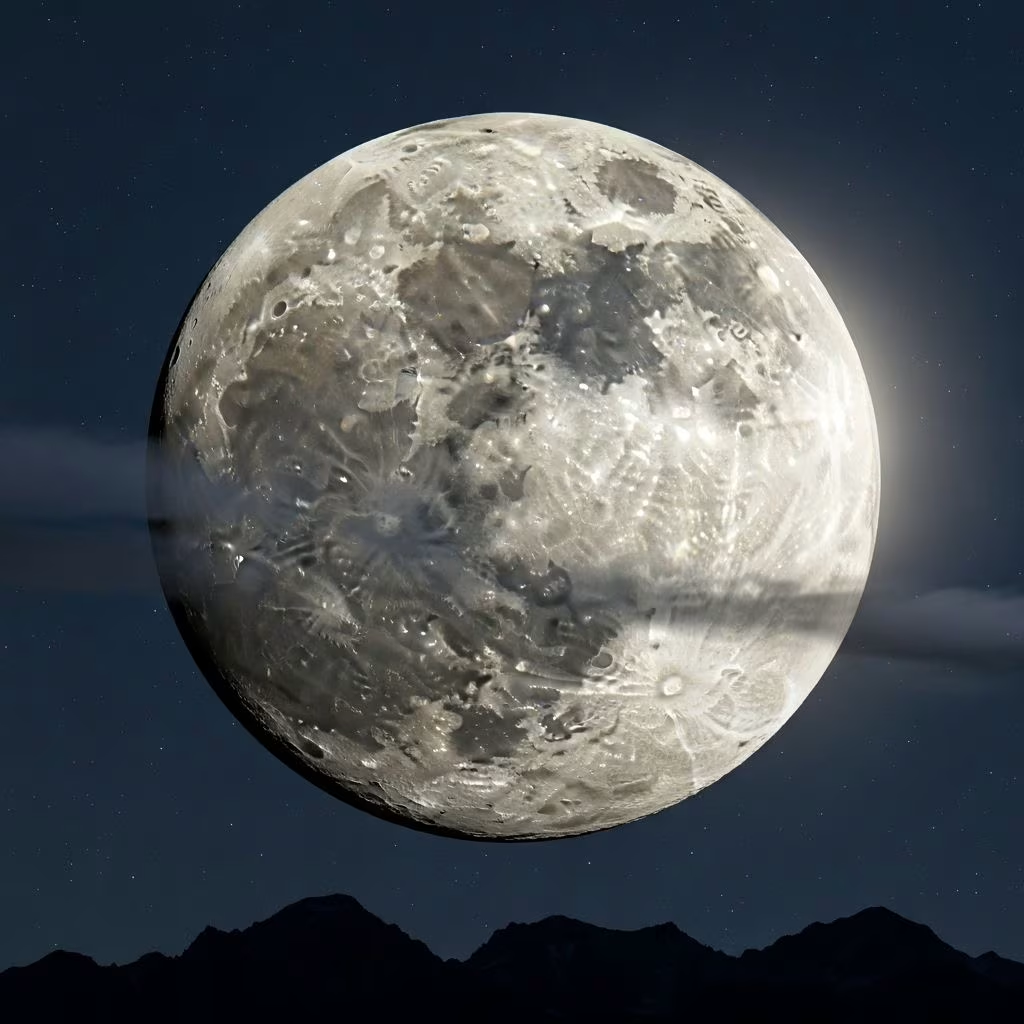
The October 2025 full moon offers a stunning celestial display: it rises as the first supermoon of the year, glows in cultural tradition as both the Hunter’s Moon and Harvest Moon, and promises a show for skywatchers and space enthusiasts around the globe. Learn when, where, and how to see this dazzling lunar event, what makes it a supermoon, why cultures gave it so many names, and what other astronomical phenomena to look for this October.
When and Where to See the October 2025 Full Moon
The full moon of October 2025 reaches peak illumination on Monday, October 6, at 11:48 p.m. Eastern Time ( 03:48 UTC on October 7)[10]. Observers in the Americas will witness the moon at its brightest late on October 6, while those in Europe and Africa catch the moment in the predawn hours of October 7. In Asia and Oceania, the moon appears nearly full on the surrounding nights before and after the peak.
- Full Moon peak: October 6, 2025, 11:48 p.m. EDT (October 7, 03:48 UTC)
- Visible: Practically full for about three days, from October 5 to 7[10].
- Rises: Around sunset; sets at sunrise, visible all night[10].
You don’t need special equipment or a dark location—the supermoon displays its golden orb in the sky from dusk to dawn, visible to anyone with a clear night.
What Makes This a Supermoon?
Not all full moons are created equal. The full moon in October 2025 is extra special because it is a supermoon—meaning it coincides with the closest approach of the Moon to Earth in its elliptical orbit (called perigee)[10]. This makes the moon appear slightly larger and brighter than a typical full moon.
- Size: About 6–7% larger than average[10].
- Brightness: Roughly 13% brighter than a typical full moon[10].
- High illumination: The moon’s disk is 100% illuminated, appearing as a perfect, luminous circle[10].
- First of a series: Marks the first of three back-to-back supermoons (October, November, December 2025)[10].
This 2025 supermoon is particularly notable because the last full supermoon occurred almost a year earlier in late 2024, raising excitement among astronomers and skywatchers for its return.
October Full Moon Names and Meanings
The October full moon carries a rich tapestry of names, reflecting both nature’s cycles and human culture:
- Hunter’s Moon: Traditionally, the full moon following the Harvest Moon (the one closest to the autumn equinox) is called the Hunter’s Moon. In some years, as in 2025, the October full moon also serves as the Harvest Moon when it falls closer to the equinox[10]. It marked the time when game was hunted for sustenance in preparation for winter.
- Harvest Moon: In 2025, the October full moon earns this title because it is the closest full moon to the autumn equinox, providing extra light for farmers harvesting crops late into the evening[10].
- Indigenous Names:
- Falling Leaves Moon (Northeastern Tribes): A nod to the autumnal transformation[10].
- Someone Stores Food Moon (Oneida): Highlighting the need to prepare for winter’s scarcity[10].
- When They Store Food in Caches Moon (Ponca): Signifies the storage of provisions in anticipation of the cold season[10].
| Moon Name | Origin | Significance |
|---|---|---|
| Hunter’s Moon | European/Colonial | Prime hunting time after harvest |
| Harvest Moon | Agricultural/Seasonal | Closest full moon to autumn equinox, aids harvest |
| Falling Leaves Moon | Native American (Northeast) | Autumnal falling of leaves |
| Someone Stores Food Moon | Oneida | Food preservation before winter |
| When They Store Food in Caches Moon | Ponca | Communal preparation for winter |
How to Best View the October Supermoon
The October supermoon offers fantastic viewing opportunities, whether you are a casual observer or a dedicated sky enthusiast:
- Best Dates: Observe the moonrise or moonset between October 5–7 for the fullest disk.
- Moon Illusion: Watch the full moon near the horizon at sunset (or sunrise). The “moon illusion” makes it appear larger and a striking golden-orange due to atmospheric refraction.
- Equipment: The supermoon is bright enough for naked-eye viewing, but binoculars or a small telescope reveal more detail in lunar surface features.
- Photographing: Use a tripod and telephoto lens for dramatic images against autumn landscapes or city skylines.
Skywatching Tips
- Find a vantage point with a clear eastern horizon for moonrise or western horizon for moonset.
- If photographing, frame the moon with trees, buildings, or distant hills for added perspective.
- Check local weather forecasts in advance for a clear night.
Other Celestial Events: Saturn, Meteor Showers, and More
October 2025 offers several other celestial sights beyond the supermoon:
- Saturn in the Sky: Saturn will appear about 3–4° from the full moon between October 6–7, shining at a prominent magnitude 0.6 near the Pisces constellation[10]. Observers can spot both in the same field of view with binoculars.
- Meteor Showers:
- Draconids: Peak around October 8, but the brightness of the nearly full moon will outshine most meteors this year[10].
- Orionids: Peak near the new moon on October 21, making it an excellent opportunity for meteor spotting as the sky will be much darker.
- No Lunar Eclipse: There is no lunar eclipse in October 2025; the full moon occurs outside the eclipse season[10].
October 2025 Lunar Phases
- Full Moon: October 7, 03:48 GMT (October 6, 11:48 p.m. EDT)
- Last Quarter: October 13, 18:13 GMT
- New Moon: October 21, 12:25 GMT
- First Quarter: October 29, 16:21 GMT
| Phase | Date & Time (GMT) |
|---|---|
| Full Moon | October 7, 03:48 |
| Last Quarter | October 13, 18:13 |
| New Moon | October 21, 12:25 |
| First Quarter | October 29, 16:21 |
The new moon on October 21 ensures especially dark skies, perfect for catching the Orionids meteor shower late at night.
Frequently Asked Questions about the October Full Moon
Q: Will the October 2025 full moon look unusually large?
A: Yes. As a supermoon near perigee, it will appear about 6–7% larger and up to 13% brighter compared to a typical full moon, especially noticeable near the horizon at moonrise or moonset[10].
Q: Why is the October full moon sometimes called both Hunter’s Moon and Harvest Moon?
A: The Harvest Moon is defined as the full moon closest to the September equinox. Some years, including 2025, this falls in October, making the traditional Hunter’s Moon also the Harvest Moon[10].
Q: Will the full moon in October 2025 coincide with a lunar eclipse?
A: No. There is no lunar eclipse this October, as the full moon is outside the eclipse season this year[10].
Q: Can I see the October full moon from both hemispheres?
A: Yes. The full moon will be visible anywhere on Earth where it is nighttime, regardless of hemisphere. Its appearance and timing may vary slightly depending on your location, but all will see a nearly full disk[10].
Q: What’s the best way to observe the October supermoon?
A: Find a clear view to the eastern horizon at sunset for moonrise, or the western horizon at sunrise for moonset. No special equipment is necessary, but binoculars can enhance the view.
Key Facts and Recap
- The October 2025 full moon is a supermoon—bigger and brighter than usual.
- This moon is both the Hunter’s Moon and the year’s Harvest Moon.
- Saturn will appear nearby, and while meteor watchers might be challenged during the Draconids due to brightness, the Orionids during the new moon are promising for skywatching.
This rare overlap of supermoon spectacle and cultural tradition makes October 2025’s full moon an event not to miss for astronomers, photographers, and skywatchers of all ages.
References
- https://www.spaceweatherlive.com/en/moon-phases-calendar/2025/10.html
- https://www.rmg.co.uk/stories/space-astronomy/full-moon-calendar-2025
- https://www.astronomy.com/observing/full-moon-calendar-dates-times-types/
- https://www.space.com/30939-october-full-moon-rises-tonight.html
- https://starwalk.space/en/news/full-moon-october
- https://www.livescience.com/space/the-moon/full-moons-of-2025-names-dates-and-everything-you-need-to-know
- https://www.moongiant.com/calendar/october/2025/
- https://www.space.com/34391-october-full-hunters-moon.html
- https://www.skyatnightmagazine.com/advice/next-full-moon
- https://ts2.tech/en/dont-miss-october-2025s-super-hunters-moon-a-dazzling-full-moon-spectacle/
- https://www.calendar-12.com/moon_calendar/2025/october
- https://griffithobservatory.org/explore/observing-the-sky/whats-in-the-sky/the-moon/2025-phases-of-the-moon/
- https://theskylive.com/moon-calendar?year=2025&month=10
- https://www.farmersalmanac.com/full-moon-dates-and-times
- https://www.adlerplanetarium.org/blog/what-to-see-stargazing-tips-october-2025/
- https://starwalk.space/en/news/full-moon-calendar-2025
- https://www.timeanddate.com/astronomy/moon/hunters.html
- https://www.moongiant.com/calendar/October/2025/
- https://www.fullmoon.info/en/fullmoon-calendar.html
- https://www.fullmoonology.com/news/full-moon-october-2025/