Pluto: The Ninth Planet That Became a Dwarf
Pluto’s tale combines scientific intrigue, cultural impact, and ongoing discovery. Once hailed as the farthest planet from the Sun, its status was dramatically changed in 2006, sparking global debate and fascination. As a world on the frontier of our solar system, Pluto’s story continues to evolve through mission milestones and scientific investigation.
Overview: Pluto’s Place in the Solar System
Pluto is located in the Kuiper Belt, a region of icy bodies beyond Neptune. This neighborhood is teeming with objects left over from the solar system’s formation, making Pluto both exceptional and representative of this distant domain.
At some 3.7 billion miles (5.9 billion kilometers) from the Sun—about 39 astronomical units (AUs)—Pluto spends its years surrounded by small, cold worlds. For decades, it was taught as the ninth planet in classrooms; today, it is recognized as a dwarf planet.
- Largest object in the Kuiper Belt — but still smaller than Earth’s Moon
- One fifth the mass of our Moon
- Unique surface features observed in detail only since 2015
History: Discovery and Naming
Discovery
The search for a ninth planet began in the early 20th century, inspired by disturbances in the orbits of Uranus and Neptune.
After years of searching for the hypothetical “Planet X,” Clyde Tombaugh discovered Pluto on February 18, 1930 at Lowell Observatory in Arizona.
- Initial identification via photographic plates
- The first new planet discovered in the 20th century
Naming
The name “Pluto” was proposed by Venetia Burney, an 11-year-old English schoolgirl, who suggested it referencing the Roman god of the underworld.
The astronomical community accepted the name in March 1930, a nod to both mythology and the planet’s distant, shadowy realm.
Major Milestones in Pluto’s History
| Date | Event |
|---|---|
| April 6, 1929 | Search for “Planet X” intensifies |
| February 18, 1930 | Pluto officially discovered |
| March 14, 1930 | Pluto named |
| June 22, 1978 | Charon, Pluto’s largest moon, discovered |
| February 7, 1979 | Pluto crosses inside Neptune’s orbit |
| May 15, 2005 | Nix and Hydra moons discovered |
| January 19, 2006 | Launch of New Horizons |
| August 24, 2006 | Reclassification as a dwarf planet by IAU |
| July 14, 2015 | New Horizons flyby reveals Pluto’s stunning geology |
Physical Characteristics
Size and Structure
Pluto has a radius of about 715 miles (1,151 kilometers), with a volume roughly one-sixth that of our Moon.
- Diameter: About 2,376 kilometers (1,476 miles)
- Mass: Approx. 1.31 x 10²² kg
- Surface area: Comparable to Russia
Pluto’s surface showcases mountains of water ice, vast glacial plains of frozen nitrogen, valleys, and craters. Some mountains reach between 2–3 kilometers (6,500–9,800 feet) high, rivaling Earth’s Rockies.
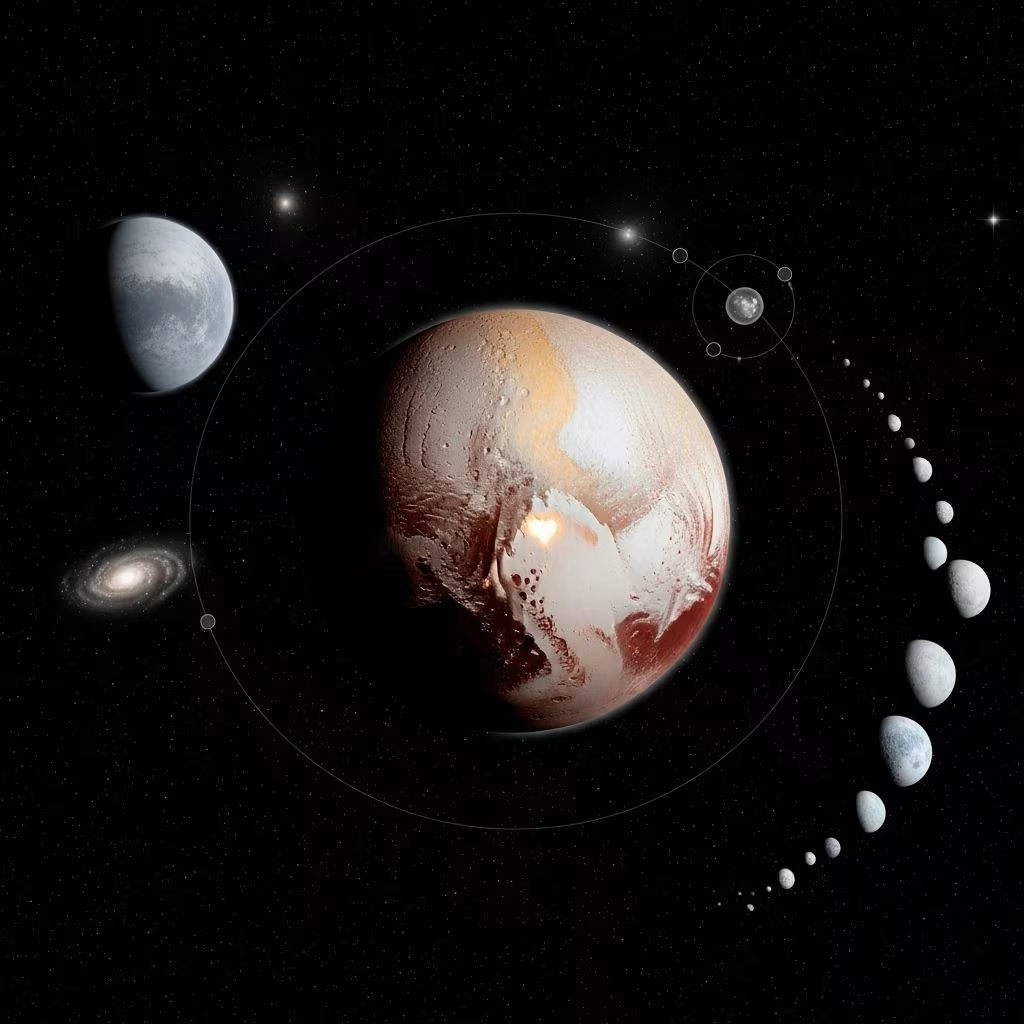
The planet’s signature “heart” area, Tombaugh Regio, is made of sheets of nitrogen ice and exhibits convection patterns—suggesting ongoing, or recent, geological activity.
Atmosphere and Climate
- Composed primarily of nitrogen, with methane and carbon monoxide
- Extremely thin — forms a haze rather than a dense cloud cover
- Surface temperatures average around -375°F (-225°C)
- The sunlight at Pluto is 1/900th as bright as on Earth, or roughly 300 times our full moon’s brightness
Color and Appearance
The world displays a variety of colors due to different ices and tholins (complex organic molecules), ranging from light blue to reddish tones in photographs.
Some areas are covered by red snows, and its surface is rugged and dynamic.
Orbit and Rotation
- Orbital Period: 248 Earth years*
- Rotation Period: About 6.4 Earth days (a Pluto “day”)
- Orbit: Highly elliptical and inclined compared to other planets
- Resides mainly beyond Neptune’s orbit but for about 20 years during its cycle, it ventures inside Neptune’s path due to its orbital eccentricity (last occurred Feb 7, 1979—Feb 11, 1999)
Pluto’s tilted orbit causes it sometimes to be closer to the Sun than Neptune, defying old rules of solar system order.
Unlike the eight major planets, Pluto’s “year” (one full revolution around the Sun) spans more than two centuries.
Moons of Pluto
Charon: Pluto’s Largest Companion
- Discovered: 1978
- Diameter: More than half Pluto’s (about 1,212 km or 753 miles)
- So massive relative to Pluto that their system is sometimes considered a binary dwarf planet
- Pluto and Charon are tidally locked — the same faces always point toward each other
Other Moons
- Styx, Nix, Kerberos, Hydra: Discovered between 2005 and 2012
- All are much smaller than Charon
- All orbit in the same plane and direction as Charon
The New Horizons Mission
The New Horizons spacecraft revolutionized our understanding of Pluto and its moons.
On July 14, 2015, after traveling over 9 years from launch, the probe performed a historic flyby — providing unprecedented detail of Pluto’s geology, atmosphere, and environment.
- Confirmed surface activity and layered atmosphere
- Discovered mountains of water-ice and convection in nitrogen ices
- Revealed color differentiation, erosional features, and possible cryovolcanism
- Returned high-resolution images and scientific measurements
Alan Stern, principal investigator for New Horizons, celebrated Pluto as “one of the most fascinating or scientifically important planets at the edge of our solar system.” The discoveries redefined the dwarf planet as a dynamic world, not merely a frozen relic.
Planetary Status and Demotion
The 2006 Redefinition
On August 24, 2006, the International Astronomical Union (IAU) established a new definition for planethood:
A planet must:
- 1. Orbit the Sun
- 2. Be massive enough for its gravity to make it nearly round
- 3. Have “cleared its neighborhood” of other objects
Pluto met the first two criteria but not the third — it shares its orbital zone with many Kuiper Belt objects. Thus, it was reclassified as a dwarf planet, along with Ceres, Eris, Haumea, and Makemake.
Ongoing Debate
The demotion continues to stir discussion among astronomers and the public. Some scientists argue Pluto’s complexity warrants planetary status, while others maintain that classification standards must be consistent.
- Popular support for Pluto as a planet persists
- Several experts call for revision or clarification of IAU rules
- The term “Plutoid” is sometimes used for distant dwarf planets orbiting beyond Neptune
Cultural Impact and Legacy
Pluto’s discovery touched off a cultural wave. As the ninth planet, it featured in textbooks, stories, and planetary models for decades. Its demotion was met with heartfelt protests, especially in the U.S., reflecting its sense of nostalgia and exploration.
Today, Pluto remains iconic—its role as an alien world and a symbol for distant frontiers live on in science, literature, and art.
- Venetia Burney’s proposal shows how ordinary people shaped planetary history
- Clyde Tombaugh and the Lowell Observatory’s legacy in astronomy remembered worldwide
- “Pluto” remains a popular dog name, evoking both Disney and adventure
Frequently Asked Questions (FAQs)
Q: Why is Pluto no longer considered a planet?
A: The International Astronomical Union redefined planet criteria in 2006; Pluto fails the requirement to clear its orbital neighborhood, thus it is classified as a dwarf planet.
Q: Will Pluto ever be reinstated as a planet?
A: The debate continues, but for now the IAU definition stands. Scientific discoveries could prompt future reconsideration, but consensus remains elusive.
Q: Does Pluto have any atmosphere?
A: Pluto has a tenuous atmosphere composed mostly of nitrogen with methane and carbon monoxide. It expands when Pluto is closer to the Sun and collapses as it moves away.
Q: How long does a day and a year last on Pluto?
A: A day on Pluto lasts about 6.4 Earth days. A year—one orbit around the Sun—equals about 248 Earth years.
Q: How did New Horizons change our view of Pluto?
A: The mission revealed Pluto’s surface features, atmosphere, and complexity, showing it to be geologically active and more than just a cold, inert rock.
Q: What are some of Pluto’s unique surface features?
- Mountains of water ice taller than many Rockies
- Vast plains of frozen nitrogen
- Long troughs and valleys, some up to 370 miles (600 km) long
- Craters as large as 162 miles (260 km) in diameter, evidence for erosion and tectonics
Q: What is the significance of Pluto’s heart-shaped region?
A: Known as Tombaugh Regio, this area is mostly nitrogen ice, demonstrating ongoing processes like convection and indicating Pluto is geologically active.
Enduring Mysteries and Future Exploration
Pluto remains a source of fascination and scientific inquiry. As missions probe farther into the Kuiper Belt, its history, conditions, and role in solar system formation promise to further illuminate our cosmic neighborhood. Whether planet or dwarf, Pluto is a unique world whose story continues to inspire and surprise.
References
- https://science.nasa.gov/dwarf-planets/pluto/
- https://en.wikipedia.org/wiki/Pluto
- https://science.nasa.gov/dwarf-planets/pluto/facts/
- https://bmsis.org/dwarf-planet-pluto/
- https://www.britannica.com/list/10-important-dates-in-pluto-history
- https://www.britannica.com/place/Pluto-dwarf-planet
- https://space-facts.com/pluto/
- https://www.loc.gov/everyday-mysteries/astronomy/item/why-is-pluto-no-longer-a-planet/
- https://www.planetary.org/worlds/pluto
- https://www.nhm.ac.uk/discover/factfile-pluto.html
- https://en.wikipedia.org/wiki/Dwarf_planet
- https://sciencenotes.org/pluto-dwarf-planet-facts/
- https://www.funkidslive.com/learn/top-10-facts/top-10-facts-about-pluto/
- https://www.youtube.com/watch?v=zfv9m4RWchE
- https://www.mentalfloss.com/article/501984/7-surprising-facts-about-pluto
- https://thefactfile.org/pluto-facts/
- https://airandspace.si.edu/explore/stories/pluto
- https://starwalk.space/en/news/facts-about-pluto