


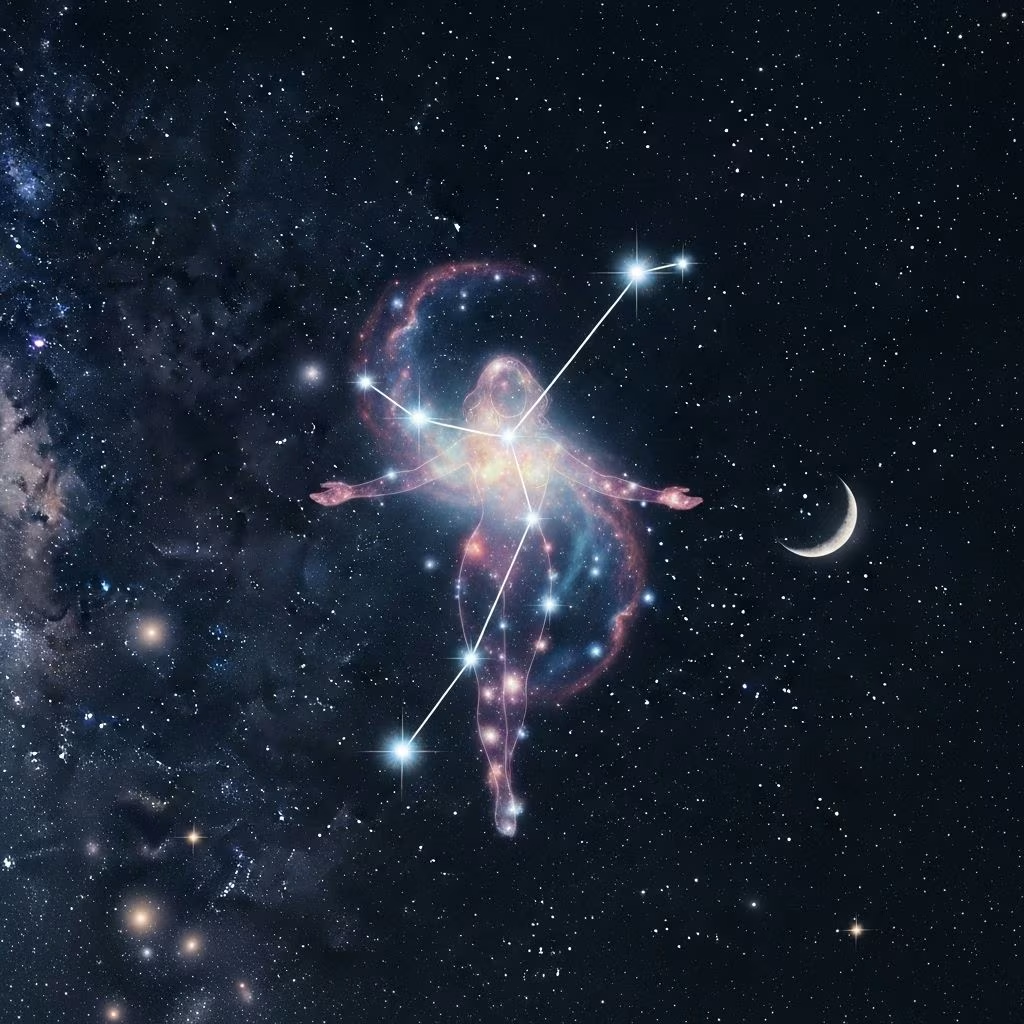
Virgo Constellation: The Celestial Virgin of Spring
The Virgo constellation, known as the Virgin, graces the spring sky with its expansive presence and rich history. Marked by the brilliant star Spica, Virgo stands as the second-largest constellation and is a cornerstone of both celestial navigation and human mythology. Its proximity to the celestial equator allows for wide visibility, while its array of deep-sky objects and historical legacy make Virgo a perennial subject of fascination for astronomers and stargazers alike.
Quick Facts & Overview
- Name: Virgo (Genitive: Virginis) (Pronounced VER-go)
- Symbol: The Virgin
- Constellation Family: Zodiacal
- Hemisphere: Southern (viewable worldwide)
- Area: 1,294 square degrees (2nd largest constellation)
- Best Viewing Month: May (Spring in Northern Hemisphere)
- Brightest Star: Spica (Alpha Virginis; magnitude: 0.98)
- Stars with Known Planets: 32-35
- Zodiac Dates: August 23 – September 22
History and Mythology
Virgo’s origins trace back thousands of years, embedded in the myths of several civilizations—from ancient Babylonia and Greece to Rome and Egypt. Its identification as a maiden reflects the agricultural cycles and concepts of purity, fertility, and justice.
- In Greek mythology, Virgo is linked to Demeter (goddess of harvest) or Persephone (goddess of spring).
- Roman tradition associates Virgo with Astraea, the virgin goddess of justice and innocence.
- In Babylonia, known as “The Furrow,” Virgo honored the goddess of grain and harvest.
- Egyptians connected Virgo to Isis, while in India, she was Kauni, the mother of Krishna.
Across eras, Virgo’s representation as a maiden or goddess was fundamental to agricultural societies, symbolizing the cycle of growth and renewal and the return of abundance each spring.
Location and Visibility
Virgo occupies a prominent spot on the sky’s map, making it a favorite for both naked-eye and telescopic observation. Its celestial coordinates and extensive area contribute to numerous astrological and astronomical applications.
- Position: Third quadrant of the southern hemisphere; near the celestial equator (Right Ascension: ~13h 21m; Declination: ~-2°).
- Neighboring Constellations: Bootes, Coma Berenices, Corvus, Crater, Hydra, Leo, Libra, Serpens Caput.
- Skywatching Best Practices: Look for Virgo after sunset during spring months, especially in May when it culminates high in the sky.
The constellation’s high visibility from most locations on Earth enables both amateurs and professionals to enjoy its celestial wonders.
Major Stars of Virgo
Several stars anchor Virgo’s brilliance and astronomical significance. The brightest and most famous is Spica, but the constellation boasts other notable stellar gems.
| Star Name | Designation | Type | Magnitude | Distance (ly) | Notes |
|---|---|---|---|---|---|
| Spica | α Virginis | Binary (Blue Giant) | 0.98 | ~262 | 16th brightest in sky; rapid rotation; Spica A & Spica B orbit every 4 days |
| Porrima | γ Virginis | Binary | 2.74 | ~38 | Named for Roman goddess; two Sun-like stars |
| Zavijava | β Virginis | F9V Yellow-White Dwarf | 3.6 | ~36 | Close to Solar System |
| Vindemiatrix | ε Virginis | G8III Yellow Giant | 2.8 | ~110 | “Grape-gatherer” in Latin; marks left arm of the Virgin |
| Auva | δ Virginis | M3III Red Giant | 3.4 | ~196 | Luminous red giant |
| 61 Virginis | 61 Vir | G-type main sequence | 4.2 | ~28 | Has 3 exoplanets, one is a super-Earth |
Virgo features more stars with known exoplanets than any other constellation, solidifying its importance in discoveries of worlds beyond our solar system.
Deep-Sky Treasures: Galaxies and Clusters
Beyond its stars, Virgo is a gateway to some of the universe’s most remarkable deep-sky objects, especially the remarkable Virgo Cluster of galaxies.
- Virgo Cluster: Contains over 1,300 known galaxies; cornerstone of local supercluster.
- Messier 87 (M87): Giant elliptical galaxy; location of the first-ever black hole image captured (2019 Event Horizon Telescope).
- Messier 49 (M49): Brightest Virgo Cluster member; an early-type elliptical galaxy.
- Messier 58, M59, M60: Notable elliptical and lenticular galaxies in the area.
- Quasar 3C 273: Among the brightest quasars visible from Earth.
The cluster’s proximity and multitude of galaxies make Virgo a rich target for amateur astrophotography and professional research alike.
Other Notable Sky Features
- Spring Triangle: Virgo’s Spica, Leo’s Denebola, and Bootes’ Arcturus form this prominent seasonal asterism.
- Exoplanet Discovery: Virgo leads in the number of stars found with planets, particularly in discoveries from 2009.
Virgo in Astrology
Virgo’s presence as a zodiac sign bridges ancient astronomy and modern culture.
| Dates | Symbol | Element | Ruling Planet | Color | Characteristics |
|---|---|---|---|---|---|
| August 23 – September 22 | Virgin | Earth | Mercury | Grey | Helpful, modest, practical, clear-headed, elegant |
- Birthstones: Sapphire, amber
- Metal: Mercury
- Zodiac Compatibility: Sagittarius, Taurus, Gemini
Although precession has shifted the sun’s path, Virgo still holds significance for those born under its sign, symbolizing analytical clarity and nurturing energy.
Skywatching Tips for Virgo
- Locate Virgo by finding Spica, often near the midpoint of the arc drawn from Arcturus to Denebola.
- Use clear, dark skies during spring for optimal visibility.
- Binoculars or a small telescope reveal Virgo’s galaxies; start with Messier objects (M87, M49, etc.).
- Virgo’s stars and galaxies form a sprawling pattern east of Leo and west of Libra.
Virgo’s breadth means it can take up a substantial chunk of the sky, so familiarize yourself with nearby constellations to orient your search.
Cultural Significance
- Virgo is the only female figure among zodiac constellations.
- Symbolizes fertility, purity, and justice in various global myths.
- Its rising marked vital agricultural seasons in ancient calendars.
- The name “Spica” means “ear of grain,” cementing Virgo’s agricultural symbolism.
Frequently Asked Questions (FAQs)
Q: What is the brightest star in the Virgo constellation?
A: Spica (Alpha Virginis) is the brightest star in Virgo, recognized for its blue giant size and binary system, making it one of the 20 brightest in the night sky.
Q: When is the best time to see Virgo?
A: Virgo is best seen in May, during spring skies in the Northern Hemisphere. It rises high in the night sky, guaranteeing good visibility.
Q: Which deep-sky objects are prominent in Virgo?
A: The Virgo Cluster of galaxies (including Messier 87, Messier 49, and notable quasars) makes Virgo a treasure trove for galaxy hunters and astrophotographers.
Q: What mythological figures are associated with Virgo?
A: Ancient cultures tied Virgo to goddesses such as Demeter, Persephone, Astraea, Isis, and Kauni, reflecting themes of purity, fertility, and justice.
Q: How many stars in Virgo host known planets?
A: Virgo holds the record for the most host stars with known exoplanets—over 32-35 stars, including the sun-like star 61 Virginis.
Q: What is Spica’s significance in both astronomy and culture?
A: Astronomically, Spica anchors Virgo and the Spring Triangle; culturally, its name means “ear of grain,” symbolizing harvest and renewal, mirroring the constellation’s maiden imagery.
Virgo Constellation in Modern Astronomy
Virgo continues to be a prime area for scientific research, particularly in extragalactic astronomy. The deep-sky features of the Virgo Cluster serve as a laboratory for studying galaxy formation, dark matter, and the dynamics of supermassive black holes. Important observations from the Event Horizon Telescope provided the first direct image of a black hole’s event horizon at M87’s center, placing Virgo at the pinnacle of cosmic exploration.
- New discoveries of exoplanets around Virgo’s stars propel studies of planetary systems beyond our own.
- The region is crucial for mapping the universe’s large-scale structures, including superclusters and filaments.
Summary Table: Virgo’s Astronomical Highlights
| Feature | Description |
|---|---|
| Area | 1,294 square degrees; 2nd largest constellation |
| Brightest Star | Spica (Alpha Virginis) |
| Best Viewing | May, Spring in Northern Hemisphere |
| Deep-Sky Objects | Virgo Cluster (M87, M49), Quasar 3C 273 |
| Mythology | Maidens, goddesses: Demeter, Astraea, Persephone |
| Astrological Dates | Aug. 23 – Sept. 22 |
Further Exploration & Resources
- Use sky maps to locate Virgo’s bright stars and deep-sky wonders on clear spring nights.
- Explore mythology, cultural traditions, and scientific research for a holistic view of Virgo’s importance.
From ancient legends to cutting-edge science, the Virgo constellation remains a beacon of beauty and mystery in the celestial tapestry. Its expanse is a bridge across epochs—rooted in harvests and myths, illuminated by brilliant stars, and echoing with the birth of galaxies far beyond our own.
References
- https://en.wikipedia.org/wiki/Virgo_(constellation)
- https://www.constellation-guide.com/constellation-list/virgo-constellation/
- https://www.britannica.com/place/Virgo
- https://www.go-astronomy.com/constellations.php?Name=Virgo
- https://theskylive.com/sky/constellations/virgo-constellation
- https://www.jameswebbdiscovery.com/universe/100-fascinating-facts-about-virgo-constellation
- https://www.astronomytrek.com/constellations/virgo/
- https://www.space.com/15678-virgo-constellation-skywatching-tips.html
- https://astrobackyard.com/constellation-virgo/
- https://www.star-registration.com/blogs/constellations-and-zodiac-signs/constellation-virgo
- https://milwaukeeastro.org/Stargazing/virgo.asp
- https://interstellarium.com/en/constellations/virgo/
- https://usvao.org/virgo-constellation-facts/
- https://lovethenightsky.com/virgo-constellation-guide/
- https://www.horoscope.com/article/4-virgo-constellation-facts/
- https://www.centreofexcellence.com/virgo-constellation/
- https://www.space.com/29142-spring-skywatching-constellation-virgo.html


