How Far Is Earth from the Sun?
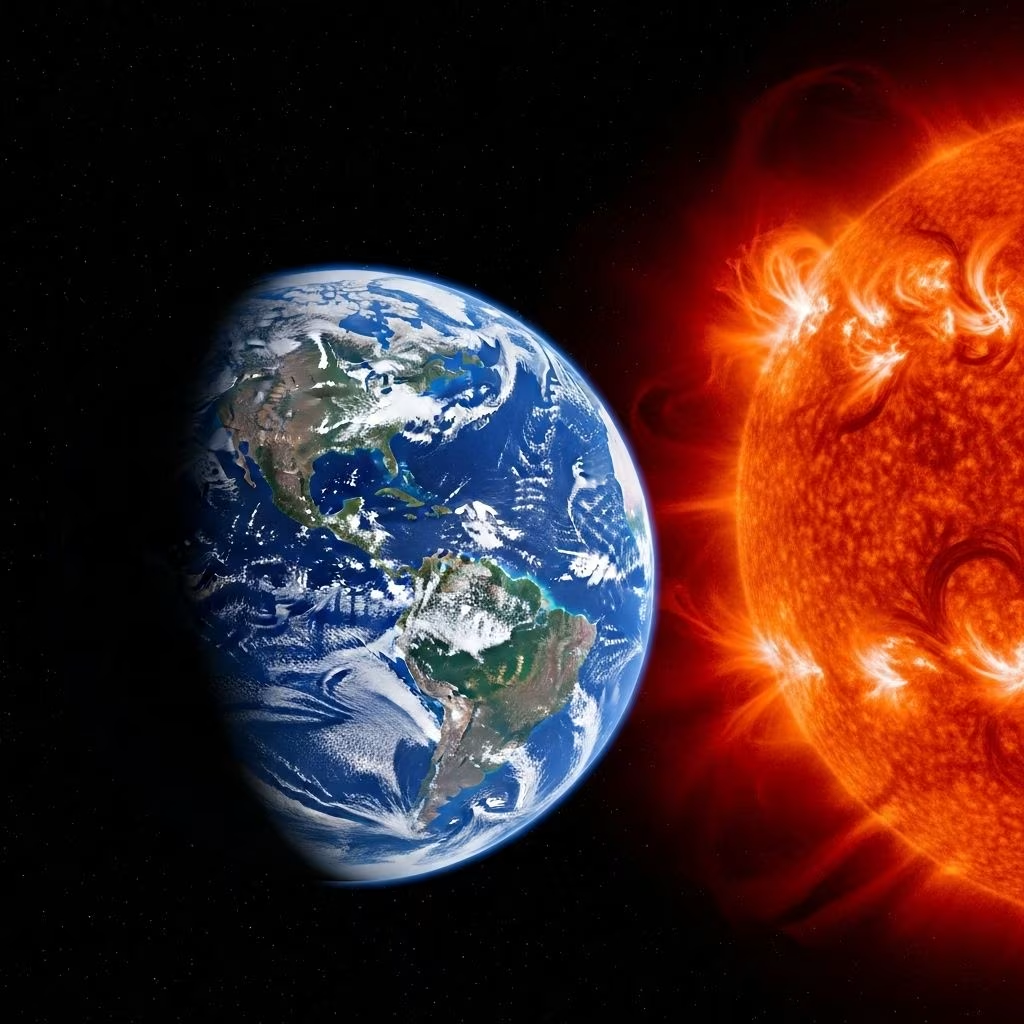
The distance between Earth and the Sun is so fundamental to our understanding of astronomy that it defines the scale of our solar system. Yet, this distance is neither constant nor insignificant: it forms the basis for the astronomical unit (AU), shapes our environmental conditions, and has been the subject of scientific inquiry for centuries.
Average Distance: Defining the Astronomical Unit
On average, Earth is about 93 million miles (150 million kilometers) away from the Sun. Scientists have defined this average distance as 1 astronomical unit (AU) [12]. This unit is critical for expressing vast cosmic distances comfortably.
- 1 AU = 93 million miles (150 million km)
- 1 AU serves as the standard yardstick for measuring distances in the solar system
- Used for comparing distances of other planets, asteroids, and comets from the Sun
The Orbit: Elliptical, Not Circular
While it is easy to imagine Earth orbiting the Sun in a perfect circle, the reality is more complex. Earth’s orbit is elliptical, which means the distance between the planet and the Sun changes throughout the year [12].
This shape causes two important points in Earth’s orbit:
- Perihelion: The point at which Earth is closest to the Sun
- Aphelion: The point at which Earth is farthest from the Sun
| Term | Distance (miles) | Distance (km) | Time of Year |
|---|---|---|---|
| Average (1 AU) | ~93,000,000 | ~150,000,000 | — |
| Perihelion (Closest) | ~91,400,000 | ~147,100,000 | Early January |
| Aphelion (Farthest) | ~94,500,000 | ~152,100,000 | Early July |
Why Does Earth’s Distance from the Sun Change?
The elliptical shape of Earth’s orbit means the distance to the Sun is always in flux. At perihelion (early January), Earth is about 91.4 million miles (147.1 million km) from the Sun; at aphelion (early July), it is about 94.5 million miles (152.1 million km) [12].
Key Points About Earth’s Orbit
- The difference between perihelion and aphelion is roughly 3.1 million miles (5 million km).
- All planetary orbits are somewhat elliptical, but Earth’s orbit is less eccentric than most.
- This change in distance affects the intensity of sunlight but does not cause the seasons.
Is Earth’s Orbit Becoming Larger or Smaller?
The longest-term trend is that the average distance between Earth and the Sun is slowly increasing over millions of years. Two main factors drive this subtle effect:
- The Sun is losing mass through nuclear fusion and solar wind, slightly reducing its gravitational pull.
- Gravitational interactions (mainly with the Moon) cause tidal forces that gradually affect orbital distances .
How Long Does Sunlight Take to Reach Earth?
Despite the vast distance, light from the Sun takes about 8 minutes and 20 seconds to reach Earth . This figure is based on the speed of light (186,000 miles per second or nearly 300,000 kilometers per second) and forms the foundation for understanding cosmic timescales.
- Speed of Light: 299,792 km/s (186,282 miles/s)
- Time for Sunlight to reach Earth: ≈8 minutes 20 seconds
Does Earth’s Distance from the Sun Affect the Seasons?
It may seem logical that being closer to the Sun means it would be summer, and being farther away means winter. However, Earth’s seasons are not caused by its changing distance from the Sun. The real cause of the seasons is the tilt of Earth’s axis (about 23.5 degrees) [12].
Here’s what matters:
- Northern Hemisphere is closest to the Sun (perihelion) in January, when it is winter—not summer!
- Southern Hemisphere experiences summer at perihelion.
- Seasons are determined by which hemisphere is tilted toward or away from the Sun, not by changing distance.
Why Is the Distance to the Sun So Important?
Earth’s moderate, relatively stable distance from the Sun is vital for life. If Earth were much closer or farther, the balance of energy reaching our planet’s surface would not support liquid water—or life as we know it.
- Stable climate: Only small fluctuations in sunlight due to Earth’s nearly circular orbit
- Temperature suitability: In the habitable zone, supporting complex life
How Have Scientists Measured the Sun’s Distance?
Understanding the Earth-Sun distance has been a historical quest for astronomers. Early scientists endlessly debated its value and devised ingenious methods to determine it. The main approaches have included:
1. Parallax Method
This technique uses the apparent shift in position of the Sun (or other planets) against distant background stars, viewed from two points on Earth’s surface . Although challenging due to the Sun’s brightness, parallax was crucial for refining the Earth-Sun distance as telescopes improved.
2. Transits of Venus
Perhaps the most famous historical effort: scientists observed Venus crossing the face of the Sun from different global locations, timing the event to calculate relative distances (using geometry and the known scales of other planetary orbits).
- First measured accurately in the 18th century by observing the transit of Venus.
- Observations from many locations improved accuracy, as slight differences in timing provided crucial data.
3. Radar and Modern Measurements
Today, scientists use precise radar signals bounced off other planets (like Venus or Mercury) and track the return time. Combined with knowledge of orbital dynamics, this has allowed for extremely accurate measurements of the astronomical unit.
Fun Facts: Earth, the Sun, and Our Place in Space
- Earth’s almost circular orbit is rare; only Venus and Neptune have orbits as close to circular among major planets .
- The AU has been measured within a few meters, a remarkable feat considering the scale involved.
- Though the Sun is nearly 400 times farther away than the Moon, it appears the same size in the sky because it is almost 400 times larger in diameter.
Frequently Asked Questions (FAQs)
Q: What is the actual current distance from Earth to the Sun?
A: The distance changes constantly due to Earth’s elliptical orbit, but it ranges between 91.4 million miles (147.1 million km) at perihelion and 94.5 million miles (152.1 million km) at aphelion. The average is about 93 million miles (150 million km).
Q: Is Earth getting closer or farther from the Sun?
A: On average, Earth is drifting very slowly away from the Sun as the Sun loses mass and tidal forces reshape the system. However, the change is extremely gradual and measured over millions of years.
Q: Does the distance to the Sun determine the seasons?
A: No, the tilt of Earth’s axis is responsible for the seasons. The change in distance to the Sun during the year is too small to have a significant effect on temperature.
Q: How was the distance to the Sun first measured?
A: Early measurements used the parallax method and later the transits of Venus for greater accuracy. Modern values are determined by radar ranging and spacecraft telemetry.
Q: Can the distance from Earth to the Sun change drastically in the future?
A: Not in any way that would impact human life for millions of years. The gradual drift is very small per year.
Summary Table: Earth-Sun Distance in Various Units
| Distance | Miles | Kilometers | Light-minutes |
|---|---|---|---|
| Average (1 AU) | 93,000,000 | 150,000,000 | ~8.3 |
| Perihelion | 91,400,000 | 147,100,000 | ~8.16 |
| Aphelion | 94,500,000 | 152,100,000 | ~8.47 |
The Bigger Picture: Why This Knowledge Matters
Understanding the Earth-Sun distance is more than an astronomical curiosity. It serves as a fundamental reference point for navigation, planetary science, and our sense of place in the universe. It defines our habitable zone, enabling Earth to maintain moderate temperatures and a relatively stable climate—essential factors for life as we know it. As science advances, our measurements and understanding continue to refine, illuminating both our past and our cosmic future.
References
- https://en.wikipedia.org/wiki/Sun
- https://science.nasa.gov/sun/facts/
- https://www.astronomy.com/science/earth/
- https://science.nasa.gov/earth/facts/
- https://en.wikipedia.org/wiki/Earth’s_orbit
- https://coolcosmos.ipac.caltech.edu/ask/8-How-far-away-is-the-Sun-
- https://theskylive.com/how-far-is-sun
- https://www.britannica.com/topic/How-Far-Is-the-Sun-from-Earth
- https://www.livescience.com/is-earth-moving-closer-farther-sun
- https://www.youtube.com/watch?v=nRzAu1yG_uw
- https://theskylive.com/sun-info
- https://www.worldatlas.com/space/how-far-away-is-the-sun.html
- https://www.worldatlas.com/articles/how-far-is-the-earth-from-the-sun.html
- https://www.vedantu.com/physics/sun-distance-to-earth
- https://www.space.com/58-the-sun-formation-facts-and-characteristics.html