


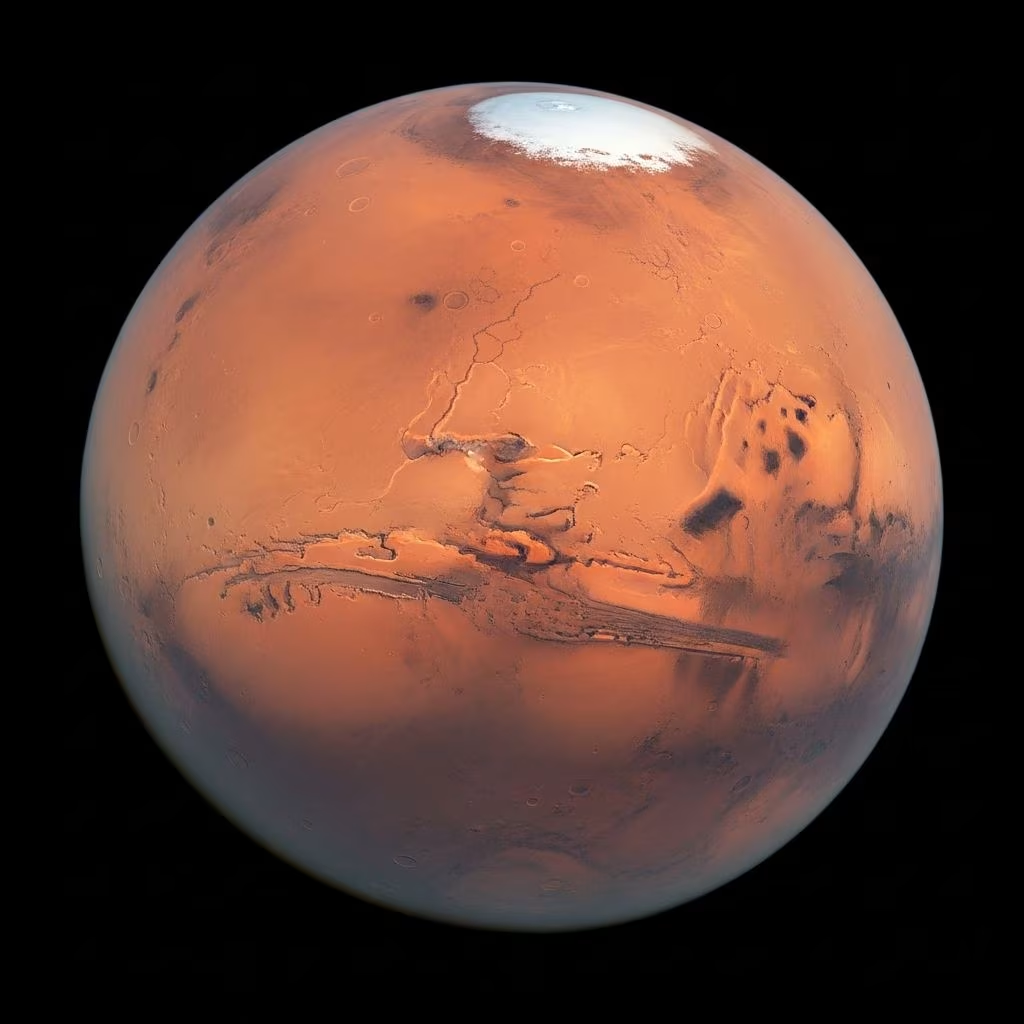
Mars, the Red Planet, has long held scientific and popular fascination as Earth’s closest planetary neighbor with a real chance to harbor life, past or present. Its red hue, unique geography, dynamic climate, and rich history of exploration make it a captivating object of study. This article delves deeply into Mars—from its physical properties and atmosphere to its legendary volcanoes, canyons, and moons, alongside a review of key Mars missions and the ongoing quest to understand its mysteries.
Why is Mars Called the Red Planet?
Mars is visually distinctive in the night sky with its unmistakable reddish appearance. This rusty color is caused by iron minerals in the Martian soil that oxidize, reacting with small amounts of atmospheric oxygen and giving the rocks and dust their familiar hue.
- The Romans named Mars after their god of war due to its blood-like appearance.
- Egyptians called Mars “Her Desher,” meaning “the red one.”
- Oxidized iron (rust) coats the surface, scattering sunlight to appear distinctly red.
Basic Mars Facts and Physical Characteristics
| Attribute | Mars | Earth |
|---|---|---|
| Position from Sun | 4th | 3rd |
| Diameter | 6,779 km | 12,742 km |
| Surface gravity | 0.38 × Earth | 1 |
| Length of day | 24.6 hours | 24 hours |
| Length of year | 687 Earth days | 365 days |
| Average temperature | -63°C | 14°C |
| Moons | 2 (Phobos & Deimos) | 1 |
- Mars is about half as wide as Earth, yet its land area is roughly equal to all the dry land on our planet.
- Its day—called a “sol”—lasts 24.6 hours, making Martian time similar to Earth’s.
- A Martian year is almost twice as long as an Earth year due to its more distant, elongated orbit.
The Structure of Mars: Inside the Red Planet
Much like Earth, Mars has a layered internal structure:
- Core: Dense and metallic, likely comprised mostly of iron, nickel, and sulfur.
- Mantle: Silicate rock responsible for Mars’ volcanic and tectonic features.
- Crust: Ranges from ~6 km to over 70 km thick, much thicker than Earth’s crust on average.
Mars is seismically active: NASA’s InSight lander has confirmed the presence of ‘marsquakes,’ revealing clues about tectonic activity and planet formation.
Surface Features: Canyons, Volcanoes, and Dust
Mars is home to some of the solar system’s most dramatic geological features.
- Olympus Mons: The tallest volcano and mountain (21.9 km high; nearly 2.5 times Mount Everest).
- Valles Marineris: A vast canyon system stretching over 4,000 km long and up to 7 km deep—much larger than Earth’s Grand Canyon.
- Polar Ice Caps: Seasonal caps at both poles, made mainly of water ice with seasonal layers of frozen carbon dioxide (‘dry ice’).
- Endless cratered highlands in the south and wide, flat plains in the north create a pronounced Martian “dichotomy.”
Frequent dust storms sweep the planet, with some storms growing planet-wide and obscuring the surface for weeks.
The Atmosphere of Mars: Thin and Hostile
The Martian atmosphere is very thin and composed mainly of carbon dioxide (95%), with smaller amounts of nitrogen and argon.
- Atmospheric Pressure: Less than 1% of Earth’s surface pressure; insufficient for stable liquid water on the surface.
- Temperature Extremes: Ranges from about 20°C down to -153°C. Daily and seasonal swings are large.
- Sky Color: Appears orangish-red or butterscotch due to fine dust; sunsets can appear blue.
- Weather: Features thin clouds, frosts, and violent dust storms but little rainfall.
Does Mars Have a Magnetic Field?
Mars no longer has a global magnetic field. However, remnants of an ancient magnetic field are found “frozen” in sections of its southern crust, hinting at a more active past.
Seasons on Mars
Mars is tilted on its axis by roughly 25 degrees, similar to Earth, leading to distinct seasons—but they last much longer due to Mars’ slower orbit.
- Martian year: 687 Earth days.
- Temperature swings: Colder than Earth; variations are more extreme due to the thin atmosphere.
- Seasonal changes at the poles cause the polar ice caps to grow and recede.
- Dust storms often occur when Mars is closest to the sun, during its southern summer.
Water on Mars: Evidence for a Wetter Past
Water is one of the most studied Martian topics. While Mars is dry and cold today, ample evidence points to a much wetter and warmer past.
- Ancient riverbeds, deltas, and lakebeds are visible from orbit.
- Signs of catastrophic flooding and valleys carved by flowing water.
- Recent missions have found permafrost and water ice just below the surface in many regions.
- Some salt deposits and recurring slope flows may indicate briny liquid water occasionally occurs today.
The search for water is closely tied to the search for ancient life on Mars.
Mars’ Moons: Phobos and Deimos
Mars possesses two small, irregularly shaped moons:
- Phobos: The larger, orbits closest to Mars, rising and setting twice a day. Very slowly spiraling inward and may eventually crash.
- Deimos: Smaller and more distant, with a smooth surface and a much slower orbit.
Both are probably captured asteroids from the solar system’s early days.
History of Mars Observation and Exploration
Mars has been a focus of human observation for millennia, regularly studied by ancient astronomers. In the modern era, telescopes and spacecraft have transformed our understanding.
- Early Telescopic Views: 19th-century astronomers believed they saw “canals,” igniting speculation about Martian civilizations.
- First Flybys: NASA’s Mariner 4 (1965) provided the initial close-up images—revealing a cratered, moonlike surface.
- Landers and Rovers: Subsequent missions have landed on Mars, including Viking 1 and 2, Pathfinder, Spirit, Opportunity, Curiosity, and Perseverance, revealing landscapes, surface chemistry, climate history, and hints about habitability.
- Orbiters and Satellites: A global network of orbiters maps the planet, studies weather and atmosphere, and acts as communication relays for landers.
- Robotic Innovations: From drones like Ingenuity to future sample-return plans, Mars is the most explored planet after Earth.
Fascinating Mysteries and Potential for Life
The big question: Has Mars ever supported life? To date, no undisputed signs of life have been found, but several lines of evidence keep hope alive for past (and possibly present) microbial life:
- Possible organic molecules trapped in rocks explored by rovers.
- Gullies, recurring slope lineae, or dark streaks pointing toward recent water activity.
- Presence of methane spikes in the atmosphere, which could originate from biological or geological processes.
Ongoing and future missions aim to answer whether Mars ever hosted life—or even still does, deep beneath its surface.
Mars in Popular Culture
For centuries Mars has fueled the human imagination, feeding stories and myths about Martians—ranging from H.G. Wells’ “War of the Worlds” to contemporary cinema like “The Martian.” Its proximity and similarity to Earth, plus decades of unmanned exploration, ensure Mars remains science fiction’s favorite planetary neighbor.
Frequently Asked Questions (FAQs)
Why is Mars red?
Mars appears red due to iron oxide—or rust—in the soil and dust, which scatters sunlight and creates that characteristic hue.
How cold does Mars get?
Mars surface temperatures can range from a daytime high near 20°C (68°F) to nighttime lows near -153°C (-243°F), with an average near -63°C (-81°F).
Does Mars have water?
Water exists on Mars in the form of polar ice, permafrost, and thin layers of frost. Signs of past rivers, lakes, and floods are visible, but stable surface liquid water is not present today.
Can humans live on Mars?
Mars’ thin atmosphere, extreme cold, and radiation make unprotected human life impossible, but with advanced habitats and technology, future astronauts could survive with life-support systems.
What are the names of Mars’s moons?
Mars has two small moons: Phobos and Deimos. Both are likely captured asteroids and very different from Earth’s moon.
Key Takeaways
- Mars is a small, rocky planet, about half Earth’s width but equally rich in geological wonders.
- Red surface originates from oxidized iron, earning it the nickname “Red Planet.”
- Dynamic climate and geology include planet-sized dust storms, ancient volcanoes, and massive canyons.
- Atmosphere is thin, mostly CO2, unsuited for human breathing and lacking a global magnetic field.
- Seasons and polar ice caps change dramatically through the Martian year.
- Exploration continues, with robotic missions seeking evidence of ancient habitability and the potential for life.
As ambitious plans for human missions and possible Martian outposts develop, Mars will continue inspiring scientists and dreamers alike, as humanity inches closer to stepping foot on this enigmatic red world.
References
- https://science.nasa.gov/mars/facts/
- https://en.wikipedia.org/wiki/Mars
- https://www.nhm.ac.uk/discover/planet-mars.html
- https://science.nasa.gov/mars/
- https://www.littlehouseofscience.com/20_fascinatingfun_science_facts_planet_mars/
- https://www.natgeokids.com/au/discover/science/space/facts-about-mars/
- https://www.natgeokids.com/uk/discover/science/space/facts-about-mars/
- https://www.britannica.com/place/Mars-planet
- https://www.aeronomie.be/en/encyclopedia/mars-red-planets-main-characteristics-short
- https://www.planetary.org/worlds/mars
- https://theplanets.org/mars/
- https://www.funkidslive.com/learn/top-10-facts/top-10-facts-about-mars/
- https://revolutionized.com/interesting-planet-mars-facts/
- https://www.youtube.com/watch?v=Ruo_uZHeLls
- https://www.britannica.com/summary/Mars-planet
- https://www.solarsystemscope.com/spacepedia/handbook/mars
- https://earthhow.com/planet-mars-facts/
- https://learn.humsa.com/articles/mars-planet/


