Black holes stand among the universe’s most fascinating and mysterious phenomena. Characterized by an extreme gravitational pull from which nothing can escape—not even light—these exotic objects have reshaped how astronomers understand space, time, and the evolution of galaxies. This comprehensive guide unveils the nature, origin, and significance of black holes, tracing their journey from theoretical curiosities to crucial players in cosmic evolution.
What Is a Black Hole?
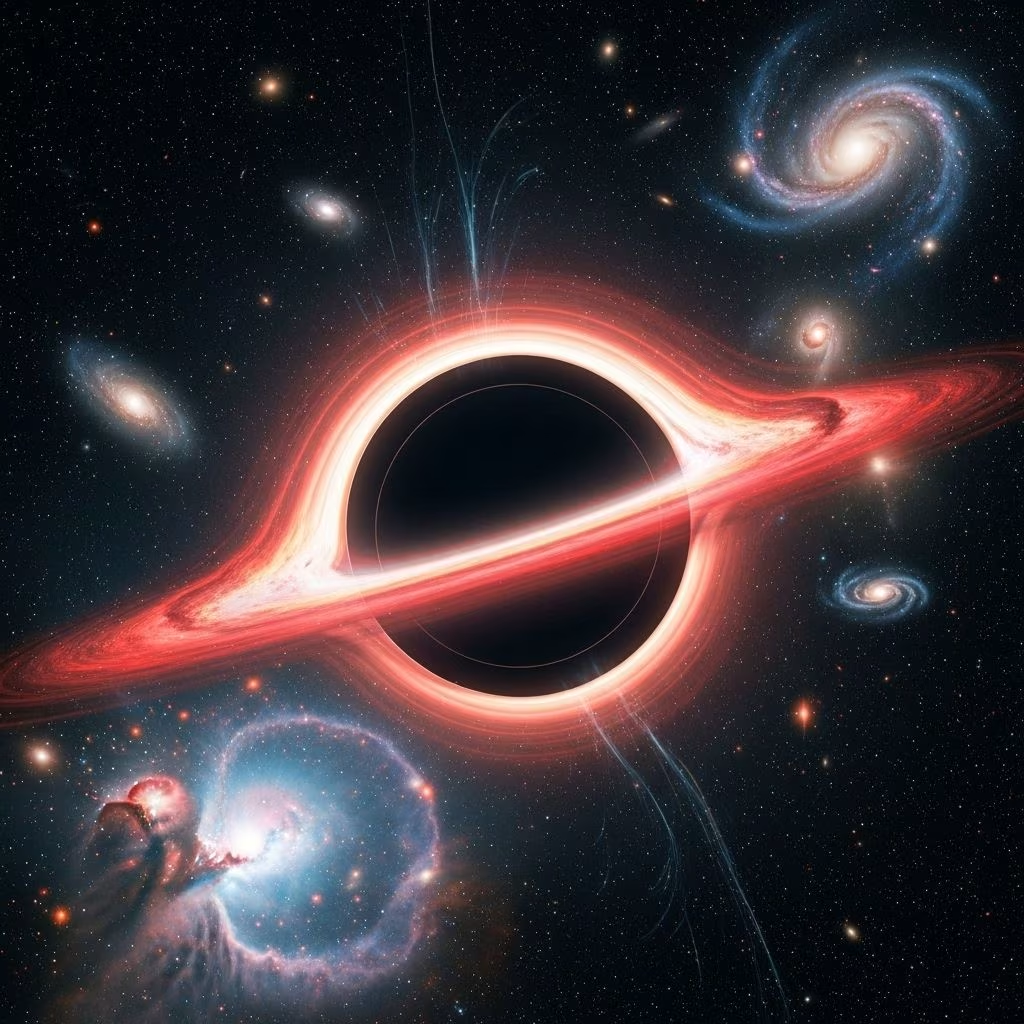
Black holes are regions in space where gravity is so powerful that nothing, not even light, can escape once it crosses a boundary called the event horizon. The event horizon is not a solid surface; it is the invisible point of no return surrounding a singularity—a core where matter is compressed into infinite density and the laws of physics as we know them break down . Anything entering the event horizon is inexorably drawn toward the singularity.
- Event Horizon: The boundary beyond which escape is impossible.
- Singularity: The infinitely dense central point inside the black hole.
- Gravitational Effects: Black holes warp space and time, distorting both light and matter in their vicinity .
Origin and Early Theories
The concept of black holes dates to the late 18th century when scientists such as John Michell and Pierre-Simon Laplace speculated about bodies so massive that even light could not escape. However, the foundation of modern black hole theory began with Albert Einstein’s general relativity in 1915. Shortly thereafter, Karl Schwarzschild formulated a solution that described the gravitational field around a massive, collapsing object .
- 1916: Schwarzschild’s solution predicts black holes mathematically.
- 1960s: Theoretical evidence solidifies black holes as an actual astrophysical prediction rather than mere mathematics.
- 1971: Cygnus X-1 becomes the first strong black hole candidate discovered in space .
How Do Black Holes Form?
Black holes can form in several distinct ways, usually involving the catastrophic collapse of massive objects:
- Stellar Collapse: When massive stars burn out their nuclear fuel, their cores collapse under gravity, forming stellar-mass black holes.
- Supermassive Formation: Supermassive black holes may form from the merging of smaller black holes, accretion of gas, or direct collapse of massive gas clouds during galaxy formation .
- Accretion: Black holes continue to grow by absorbing nearby matter—gas, dust, stars, and even other black holes.
Types of Black Holes
Black holes are categorized based on their mass and formation mechanism. The principal types include:
| Type | Mass Range | Origin | Notable Examples |
|---|---|---|---|
| Stellar-Mass | 3–100+ solar masses | Collapse of massive stars | Cygnus X-1 |
| Supermassive | Millions to billions of solar masses | Galactic centers, accretion/mergers | Sagittarius A*, M87, Centaurus A |
| Intermediate-Mass | 100–10,000 solar masses | Possible mergers, star cluster collapse | Few candidates, e.g., GW190521 |
| Primordial | Micro to planetary-mass | Theorized, early Universe | Hypothetical |
Supermassive Black Holes and Galactic Cores
Supermassive black holes (SMBHs) reside at the center of most galaxies, including our Milky Way. Their masses reach millions or billions of times that of the Sun. The SMBH at the center of the Milky Way, called Sagittarius A* (Sgr A*), weighs about 4.3 million solar masses .
- M87: Central black hole imaged by the Event Horizon Telescope; mass around 3.5 billion suns.
- Centaurus A: Holds a black hole of about 55 million solar masses powering jets across vast distances.
- Active Galactic Nuclei (AGN): Bright regions powered by matter falling into black holes, sometimes forming jets that span thousands of light-years.
What Happens Near a Black Hole?
Approaching a black hole, several key physical effects occur:
- Extreme Gravity: Objects experience intense gravitational pull as they approach the event horizon.
- Gravitational Time Dilation: Time slows dramatically for an object nearing the event horizon compared to a distant observer .
- Accretion Disk: Infalling material forms a swirling, superheated disk that emits vast amounts of X-rays and other radiation.
- Spaghettification: Tidal forces stretch and compress objects falling toward the singularity.
- Permanent Capture: Anything crossing the event horizon is irreversibly trapped.
Observation and Detection
Despite their name and the fact that light cannot escape, black holes can be detected by their effects on nearby matter and gravitational fields:
- X-ray Emission: Matter in the accretion disk heats up and shines brightly in X-rays before plunging into the black hole.
- Star Orbits: Astronomers monitor stars orbiting invisible companions; these orbits reveal the masses of black holes.
- Gravitational Lensing: Black holes bend and magnify light from objects behind them, distorting their appearance.
- Gravitational Waves: Colliding black holes produce ripples in spacetime detected by instruments like LIGO, confirming their existence.
Famous Black Holes
- Cygnus X-1: The first robust black hole candidate, an X-ray binary system 6,500 light-years from Earth.
- Sagittarius A*: The supermassive black hole at our galaxy’s center.
- M87: Site of the first direct black hole image, showing a dark ‘shadow’ encircled by glowing gas.
- Centaurus A: Features dramatic jets seen in radio wavelengths.
Black Holes in Modern Science
Black holes are now central to various fields of astrophysics and cosmology:
- Active Research: Scientists probe how black holes form, merge, and evolve, and what happens at their cores.
- Hawking Radiation: Quantum physics predicts black holes slowly emit radiation and could eventually evaporate, though for large black holes this is incredibly slow.
- Cosmic Engines: SMBHs power the most energetic phenomena in the universe, such as quasars and some gamma-ray bursts.
The New Frontiers of Black Hole Research
- Direct Imaging: The Event Horizon Telescope’s image of M87’s black hole in 2019 marked a milestone in astrophysics, revealing the shadow of a black hole for the first time.
- Gravitational-Wave Astronomy: The detection of gravitational waves from merging black holes opens a new window on the universe and supports black hole theories.
- Ongoing Mysteries: Key questions remain about the fate of information entering a black hole and the exact nature of the singularity.
Fascinating Facts About Black Holes
- Black holes do not “suck”; objects must come very close to be pulled in.
- Time appears to slow near a black hole; an outside observer would never see an object cross the event horizon.
- Supermassive black holes can weigh billions of solar masses, while primordial black holes (if they exist) could be much smaller.
- Black holes can spin, carrying angular momentum from their progenitor stars or accumulated material.
- They are invisible by nature, detected primarily through their interaction with surrounding matter and energy .
Frequently Asked Questions (FAQs)
Q: Can the Sun ever become a black hole?
A: No, the Sun lacks adequate mass to collapse into a black hole. Stars must generally be at least about 20 times the Sun’s mass to form a stellar black hole when they die.
Q: What happens if you fall into a black hole?
A: The tidal forces near a black hole stretch objects ‘spaghettification’—and nothing returns once past the event horizon. Time also dilates tremendously relative to the outside world.
Q: How do we know black holes are real?
A: Evidence includes X-ray emissions from accretion disks, the orbits of stars near the galactic center, gravitational lensing, and detection of gravitational waves from mergers — all matching black hole predictions.
Q: How big can black holes get?
A: Supermassive black holes can reach tens of billions of solar masses, often found at the centers of large galaxies.
Q: Are black holes dangerous to Earth?
A: No known black holes are near enough to threaten Earth. Most black holes exist far from our solar system.
References
- NASA: What Are Black Holes?
- Space.com: Black Holes Facts, Formation & Discovery
- Wikipedia: Black Hole
References
- https://www.space.com/19339-black-holes-facts-explained-infographic.html
- https://en.wikipedia.org/wiki/Black_hole
- https://space-facts.com/black-holes/
- https://science.nasa.gov/universe/black-holes/
- https://www.space.com/black-holes-solar-system
- https://www.nsf.gov/science-matters/5-black-hole-facts-blow-your-mind
- https://www.nasa.gov/universe/what-are-black-holes/
- https://www.youtube.com/watch?v=Kkwp7Ap6N9A
- https://www.britannica.com/science/black-hole
- https://www.livescience.com/space/astronomy/black-holes
- https://www.sentintospace.com/post/space-education-black-holes
- https://news.uchicago.edu/explainer/black-holes-explained
- https://astro.umaine.edu/10-fun-facts-about-black-holes/
- https://www.jameswebbdiscovery.com/universe/100-fascinating-facts-about-black-holes
- https://www.thespacemystery.com/space-facts/black-holes-facts/
- https://spaceyv.com/black-hole-theory-all-things-you-need-to-know/
- https://packer.hms.harvard.edu/17-black-hole-facts-unlock-ultimate-space-secrets
- https://study.com/academy/lesson/black-hole-definition-types-quiz.html
- https://www.britannica.com/summary/black-hole