


Alpha Centauri: Exploring Our Closest Stellar Neighbor
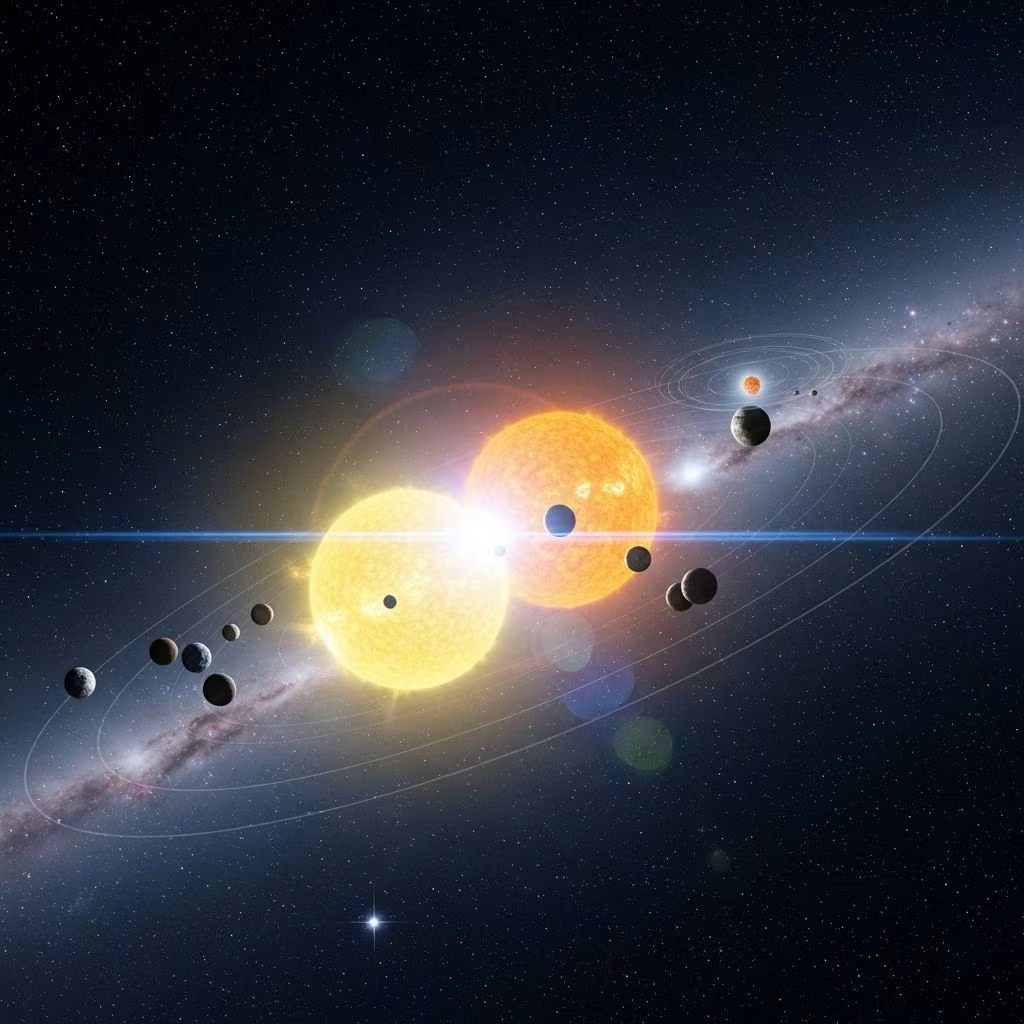
Alpha Centauri is not only the nearest star system to our Solar System but also one of the most intriguing for both astronomers and the general public. This triple star system captivates scientists with its unique composition, proximity, and the tantalizing prospects of hosting exoplanets that might support life. In this article, we delve into what makes Alpha Centauri remarkable—from its stellar dynamics and planetary systems to its place in astronomy and popular culture.
Quick Facts about Alpha Centauri
- Location: Southern constellation of Centaurus, about 4.37 light-years from Earth.
- System Type: Triple star system: Alpha Centauri A, Alpha Centauri B, and Proxima Centauri (Alpha Centauri C).
- Brightness: Third brightest star system in the night sky after Sirius and Canopus.
- Orbital Period: Alpha Centauri A and B orbit each other every 79.76 years.
- Proxima Centauri: Closest individual star to the Solar System, at 4.25 light-years away.
- Exoplanets: Confirmed planets around Proxima Centauri and candidate exoplanets around Alpha Centauri A.
The Alpha Centauri Star System in Detail
The Alpha Centauri system consists of three distinct stars bound by gravity:
- Alpha Centauri A (Rigil Kentaurus): A G2V yellow main-sequence star, similar to our Sun, but slightly larger and more luminous.
- Alpha Centauri B (Toliman): A K1V orange main-sequence star, smaller and cooler than Alpha Centauri A.
- Proxima Centauri (Alpha Centauri C): An M-type red dwarf star, faint and small, but the closest of the trio to our Solar System.
Together, Alpha Centauri A and B form a binary star system, appearing as a single point of light to the naked eye. Proxima Centauri, by contrast, orbits the binary pair at a much greater distance—about 13,000 astronomical units (AU) away.
Table: Main Properties of Alpha Centauri Stars
| Star | Spectral Type | Mass (Sun = 1) | Diameter (Sun = 1) | Apparent Mag. | Distance from Sol (ly) |
|---|---|---|---|---|---|
| Alpha Centauri A | G2V | 1.1 | 1.2 | -0.01 | 4.37 |
| Alpha Centauri B | K1V | 0.9 | 0.86 | 1.33 | 4.37 |
| Proxima Centauri | M5.5Ve | 0.12 | 0.15 | 11.13 | 4.25 |
Orbits and Stellar Dynamics
Alpha Centauri A and B are locked in an elliptical orbit around their common center of mass. The distance between them varies over an orbital cycle, ranging from as close as 11.2 AU (about the distance from the Sun to Saturn) to as far as 35.6 AU (beyond Neptune’s orbit). The period of this orbit is 79.76 years. Proxima Centauri, much farther out, orbits the AB pair on a much wider path and is considered loosely bound to the system.
From Alpha Centauri AB, the Sun would appear as a fairly bright yellow star in the constellation Cassiopeia, with an apparent magnitude of about 0.47.
Exoplanets Around Alpha Centauri
The possibility of planets orbiting the stars of Alpha Centauri has fascinated scientists and the public alike. Here is what is currently known:
- Proxima Centauri b: This Earth-size exoplanet orbits within the habitable zone of Proxima Centauri, discovered in 2016. It has a minimum mass similar to Earth’s and an orbital period of about 11 days. Liquid water may exist under the right conditions.
- Proxima c and d: Two additional candidates orbit Proxima Centauri; c is a super-Earth or mini-Neptune (unconfirmed), while d is even smaller and has a short orbital period.
- Alpha Centauri A and B: The hunt for planets around the two Sun-like stars continues. A candidate Neptune-sized planet orbiting Alpha Centauri A was directly imaged by the James Webb Space Telescope in 2025, but needs confirmation. No confirmed exoplanets have been found around Alpha Centauri B yet.
Why Alpha Centauri’s Exoplanets Matter
The discovery of potentially habitable exoplanets in the Alpha Centauri system is of profound importance:
- Alpha Centauri is close enough to permit deep study with both existing and future telescopes.
- Its stars present unique laboratory conditions for comparative planetary science.
- Planets found in the habitable zone could be targets for future robotic or interstellar missions.
Discovery and Observation
Alpha Centauri has been known to indigenous peoples and was first cataloged in the West in ancient times. Its brightness and location in the southern sky made it a staple for navigation—especially in the Southern Hemisphere. Observing Alpha Centauri is challenging from much of the Northern Hemisphere, as it sits far south on the celestial sphere.
Key Milestones in Study
- Ancient Discovery: Known since antiquity to observers in the Southern Hemisphere.
- Western Cataloguing: First Latin designation by Johannes Bayer in 1603 as ‘α Centauri’.
- Binary Nature: Resolved into two stars using telescopes in the 17th century.
- Proxima Centauri Discovery: Identified by Robert Innes in 1915—found to be the closest known star to the Sun.
- Exoplanet Discoveries: First confirmed exoplanet around Proxima Centauri identified in 2016.
The Significance of Alpha Centauri
Alpha Centauri’s proximity makes it a fundamental object of study for astronomers, providing key insights and sparking scientific curiosity:
- Benchmark for Stellar Evolution: The Sun-like compositions of Alpha Centauri A and B offer a close comparison to our own star.
- Testing Ground for Exoplanet Research: The search for and study of exoplanets in this system allows refinement of planet-hunting techniques and future mission planning.
- Relevance to Future Exploration: As the nearest star system, Alpha Centauri is the logical first candidate for practical interstellar exploration (see Breakthrough Starshot below).
Alpha Centauri in Popular Culture
The system has long fascinated science fiction writers, inspiring numerous stories, films, and video games about humanity’s first voyage to another star. Its proximity and potential for habitable worlds make it a perennial favorite for interstellar destinations in fiction.
Future Missions and Research
Alpha Centauri continues to be the centerpiece of proposed missions and technological developements:
- Breakthrough Starshot: This ambitious initiative aims to develop a fleet of tiny, laser-driven spacecraft that could reach Proxima Centauri within a human lifetime and return data on planets and stellar conditions.
- Space-based Telescopes: Future missions such as the Habitable Exoplanet Observatory (HabEx) or the Large UV/Optical/IR Surveyor (LUVOIR) could visually resolve exoplanets in Alpha Centauri for the first time.
- James Webb Space Telescope: The JWST has already begun providing new data, including direct imaging attempts of candidate planets around Alpha Centauri A.
Frequently Asked Questions (FAQs)
Q: What is Alpha Centauri?
A: Alpha Centauri is the closest star system to the Solar System, located about 4.37 light-years away and composed of three stars: Alpha Centauri A, Alpha Centauri B, and Proxima Centauri.
Q: Why is Alpha Centauri important for astronomers?
A: Its proximity and similarity to our Sun make it an ideal testbed for studies of stellar evolution, exoplanet research, and potential interstellar exploration.
Q: Can Alpha Centauri be seen from Earth?
A: Yes, Alpha Centauri is the third brightest star system and is visible to the naked eye from much of the Southern Hemisphere. It is difficult or impossible to see from much of the Northern Hemisphere.
Q: Are there planets around Alpha Centauri?
A: Confirmed planets exist around Proxima Centauri, including one (Proxima b) that is roughly Earth-sized and could be in the habitable zone. There are candidate planets reported around the other two stars, but these await confirmation.
Q: How far away is Alpha Centauri?
A: Alpha Centauri A and B are about 4.37 light-years away. Proxima Centauri is slightly closer at 4.25 light-years from Earth.
Q: Will we ever travel to Alpha Centauri?
A: Practical interstellar travel remains beyond current technological reach, but proposals like Breakthrough Starshot aim to send tiny probes within the coming decades. Human travel is a much more distant goal.
Conclusion: A Gateway to the Stars
Alpha Centauri stands as a beacon of hope in our search for other worlds, bridging the gap between the Solar System and the vast cosmic ocean. Its three stars—and the planets that orbit them—remain a focal point of astronomical exploration, technological advancement, and the human imagination.
As new telescopes and missions come online, Alpha Centauri will doubtless reveal even more secrets, bringing us ever closer to answering one of the greatest questions: Are we alone in the universe?
References
- https://en.wikipedia.org/wiki/Alpha_Centauri
- https://www.nasa.gov/image-article/alpha-centauri-triple-star-system-about-4-light-years-from-earth/
- https://www.britannica.com/place/Alpha-Centauri
- https://svs.gsfc.nasa.gov/20377
- https://theplanets.org/stars/alpha-centauri-facts/
- https://www.astronomytrek.com/10-interesting-facts-about-alpha-centauri/
- https://www.livescience.com/54387-5-facts-about-alpha-centuari-starshot.html
- https://www.star-facts.com/alpha-centauri/
- https://www.youtube.com/watch?v=39VKA8vPXGg
- https://en.wikipedia.org/wiki/Alpha_Centauri_B
- https://nineplanets.org/alpha-centauri-system/
- https://www.space.com/32570-5-facts-about-alpha-centuari-starshot.html
- https://wrdsclassroom.wharton.upenn.edu/what-is-alpha-centauri_30775.html
- https://www.space.com/18097-alpha-centauri-stars-planet-explained-infographic.html
- https://www.youtube.com/watch?v=ImThtU6txiU
- https://www.allthescience.org/what-is-alpha-centauri.htm


