The Moon remains one of humanity’s most studied celestial neighbors. Despite centuries of observation, scientific exploration over the last fifty years has revealed much about the Moon’s origin, structure, geology, surface chemistry, and rarefied atmosphere. This comprehensive guide answers what the Moon is made of — chemically, physically, and historically — drawing on lunar samples, satellite data, and decades of research.
Layers of the Moon: Crust, Mantle, and Core
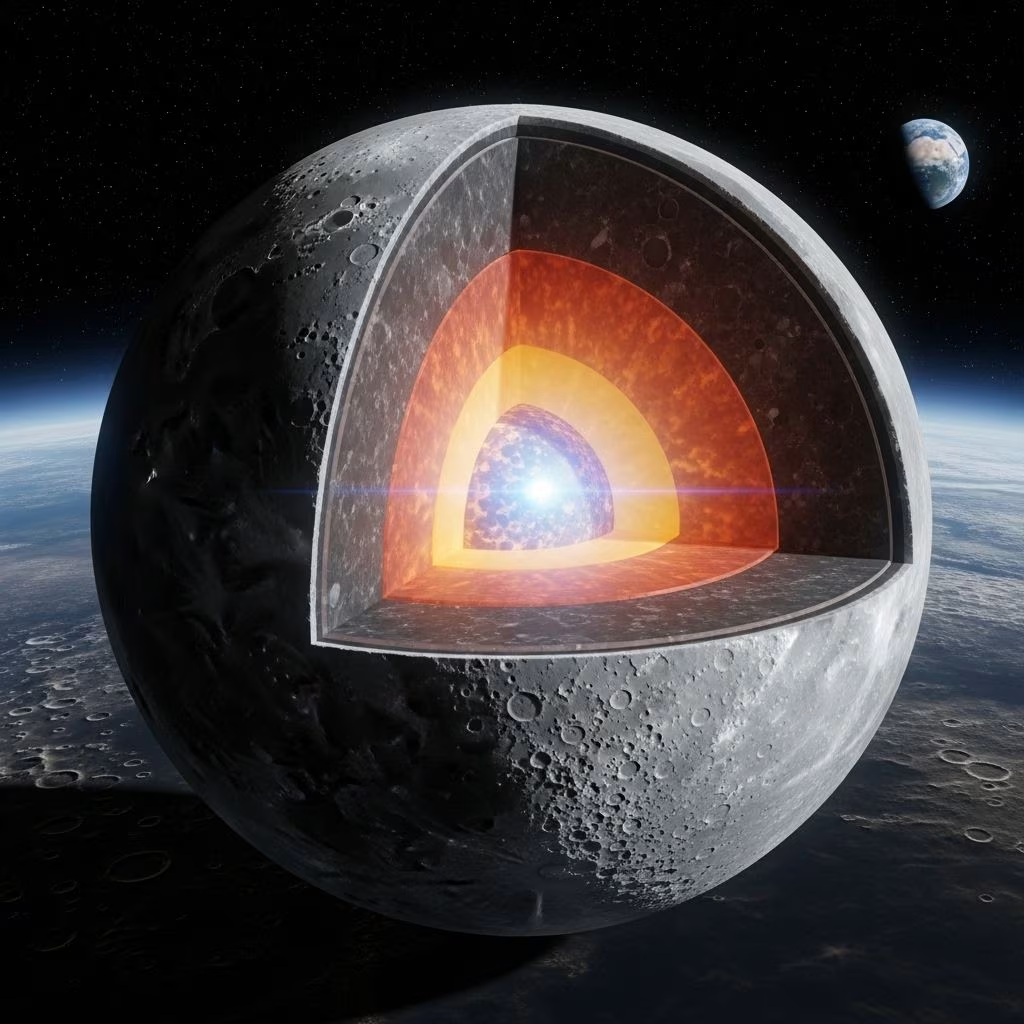
Similar to Earth, the Moon possesses a layered internal structure, though the proportions, makeup, and properties differ significantly. The Moon’s internal organization can be divided into:
- Crust: The outermost, rigid shell.
- Mantle: A thick layer beneath the crust dominated by silicate minerals.
- Core: The small and dense innermost region, likely metallic.
Lunar Crust
The crust varies in thickness but averages roughly 50 km. Near the Moon’s far side, it can reach up to 100 km, while the near side is thinner. It consists primarily of oxygen-rich silicate minerals, including plagioclase feldspar (aluminum-rich), with important contributions from basaltic rocks formed by ancient volcanic activity. The crust contains more aluminum and calcium compared to the underlying mantle.
Lunar Mantle
The mantle, stretching down to approximately 1,000 km, is composed mainly of dense silicate minerals high in magnesium and iron, like olivine and pyroxene. The mantle was once partially molten in the Moon’s early history, which led to volcanic eruptions that filled the vast dark plains (maria) we see today.
Lunar Core
The Moon’s core is small — only about 1–2% of its total mass — and its radius likely ranges from 300 to 400 km. Seismic data, gravity measurements, and magnetism suggest the core contains iron, nickel, and possibly sulfur.
Simulations and analyses infer much of the core may be partially melted and surrounded by an even smaller solid inner core, resembling a miniature version of Earth’s core but with key compositional differences.
| Layer | Average Thickness | Main Composition |
|---|---|---|
| Crust | ~50 km | Silicate minerals (feldspar, basalt) |
| Mantle | ~1,000 km | Olivine, pyroxene (Mg, Fe silicates) |
| Core | ~350 km | Iron, nickel, sulfur (metallic) |
Surface Composition: The Highlands and the Maria
The Moon’s surface is dominated by two physically and chemically distinct terrains: the older, lighter-colored highlands (terrae) and the younger, darker maria (plural of mare). Their differences provide clues to the Moon’s volcanic and impact-riddled past.
Lunar Highlands
The highland regions are composed mainly of anorthosite — a rock rich in plagioclase feldspar. Highlands have high concentrations of aluminum and calcium, and are saturated with craters, many billions of years old. These areas are some of the oldest surviving surfaces in the solar system.
Lunar Maria
Maria are vast, flat plains formed by ancient volcanic eruptions. The underlying rocks here are primarily basalts, rich in iron, magnesium, and sometimes titanium. Compared with the highlands, the maria are younger, less cratered, and appear darker because of their higher iron and lower aluminum content.
| Compound | Maria (%) | Highlands (%) |
|---|---|---|
| Silica (SiO2) | 45.4 | 45.5 |
| Alumina (Al2O3) | 14.9 | 24.0 |
| Lime (CaO) | 11.8 | 15.9 |
| Iron(II) oxide (FeO) | 14.1 | 5.9 |
| Magnesia (MgO) | 9.2 | 7.5 |
| Titanium dioxide (TiO2) | 3.9 | 0.6 |
| Sodium oxide (Na2O) | 0.6 | 0.6 |
| Total | 99.9 | 100.0 |
Lunar Surface Elements & Minerals
Elemental analysis, largely informed by Apollo and robotic missions, reveals the most abundant elements on the Moon’s surface are:
- Oxygen (O): The most prevalent element (about 45% by weight), primarily part of silicate minerals.
- Silicon (Si): About 21%, key in rock-forming minerals.
- Iron (Fe): Ranges from 5%–14% depending on location.
- Magnesium (Mg)
- Calcium (Ca)
- Aluminum (Al)
- Manganese (Mn) and Titanium (Ti): Less abundant but important for certain volcanic rocks.
Trace elements like potassium (K), phosphorus (P), uranium (U), thorium (Th), and rare earth elements exist in lower concentrations.
Volatiles, Water, and Polar Compounds
The Moon has long been considered dry, but more recent orbital and sample analyses reveal evidence of hydrogen and modest amounts of water ice, especially at the cold, permanently shadowed poles. These volatiles are found not as part of the surface material but embedded in mineral grains or as ice in polar craters — possibly delivered by comets, meteorites, or retained from solar wind implantation.
- Hydrogen (H): Concentrated at the lunar poles, identified by neutron spectrometry.
- Water Ice: Detected in shadowed polar craters and as molecular traces in volcanic glass beads.
- Solar Wind-implanted Elements: Besides hydrogen, helium is another significant volatile implanted by the solar wind.
The Moon’s Atmosphere: An Exosphere
Unlike Earth, the Moon lacks a true atmosphere and instead possesses a tenuous shell of gases — an exosphere — so rarefied it’s almost a vacuum compared to terrestrial standards. This layer extends hundreds of kilometers above the surface and is constantly replenished and removed through interactions with micrometeorites and the solar wind.
Composition of the Lunar Exosphere
The gases detected, often only a few thousand atoms per cubic centimeter, include:
- Helium (He): 5,000–30,000 atoms/cm3
- Neon (Ne) and Argon (Ar): Argon varies from 20,000–100,000 atoms/cm3
- Hydrogen (H), Ammonia (NH3), Methane (CH4)
- Trace sodium (Na), potassium (K), carbon dioxide (CO2)
The atmosphere is so thin that gases are lost quickly unless constantly replenished. Processes contributing to the exosphere include surface outgassing, solar wind sputtering, and impact vaporization by meteoroids.
The Moon’s Surface: Regolith and Rocks
The Moon’s surface is blanketed in regolith — a loose, dusty, and rocky layer varying from a few meters to more than 20 meters thick. This regolith is composed of:
- Fragmented rock and mineral grains from repeated meteoritic impacts.
- Tiny glass beads, produced by ancient volcanic eruptions and meteorite impacts melting the surface rock.
- Isolated crystalline rock fragments (called breccias created when impacts fuse rock pieces together).
How Do We Know? Lunar Samples and Remote Sensing
Our understanding of the Moon’s composition comes from several sources:
- Sample Return Missions: Apollo astronauts collected 382 kilograms of rock and regolith between 1969 and 1972, from six different lunar locations. Uncrewed missions also brought back small samples.
- Remote Sensing: Orbiters have used spectrometers, radar, neutron detectors, and other tools to map the entire surface and detect key elements.
- Lunar Meteorites: Lunar rocks ejected from impacts and found on Earth supply data about other parts of the Moon not directly sampled.
The Origin Story: Why Does the Moon Have This Composition?
Scientists generally agree that the Moon formed about 4.5 billion years ago, soon after Earth. The most plausible scenario is the giant impact hypothesis, proposing that a Mars-sized body collided with the infant Earth, blasting material into orbit that eventually coalesced to form the Moon. This origin explains many compositional similarities and differences:
- Lunar material is generally similar to Earth’s mantle, especially in oxygen and other isotopes — supporting a common origin.
- The Moon is depleted in volatiles (elements that vaporize easily), likely lost during the violent impact and subsequent heating.
- Certain element ratios show subtle differences, likely reflecting mixing and separation during or after formation.
Recent studies of isotopic ratios (e.g., oxygen, titanium, chromium) confirm the deep connection between lunar and terrestrial rocks, yet also highlight the unique history written into the Moon’s chemistry.
Frequently Asked Questions (FAQs)
Q: What is the Moon’s surface made of?
A: The surface is mostly a gray regolith (rocky dust) made of fragmented basalt and anorthosite, sprinkled with mineral grains, glass beads, and small rock fragments.
Q: Does the Moon contain water?
A: Yes — in trace amounts as ice and water molecules, primarily in polar regions inside permanently shadowed craters.
Q: Is the Moon made of the same materials as Earth?
A: The Moon contains many of the same elements as Earth’s crust and mantle, but with differences in the proportions of iron, water, and volatile elements.
Q: Why doesn’t the Moon have an atmosphere like Earth?
A: The Moon’s gravity is too weak to hold onto a thick atmosphere; instead, it has a tenuous exosphere that constantly escapes to space.
Q: How do we know what the Moon is made of?
A: By analyzing lunar samples (from missions and meteorites), and using remote sensing from orbiting spacecraft to survey the entire moon’s surface.
Conclusion
The Moon is not simply a dry ball of rock; it is a complex, ever-changing world of silicates, metals, and dust, shaped by volcanic eruptions, deep impacts, and a near-lifeless exosphere. Its composition tells a cosmic story: from fiery beginnings shared with Earth, through billions of years of bombardment and change, to a silent witness above us — the Moon continues to illuminate our understanding of the solar system’s birth and evolution.
References
- https://www.space.com/19582-moon-composition.html
- https://science.nasa.gov/moon/composition/
- https://www.space.com/earth-moon-different-compositions-surprise.html
- https://science.nasa.gov/moon/formation/
- https://en.wikipedia.org/wiki/Geology_of_the_Moon
- https://en.wikipedia.org/wiki/Moon
- https://www.iop.org/explore-physics/moon/composition-and-origins-moon
- https://myspacemuseum.com/what-is-the-moon-made-of
- https://www.spacesettlement.com/moon-origin-composition.html
- https://arxiv.org/abs/2408.16840
- https://www.telescopenerd.com/celestial-objects/moon-atmosphere.htm
- https://www.skyatnightmagazine.com/space-science/what-is-the-moon-made-of-how-did-form
- https://arxiv.org/html/2408.16840v1
- https://www.sciencealert.com/its-official-scientists-confirmed-whats-inside-our-moon
- https://studylatam.com/moon-rocks-composition-types-characteristics/
- https://www.chemistryworld.com/features/what-is-the-moon-made-of/3010686.article