Electrons are not just fundamental particles in the world of physics—they form the bedrock of chemistry, technology, and our entire understanding of matter. This in-depth article investigates what electrons are, how they behave, their role in atomic structure, and why the quest to understand their properties continues to challenge and refine modern physics.
What Is an Electron?
The electron is a negatively charged subatomic particle found in the outermost regions of atoms. It is considered elementary, meaning it cannot be broken down into smaller constituents. Electrons are a crucial part of the family of particles known as leptons.
- Charge: -1 (in atomic units); fundamental to all electricity and chemistry.
- Symbol: e–
- Rest mass: Approximately 9.11 x 10⁻³¹ kilograms.
- Location in atom: Occupy regions known as orbitals around the nucleus.
Unlike protons and neutrons—which are composed of quarks—electrons are believed to be point-like with no internal structure, a conclusion supported by the most detailed modern experiments.
Electron Behavior: Particle, Wave, or Both?
One of the most intriguing features of electrons is their duality: under different circumstances, they behave like both particles and waves. This phenomenon, called wave-particle duality, is a cornerstone of quantum mechanics.
- As particles, electrons can interact with other particles in collisions.
- As waves, they create interference patterns—as famously demonstrated in the double-slit experiment.
- Because of this duality, electrons occupy regions of space (orbitals), rather than being precisely localized at any given time.
Quantum mechanics computes the probability of finding an electron in a given region, not its exact location.
Electron Orbitals and the Bohr Model
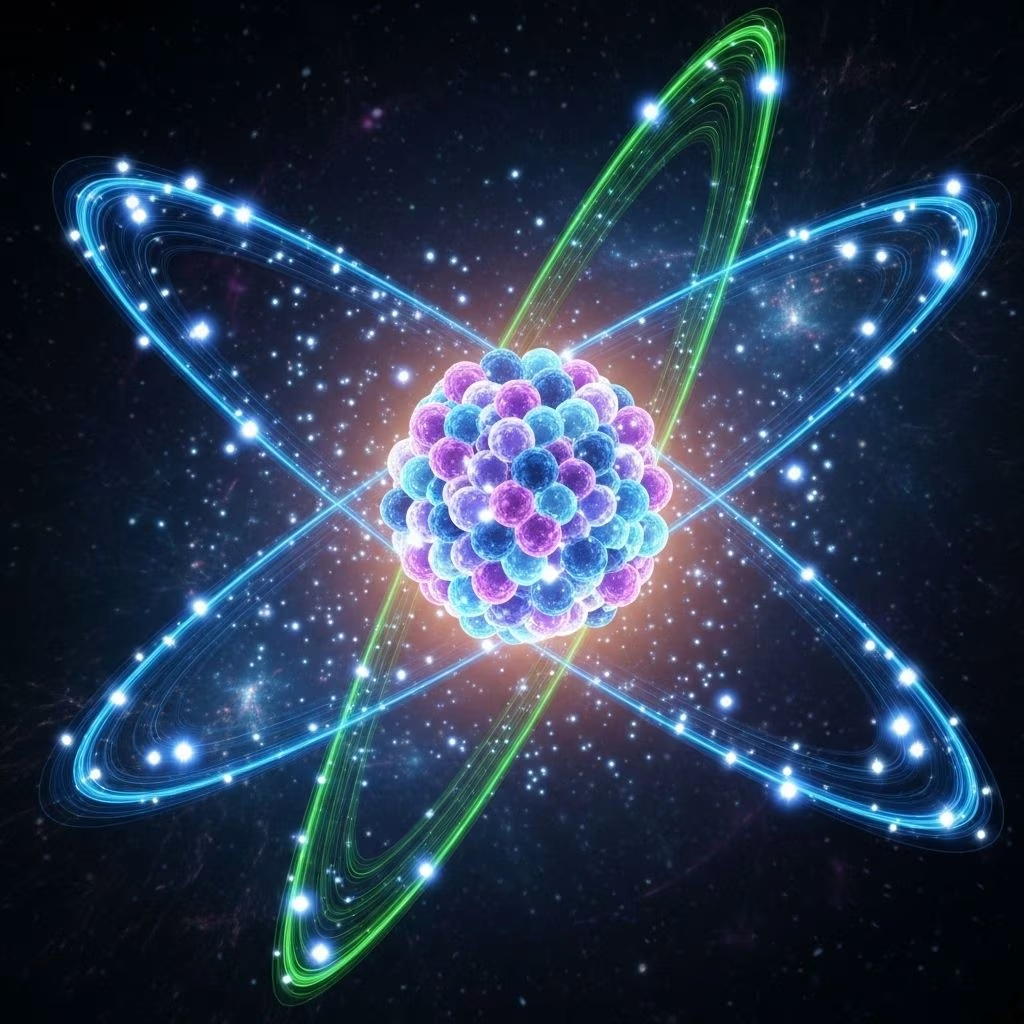
Electrons do not orbit the nucleus in fixed paths. Instead, they populate orbitals—probability clouds where an electron is likely (but not guaranteed) to be found. Understanding orbitals is key to grasping how atoms form bonds and chemical structures.
Key Features of Electron Orbitals
- Orbital: A region of space with a high probability (over 90%) of containing an electron.
- Maximum occupancy: Each orbital can hold up to two electrons, with opposite spins.
- Electron shells: Orbitals group into shells surrounding the nucleus; lower energy shells fill up first.
- Subshells: Each shell may have one or more subshells (s, p, d, f), each with its own arrangement and number of orbitals.
- Energy levels: Shells closer to the nucleus are lower in energy than those further away.
One of the earliest models of atomic structure, the Bohr Model (proposed by Niels Bohr in 1913), depicted electrons orbiting the nucleus much like planets orbit the sun. However, quantum mechanics now provides a more accurate description, modeling electrons as delocalized clouds.
How Electrons Move Between Shells
- An electron can absorb energy and move to a higher shell (excited state).
- It can release energy and move to a lower shell, often emitting a photon in the process.
- The energy change must exactly match the gap between shells for the transition to occur.
Atoms prefer to be in their lowest energy state, so electrons “fill” lower energy shells first. This principle underpins much of chemistry and materials science.
The Enigmatic Shape and Size of the Electron
While electrons are commonly treated as point particles, physicists have sought to measure any deviation from perfect roundness. The size of an electron—if it has one at all—is so small that it defies straightforward measurement.
- Recent experiments using lasers have probed electrons for asymmetries in their charge distribution.
- The most precise measurements show electrons are extremely round—with any deviation below the detection limits of current technology.
| Property | Result |
|---|---|
| Measured Shape | Spherical within experimental limits |
| Radius (if any) | < 10-19 meters (upper bound, indistinguishable from zero) |
| Electric Dipole Moment (EDM) | No detectable EDM—no distortion from spherical shape found |
These results not only reinforce the Standard Model of particle physics but also challenge alternative theories seeking new physics beyond it.
The Standard Model: Electrons and Fundamental Physics
The Standard Model is the reigning theory describing the basic building blocks of matter and the forces acting on them (except gravity). In this framework:
- Electrons belong to a family of particles called leptons.
- The Standard Model accurately predicts most known interactions involving electrons.
- Ongoing experiments test the veracity and limits of the model by meticulously measuring electron properties.
Attempts to detect an electric dipole moment (EDM) in the electron—a signal of physics beyond the Standard Model—have thus far come up empty, reinforcing the current theoretical picture.
How Do We Study Electrons?
Because electrons are so tiny and elusive, researchers study them indirectly:
- Laser experiments can probe electron shape by measuring charge distribution in carefully prepared molecules.
- Spectroscopy can analyze energy absorption and emission as electrons jump between energy levels.
- Particle accelerators smash electrons together at high energies to probe their properties and interactions.
Recent Advances
Projects like the ACME (Advanced Cold Molecule Electron Electric Dipole Moment Search) have pushed the boundaries of precision, reaching 10 times better resolution than previous experiments.
Electrons in Nature and Technology
Electrons underpin nearly all aspects of modern science and daily life:
- Chemical bonds: Electron sharing and transfer between atoms create molecules and materials.
- Electricity: Electric current is the flow of electrons through a conductor.
- Magnetism: Arises from the motion of electrons, especially their spin and movement in materials.
- Light and lasers: Emission and absorption of photons by electrons create all forms of visible and invisible light.
- Semiconductor devices: Control the flow of electrons in transistors, microchips, and solar panels.
Relativistic and Cosmic Electrons
Not all electrons remain peacefully in atoms. Some achieve tremendous energies:
- In space: Solar storms accelerate electrons to near light-speed, producing radiation belts around planets and triggering phenomena like auroras.
- In particle physics: Labs like CERN use powerful accelerators to propel electrons (and other particles) to enormous energies for research.
| Environment | Typical Electron Energy |
|---|---|
| Atoms (ground state) | Few electron volts (eV) |
| Solar storms / Van Allen belts | Up to ~7 million electron volts (MeV) |
| Particle accelerators (CERN) | Up to ~50 million electron volts (MeV) |
Such high-energy electrons are key actors in astrophysics and advanced technology.
Electrons and the Quest for New Physics
Electrons are crucial to the search for physics beyond the Standard Model. Physicists hypothesize that if undiscovered heavy particles exist, they might subtly affect electron properties. By meticulously measuring the electron’s shape and electric dipole moment, scientists test the boundaries of current theory.
- No measurable distortion has been found at extremely high precision.
- If a deviation is ever found, it could lead to new breakthroughs in fundamental physics.
For now, the electron remains the most perfectly round fundamental particle known.
Frequently Asked Questions (FAQs) About Electrons
Q: Why are electrons considered fundamental particles?
A: Electrons are “elementary” or fundamental because, unlike protons and neutrons, they are not composed of smaller constituents. They are point-like and indivisible according to current physics theories and experimental evidence.
Q: Can we see electrons directly?
A: No, electrons are too small to be seen with even the most powerful light-based microscopes. Their properties and behaviors are inferred from indirect experiments, such as electron scattering and spectroscopy.
Q: How do electrons produce light?
A: When electrons jump from higher to lower energy levels within an atom, they emit energy in the form of photons (light). The exact color or wavelength depends on the energy difference between the levels.
Q: Do electrons have mass?
A: Yes, electrons have mass—about 9.11 x 10⁻³¹ kilograms. While this is much less than protons or neutrons, it is not zero.
Q: What happens if we discover an electric dipole moment in the electron?
A: Discovering an EDM would imply new interactions or particles not accounted for in current physics, possibly revolutionizing our understanding of matter and forces in the universe.
Key Takeaways
- Electrons are negatively charged, fundamental particles central to atomic structure and all matter.
- They demonstrate both wave-like and particle-like behavior, forming the basis for quantum mechanics.
- Modern experiments confirm electrons are *extraordinarily round* and indivisible, consistent with the predictions of the Standard Model.
- Electrons power technologies from chemistry to electronics, and their precise study continues to push the limits of modern physics.
Further Reading
- Quantum Mechanics and the Nature of Particles
- Chemistry: The Role of Electrons in Bonding
- The Standard Model and Beyond: Search for New Physics
References
- https://www.space.com/electrons-negative-subatomic-particles
- https://www.space.com/42187-subatomic-particle-size-limit.html
- https://www.space.com/astronomy/sun/scientists-discover-explosive-origins-of-superspeed-electrons-streaming-from-the-sun
- https://www.space.com/41458-omg-particle-cosmic-ray-mystery.html
- https://www.space.com/electron-ice-snapshot-first-time
- https://www.youtube.com/watch?v=d2B9BfeGB4M
- https://www.space.com/van-allen-electrons-ultra-relativistic
- https://www.youtube.com/watch?v=ZiOPVei9xgQ
- https://science.slashdot.org/story/20/12/07/0117216/voyager-probes-detect-new-kind-of-electron-burst-in-interstellar-space
- https://newatlas.com/space/nasa-astronaut-spacesuit-electron-beam/
- https://homework.study.com/explanation/explain-why-electrons-inhibit-regions-of-space-around-the-nucleus-called-orbitals.html
- https://www.britannica.com/science/space-charge
- https://en.wikipedia.org/wiki/Electron
- https://scitechdaily.com/giant-particle-accelerator-in-the-sky-extremely-high-energy-electrons-within-the-van-allen-radiation-belts/
- https://homework.study.com/explanation/an-atom-has-charged-electrons-moving-in-the-space-around-the-nucleus-a-positively-b-negatively.html
- https://scitechdaily.com/unique-physics-in-interstellar-space-voyager-spacecraft-detect-new-type-of-solar-electron-burst/
- https://www.spectroscopyonline.com/view/spectroscopy-and-space-exploration-outer-space-the-final-frontier