Venus and Jupiter Conjunction 2025: A Guide to Observing Two Iconic Planets in the Morning Sky
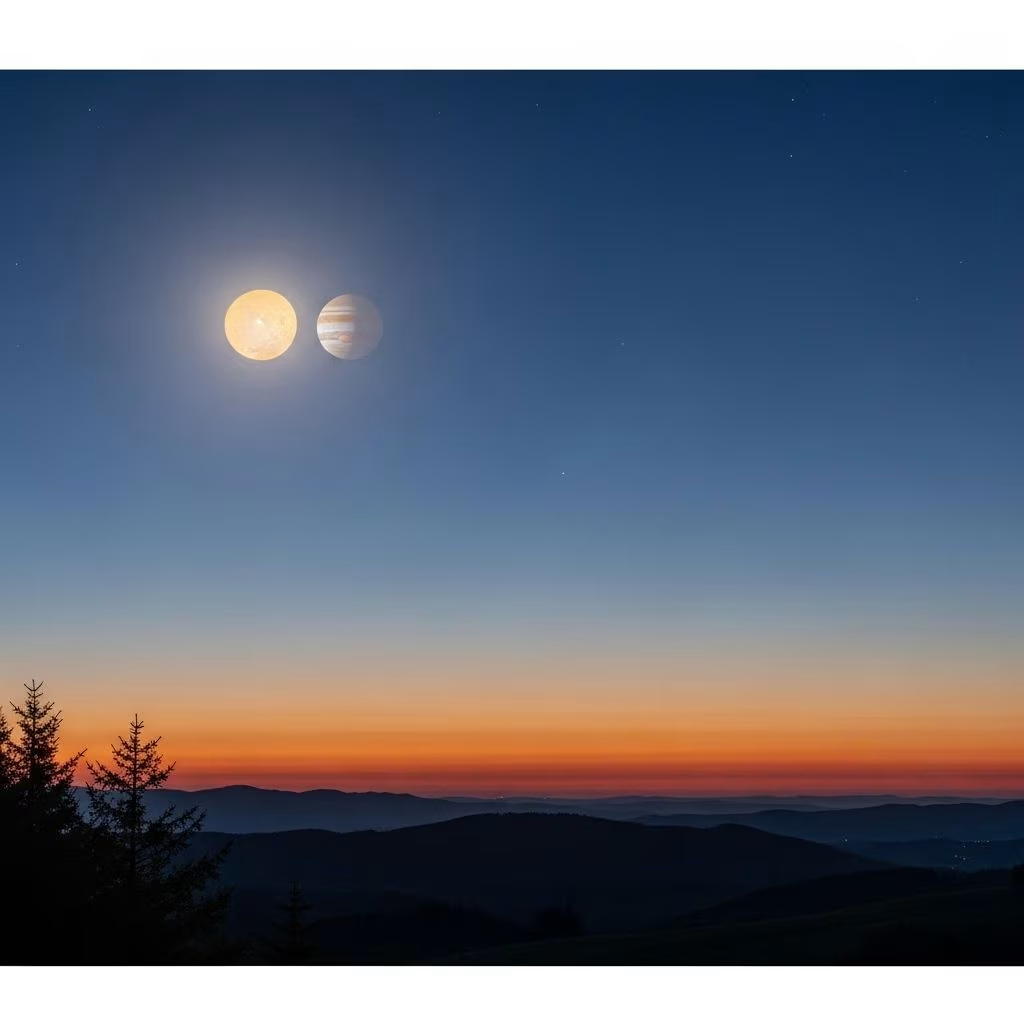
Early mornings in mid-August 2025 present skywatchers with an extraordinary opportunity: Venus and Jupiter, the two brightest planets visible from Earth, will draw exceptionally close together in the dawn sky. This rare astronomical event—called a conjunction—is set to dazzle observers worldwide, offering a brilliant spectacle above the eastern horizon. Explore how, when, and where to catch this planetary duo, learn what makes conjunctions special, and discover future dates for these cosmic meetings.
What Is the Venus-Jupiter Conjunction?
An astronomical conjunction occurs when two celestial objects, such as planets, appear very close to each other in the sky from our viewpoint on Earth. While conjunctions are common between various planets, those between Venus and Jupiter are especially striking due to their inherent brightness and proximity.
- Venus shines at magnitude -4.0 at its peak, making it the brightest object in the night sky after the moon.
- Jupiter is almost as impressive, shining at magnitude -1.9, easily visible and often outshining most stars.
When these two planets appear near each other, their combined brilliance produces a spectacle that is accessible to both amateur and professional astronomers alike.
Key Dates and How the Conjunction Unfolds
The Venus-Jupiter conjunction of August 2025 unfolds over several mornings, giving ample opportunity to experience its spectacle. Mark your calendars with these important dates:
| Date | Separation | Sky | Observing Notes |
|---|---|---|---|
| August 6 | 5.8° | Morning | Venus and Jupiter are just over half a fist apart |
| August 10 | 2° | Morning | Separation closes to a thumb’s width |
| August 12 (closest approach) | 0.86° | Morning | Planets appear side by side—spectacular! |
| August 12–20 | 1–2° | Morning | Waning crescent Moon joins the pair |
On August 12, Venus and Jupiter are separated by only 0.86 degrees—less than twice the apparent diameter of the moon—hovering above the east-northeast horizon throughout North America.
Where and When to Look: Observing Tips for the 2025 Conjunction
To see the conjunction at its best, follow these essential stargazing recommendations:
- Time: Head outside from 4 a.m. local time until sunrise, when Venus and Jupiter are highest and brightest.
- Location: Select a spot with an unobstructed view of the eastern horizon, such as an open field or elevated vantage point.
- Tools: Both planets are visible to the naked eye, but a pair of binoculars can enhance the scene, revealing the crescent moon and nearby stars.
- Constellations: Look for the winter constellation Orion off to the right of Venus and Jupiter—another visual treat.
- Celestial landmarks: Venus sits within Gemini, just below the star Tejat Posterior, while Jupiter lingers above Castor and Pollux.
Remember: If you hold your clenched fist at arm’s length, it measures roughly 10 degrees of sky, helping you estimate the distance between objects easily.
Visual Highlights and What You’ll See
The predawn sky over the week of August 12 offers a dynamic tableau:
- The planets draw closer each morning, culminating in a luminous pairing.
- Venus gleams just above the horizon, Jupiter shining to its upper left, both dominating the morning twilight.
- On August 12, the waning crescent moon drops by to join the two planets, forming a striking trio for several mornings afterward.
Why Is This Conjunction Noteworthy?
Venus and Jupiter conjunctions are among the most visually brilliant and widely observed planetary meetings. Astronomers and enthusiasts look forward to these events because:
- They occur at mean intervals of 13 months (the synodic period), providing regular but not overly frequent opportunities.
- Their brightness and visibility make them easily accessible, even in light-polluted urban skies.
- The 2025 pairing is exceptionally close (0.86°), rarer than many previous conjunctions.
The next time Venus and Jupiter get this close will be in the evening sky late next spring, although the visual separation will be larger than in 2025.
Orbital Mechanics: What Causes Planetary Conjunctions?
Conjunctions occur as the planets follow their respective orbits around the sun, appearing to “catch up” and align as viewed from Earth:
- Venus’ orbit is much closer to the Sun, completing a revolution approximately every 225 Earth days.
- Jupiter takes nearly 12 Earth years for a single orbit.
- Their varying speeds mean conjunctions recur at intervals governed by the synodic period—the time it takes Jupiter to return to the same position relative to the Sun as seen from Earth (about 398.88 days).
Venus and Jupiter Conjunctions: Past and Future Dates
The following table outlines future Venus-Jupiter conjunctions over the coming years, allowing stargazers to plan ahead:
| Year | Date | Sky | Closest Separation |
|---|---|---|---|
| 2025 | August 12 | Morning | 0.86° |
| 2026 | June 9 | Evening | 1.6° |
| 2027 | August 26 | Evening | 0.5° |
| 2028 | November 9 | Morning | 0.6° |
| 2029 | September 7 | Evening | 1.7° |
| 2030 | November 20 | Morning | 0.6° |
Intervals can range from as short as ten months to as long as fifteen months, depending on planetary configurations.
Bonus: A Parade of Planets in August 2025
August 2025 doesn’t only feature the Venus-Jupiter conjunction—other planets join the show in a spectacular morning alignment:
- Saturn hovers halfway up in the south-southwest sky, located in Pisces.
- Mercury sprints into the dawn, though best viewed in bright twilight.
- Uranus can be glimpsed through binoculars near the Pleiades.
- Neptune appears close to Saturn, but is quite faint.
- Orion—the famous constellation—rests off to the right of the conjunction.
This six-planet alignment develops before sunrise around mid-month, peaking just as Venus and Jupiter make their closest approach.
Frequently Asked Questions (FAQs)
Q: What makes the 2025 Venus-Jupiter conjunction special?
A: The 2025 event features an unusually close approach—only 0.86 degrees apart—offering one of the decade’s brightest and most visually stunning planetary pairings.
Q: Can I see the conjunction with the naked eye?
A: Yes, both Venus and Jupiter are exceptionally bright and easily visible without any optical aid. Binoculars or a small telescope can enhance the view but are not necessary.
Q: Do I need special equipment?
A: No special equipment is needed, but having binoculars or a telescope can reveal additional stars and add detail to the crescent moon.
Q: What if I miss this conjunction?
A: Venus and Jupiter meet frequently—about every 13 months. The next notable conjunction is in June 2026, though it’s not as close as 2025.
Q: Will other planets be visible?
A: Yes. Saturn, Mercury, Uranus, and Neptune also appear in the predawn sky in August 2025, forming a rare and eye-catching planetary parade.
Q: What is the best way to photograph the event?
A: Use a tripod-mounted DSLR or mirrorless camera with a wide-angle lens. Capture the scene during nautical twilight for best contrast between planet glow and background sky.
Final Observing Tips for August 2025
- Check local sunrise times to optimize your observing window.
- Plan for several mornings—the spectacle improves each day as the planets converge.
- Bring friends or family; planetary conjunctions are ideal for beginner stargazers.
- Use sky charts or apps to locate the planets—Gemini and Orion serve as useful guides.
- Remember weather and light pollution may impact visibility—seek clear skies!
Whether you are an experienced astronomer or simply curious about the cosmos, the Venus-Jupiter conjunction in August 2025 promises an unforgettable celestial experience. Set your alarm, look east, and marvel as two worlds meet above the horizon—one of the brightest gifts the universe offers skywatchers this year.
References
- https://www.space.com/stargazing/venus-and-jupiter-conjunction-2025-how-to-see-two-iconic-planets-meet-in-the-morning-sky
- https://www.skyatnightmagazine.com/news/venus-jupiter-conjunction-12-august-2025
- https://science.nasa.gov/solar-system/whats-up-august-2025-skywatching-tips-from-nasa/
- https://www.timeanddate.com/news/astronomy/planet-parade-august-2025
- https://www.skyatnightmagazine.com/news/venus-jupiter-august-2025
- https://www.livescience.com/space/planets/venus-and-jupiter-conjunction-how-to-watch-the-2-brightest-planets-kiss-on-aug-12
- https://whenthecurveslineup.com/2025/07/21/2025-august-5-venus-approaches-jupiter-brilliant-conjunction-and-six-planet-parade-unfold-before-sunrise/
- https://in-the-sky.org/news.php?id=20250812_20_100
- https://whenthecurveslineup.com
- https://www.yourtango.com/zodiac/why-astrologers-want-every-single-zodiac-sign-mark-august-12-2025-calendars
- https://www.colorado.edu/fiske/2025/07/11/august-11-13-2025-conjunction-jupiter-and-venus
- https://www.chani.com/this-year/key-dates/2025-astrological-key-dates-for-love
- https://www.livescience.com/space/planets/the-final-planet-parade-of-2025-rises-sunday-heres-how-to-see-the-full-6-planet-show
- https://starwalk.space/en/news/planetary-conjunctions
- https://www.astrosofa.com/horoscope/planets/venus-jupiter-neptune-pluto/2025/1/1
- https://www.youtube.com/watch?v=dRh7XchcfCU
- https://www.youtube.com/watch?v=5t3hrcyNTcE
- https://nasaspacenews.com/2025/08/dont-miss-the-venus-and-jupiter-align-in-august-2025-a-sky-show-like-no-other/