


What Is Earth Made Of?
Earth, our home in the cosmos, is a complex planet made up of diverse layers, elements, and materials. Since ancient times, humans have wondered about the true nature of our planet, and centuries of scientific inquiry—ranging from direct sampling to indirect geophysical measurements—have provided detailed models of Earth’s internal structure and chemical composition. But what, exactly, is Earth made of, and how do we know?
Overview: Layers and Elements
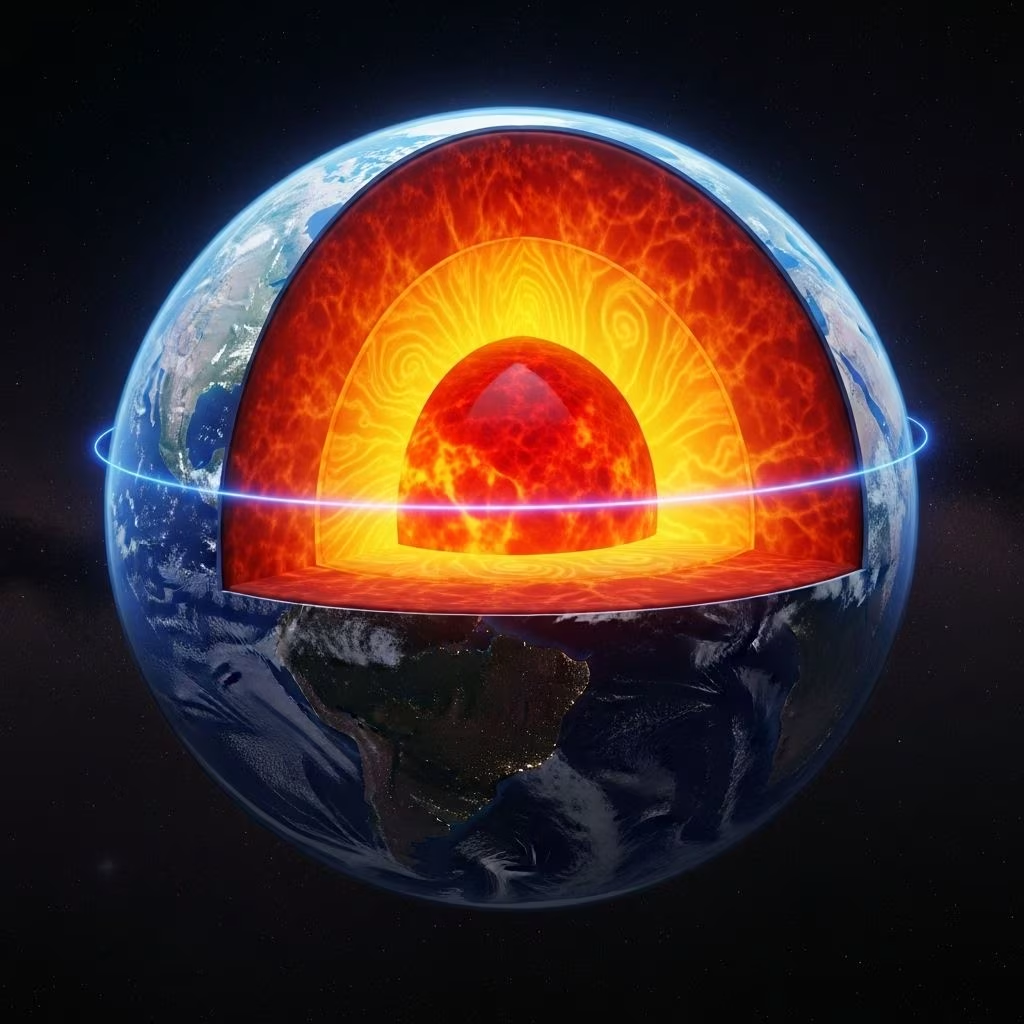
Earth’s structure is organized in three main layers:
- Core – the dense metallic center
- Mantle – the thick, rocky middle layer
- Crust – the thin outer shell on which we live
Chemically, more than 90% of Earth is made up of just four elements: iron, oxygen, silicon, and magnesium. The proportions vary by depth, reflecting processes from the planet’s fiery birth onward.
How Did Earth Form?
The formation of Earth began over 4.6 billion years ago from the collapse of a dense cloud of gas and dust—the same cloud that formed the Sun and other planets. Gravity pulled together local concentrations of material, while violent collisions and radioactive decay generated intense heat. Initially, the planet was molten and layered by density: heavier materials sank to form the core, while lighter minerals floated up, establishing Earth’s modern structure.
This early differentiation set the chemical foundation for what Earth is made of today.
The Main Layers of Earth
Earth is not homogenous but is distinguished by physical and chemical layers. These are:
- Crust: The solid, brittle outermost layer.
- Mantle: Below the crust, a solid but slow-flowing region of silicate rocks.
- Core: Consisting of a liquid outer core and a solid inner core, both primarily iron-rich.
| Layer | Thickness (approx.) | Main Composition | State |
|---|---|---|---|
| Crust | 5–70 km | Oxygen, silicon, aluminum, calcium, potassium, sodium | Solid |
| Mantle | ~2,900 km | Silicon, oxygen, magnesium, iron | Solid (plastic, slow flowing) |
| Outer core | ~2,200 km | Iron, nickel, minor lighter elements | Liquid |
| Inner core | ~1,220 km | Iron, nickel | Solid |
The Core: Earth’s Iron Heart
Earth’s core makes up about one-third of the planet’s total mass, but only 15% of its volume. It is remarkably rich in iron (over 85%) and also contains nickel and lighter elements such as sulfur and oxygen. The core is split into:
- Outer Core: Liquid metal, responsible for generating Earth’s magnetic field through dynamo action.
- Inner Core: A solid sphere primarily of iron and some nickel, with temperatures as high as 6,000°C (10,800°F).
The core’s heat is transported upwards, impacting mantle dynamics and geologic activity such as volcanism and tectonics.
The Mantle: Churning Slowly
Beneath the crust lies the mantle, a solid yet slowly moving shell spanning nearly 2,900 km in thickness. The mantle consists mostly of silicate minerals high in magnesium and iron (notably olivine and pyroxene). Although solid, over geologic time the mantle can flow, driving continental drift and seafloor spreading.
The mantle can be divided into an upper and lower section. Convection currents within the mantle play a crucial role in Earth’s geological activity.
Crust: Where Life Thrives
Covering less than 1% of Earth’s volume, the crust is the planet’s outer skin.
- Continental Crust is thick (averaging 35–70 km), less dense, and rich in granite-type rocks containing oxygen, silicon (as quartz), aluminum, and potassium.
- Oceanic Crust is thinner (about 5–10 km), denser, and mostly basaltic, with higher levels of magnesium and iron.
The crust is primarily made up of oxygen, silicon, aluminum, iron, calcium, sodium, potassium, and magnesium, accounting for about 99% of its mass. Surface rocks are dominated by silicate minerals, especially feldspars and quartz.
The Elements: What Are We Made Of?
Earth’s mass is dominated by a handful of key elements, though dozens are present.
| Element | Approximate % of Earth (by mass) | Role/Occurrence |
|---|---|---|
| Iron (Fe) | 32.1% | Core, significant in mantle |
| Oxygen (O) | 30.1% | Crust and mantle, forms oxides and silicates |
| Silicon (Si) | 15.1% | Crust and mantle, silicate minerals |
| Magnesium (Mg) | 13.9% | Mainly mantle |
| Sulfur (S) | 2.9% | Core |
| Nickel (Ni) | 1.8% | Core |
| Calcium (Ca) | 1.5% | Crust |
| Aluminum (Al) | 1.4% | Crust |
Together, these eight elements make up over 98% of Earth’s total mass. The remaining mass consists of trace elements such as potassium, sodium, and various metals and non-metals.
The Atmosphere: Our Fragile Shield
Earth is wrapped in a thin, life-supporting atmosphere—just a fraction of a percent of the planet’s mass, but crucial for life and planetary stability. The atmosphere is made up of:
- Nitrogen (N2) ~78%
- Oxygen (O2) ~21%
- Argon (Ar) ~0.93%
- Carbon Dioxide (CO2) ~0.04%
- Trace gases: neon, helium, methane, ozone, water vapor, etc.
Besides providing oxygen for life, the atmosphere protects us by filtering solar radiation, moderating global climate, and redistributing heat and water.
How Do We Know What’s Inside Earth?
Direct exploration is limited; the deepest drill (Kola Superdeep Borehole) reached only 12 km—just a fraction of Earth’s 6,400 km radius. So, how do we know about Earth’s interior?
- Seismic Waves: Earthquakes send shock waves through the planet. Their speed and path provide clues to the composition and state of internal layers.
- Laboratory Experiments: By subjecting rocks to high pressures and temperatures, scientists reveal how materials behave deep within Earth.
- Comparison to Meteorites: Many meteorites are thought to resemble the primitive material from which Earth formed, offering analogues for the planet’s building blocks.
- Gravitational and Magnetic Fields: Variations help constrain models of Earth’s structure and distribution of materials.
Through these methods, we’ve built a comprehensive—though still evolving—picture of our planet from crust to core.
Earth’s Internal Heat
Earth remains a geologically active world, driven by its internal heat. The sources of this heat are:
- Primordial Heat: Remnants from planetary formation, including impacts and gravitational compression.
- Radiogenic Heat: Produced by the decay of radioactive isotopes such as uranium-238, thorium-232, and potassium-40.
This heat is continuously escaping to space, powering plate tectonics, magnetic field generation, and volcanic activity. In Earth’s infancy, much more heat was produced, allowing for different rock formations and more dynamic geologic processes.
Frequently Asked Questions
Q: What are the most abundant elements in Earth?
A: Iron, oxygen, silicon, and magnesium are the four most abundant, together making up over 90% of Earth’s mass.
Q: How thick is Earth’s crust?
A: The crust varies: continental crust is typically 35–70 km thick, while oceanic crust is about 5–10 km thick.
Q: Is Earth’s core solid or liquid?
A: The inner core is solid, primarily iron and nickel; the outer core is liquid metal and moves to create Earth’s magnetic field.
Q: What is the main difference between oceanic and continental crust?
A: Oceanic crust is thinner, denser, and richer in iron and magnesium, while continental crust is thicker and richer in silicon and aluminum.
Q: Can we ever sample the Earth’s mantle directly?
A: So far, humans have only retrieved rare samples brought up by volcanic activity or tectonic processes, but direct drilling to the mantle remains a challenging engineering goal.
Conclusion
Earth is an extraordinary world intricately structured in layers, built from just a handful of key elements yet supporting a vast diversity of rocks, minerals, and—uniquely—life. Our understanding, gained by indirect measurement and creative science, continues to evolve, offering ever-clearer insight into what Earth is made of and how our dynamic planet works.
References
- https://www.space.com/54-earth-history-composition-and-atmosphere.html
- https://www.space.com/17777-what-is-earth-made-of.html
- https://www.spacedaily.com/reports/Scientists_Produce_Best_Estimate_of_Earths_Composition_999.html
- https://www.youtube.com/watch?v=DOj6yiUBsIY
- https://spaceref.com/earth/new-research-explains-earths-peculiar-chemical-composition/
- https://study.com/academy/lesson/earths-atmosphere-components-structure.html
- https://en.wikipedia.org/wiki/Earth
- https://oceanatm.com/wp-content/uploads/2015/08/2-Earth-Composition-Structure.pdf
- https://en.wikipedia.org/wiki/Internal_structure_of_Earth
- https://science.nasa.gov/earth/facts/
- https://www.britannica.com/place/Earth
- https://www.earth.com/news/earths-composition-similar-planetary/
- https://sigmaearth.com/the-earths-atmosphere-all-you-need-to-know/
- https://chem.libretexts.org/Bookshelves/Introductory_Chemistry/Chemistry_for_Changing_Times_(Hill_and_McCreary)/12:_Chemistry_of_Earth/12.01:_Spaceship_Earth-_Structure_and_Composition
- https://www.youtube.com/watch?v=uwy9Z3xbdxE
- https://rashidfaridi.com/2008/04/26/structure-and-composition-of-the-earth/
- https://earthhow.com/density-of-earth/
- https://www.ebsco.com/research-starters/science/earths-composition
- https://study.com/academy/lesson/core-of-the-earth-facts-composition-layers-temperature.html
- https://www.universetoday.com/articles/composition-of-the-earths-atmosphere


