The Pleiades: The Seven Sisters Star Cluster
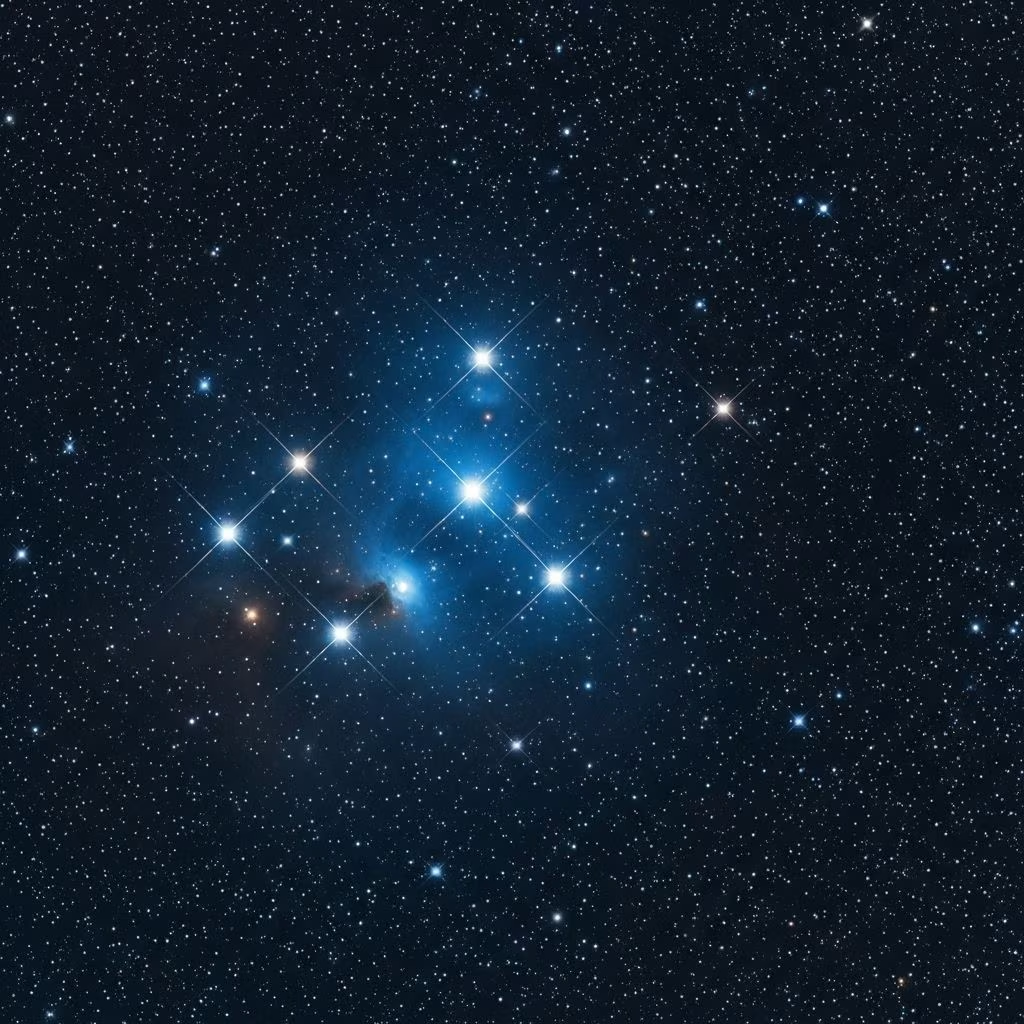
The Pleiades, also known as the Seven Sisters or Messier 45 (M45), is one of the brightest and most recognizable open star clusters in the night sky. Nestled in the constellation Taurus, the cluster has captivated human imagination for millennia, blending striking astronomical features with rich mythological and cultural significance. Its dazzling cluster of hot blue stars makes it a favorite among professional astronomers and casual stargazers alike.
Overview: What Are the Pleiades?
The Pleiades is an open star cluster—a group of stars born from the same giant molecular cloud and loosely bound by gravity. Located about 444 light-years from Earth, it stands as one of the nearest and most studied open clusters in the universe. It is visible to the naked eye from most places on Earth, even under moderately light-polluted skies, and is prominent in the sky from autumn through spring in the Northern Hemisphere.
- Constellation: Taurus
- Distance from Earth: Approximately 444 light-years
- Apparent Magnitude: 1.6 (cluster); brightest individual star (Alcyone): +2.87
- Number of stars visible by eye: 6 to 7, up to 14 with exceptional viewing conditions
- Total stars in the cluster: Over 1,000 identified members
Physical Properties and Composition
The Pleiades cluster is dominated by hot, blue, B-type stars that have formed within the last 100 million years. These stars shine brightly in white to blue hues, and many are enveloped by a faint, wispy blue reflection nebula. Early astronomers believed these nebulae were remnants of the stars’ formation, but recent studies indicate they are instead clouds of interstellar dust that the cluster is currently passing through.
- Cluster type: Open
- Composition: Mainly B-type main-sequence stars, with some white dwarfs and brown dwarfs
- Nebulosity: Reflection nebulae (not formation remnants but intervening dust)
Main Stars of the Pleiades
The cluster’s most prominent members are named after the Seven Sisters of Greek mythology and their parents. The brightest stars, arranged in a dipper-like pattern, are easily seen without telescopic aid:
| Star Name | Role in Mythology | Apparent Magnitude | Notable Features |
|---|---|---|---|
| Alcyone | Brightest sister | +2.87 | Central, often considered the group’s leader |
| Atlas | Father | +3.62 | Forms the ‘handle’ of the dipper |
| Pleione | Mother | +5.09 | Close to Atlas; periodically variable |
| Maia | Eldest sister | +3.87 | Noted for distinct separation in the cluster |
| Electra | Sister | +3.70 | Part of main arc |
| Merope | Sister | +4.18 | Embedded in the Merope Nebula |
| Taygeta | Sister | +4.29 | Fainter but often visible |
| Celaeno | Sister | +5.45 | Often hard to spot |
| Asterope | Sister | +5.76 | Double star system |
Formation and Evolution
The Pleiades cluster originated from a dense stellar nursery, perhaps similar to today’s Orion Nebula. Computer simulations suggest that the stars initially formed in a much tighter configuration. Over time, the cluster’s stars spread out, their mutual gravitational attraction lessening as they interact with the surrounding Milky Way. Astronomers expect the cluster to dissolve in about 250 million years as these stars are scattered by galactic forces.
- Current age: ~100 million years
- Estimated survival: Another 250 million years before dispersal
- Past configuration: Compact cloud, possibly like Orion Nebula
- Main changes: Gradual dispersal due to galactic tidal forces
How to Find the Pleiades in the Night Sky
The Pleiades are easy to locate for most observers. Here’s how to spot them:
- Look in the constellation Taurus, northwest of the distinctive V-shaped Hyades cluster that marks the face of the bull.
- The Pleiades have a size of about 110 arcminutes (almost four times the diameter of the full moon).
- In northern autumn and winter, the cluster rises early in the evening and is visible overhead.
- Use the familiar ‘three stars in a row’ of Orion’s Belt: draw a line upward (from left to right) to reach the Pleiades’ cluster[10].
- The group forms a tiny dipper shape; do not confuse it with the Little Dipper (Ursa Minor).
Observing the Pleiades
The Seven Sisters are impressive to the unaided eye, but binoculars or a small telescope reveal dozens of fainter stars and the blue nebulosity encasing the brightest members. Astrophotographers prize the cluster for its bright, well-defined stars against a murky background. Here are some tips for observation:
- Best viewing time: Late autumn through winter (Northern Hemisphere); cluster culminates in November and December.
- Equipment: Visible to naked eye; binoculars or a wide-field telescope enhance the sight.
- Under dark skies: Look for a scattering of 7-14 stars, plus hints of misty blue nebulosity around the brightest ones.
- Through binoculars/telescope: Hundreds of stars become visible, with vibrant color and detail.
- Astrophotography: Long exposures reveal the cluster’s surrounding reflection nebula.
Pleiades in Mythology
The Pleiades’ distinctive appearance has earned it a prominent place in the mythology and folklore of cultures across the world. The ancient Greeks called the stars the Seven Sisters—daughters of Atlas and Pleione. Many cultures have their own stories and interpretations:
- Greek Mythology: The sisters, pursued by Orion, were placed in the sky by Zeus.
- Japanese: Known as Subaru, symbolizing unity (and the car company’s logo).
- Native American: Numerous tribes describe the group as sisters or maidens; in some legends, the Pleiades are children escaping a bear or dancing for the gods.
- Ancient Egyptians: Associated with the goddess Neith and seasonal cycles.
The number of stars seen (usually six to seven) led to tales explaining the ‘missing sister’ across cultures.
Cultural and Historical Significance
Historically, the Pleiades played a vital role in marking the changing seasons and guiding agricultural calendars. Around 2,300 BC, the cluster marked the position of the vernal equinox in the ancient sky.
- Astronomical calendars: Many ancient peoples used the heliacal rising (first visible pre-dawn appearance) of the Pleiades as a marker for sowing and harvest times.
- Navigational aid: The cluster’s brightness and position made it a reference point for sea voyagers, especially in the Pacific and Mediterranean.
- Astronomy: The Pleiades, along with the nearby Hyades cluster, form the ‘Golden Gate of the Ecliptic’, a region of the sky through which the Sun, Moon, and planets regularly pass.
The Science Behind the Pleiades
Modern studies of the Pleiades provide crucial insights into stellar evolution, cluster dynamics, and the composition of the interstellar medium:
- Stellar ages: The cluster’s stars are among the youngest in the galaxy, offering a snapshot of early stellar and planetary formation.
- Dust interaction: The blue nebulosity arises because the cluster is currently passing through a cloud of dust (moving at ~18 km/s) unrelated to the cluster’s formation.
- Future: Over millions of years, the cluster will gradually disperse due to gravitational interactions with the Milky Way.
- Brown dwarfs: Recent discoveries highlight numerous brown dwarfs and planetary-mass objects in the cluster, pushing the limits of current observational technology.
- Distance: Recent Hubble Space Telescope measurements place the cluster at 444 light-years—somewhat resolving previous debates between earlier parallax, main-sequence fitting, and Hipparcos data.
Astrophotography and Skywatching Tips
- Use a DSLR or mirrorless camera with a telephoto or short focal length telescope for deep exposures.
- Track the sky with a star tracker (or equatorial mount) to allow longer exposures and reveal nebulosity.
- Even short exposures from a dark-sky site will capture the blue haze around Merope and Maia.
- Wide-field photos often include both the Pleiades and the Hyades.
Fun Facts About the Pleiades
- The cluster’s stars are sometimes mistaken for the Little Dipper—an easy error since the Pleiades form a miniature ‘dipper’ shape, but are unrelated to Ursa Minor.
- The Subaru automobile logo features six stars, representing the visible Pleiades and symbolizing the merger of five companies into one.
- The Pleiades have been referenced in texts from Homer’s Odyssey to the Bible and countless works of art and literature.
Frequently Asked Questions (FAQs)
Q: How many stars make up the Pleiades?
A: Astronomers have identified over 1,000 stars in the cluster, but only six or seven are typically visible to the naked eye, depending on observing conditions.
Q: Why are the Pleiades called the Seven Sisters?
A: The name refers to the seven brightest stars, which correspond to the daughters of Atlas and Pleione in Greek mythology.
Q: Are the Pleiades and the Little Dipper the same?
A: No, the Pleiades and the Little Dipper are distinct. The Little Dipper is a pattern in Ursa Minor, while the Pleiades form a much smaller dipper shape in Taurus.
Q: Can you see the Pleiades from the Southern Hemisphere?
A: Yes, the Pleiades are visible from much of the Southern Hemisphere, but appear lower in the northern sky, especially from southern latitudes.
Q: What is special about the blue nebulosity around the Pleiades?
A: The blue glow is caused by interstellar dust reflecting the light of hot, young stars—the color results from efficient scattering of blue wavelengths.
Summary
The Pleiades offers a remarkable window into stellar evolution, cosmic history, and human imagination. Whether you investigate its scientific mysteries or gaze up in awe at its celestial beauty, the Seven Sisters continue to inspire astronomers, storytellers, and skywatchers across the globe.
References
- https://en.wikipedia.org/wiki/Pleiades
- https://science.nasa.gov/mission/hubble/science/explore-the-night-sky/hubble-messier-catalog/messier-45/
- https://www.space.com/34771-stunning-pleiades-star-cluster-stargazer-photo.html
- https://www.space.com/star-clusters-winter-skywatching
- https://www.rmg.co.uk/stories/space-astronomy/what-are-pleiades
- https://astrobackyard.com/m45-the-pleiades/
- https://science.nasa.gov/missions/hubble/hubble-refines-distance-to-pleiades-star-cluster/
- https://www.skyatnightmagazine.com/astrophotography/stars/star-clusters/pleiades
- https://case.edu/news/astronomys-chris-mihos-explains-bright-star-cluster-known-pleiades
- https://www.glyphweb.com/esky/clusters/pleiades.html
- https://starwalk.space/en/news/m45-pleiades-star-cluster
- https://cosgrovescosmos.com/projects/m45-pleaides-star-cluster
- https://www.cfa.harvard.edu/news/how-far-are-pleiades-really
- http://www.pleiade.org/pleiades_03.html
- https://thedaily.case.edu/astronomys-chris-mihos-explains-bright-star-cluster-known-as-the-pleiades/
- https://www.sciencefocus.com/space/how-can-i-see-the-pleiades-star-cluster
- https://telescopicwatch.com/how-to-find-pleiades-star-cluster/