


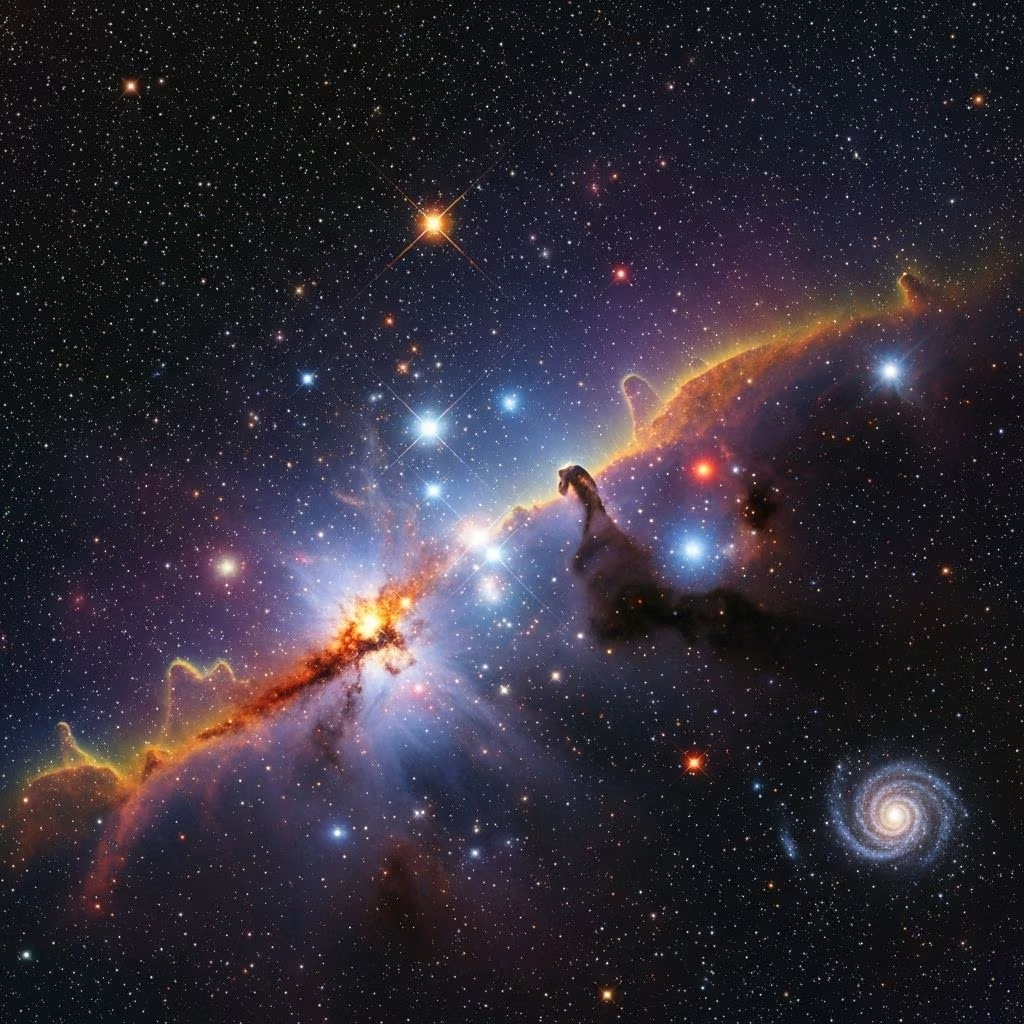
What Is a Nebula?
A nebula is an immense cloud of gas and dust found in interstellar space, often stretching for tens or even hundreds of light-years. The term “nebula” comes from the ancient Greek word for “cloud” and represents some of the most visually arresting objects in astronomy.
Nebulae are significant for their role in star formation and their contribution to the galactic ecosystem.
- Composed mainly of hydrogen and helium gases, with traces of heavier elements.
- Appear either as glowing patches, dark shrouds blocking starlight, or indistinct luminous regions in the night sky.
- Density is extremely low—often less than the best vacuum humans can create, but still far denser than typical space.
- Sizes can range from a few light-years to hundreds of light-years across.
- Vital for understanding star birth, death, and recycling of cosmic material.
Types of Nebulae
Nebulae are classified into several categories based on how they interact with light and their origin. The most widely accepted classification divides nebulae into diffuse nebulae and other distinct types.
| Nebula Type | Key Features | Main Examples |
|---|---|---|
| Emission Nebulae | Glow due to ionized gas emitting light; usually red from hydrogen emission. | Orion Nebula, Lagoon Nebula |
| Reflection Nebulae | Shine due to starlight reflecting off dust particles; appear blue. | Pleiades Nebula, Witch Head Nebula |
| Dark Nebulae | Dense clouds that block background starlight; visible as dark patches. | Horsehead Nebula, Barnard 68 |
| Planetary Nebulae | Formed from dying stars shedding outer layers; usually ring-like. | Ring Nebula, Helix Nebula |
| Supernova Remnants | Expanding shells of material expelled in supernova explosions from massive stars. | Crab Nebula, Cassiopeia A |
Diffuse Nebulae
The term diffuse nebula includes both emission and reflection nebulae and encompasses nebulae with no sharply defined edges. These are often the most visually stunning and complex forms seen in astrophotography.
Emission Nebulae
- Emissions occur when high-energy radiation from hot, young stars ionizes surrounding hydrogen gas.
- Ionized hydrogen (H II regions) emits distinctive red light.
- Often serve as stellar nurseries where new stars are actively forming.
- Orion Nebula is the classic example, visible even to amateur astronomers.
Reflection Nebulae
- Do not produce their own light but reflect light from nearby stars.
- Appear blue due to scattering of shorter wavelengths off dust particles (similar to Earth’s sky).
- Often found alongside emission nebulae or embedded within star clusters.
- The Pleiades Reflection Nebula is a prominent example.
Dark Nebulae
- Regions of dense dust and gas that absorb visible light, blocking it from reaching Earth.
- Appear as silhouettes against brighter backgrounds like star fields or glowing nebulae.
- Often rich sites for star formation deep within their opaque interiors.
- The Horsehead Nebula and Barnard 68 are among the best known.
Planetary Nebulae
A planetary nebula forms from low- to intermediate-mass stars near the end of their lives. As the star exhausts its nuclear fuel, it sheds its outer layers, leaving behind a hot core that ionizes the expelled gas and produces a glowing shell. Planetary nebulae are usually:
- Small and bright, lasting only tens of thousands of years in a typical star’s life cycle.
- Characterized by intricate ring-like, bubble, or hourglass shapes.
- Invariably property of the stellar evolution ending in a white dwarf.
- Ring Nebula and the Helix Nebula are popular examples, often studied for their beauty and scientific value.
Supernova Remnants
When a massive star ends its life in a catastrophic supernova explosion, the material ejected forms an expanding shell filled with energised particles and illuminated by shock waves. These remnants:
- Can span dozens of light-years as they expand over thousands of years.
- Include both gas and high-energy subatomic particles accelerated to extreme velocities.
- Are vital for spreading heavy elements into the galaxy, enriching future stars and planets.
- Crab Nebula is the archetypal supernova remnant, studied for its pulsar and dazzling structure.
Composition of Nebulae
Most nebulae are made up of simple atoms—primarily hydrogen and helium. However, they also include:
- Interstellar dust grains composed of carbon, silicates, ice, and metals.
- Traces of heavier elements such as oxygen, nitrogen, and sulfur—products of stellar nucleosynthesis.
- Molecules ranging from simple hydrogen (H2) to complex organic compounds in certain cases.
This composition is crucial for the formation of new stars, planetary systems, and even organic molecules that may play a role in cosmic chemistry.
How Nebulae Form
Nebulae can form through several cosmic processes:
- Stellar birth: Collision and gravitational collapse of interstellar clouds triggers star formation, generating emission and reflection nebulae.
- Stellar death: Planetary nebulae and supernova remnants result from the end-of-life phases of stars.
- Interstellar shocks: Massive stellar winds or supernova explosions compress surrounding matter, giving rise to new nebulae.
- Galactic recycling: Nebulae continuously gather and redistribute the “raw ingredients” for future generations of stars and planets.
Role of Nebulae in Astronomy
Nebulae are stellar nurseries—crucial sites for the birth of stars and planetary systems. Observing nebulae provides astronomers with answers to some of the most essential questions about our universe:
- How do stars form and die?
- How are heavy elements created and distributed?
- How do planets form from the remnants of stars?
- What conditions are necessary for complex molecules to emerge?
Telescopes equipped with special filters and high sensitivity capture intricate details from nebulae across the electromagnetic spectrum. Infrared, ultraviolet, and X-ray imagery reveal processes invisible to the human eye.
Examples of Famous Nebulae
- Orion Nebula (Messier 42): An emission nebula and stellar nursery, visible to the naked eye in Orion’s sword.
- Ring Nebula (Messier 57): A classic planetary nebula showcasing the end-of-life stage of a dying star.
- Crab Nebula (Messier 1): A supernova remnant left from a star explosion observed in 1054 AD, now pulsing with energy from a neutron star.
- Horsehead Nebula: A dramatic dark nebula silhouetted in the constellation Orion.
- Pleiades Nebula: A reflection nebula found around the hot, blue stars of the Pleiades star cluster.
The Science Behind Nebular Glow
The breathtaking glow of nebulae arises from their composition and the presence of energetic stars:
- Ionized gases in emission nebulae shine brightly due to electron transitions emitting at specific wavelengths.
- Dust grains scatter blue light from nearby hot stars, making reflection nebulae appear blue.
- Dark nebulae do not emit visible light—they are revealed only by the absence of light and through infrared observations that penetrate dust.
- The visible light we see can be enhanced by telescopes using long exposures and narrowband imaging techniques, revealing structures invisible to the naked eye.
Observing Nebulae
Modern astronomy relies heavily on observing nebulae to understand stellar evolution and the dynamics of the galaxy:
- Optical telescopes capture stunning views in visible light.
- Infrared telescopes can peer through dust, revealing hidden stars and embedded protostars.
- Radio telescopes detect cold gas and molecules in dark nebulae.
- Spectroscopy helps dissect the light from nebulae for clues on chemical composition, temperature, density, and movement.
FAQs: Nebulae Explained
Q: What is the difference between emission, reflection, and dark nebulae?
A: Emission nebulae glow due to ionized gas emitting light; reflection nebulae shine by reflecting starlight; dark nebulae block background light and appear as silhouettes.
Q: Can we see nebulae with the naked eye?
A: Only a few, like the Orion Nebula and occasional patches of the Milky Way, are visible without telescopes. Most require long exposures or large instruments.
Q: Why are planetary nebulae called ‘planetary’?
A: The term arose from early astronomers who thought these roundish nebulae resembled the disks of distant planets. They have no relation to actual planets.
Q: Are nebulae only found in our galaxy?
A: Nebulae exist in galaxies throughout the universe. Similar processes shape star formation and death wherever stars are present.
Q: How do nebulae influence the life cycle of stars?
A: Nebulae both create new stars through gravitational collapse and recycle elements for future generations through planetary and supernova nebulae.
Conclusion
Whether seen as luminous veils or mysterious dark patches, nebulae embody the very heart of stellar birth, death, and cosmic renewal. Their study reveals the interconnected cycles that shape our galaxy, enrich our skies, and inspire astronomers and observers alike. As technology advances, humanity’s vision of nebulae grows ever more detailed and wondrous, unlocking secrets of the universe written across these majestic cosmic clouds.
References
- https://www.britannica.com/science/nebula
- https://en.wikipedia.org/wiki/Nebula
- https://astrobackyard.com/what-is-a-nebula/
- https://www.photographingspace.com/what-are-nebulae/
- https://study.com/academy/lesson/nebula-definition-theory-quiz.html
- https://myspacemuseum.com/types-of-nebulae
- https://study.com/learn/lesson/nebula-types-differences.html
- https://www.telescopenerd.com/celestial-objects/nebula.htm
- https://science.nasa.gov/mission/hubble/science/universe-uncovered/hubble-nebulae/
- http://www.spaceopedia.com/space-universe/nebulae/
- https://www.space4alleducation.com/all-about-nebulas/
- https://spaceplace.nasa.gov/nebula/en/
- https://orbitaltoday.com/2024/09/20/what-is-a-nebula-the-cradle-and-tomb-of-the-stars/
- https://bigthink.com/starts-with-a-bang/different-types-nebula-astronomy/
- https://space-facts.com/nebulae/
- https://www.britannica.com/science/planetary-nebula
- https://observetheuniverse.com/what-is-a-nebula-and-how-is-it-formedtypes-of-nebulae/
- https://www.highpointscientific.com/astronomy-hub/post/astronomy-101/what-is-a-nebula-and-which-are-the-best-ones
- https://www.spacecentre.co.uk/news/space-now-blog/what-is-a-nebula/
- https://www.skyatnightmagazine.com/space-science/beginners-guide-nebulae


