Who Invented the Telescope?
The invention of the telescope marks one of humanity’s most significant scientific advancements, transforming our understanding of the cosmos and our place within it. While the question ‘Who invented the telescope?’ seems straightforward, the real story unfolds across centuries of optical innovation, invention disputes, and remarkable breakthroughs that shaped modern astronomy.
What Is a Telescope?
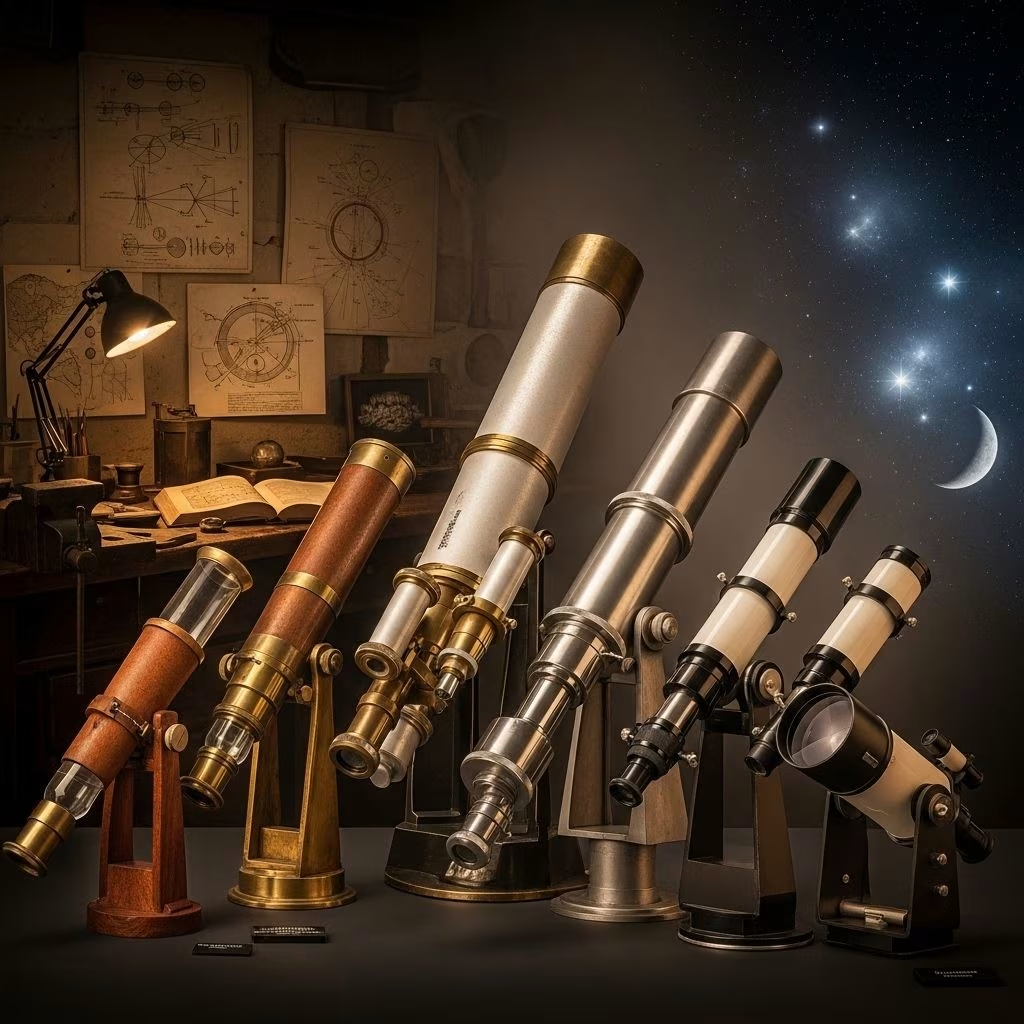
A telescope is an optical instrument designed to make distant objects appear closer and more detailed by gathering and focusing light. While today telescopes come in many varieties (refracting, reflecting, radio, and more), their essential purpose has remained unchanged since the earliest designs: to extend the human eye’s reach beyond unaided vision.
Ancient Foundations: Early Optics & Precursors
- Egyptian Artisans (circa 2560 BC): Polished rock crystals and glass for statuary eyes, hinting at an early understanding of optical illusions and light manipulation.
- Aristophanes and Water Lenses (424 BC): Ancient Greeks experimented with water-filled glass globes to magnify text and create basic lenses.
- Euclid (3rd Century BC): Pioneered the mathematical study of light, reflection, and refraction, laying groundwork for optical science.
- Ibn al-Haytham (10th–11th Century): His ‘Book of Optics’ deeply influenced European exploration of lenses and vision.
- Late 13th Century: The invention of spectacles in Europe established the lens-making craftsmanship needed for future telescopes.
The Birth of the Telescope: 17th Century
The breakthrough that would define the modern telescope occurred in the early 1600s in the Netherlands, at a crossroads of lens-making expertise and scientific curiosity.
Hans Lippershey: The First Patent
- Hans Lippershey was a Dutch spectacle-maker in Middelburg.
- On October 2, 1608, Lippershey applied for a patent for an instrument ‘for seeing things far away as if they were nearby.’
- The original device used a combination of convex and concave lenses, achieving a modest magnification (around 3x) and producing an upright (not inverted) image.
- The patent was not granted (others already knew of the technology), but the design quickly spread across Europe, with Lippershey awarded a government contract for copies.
Other Contenders: Jacob Metius & Zacharias Janssen
- Jacob Metius applied for a similar patent only weeks after Lippershey.
- Zacharias Janssen, another Dutch spectacle-maker, has also been named by some sources as a possible inventor, though with less direct documentary evidence.
- The intense burst of inventions in the Netherlands around 1608 highlights how ripe the era was for the telescope’s development.
Table: Early Telescope Inventors
| Name | Contribution | Year | Notes |
|---|---|---|---|
| Hans Lippershey | First patent application for telescope | 1608 | Received government contract, not patent |
| Jacob Metius | Similar patent application | 1608 | Unsuccessful |
| Zacharias Janssen | Later claims as inventor | Circa 1608 | Documentation disputed |
Galileo’s Revolution: The Telescope Meets Astronomy
The telescope’s potential was transformed by Galileo Galilei, who learned of its design via reports from Holland in 1609. Within months, Galileo built his own improved version and directed it at the night sky.
- Galileo’s telescopes offered up to 20x magnification, exceeding the original Dutch devices.
- He discovered Jupiter’s moons, lunar craters, Venus’s phases, and countless new stars, forever changing our understanding of the cosmos.
- Galileo did not invent the telescope, but by applying it to astronomy, he cemented its place in scientific history.
Key Discoveries by Galileo
- Four largest moons of Jupiter (Io, Europa, Ganymede, Callisto)
- Mountains and craters on the Moon
- Phases of Venus (vindicating heliocentric theory)
- Countless new stars in the Milky Way
Early Telescope Improvements: Kepler and Beyond
- Johannes Kepler (1611): Proposed the “Keplerian” telescope with two convex lenses, enabling higher magnification but inverting the image—still the foundation for modern refractors.
- Christiaan Huygens (1655): Developed even more powerful telescopes for astronomy, though early designs were unwieldy due to their length.
Reflecting & Achromatic Telescopes: Solving New Challenges
Early refracting telescopes suffered from “chromatic aberration,” a rainbow-like distortion around images. The quest for clarity pushed builders toward new solutions.
Reflecting Telescopes
- Isaac Newton (1668): Built the first successful reflecting telescope, using mirrors instead of lenses to gather light, thereby eliminating chromatic aberration.
- Laurent Cassegrain (1672): Created a new reflector design with a convex secondary mirror (the basis of many modern observatory telescopes).
Achromatic Lenses
- Chester Moore Hall (1733): Invented the achromatic lens, greatly reducing color distortions. However, he did not publicize the invention.
- John Dollond (1758): Independently developed and patented achromatic lenses, making practical, shorter telescopes possible.
Table: Milestones in Telescope Design
| Year | Innovation | Innovator | Impact |
|---|---|---|---|
| 1611 | Keplerian Refractor | Johannes Kepler | Higher magnification, inverted image, astronomy-focused |
| 1668 | Reflecting Telescope | Isaac Newton | Mirror-based optics, eliminated chromatic aberration |
| 1733 | Achromatic Lens | Chester Moore Hall | Reduced color distortion |
| 1758 | Achromatic Lens Patent | John Dollond | Commercial production of advanced refractors |
Who Truly “Invented” the Telescope?
The race to invent the telescope sparked renowned disputes and myths:
- Lippershey is most often credited with the first practical telescope.
- Some argue for Jacob Metius or Zacharias Janssen, but patent records and early contracts favor Lippershey.
- The idea of lenses making distant things appear near circulated for decades before 1608.
- The invention quickly diffused throughout Europe, where further improvements and applications rapidly took off.
Lasting Impact: Astronomy and Beyond
Telescope technology transformed not only astronomy but also fields as varied as navigation, warfare, and microscopy:
- Revealed the structure of the solar system and paved the way for modern astrophysics.
- Facilitated critical navigation improvements for exploration.
- Laid foundations for technologies like the microscope, opening new worlds in biology and medicine.
- Modern telescopes—radio, infrared, space-based—are direct heirs to these 17th-century innovations.
Telescope Timeline: Key Events
- 424 BC: Water-filled globes used as basic lenses (Aristophanes).
- 3rd Century BC: Euclid’s studies of light, reflection, and refraction.
- 10th–12th Century: Ibn al-Haytham’s optics inspire European lens-makers.
- 1608: Lippershey’s patent application in the Netherlands.
- 1609: Galileo constructs telescope for astronomy.
- 1611: Kepler’s improved refractor design.
- 1668: Newton’s reflecting telescope.
- 1672: Cassegrain’s secondary mirror innovation.
- 1733–1758: Achromatic lens development (Hall, Dollond).
Frequently Asked Questions (FAQs)
Who is officially credited with inventing the telescope?
Hans Lippershey is most often credited with inventing the first practical telescope, based on his 1608 patent application in the Netherlands.
Did Galileo invent the telescope?
No. Galileo improved on Dutch designs and was the first to apply the telescope systematically to astronomy, making landmark discoveries as a result.
Why was there controversy over the invention?
Multiple Dutch lens-makers developed similar devices around the same time, and patent disputes and unclear records have fueled debate over who deserves the credit.
What is the difference between refracting and reflecting telescopes?
- Refracting telescopes use lenses to gather and focus light.
- Reflecting telescopes use mirrors, which can be much larger, avoid chromatic aberration, and are the basis of most large research telescopes today.
How did telescopes change science?
- They allowed direct observation of celestial bodies, disproving ancient cosmological models and igniting the Scientific Revolution.
- Modern instrumentation owes its lineage directly to these early optical breakthroughs.
Conclusion: The Telescope’s Ongoing Legacy
The telescope began as a modest device for magnifying distant objects but rapidly evolved into humanity’s primary tool for exploring the universe. Its story is one of incremental innovation, international competition, and transformative discovery. As our instruments grow ever more sophisticated—from enormous ground-based observatories to powerful space telescopes—the humble 17th-century Dutch telescope remains the original spark of cosmic curiosity.
References
- https://en.wikipedia.org/wiki/History_of_the_telescope
- https://en.wikipedia.org/wiki/Timeline_of_telescope_technology
- https://www.historyoftelescope.com/telescope-history/telescope-timeline/
- https://www.telescopenerd.com/telescope-timeline.htm
- https://ethos.lps.library.cmu.edu/article/id/480/
- https://www.rmg.co.uk/stories/space-astronomy/history-telescope
- https://www.space.com/21950-who-invented-the-telescope.html
- https://history.aip.org/exhibits/cosmology/tools/tools-first-telescopes.htm
- https://www.youtube.com/watch?v=eChiW3coNcY
- https://www.historyoftelescope.com
- http://www.scientus.org/timeline/telescope.html
- https://www.loc.gov/collections/finding-our-place-in-the-cosmos-with-carl-sagan/articles-and-essays/modeling-the-cosmos/galileo-and-the-telescope
- https://www.highpointscientific.com/astronomy-hub/post/astronomy-101/the-evolution-of-the-telescope
- https://science.nasa.gov/mission/hubble/overview/hubble-timeline/
- https://www.britannica.com/science/optical-telescope
- https://www.britannica.com/science/optical-telescope/The-development-of-the-telescope-and-auxiliary-instrumentation
- https://aas.org/posts/story/2017/10/month-astronomical-history-invention-telescope
- https://www.youtube.com/watch?v=NUqMRH3tJaU