


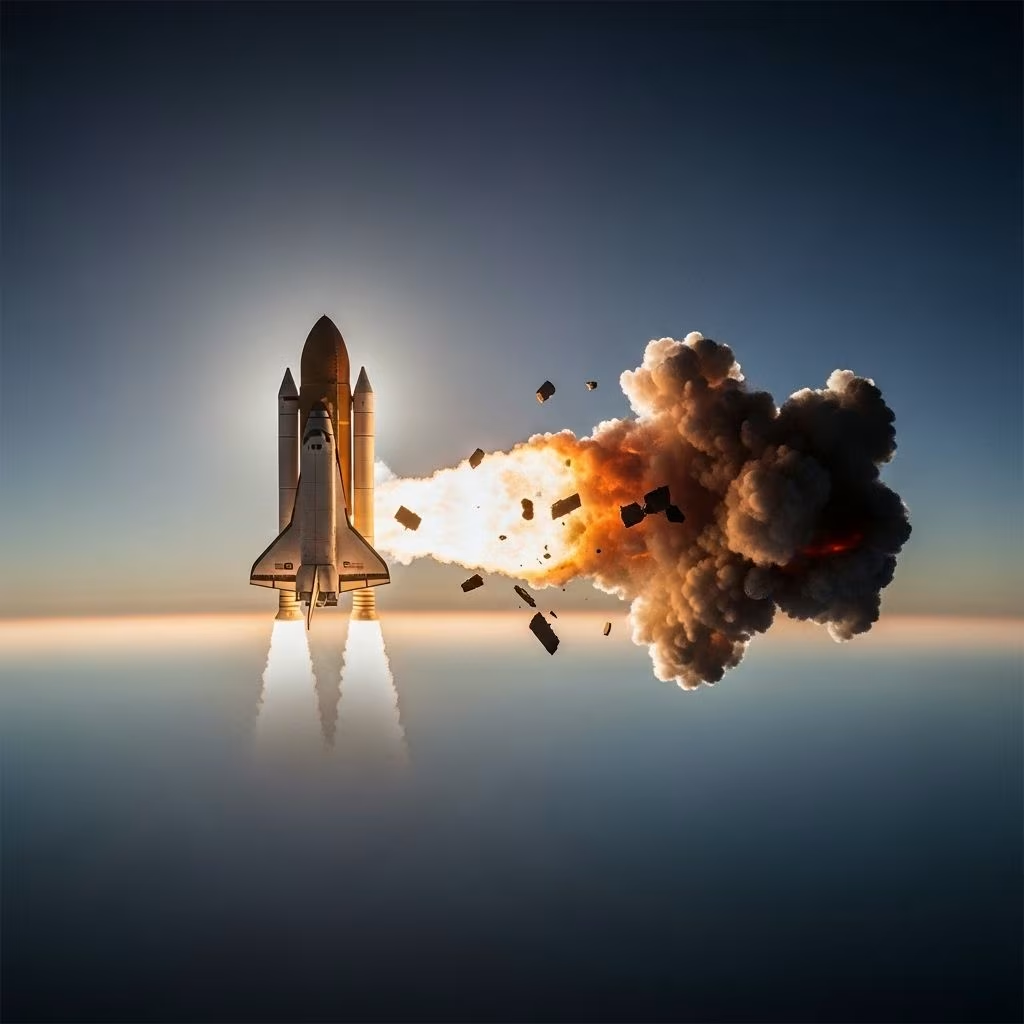
Space Shuttle Challenger: Tragedy, Causes, and Lasting Impact
The destruction of the Space Shuttle Challenger on January 28, 1986, stands as a defining moment in the history of human spaceflight. Its tragic loss shook the world, resulted in the deaths of seven astronauts, and forced a radical reassessment of space program safety and culture. This comprehensive article examines the mission, the disaster, its technical and organizational causes, the aftermath, and the indelible lessons Challenger left for future generations.
Mission Overview
Challenger’s ill-fated mission, STS-51-L, was intended to be a milestone in space exploration and science education. As the 25th launch of the U.S. Space Shuttle fleet and the tenth flight of the orbiter Challenger, its goals included:
- Deploying a commercial communications satellite into orbit.
- Conducting scientific studies of Halley’s Comet using onboard equipment.
- Flying Christa McAuliffe, the first civilian and teacher in space, as part of NASA’s Teacher in Space Project.
This high-profile mission drew intense public and media attention, especially in schools across America, where students watched the launch live, investing hopes in educational outreach and civilian inclusion in spaceflight.
The Crew of Challenger STS-51-L
The crew of Challenger represented not only the technical and scientific excellence of NASA’s astronaut corps, but also the growing diversity and reach of American space exploration. The seven astronauts lost in the disaster were:
- Francis R. (Dick) Scobee – Commander
- Michael J. Smith – Pilot
- Judith A. Resnik – Mission Specialist
- Ellison S. Onizuka – Mission Specialist
- Ronald McNair – Mission Specialist
- Christa McAuliffe – Payload Specialist, Teacher in Space
- Gregory Jarvis – Payload Specialist
Christa McAuliffe’s inclusion captured the imagination of millions, positioning the mission as a transformative event for education and public engagement with the U.S. space program.
Launch Day: January 28, 1986
Date & Time: 11:39:13 a.m. EST (16:39:13 UTC)
Location: Kennedy Space Center, Launch Complex 39B, Cape Canaveral, Florida
The launch day was marked by record-low temperatures, dipping to levels not previously tested in shuttle launches. Frost and ice were present at the launch site, raising concerns among engineers and technical staff.
The Disaster Unfolds
Challenger lifted off successfully, but just 73 seconds into flight, catastrophe struck. The shuttle reached an altitude of approximately 46,000 feet (14 km), then suddenly broke apart in a massive explosion visible to millions watching live.
- Time of Breakup: 73 seconds after liftoff
- Speed: Mach 1.92 (nearly twice the speed of sound)
- Location: Over the Atlantic Ocean, off Cape Canaveral
The two solid rocket boosters separated and continued uncontrolled flight for several seconds before range safety officers remotely detonated them to avoid further hazards. The main orbiter cabin, still mostly intact, plunged into the sea with the crew inside.
What Caused the Challenger Disaster?
The immediate and ultimate causes of the Challenger disaster were both technical and organizational:
Technical Cause: O-Ring Failure
- The right Solid Rocket Booster (SRB) used a series of O-ring seals to prevent hot gases from escaping the segmented joints.
- The unprecedented cold on launch day made the O-rings brittle, reducing their flexibility and failure to properly seal a joint between segments.
- Shortly after ignition, hot, pressurized gases escaped through a hole created by this failed seal—called a “blow-by.”
- This hot gas plume eventually impinged on the external fuel tank’s strut, weakening structural support and resulting in a catastrophic breach of the fuel tank.
This sequence culminated in the structural collapse of the fuel tank, destruction of orbiter Challenger, and the fatal breaking apart of the shuttle stack.
Organizational and Management Failures
- Engineers at Morton Thiokol, the booster manufacturer, had previously warned of O-ring failures in cold weather, but their concerns were overridden by NASA management under schedule and budget pressures.
- NASA failed to adequately respond to known design flaws and to enforce rigorous safety checks for conditions outside tested envelopes.
- Communication failures and a lack of a robust safety culture within both NASA and its contractors contributed significantly to the tragedy.
Sequence of the Tragedy: Analyzed Steps
| Event | Time (Seconds) | Description |
|---|---|---|
| Launch | 0 | Challenger lifts off from Launch Pad 39B |
| Smoke Observed at SRB Seal | +0.678 | Puffs of black smoke emerge from right booster O-ring joint |
| Flame Breach Evident | ~59 | Jet of flame burns through booster strut, contacting fuel tank |
| Explosion and Disintegration | +73 | External tank collapses and explodes, destroying orbiter |
| SRB Destruction by Range Officer | +110 | Uncontrolled solid boosters detonated to prevent further danger |
The Aftermath: Investigation and National Grief
The nation and world mourned the loss of Challenger’s crew. An extensive search and salvage operation was launched to recover debris and, tragically, the bodies of the astronauts from the Atlantic Ocean.
- The shock was intensified by the widespread broadcast of the disaster, including classrooms of children watching in real time.
Presidential Inquiry: The Rogers Commission
Immediately after the accident, President Ronald Reagan convened the Rogers Commission to investigate the causes and circumstances. The commission, led by former Secretary of State William P. Rogers and featuring physicist Richard Feynman, identified and highlighted:
- The direct technical cause (O-ring seal failure and cold-induced brittleness).
- Insufficient communication between engineers and decision-makers at both NASA and Morton Thiokol.
- Pervasive issues in NASA’s culture, such as schedule-driven decision-making that allowed risks to accumulate.
- A need to overhaul management, safety protocols, and quality assurance throughout NASA and its contractors.
Changes to Shuttle Program After Challenger
The Challenger disaster profoundly shaped the course of the U.S. space program and shuttle safety protocols:
- Redesign of the Solid Rocket Boosters: O-ring joint design was completely overhauled, including triple redundancy and heaters to preserve flexibility in low temperatures.
- Overhaul of NASA Safety Practices: NASA established the Office of Safety, Reliability, and Quality Assurance, separating safety concerns from program management.
- Expanded Escape Procedures: Contingency and abort options were expanded, though inherent limits in shuttle orbiter design still prevented full mid-flight crew escape options.
- Educational and Public Outreach: The Teacher in Space Project was suspended, but its legacy inspired renewed focus on education and STEM initiatives in the years following.
Shuttle flights resumed only in 1988 with STS-26, featuring strengthened safety, improved management, and acknowledgment of the lessons paid for by Challenger’s loss.
Lasting Impact and Legacy
- The Challenger accident remains a sobering reminder of the risks involved in spaceflight and the imperative to prioritize safety over schedules or external pressures.
- It highlighted the need for transparent communication and a culture where technical expertise could override bureaucratic inertia or political pressures.
- Challenger’s story endures in classrooms and policy debates as a catalyst for engineering ethics, risk management, and a testament to the courage of space explorers.
Frequently Asked Questions (FAQs)
What was the immediate cause of the Challenger explosion?
The immediate technical cause was the failure of O-ring seals in the right solid rocket booster due to cold temperatures, permitting hot gas to escape and breach the external fuel tank, leading to vehicle breakup.
Who were the astronauts lost in the Challenger disaster?
- Francis R. (Dick) Scobee
- Michael J. Smith
- Judith A. Resnik
- Ellison S. Onizuka
- Ronald McNair
- Christa McAuliffe
- Gregory Jarvis
How did the public react to the Challenger disaster?
The disaster elicited national grief, intensified by live broadcasts, especially to schoolchildren. The tragedy sparked intense scrutiny and calls for change in NASA’s procedures and leadership.
What changes did NASA implement after Challenger?
- Redesign of shuttle solid boosters with improved joint and O-ring mechanisms.
- Increased independence and authority of NASA’s safety offices.
- New protocols for risk assessment, management supervision, and mission readiness.
What lessons does Challenger teach future space programs?
The tragedy emphasizes the need for relentless attention to technical warnings, transparent communications, and a safety-first culture. These lessons are fundamental to successfully undertaking complex, high-risk technological missions.
Key Facts Table: Challenger Disaster
| Mission Name | STS-51-L |
|---|---|
| Date of Accident | January 28, 1986 |
| Time to Disaster | 73 seconds after launch |
| Main Cause | O-ring failure in right SRB exacerbated by extreme cold |
| Fatalities | 7 crew members |
| Investigative Body | Rogers Commission |
| Outcomes | Redesigns, safety reforms, increased oversight |
Further Reading and Resources
- Rogers Commission Report: The official findings and recommendations from the presidential commission are a cornerstone for understanding both the accident and the reforms that followed.
- NASA Challenger STS-51L Accident Page: Contains detailed timelines, engineering diagrams, and the legacy of the mission.
- Educational Initiatives: Resources inspired by Christa McAuliffe’s legacy continue to encourage students in science, mathematics, and engineering fields.
The Challenger disaster remains, decades later, not solely a technical failure, but a cultural and organizational turning point for NASA and space exploration worldwide—a reminder etched into the legacy of all who dream of the stars.
References
- https://en.wikipedia.org/wiki/Space_Shuttle_Challenger_disaster
- https://www.britannica.com/event/Challenger-disaster
- https://www.nasa.gov/challenger-sts-51l-accident/
- https://www.harpercollins.com/blogs/harperkids/space-shuttle-challenger-explosion
- https://www.ebsco.com/research-starters/history/challenger-accident
- https://www.youtube.com/watch?v=BRK70foCSkk
- https://www.youtube.com/watch?v=gr2WO2Q-CJY
- https://www.nasa.gov/mission/sts-51l/
- https://en.wikipedia.org/wiki/Challenger_explosion
- https://www.ducksters.com/history/us_1900s/space_shuttle_challenger.php
- https://www.space.com/space-shuttle-challenger-disaster-35th-anniversary-2021
- https://www.simscale.com/blog/space-shuttle-challenger-disaster/
- https://www.space.com/31732-space-shuttle-challenger-disaster-explained-infographic.html
- https://www.icheme.org/media/2081/lpb251_pg26.pdf
- https://www.vedantu.com/history/challenger-disaster
- https://cte.ku.edu/sites/cte/files/documents/portfolios/Starrett/Space%20Shuttle%20Challenger%20Disaster.pdf
- https://kyma.com/news/national-world/cnn-national/2023/01/13/space-shuttle-challenger-fast-facts/


