


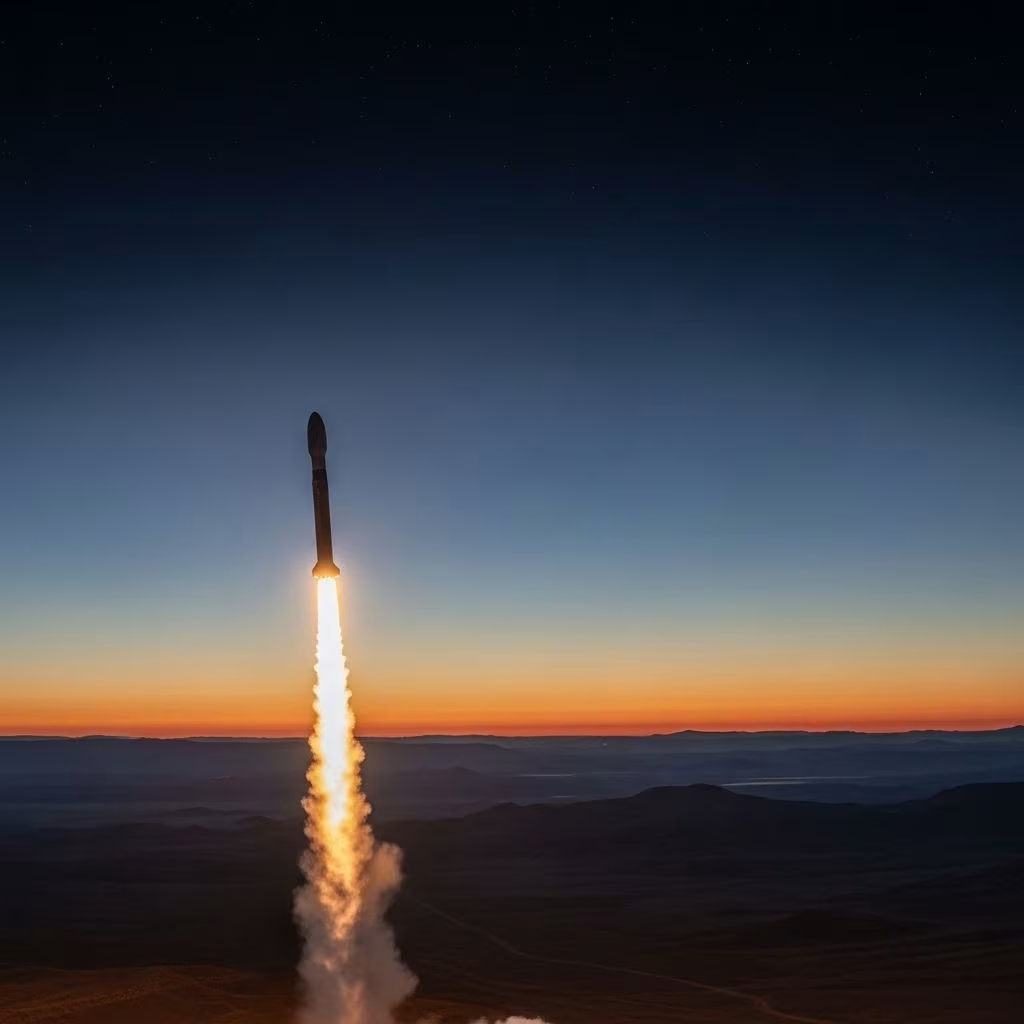
Blue Origin Achieves Milestone with 200th Payload on 35th New Shepard Flight
On August 23, 2025, Blue Origin launched its 35th New Shepard mission (NS-35), marking a historic achievement by carrying its 200th payload into space. The uncrewed suborbital flight took place from Launch Site One in West Texas, and set fresh benchmarks for both commercial spaceflight and scientific research in microgravity environments. The mission’s success highlights the continued evolution of private space companies toward enabling rapid, reliable access to suborbital space for researchers, students, and future explorers.
Table: NS-35 Mission Snapshot
| Mission Name | Launch Date | Vehicle | Payloads Flown | Mission Duration |
|---|---|---|---|---|
| New Shepard NS-35 | August 23, 2025 | RSS H.G. Wells Crew Capsule | 200th+ Science, Research & Educational Payloads | 10 minutes, 14 seconds |
New Shepard’s NS-35 Mission: Overview and Objectives
With a launch time of 8:00 AM CDT (13:00 UTC), NS-35 focused on deploying an array of 40+ payloads originating from NASA, universities, commercial companies, and educational initiatives. The flight was a part of Blue Origin’s broader effort to democratize access to space, support scientific experimentation, and provide unparalleled opportunities for students and educators to test ideas in microgravity.
- Primary Objectives:
- Ferry a diverse range of scientific and educational payloads above the Kármán Line (boundary of space).
- Test and validate new space technologies and research methodologies.
- Engage the next generation through outreach programs and participation in payload development.
- Mission Duration: The entire suborbital hop lasted approximately 10 minutes and 14 seconds, including ascent, apogee, and safe return of both booster and capsule.
Technical Highlights: Capsule, Booster, and Flight Statistics
The NS-35 mission utilized the RSS H.G. Wells Crew Capsule, exclusively configured to carry cargo payloads and the popular ‘Postcards to Space’ outreach program. This was the 12th and final flight for this capsule, which will now be retired from active flight and repurposed for ground testing and future development projects.
- Key Flight Statistics:
- Official Launch Time: 8:00 AM CDT / 13:00 UTC
- Booster Apogee: 341,489 ft (104 km) AGL
- Capsule Apogee: 341,805 ft (104 km) AGL
- Capsule Landing Time: 8:10:14 AM CDT
- Mission Elapsed Time: 10 minutes, 14 seconds
- Both booster and capsule returned safely, highlighting Blue Origin’s reusable system capabilities.
Pioneering Payloads and Experiments aboard NS-35
The diversity of payloads aboard NS-35 underscore Blue Origin’s commitment to facilitating scientific and educational progress in space.
Nasa TechRise Student Challenge
- Selected student experiments centered on plant cultivation in microgravity, liquid behavior, and medical research techniques applicable to future lunar or Martian missions.
- Offering real-world experience for young engineers, these projects tested the boundaries of biological and physical sciences in space.
Teachers in Space Payloads
- Educator-led research initiatives allowed teachers to pilot studies in suborbital settings, broadening science curriculum and inspiring classrooms.
Advanced Technology Demonstrations
- Experiments ranged from spacecraft fuel cell testing to biomedical sensors, all contributing to future moon or Mars hardware development.
Student and University Initiatives
- Many payloads originated from university teams, encouraging the next generation of space scientists and engineers.
Club for the Future: Inspiring with ‘Postcards to Space’
The NS-35 mission also benefited the outreach efforts of Club for the Future, Blue Origin’s nonprofit devoted to STEM inspiration. Thousands of student-created postcards were flown to space during the launch, to be sent back with an official ‘Flown to Space’ stamp, igniting interest and curiosity in space among youth worldwide.
- This signature program continues to expand its reach, with digital methods now available for postcard creation and submission.
Reliable Access, Rapid Turnaround: Blue Origin’s Suborbital Strategy
Blue Origin’s repeated success with New Shepard highlights its leadership in reusable launch technologies and commitment to providing expedient, cost-effective access to suborbital space.
- Booster executes precision, propulsive landings on a concrete pad.
- Capsule lands softly under parachutes, ensuring safe recovery of scientific payloads.
- Enables swift sample return and quick experiment turnaround, vital for iterative space research.
RSS H.G. Wells: The Capsule’s Final Flight and Future Legacy
With NS-35, the dedicated crew capsule ‘RSS H.G. Wells’ completed its service as the primary payload carrier. It will now be used for ground-based test projects and educational engagement before eventually being placed on permanent display at a location to be announced.
- Capsule’s legacy: Twelve flights, hundreds of experiments, thousands of student postcards flown.
- Its retirement signifies both the end of a chapter and a stepping stone toward new New Shepard developments and vehicle upgrades.
NS-35 Mission Challenges: Launch Delay and Avionics Issues
Originally scheduled for August 23, the NS-35 flight was briefly delayed due to an avionics issue with the New Shepard booster, demonstrating the complexities inherent in high-stakes, uncrewed suborbital missions.
- Avionics issue prompted additional safety checks and a short hold prior to launch.
- Prompt issue resolution highlighted Blue Origin’s dedication to reliability and risk mitigation.
Impact and Future of Suborbital Research
With over 200 payloads now flown, New Shepard continues to establish itself as a premier platform for space research and technology validation.
These flights are crucial for:
- Accelerating technology development cycles for lunar and planetary applications.
- Testing biological, chemical, and medical processes in microgravity.
- Fostering STEM engagement and outreach worldwide.
Organizations and individuals can apply to send research or educational payloads on future missions, further expanding access and impact.
How to Participate: Research, Flight Opportunities, and Outreach
- Researchers can apply to fly payloads aboard New Shepard, gaining access to high-fidelity suborbital microgravity environments.
- Students can participate via programs such as NASA TechRise and Club for the Future.
- Blue Origin facilitates both commercial and educational bookings for future launches.
- Commemorative mission merchandise and media available through Blue Origin’s official shop.
Frequently Asked Questions (FAQs)
What is the New Shepard vehicle?
New Shepard is Blue Origin’s reusable suborbital launch system, designed for both passenger and payload flights above the Kármán line (~100 km altitude).
What types of experiments fly on New Shepard?
The vehicle routinely carries scientific, educational, technological, and outreach payloads, encompassing fields such as biology, materials science, engineering, and space medicine.
How long do New Shepard missions last?
Each suborbital flight lasts roughly 10 minutes from liftoff to landing, providing several minutes of microgravity for experiments.
Is it possible for students or educators to fly payloads?
Yes. Programs like NASA TechRise Student Challenge and Teachers in Space offer flight opportunities for student-driven and educator-led experiments.
What is Club for the Future?
Club for the Future is Blue Origin’s foundation, dedicated to inspiring students to pursue space exploration through programs like ‘Postcards to Space,’ which enables children to send art and messages on real spaceflights.
Where can I watch New Shepard launches?
Missions are typically broadcast live on Blue Origin’s website and occasionally via simulcast on platforms like Space.com.
Conclusion: Paving the Way for Accessible Space Research
Blue Origin’s 35th New Shepard flight and its historic 200th payload encapsulate a new era of accessible space research, STEM outreach, and next-generation technology development. The NS-35 mission’s safe and successful execution, coupled with its richly diverse payload manifest, represents a crucial step in fostering scientific innovation, educational participation, and the democratization of space.
References
- https://www.blueorigin.com/news/new-shepard-ns-35-mission
- https://www.space.com/space-exploration/launches-spacecraft/blue-origin-launch-200th-payload-35th-new-shepard-spaceflight
- https://www.youtube.com/watch?v=LTHjVKjGb_E
- https://www.space.com/space-exploration/launches-spacecraft/blue-origin-new-shepard-ns-35-suborbital-launch
- https://www.blueorigin.com/missions/ns-35
- https://news.ssbcrack.com/blue-origin-to-launch-35th-new-shepard-mission-with-200th-payload-on-august-23/
- https://www.youtube.com/watch?v=_N1c0v79MRY
- https://www.friendsofnasa.org/2025/09/blue-origin-new-shepard-ns-35-flight.html
- https://www.friendsofnasa.org/2025/09/blue-origin-ns-35-flight-payload.html
- https://news.satnews.com/2025/09/18/blue-origin-completes-35th-new-shepard-mission/
- https://inspenet.com/en/noticias/blue-origins-new-shepard-completes-35th-suborbital-flight/
- https://ts2.tech/en/blue-origins-new-shepard-roars-back-40-experiments-soar-on-ns-35-after-delay/
- https://en.wikipedia.org/wiki/Blue_Origin
- https://en.wikipedia.org/wiki/New_Shepard
- https://www.rocketlaunch.live/?filter=new-shepard
- https://www.indiatoday.in/science/story/jeff-bezos-shares-stunning-free-flying-camera-view-of-rocket-flying-above-earth-2791186-2025-09-22
- https://www.newsbytesapp.com/news/science/how-to-watch-blue-origins-ns-35-launch-on-saturday/tldr
- https://www.gadgets360.com/science/news/blue-origin-ns-35-launch-carries-40-experiments-retires-capsule-9307068


