How Big Is Mercury?
Mercury is the smallest planet in our solar system, but its size belies a world of exceptional density and some startling features. Despite being diminutive by planetary standards, Mercury packs a punch with its heavy iron core and surface battered by aeons of solar wind and meteoric impacts. This article explores just how Mercury’s size compares to other planets and major moons, examines its inner structure and density, and answers some of the most common questions about our sun’s innermost planet.
Core Facts and Quick Comparison
- Average diameter: 4,880 km (about 38% of Earth’s diameter) [12]
- Radius: 2,440 km
- Surface area: 74,797,000 km² (about 15% of Earth’s surface area)
- Volume: 6.08 × 10¹⁰ km³ (about 5.4% of Earth’s volume) [11]
- Mass: 3.30 × 10²³ kg (about 1/20th Earth’s mass) [12]
- Density: 5.427 g/cm³ (second only to Earth) [11]
- Circumference: 15,329 km [11]
Mercury’s Size in Context
Mercury is the planet closest to the Sun and has long held the title of the smallest planet ever since Pluto’s reclassification as a dwarf planet. Even before Pluto’s demotion, Mercury was noted for its compactness and heavy composition. It is smaller in diameter and volume than many of the solar system’s moons, including Ganymede (Jupiter) and Titan (Saturn), though it is more massive than most due to its dense composition [11].
Mercury Compared to Other Solar System Bodies
| Body | Diameter (km) | Mass (1023 kg) | Average Density (g/cm³) |
|---|---|---|---|
| Mercury | 4,880 | 3.30 | 5.43 |
| Earth | 12,742 | 59.76 | 5.52 |
| Mars | 6,779 | 6.42 | 3.93 |
| Venus | 12,104 | 48.69 | 5.24 |
| Moon (Earth) | 3,474 | 0.73 | 3.34 |
| Ganymede (Jupiter) | 5,268 | 1.48 | 1.94 |
| Titan (Saturn) | 5,151 | 1.35 | 1.88 |
Mercury, despite being the smallest planet, is denser than almost every other planetary body except Earth, due largely to its massively oversized metallic core [11].
Why Is Mercury So Dense?
Mercury’s remarkable density is a product of both its iron-heavy core and its history. Scientists estimate that over 40% of its volume—about 75% of its radius—is a metallic core, mostly iron and nickel. The mantle and crust make up only a thin shell over this massive core [11][12].
There are several hypotheses about why Mercury’s core is so large. The most widely supported theory suggests that early in the solar system’s formation, a gigantic impact stripped away much of Mercury’s original rocky mantle, leaving a planet with a disproportionately large core relative to its size [11]. This impact also resulted in a planet much denser than would be expected for its size, and with a composition different from any other terrestrial planet.
- Core diameter: About 3,600 km (75% of Mercury’s diameter) [11]
- Core composition: Mainly iron, some nickel
- Outer shell: Thin silicate mantle and crust
Surface Features and Evidence of Shrinking
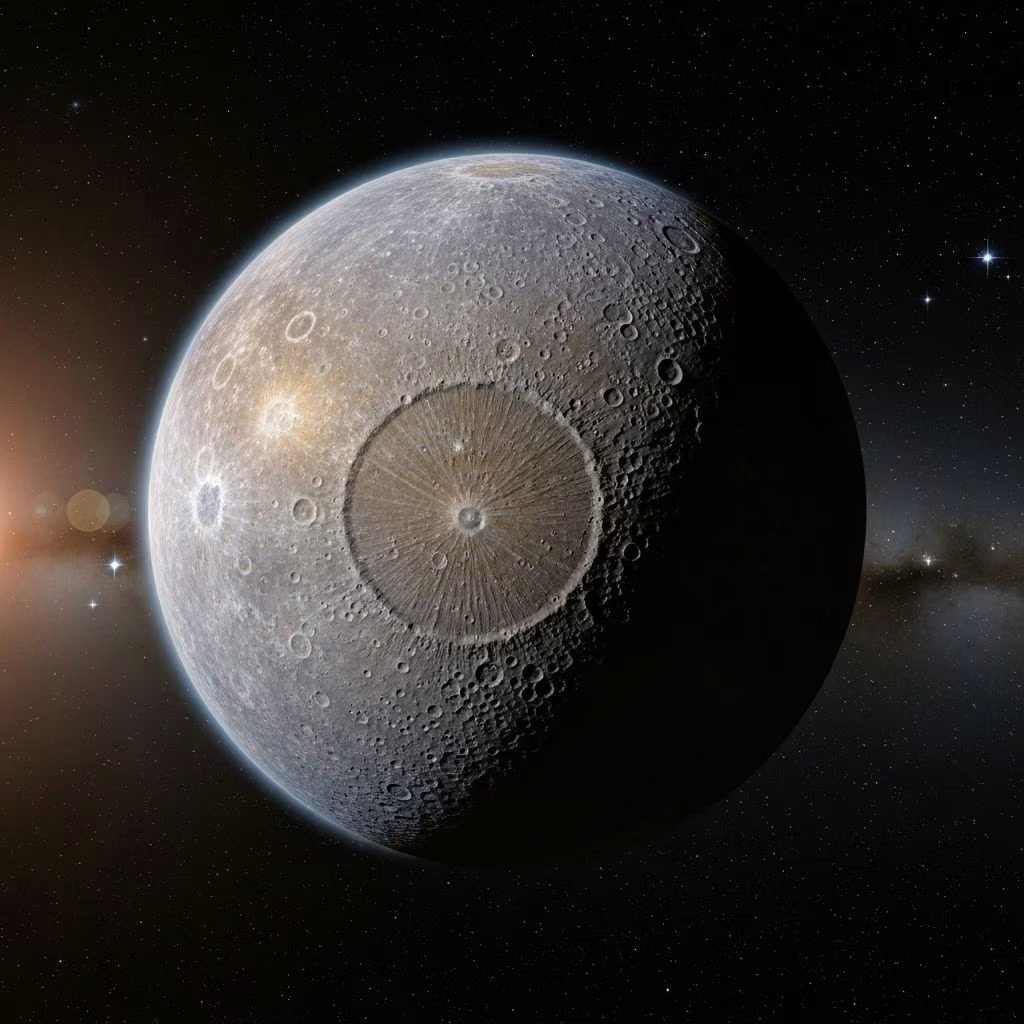
Mercury’s crust is pockmarked and ancient, comparable in appearance to our Moon. The overwhelming number of craters dates back billions of years, with scant evidence of recent geological activity. However, Mercury may have shrunk over its history. As the core cooled and contracted, the crust cracked, forming vast cliffs and ridges known as lobate scarps [11][12]. These features stretch for hundreds of kilometers and can be up to 3 km high, indicative of the global contraction of the planet.
- Heavily cratered, lunar-like surface
- Large basins and plains: Some filled long ago with volcanic basalt, forming smooth plains [12]
- Scarps: Evidence for planet-wide shrinkage over time
Orbital Characteristics and Size in Space
The planet’s proximity to the Sun gives it a unique relationship with its environment. Mercury’s average distance from the Sun is 57.9 million km, and it completes one orbit every 88 Earth days [12]. Its small size, tight and eccentric orbit, and slow rotation (a day on Mercury, from sunrise to sunrise, lasts 176 Earth days) make for dramatic temperature swings and unique surface experiences.
- Orbital period: 88 Earth days
- Day length (solar): 176 Earth days
- Orbital eccentricity: 0.2056 (highest of any major planet) [11]
Mercury vs. Earth: A Closer Look
| Measurement | Mercury | Earth |
|---|---|---|
| Diameter | 4,880 km | 12,742 km |
| Mass | 3.30 × 10²³ kg | 5.97 × 1024 kg |
| Surface Area | 74,797,000 km² | 510,072,000 km² |
| Density | 5.43 g/cm³ | 5.52 g/cm³ |
| Relative Gravity | 0.38 g | 1.00 g |
Mercury’s surface gravity is only 38% that of Earth’s, so objects weigh much less on Mercury despite its high density [12].
Mercury’s Surface Area, Volume, and Atmosphere
With just under 75 million square kilometers of surface, Mercury offers about the same real estate as Russia and Antarctica combined. However, its low gravity and proximity to the Sun mean its exosphere (an extremely thin, tenuous atmosphere) cannot retain gases. The planet’s surface is directly exposed to solar radiation and the merciless solar wind, which drives off even the smallest trace of atmospheric particles [11].
- Atmosphere: Thin exosphere, not a true atmosphere
- Primary gases: Oxygen, sodium, hydrogen, helium, potassium (in trace amounts)
- Atmosphere’s source: Solar wind, radioactive decay, and micrometeorite impacts
How Mercury Shrunk: The Impact Hypothesis
Scientists believe that the outsized core and relatively tiny mantle/crust of Mercury result from a massive collision early in its history. This impact may have stripped away much of the planet’s original crust and possibly even part of its mantle. Today, the evidence for this lies in the planet’s high iron-to-silicate ratio and the immense lobate scarps observable across its surface [11][12].
- Planet was originally larger, possibly up to 2.25x its current mass.
- Collision with large planetesimal (about 1/6 of Mercury’s mass).
- Core left as dominant remnant.
Observing Mercury: A Challenge of Proximity
Mercury is both tantalizing close and devilishly difficult to observe from Earth. Because it always lies close to the Sun in the sky, it never rises more than about 28 degrees above the horizon and is visible only during brief windows at twilight .
- Hard to see with unaided eye: Never visible in full darkness, only at dusk or dawn
- Maximum angular diameter: 13 arcseconds (barely more than a bright star)
- Closest approach to Earth: 77 million km
- Most powerful telescopes needed for detail: Best seen with dedicated solar or space probes
Surface Composition and Exploration
Mercury’s surface is dominated by silicate materials and punctuated by vast craters, fissures, and smooth plains of ancient volcanic basalt. With no substantial atmosphere to erode or weather its features, impact scars endure for billions of years. Modern spacecraft, such as NASA’s Mariner 10 and MESSENGER, have helped map and analyze this hostile world, revealing a complex geology beneath its apparent simplicity [11].
- Key features: Caloris Basin, lobate scarps, intercrater plains
- Volcanic activity ceased: About 700-800 million years ago
- Surface largely unchanged: Over the last 3.5+ billion years
Frequently Asked Questions (FAQs)
Q: Is Mercury the smallest planet in the solar system?
A: Yes. Since Pluto’s reclassification as a dwarf planet, Mercury is the smallest recognized planet in our solar system.
Q: How dense is Mercury compared to Earth?
A: Mercury is almost as dense as Earth (5.43 g/cm³ versus Earth’s 5.52 g/cm³), mainly due to its massive iron core.
Q: How does Mercury’s size compare to our Moon?
A: Mercury is about 40% larger in diameter and over four times more massive than Earth’s Moon. However, it is only slightly larger than the largest moons, Ganymede and Titan.
Q: Why is Mercury so hard to see from Earth?
A: Because Mercury sits so close to the Sun, it never appears in a truly dark sky and is often lost in solar glare. It is visible only during short periods after sunset or before sunrise.
Q: Could Mercury ever support life?
A: Mercury’s high temperatures, lack of substantial atmosphere, and exposure to intense radiation make it an extremely hostile environment for life as we know it.
Q: Has Mercury always been this size?
A: No. Models suggest Mercury was once much larger, but a giant impact long ago removed a large part of its outer layers, leaving the dense core-dominated planet we see today.
Q: What is the significance of Mercury’s large core?
A: The large core generates a magnetic field unique among terrestrial planets, with implications for planetary formation theories and the evolution of early solar system bodies.
Key Takeaways
- Mercury is the smallest, one of the densest planets, with a diameter about 38% of Earth’s.
- Its large iron core gives it unusually high density and a magnetic field.
- Mercury’s battered surface, lack of atmosphere, and position near the Sun make it a unique laboratory for planetary science.
- A massive impact early in its history explains its small size and core-dominated structure.
- Comparisons with planets and moons show that size does not always tell the whole story about planetary character.
References
- https://science.nasa.gov/mercury/facts/
- https://en.wikipedia.org/wiki/Mercury_(planet)
- https://www.britannica.com/place/Mercury-planet
- https://www.astronomy.com/science/mercury/
- https://science.nasa.gov/mercury/
- https://lco.global/spacebook/solar-system/mercury/
- https://www.nhm.ac.uk/discover/planet-mercury.html
- https://www.skyatnightmagazine.com/space-science/guide-to-the-planets-mercury
- https://www.rocketstem.org/2020/03/26/mercury-facts-questions-history/
- https://www.space.com/36-mercury-the-suns-closest-planetary-neighbor.html
- https://www.universetoday.com/articles/characteristics-of-mercury
- https://www.asc-csa.gc.ca/eng/astronomy/solar-system/mercury.asp
- https://www.livescience.com/mercury-planet
- https://www.britannica.com/place/Mercury-planet/Basic-astronomical-data
- https://starwalk.space/en/news/facts-about-mercury-all-you-need-to-know
- https://historyinnumbers.com/places/space/solar-system/planet-mercury/
- https://www.childrensmuseum.org/legacy-games/cosmicquest/mercury_more.html
- https://observatory.astro.utah.edu/Mercury.html
- https://www.ebsco.com/research-starters/astronomy-and-astrophysics/mercury-planet