How Big is Mars?
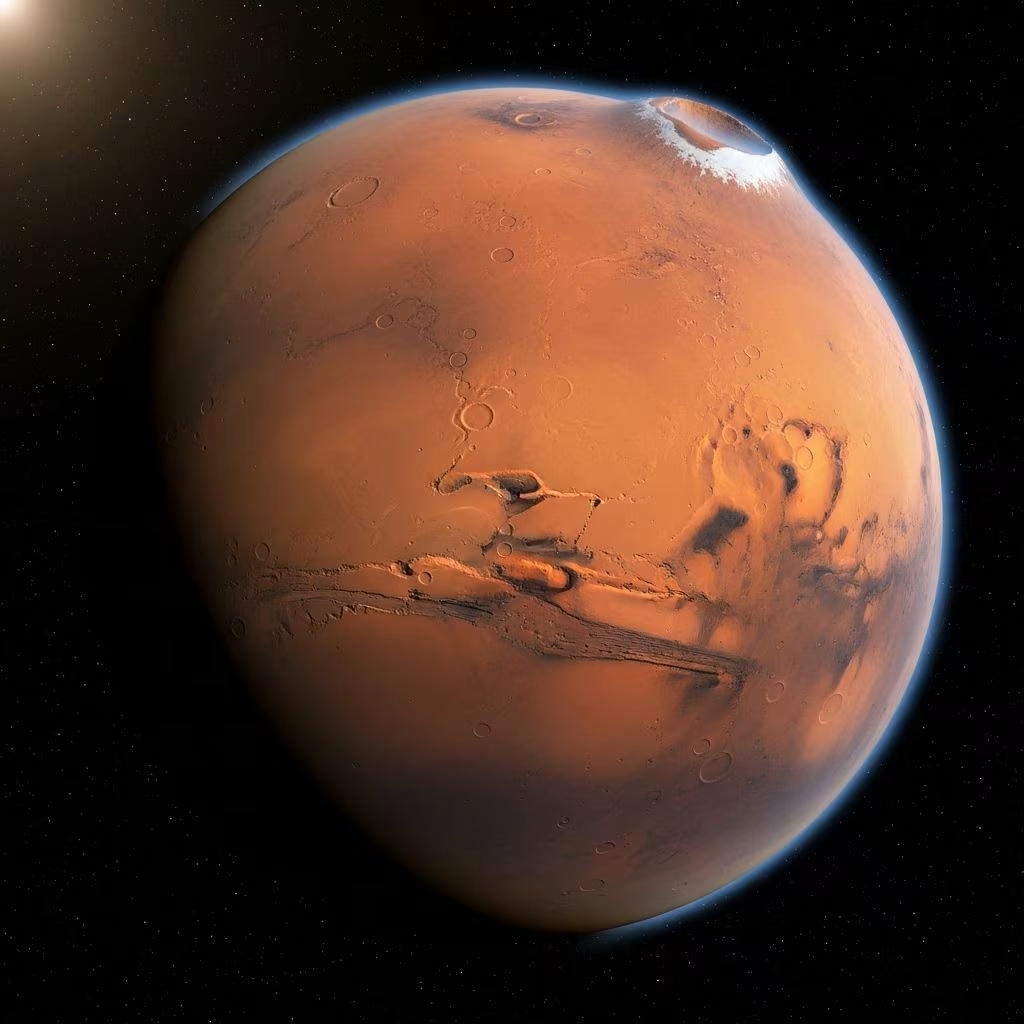
Mars, often called the Red Planet, is the fourth planet from the Sun and stands out as one of the most studied and intriguing objects in our solar system. Its distinctive rust-colored hue, thin atmosphere, and peculiar surface features have fascinated astronomers for centuries. But how big is Mars really? This article delves into the dimensions, mass, volume, surface area, gravity, and other characteristics that define Mars’ size and scale, comparing it not only to Earth but also to its solar system neighbors.
Mars Overview
Mars is a terrestrial planet, meaning it has a solid, rocky surface like Earth and Venus. It is larger than Mercury but only about half the size of Earth, making it the second smallest planet in our solar system. Despite its modest size, Mars commands outsized attention due to its Earth-like seasons, surface features, and the tantalizing possibility it once hosted liquid water and perhaps even life.
- Type: Rocky planet
- Position from the Sun: Fourth
- Noted for: Red appearance caused by iron oxide (rust) in the soil
Diameter and Dimensions of Mars
The diameter of Mars is one of its most defining characteristics. To picture its size, imagine a planet just slightly over half Earth’s width.
| Measurement | Mars | Earth |
|---|---|---|
| Equatorial Diameter | 6,779 km (4,212 miles) | 12,742 km (7,918 miles) |
| Polar Diameter | 6,752 km (4,204 miles) | 12,714 km (7,900 miles) |
| Mean Radius | 3,390 km (2,106 miles) | 6,371 km (3,959 miles) |
Mars’ diameter at the equator is roughly 53% that of Earth. If Earth were the size of a soccer ball, Mars would be about the size of a grapefruit.
Mass, Volume, and Gravity
Size isn’t the only way to compare planets. Mass, volume, and gravitational pull help portray a more complete picture of just how different Mars is from Earth.
- Mass: 6.417 × 10²³ kg (about 10.7% that of Earth)
- Volume: 1.6318 × 10¹¹ km3 (about 15% that of Earth)
- Gravity: 3.72 m/s2 (about 38% of Earth’s gravity)
This means that if you weigh 100 kg (220 lbs) on Earth, you would weigh only about 38 kg (84 lbs) on Mars. The planet’s much lower mass and smaller radius produce its weaker gravitational acceleration, making for lower surface gravity compared to our home planet.
How Mars Compares to Earth
While Mars is commonly referred to as a “sister planet” to Earth due to several surface similarities, their sizes and compositions differ notably.
| Feature | Mars | Earth |
|---|---|---|
| Diameter | 6,779 km | 12,742 km |
| Mass | 6.417 × 10²³ kg | 5.972 × 1024 kg |
| Gravity | 0.38 g | 1 g |
| Surface Area | 144.8 million km2 | 510.1 million km2 |
| Land Area | 144.8 million km2 | 148.9 million km2 |
| Day Length | 24 hours, 37 minutes | 23 hours, 56 minutes |
Although Mars is smaller, its land area is roughly comparable to the total dry land on Earth because over two-thirds of Earth is covered by water.
Surface Area and Land Comparison
Mars’ surface area measures about 144.8 million km2, or just 28% of Earth’s surface area. However, since Earth is mostly covered by oceans, the land surface of Mars is similar in area to all of Earth’s continents combined.
- Total surface area of Mars: 144,800,000 km2
- Total land area on Earth (excluding water): approximately 149,000,000 km2
Distance from the Sun and Orbit
Mars is the fourth planet from the Sun, orbiting at an average distance of about 227.9 million km (142 million miles).
- Average distance from Sun: 227.9 million km (1.52 astronomical units)
- Orbital period (year length): 687 Earth days (1.88 Earth years)
This greater distance from the Sun contributes to Mars’ colder temperatures and longer orbit.
Rotation and Length of a Martian Day
The Martian day—commonly called a sol—is strikingly similar to Earth’s, making Mars an attractive candidate for future human colonization.
- Day length: 24 hours, 37 minutes, and 22 seconds (a sol is about 40 minutes longer than an Earth day)
- Axial tilt: 25.2 degrees (just over Earth’s 23.5 degrees)
This tilt produces Mars’ four distinct seasons, though each Martian season lasts about twice as long due to the planet’s longer year.
Prominent Surface Features
Mars’ surface is a spectacular landscape, carved by volcanoes, immense canyons, craters, and evidence of ancient rivers and floodplains. Some of its features are record-setting in the solar system.
- Olympus Mons: The largest volcano in the solar system, rising 21.9 km (13.6 miles) high—almost three times the height of Mount Everest.
- Valles Marineris: An immense canyon system stretching over 4,000 km (2,500 miles) long, up to 200 km (125 miles) wide, and up to 7 km (4 miles) deep.
- Tharsis Bulge: A vast volcanic plateau housing Olympus Mons and several other giant volcanoes.
- Impact craters: Mars is pockmarked with craters, the most notable being Hellas Planitia—a giant impact basin over 2,300 km (1,400 miles) in diameter.
Layered deposits around the poles suggest past climatic shifts, and ancient river channels hint that water once flowed abundantly over its surface.
Atmosphere and Temperature
Mars’ atmosphere is thin and very different from Earth’s. This affects surface temperatures, weather patterns, and the planet’s reddish coloration.
- Major atmospheric components: Carbon dioxide (95%), nitrogen (3%), argon (1.6%), with minor oxygen, water vapor, and other gases
- Atmospheric pressure: Less than 1% of Earth’s, making it impossible for humans to breathe unassisted
- Average surface temperature: –63°C (–81°F), with extremes ranging from –143°C (–226°F) at the poles in winter to 35°C (95°F) at the equator in summer
The red color of the Martian soil stems from iron oxide, or rust, pervading the surface.
Mars’ Moons: Phobos and Deimos
Mars is orbited by two small, irregularly shaped moons—Phobos and Deimos. These are thought to be captured asteroids from the early solar system. Despite their modest size, they hold significant scientific interest.
- Phobos: About 22 km (14 miles) in diameter, orbits very close to Mars, completing one orbit every 7.7 hours.
- Deimos: About 12 km (7.5 miles) in diameter, further out than Phobos, completing an orbit in about 30.3 hours.
Their names come from Greek mythology, denoting the sons of Ares (Mars): Phobos (Fear) and Deimos (Terror).
Frequently Asked Questions about Mars’ Size and Scale
- Q: Is Mars bigger than Earth?
-
No, Mars is about half the diameter of Earth and only one-tenth its mass. However, its land surface is comparable in area to the continents of Earth due to Earth’s vast oceans.
- Q: Why does Mars look red?
-
Mars appears red because of iron oxide—essentially rust—pervading its soil and dust. Sunlight reflecting off these particles gives the planet its signature hue.
- Q: Does Mars have seasons like Earth?
-
Yes, Mars has four seasons due to its axial tilt, though they last about twice as long as Earth’s seasons.
- Q: What is the gravity like on Mars?
-
The surface gravity on Mars is 3.72 m/s2, which is about 38% of gravity on Earth. You would weigh much less on Mars.
- Q: How long is a day on Mars?
-
A day on Mars, called a “sol,” lasts 24 hours, 37 minutes, and 22 seconds—just about 40 minutes longer than a day on Earth.
Key Takeaways
- Mars is about 53% the diameter of Earth and has only about 11% its mass.
- The surface gravity on Mars is 38% of Earth’s, making movement and weight much lighter.
- Mars’ day length is similar to Earth’s, but its year is nearly twice as long.
- Despite its smaller size, Mars’ land area rivals Earth’s continental surface.
- Fascinating features like Olympus Mons and Valles Marineris make Mars a standout planet for study.
- Mars’ thin atmosphere, seasonal changes, and prominent moons contribute to its importance in planetary science and future exploration.
References
- https://en.wikipedia.org/wiki/Mars
- https://science.nasa.gov/mars/facts/
- https://nssdc.gsfc.nasa.gov/planetary/factsheet/marsfact.html
- https://www.space.com/16871-how-big-is-mars.html
- https://www.britannica.com/place/Mars-planet
- https://www.astronomy.com/science/mars/
- https://www.nhm.ac.uk/discover/planet-mars.html
- https://www.britannica.com/science/How-Big-Is-Mars
- https://www.natgeokids.com/uk/discover/science/space/facts-about-mars/
- https://www.asc-csa.gc.ca/eng/astronomy/solar-system/mars.asp
- https://www.natgeokids.com/au/discover/science/space/facts-about-mars/
- https://lco.global/spacebook/solar-system/mars/
- https://www.lpi.usra.edu/publications/slidesets/redplanet2/slide_1.html
- https://www.universetoday.com/articles/diameter-of-mars
- https://www.universetoday.com/articles/size-of-mars
- https://www.enchantedlearning.com/subjects/astronomy/planets/mars/stats.shtml
- https://marsaavcoolinfo.weebly.com/mars-size.html
- https://prod.mars.jpllab.net/all-about-mars/facts/