Quarks: What Are They? The Foundation of Matter
Quarks are the most fundamental particles known to modern science—minuscule entities that make up the stuff of the universe. Everything from atoms to stars is built upon these tiny components, which, despite their pivotal role, remain profoundly difficult to study directly due to their unique behaviors.
Quarks are essential constituents of matter, forming composite particles called hadrons, with protons and neutrons being the most stable and prevalent in atomic nuclei. All everyday matter consists primarily of up quarks, down quarks, and electrons. Quarks have unique properties such as fractional electric charge, various masses, a property called color charge, and a quantum spin.
The Six Flavors of Quarks
Quarks exist in six varieties, often called flavors:
- Up (u)
- Down (d)
- Charm (c)
- Strange (s)
- Top (t)
- Bottom (b)
The up and down quarks are the lightest and most common in the cosmos. The other four (strange, charm, bottom, and top) are far heavier, usually forming for brief moments in high-energy particle collisions before decaying into their lighter counterparts.
Quark Flavor Table
| Flavor | Symbol | Charge | Approximate Mass |
|---|---|---|---|
| Up | u | +2/3 | 2.2 MeV/c2 |
| Down | d | -1/3 | 4.7 MeV/c2 |
| Charm | c | +2/3 | 1.27 GeV/c2 |
| Strange | s | -1/3 | 96 MeV/c2 |
| Top | t | +2/3 | 173 GeV/c2 |
| Bottom | b | -1/3 | 4.18 GeV/c2 |
Quark Properties and Unique Features
- Electric Charge: Quarks possess fractional electric charges—either +2/3 or -1/3 times the elementary charge, a property unique among particles.
- Mass: Each flavor of quark has its own distinctive mass, often expressed in mega- or giga-electronvolts (MeV/GeV).
- Spin: Quarks have a quantum property called spin, which influences their interactions and the formation of composite particles.
- Color Charge: Unlike common electric charge, color charge describes how quarks interact via the strong force, mediated by gluons. Color charge drives the powerful forces that bind quarks together.
Quarks and Color Confinement: Never Alone
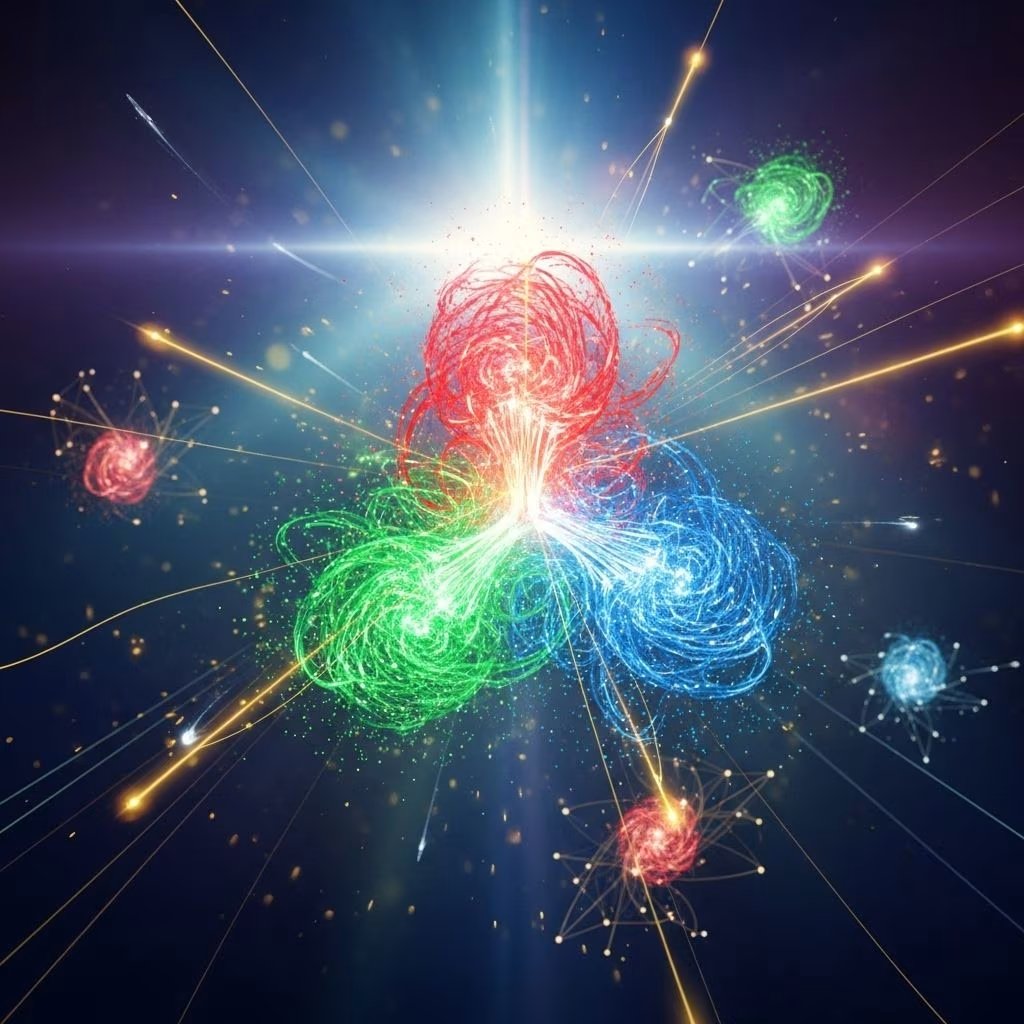
A defining rule in quark physics is color confinement: quarks are never found isolated in nature. They always exist inside larger particles—most commonly baryons (like protons and neutrons, made of three quarks) and mesons (made of a quark and an antiquark pair). Attempts to separate a quark from its partners result in the creation of additional quark-antiquark pairs, meaning there’s never a solitary quark seen outside these groupings.
Quarks and the Four Fundamental Forces
Quarks are unique in particle physics for being the only particles that experience all four fundamental forces:
- Strong interaction—binding quarks together inside protons and neutrons
- Electromagnetism—responsible for interactions related to their charge
- Weak interaction—enabling processes like radioactive decay
- Gravitation—though negligible at this scale
This versatility makes quarks central to the Standard Model, the prevailing theory of fundamental particles.
Quarks, Hadrons, and the Structure of Matter
Quarks combine to form hadrons. The two main classes are:
- Baryons: Made of three quarks (such as protons and neutrons)
- Mesons: Made of one quark and one antiquark (less stable, created fleetingly in high-energy events)
Protons and neutrons, forged from up and down quarks, make up the atomic nuclei that form all matter.
The Quark Model: A Triumph of Particle Physics
The quark model was first proposed in 1964 by physicists Murray Gell-Mann and George Zweig. This breakthrough helped organize the zoo of newly discovered particles by grouping them based on quark compositions. Confirmatory experiments came later, particularly with deep inelastic scattering at Stanford Linear Accelerator Center in 1968, which provided hard evidence for quarks as real physical entities.
Discovery Timeline: The Six Flavors of Quarks
| Quark Flavor | Year Discovered | Discovery Site |
|---|---|---|
| Up & Down | 1968 | Stanford Linear Accelerator Center |
| Strange | 1974 | Brookhaven National Laboratory |
| Charm | 1974 | SLAC & Brookhaven |
| Bottom | 1977 | Fermilab |
| Top | 1995 | Fermilab |
Quark-Antiquark Pairs and Antiparticles
Every quark has a corresponding antiquark, identical except for the opposite sign of certain intrinsic properties, such as electric charge. When a quark meets its antiquark, they can annihilate each other, releasing energy—an important process in various particle interactions and accelerator experiments.
How We Study Quarks: From Hadrons to Particle Accelerators
An impediment to quark research is that, due to color confinement, they are never isolated. Thus, scientists analyze their behavior through the particles they compose and events in particle accelerators, where high energies can reveal fleeting formation and decay patterns. Deep inelastic scattering experiments shoot electrons at atomic nuclei at extremely high speeds, indirectly “illuminating” the structure and arrangement of quarks within protons and neutrons.
Quark-Gluon Plasma: Unlocking Universe’s Primordial Conditions
Under extreme heat and pressure, such as in the early universe or inside large particle colliders, quarks and gluons can “melt” out of hadrons and form an exotic state called quark-gluon plasma—a fluid-like mixture that gives clues about the first microseconds after the Big Bang. Such plasmas are fleeting and difficult to study, but their brief existence helps physicists understand fundamental forces and matter’s origins.
Quarks in Everyday Life and the Universe
- Quarks form protons and neutrons, constituents of all atoms.
- Virtually all visible matter on Earth and in stars consists of up and down quarks.
- The heavier quarks play roles in rare, high-energy cosmic events and specialized physics experiments.
Modern Mysteries: Quarks Beyond the Basics
Current research asks profound questions:
- Why do quarks have their specific masses?
- How does the strong force really bind them together so tightly?
- Could there be more flavors beyond the known six?
- What are the implications for the fabric of the universe?
This Is Why Quarks Matter
- Quarks hold together matter at the finest level, directly shaping atomic structure.
- They operate under principles (like color confinement and fractional charge) that defy intuition rooted in macroscopic experience.
- Their behavior underpins the processes powering stars, shaping galaxies, and giving rise to everything visible and tangible.
- Understanding quarks is essential for grasping the universe’s origin, evolution, and the puzzle of existence itself.
Frequently Asked Questions (FAQs)
Q: Why can’t quarks be found on their own?
A: Due to color confinement, quarks always exist bound inside larger particles. The force between them grows stronger as they are pulled apart, ensuring they are never isolated.
Q: What are antiquarks, and why are they important?
A: Antiquarks are the opposite-charge counterparts to each quark. Antiquarks play a role in particle interactions and annihilation events that shape the structure of the universe.
Q: How do quarks influence everyday matter?
A: All material objects—from your body to a mountain to a star—are built from atoms, which themselves are made from protons and neutrons, both composed of up and down quarks.
Q: Why are there six quark flavors?
A: The six flavors reflect the underlying symmetries and rules of the Standard Model—but questions remain as to why these flavors exist as they do, making it an area of continuing research.
Q: What is the most recent quark discovered?
A: The top quark, discovered in 1995 at Fermilab, is the heaviest and most recent addition to the set of six quark flavors.
Q: How does studying quarks help us understand the universe?
A: Research into quarks provides insight into the mechanisms of the Big Bang, star formation, atomic reactions, and new physics beyond the Standard Model.
Explore Further
- Read about the development of the Standard Model
- Learn more about hadrons, mesons, and baryons
- Discover ongoing experiments in particle physics
References
- https://www.space.com/quarks-explained
- https://www.space.com/quarks-emc-effect-nucleus.html
- https://en.wikipedia.org/wiki/Quark
- https://www.energy.gov/science/doe-explainsquarks-and-gluons
- https://en.wikipedia.org/wiki/Quarks
- https://rafelski.com/~johann/QuarkUni.html
- https://openmedscience.com/secrets-of-quark-particles-the-building-blocks-of-the-universe/
- https://optimizeias.com/particles-called-quarks-hold-the-key-to-the-final-fate-of-some-stars/
- https://www.youtube.com/watch?v=2gdgCoVcZx4
- https://www.youtube.com/watch?v=syIPyRhmyx0
- https://home.cern/news/news/physics/fifty-years-quarks
- https://www.snexplores.org/article/scientists-say-quark
- https://study.com/learn/lesson/quark-types-flavors-models-what-is-a-quark.html
- https://www.home.cern/news/news/physics/fifty-years-quarks
- https://courses.lumenlearning.com/suny-physics/chapter/33-5-quarks-is-that-all-there-is/