Super-Earth 55 Cancri e: The Diamond Planet Shaping New Frontiers in Astronomy
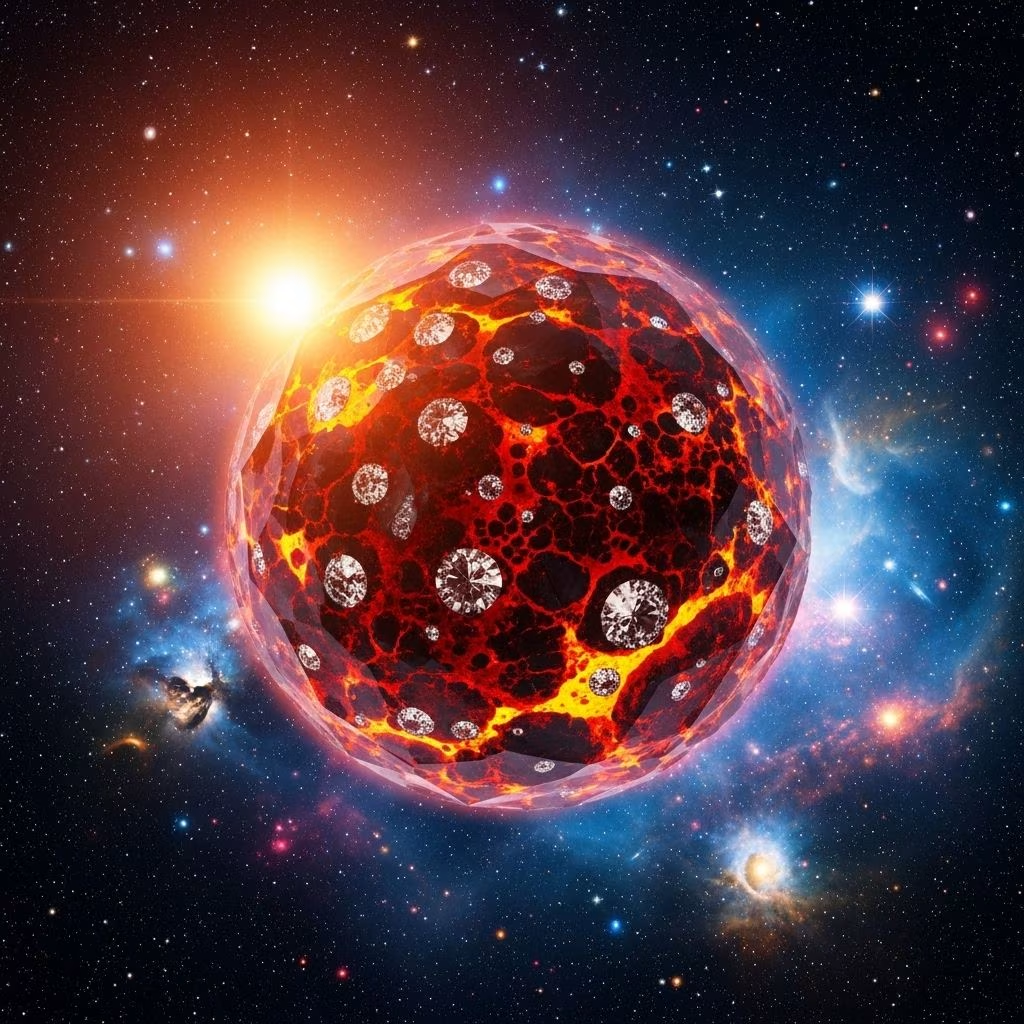
Imagine a world where the ground underfoot sparkles—not with grains of sand or fields of grass, but with glinting graphite and dazzling diamond. Astronomers have identified just such a place: 55 Cancri e, a rocky ‘super-Earth’ orbiting a sun-like star about 40 light-years away in the constellation of Cancer. Unlike any world in our solar system, evidence strongly suggests that a third of this planet’s mass may consist of pure diamond.
The Discovery of a Diamond World
55 Cancri e was first discovered in 2004 as part of a growing tally of planets outside our solar system—or exoplanets—revealed through advances in space observation and analysis. What set 55 Cancri e apart wasn’t just its mass or its radius, but how those data points—combined with what scientists have learned about its stellar host—pointed to a never-before-seen planetary makeup.
- Discovered: 2004, orbiting the star 55 Cancri A
- Distance from Earth: 40 light-years (12 parsecs)
- Classification: Super-Earth (larger than Earth, smaller than Neptune)
What Makes 55 Cancri e Unique?
Earth is rich in oxygen but contains very little carbon deep in its interior. By contrast, analysis of 55 Cancri e suggests its main ingredients are carbon (in the form of diamond and graphite), iron, silicon carbide, and possibly silicates.
- At least one-third of its mass is likely diamond.
- The planet’s surface is probably covered in graphite and diamond, not water and granite like Earth.
- Its mass is eight times that of Earth’s, with twice the radius.
How Astronomers Revealed the Diamond Planet
An international team led by Yale University researcher Nikku Madhusudhan combined several lines of evidence to deduce the dazzling composition of 55 Cancri e.
Key Investigation Steps
- Precise measurement of mass: Gravitational influence on its star provided a weight estimate.
- Radius calculation: As the planet passes in front of its star, tiny dips in starlight allowed astronomers to calculate its size.
- Host star’s chemical profile: The elemental makeup of 55 Cancri A suggested a carbon-rich environment, likely influencing planet formation in its system.
The conclusion: unlike Earth, with its oxygen-rich but carbon-poor core, 55 Cancri e’s environment fostered a very different kind of chemistry, resulting in a planet where exotic materials like diamond and graphite could form in abundance.
A Closer Look at 55 Cancri e’s Composition
Our own world formed from a solar nebula where oxygen outnumbered carbon. This created a planet rich in water, silicates, and metallic iron, but with carbon accounting for less than one-thousandth of Earth’s mass.
| Component | Earth (by mass) | 55 Cancri e (Estimated) |
|---|---|---|
| Oxygen | High | Lower |
| Carbon (Diamond/Graphite) | <0.1% | >33% |
| Iron | Significant | Significant |
| Silicon Carbide | Very low | Present |
| Water | Abundant on surface | Absent |
This fundamentally different mixture gives 55 Cancri e a unique physical structure and geologic potential. As Yale geophysicist Kanani Lee notes, this world is our first view into a planet whose landscape and geology are utterly alien to Earth’s.
Location, Size, and Orbit: Where Is the Diamond Planet?
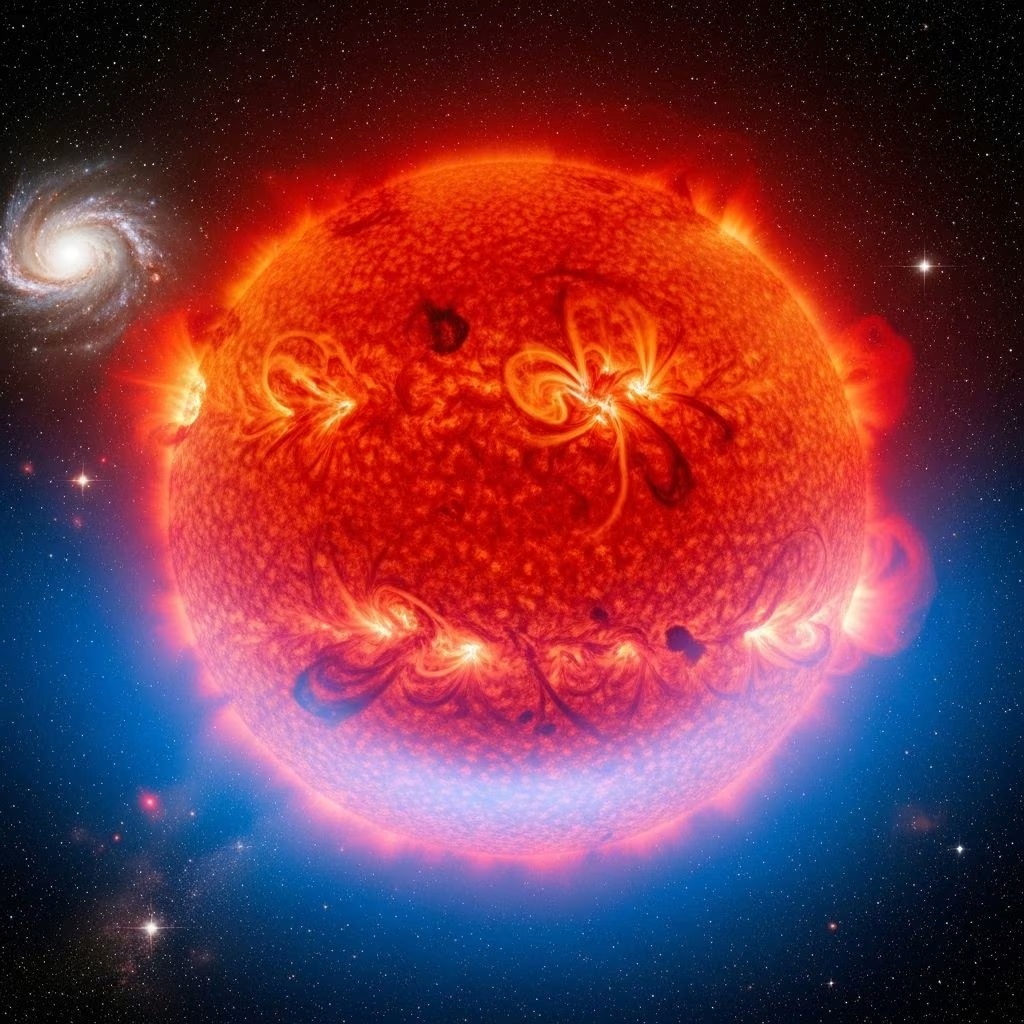
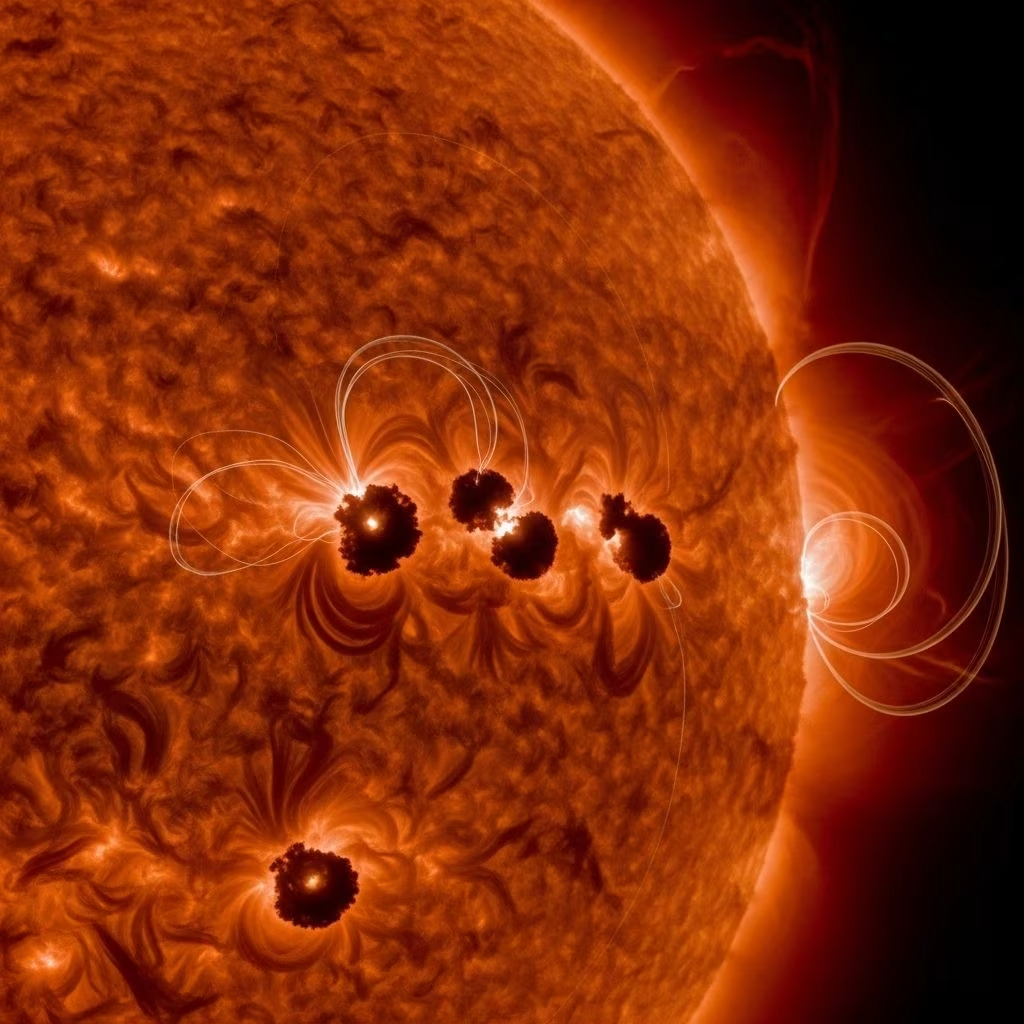
55 Cancri e is not alone. It orbits as part of a multi-planet system around 55 Cancri A—a star close enough that it’s visible to the naked eye from Earth.
- Host star: 55 Cancri A (part of a binary system)
- Other planets: At least four others orbiting the same star
- Orbital period: Under 18 hours—an extremely tight orbit, resulting in surface temperatures estimated to be above 2000°C (3632°F)
This proximity means 55 Cancri e is not only searing hot, but also faces strong gravitational forces, tidal locking, and intense stellar radiation, making its surface truly fiery.
Carbon Planets and Their Astrobiological Significance
The concept of a “diamond planet” might evoke extravagant images, yet it also points to profound implications for planetary science. Until recently, scientists understood exoplanetary formation primarily through the lens of our own solar system, dominated by oxygen-rich chemistry.
- Carbon-rich worlds (‘carbon super-Earths’) could theoretically be common, not rare, in the galaxy.
- Interior dynamics: Lacking water and geothermal energy, these diamond planets are likely cold and geologically inactive—even though their surfaces may be tortured by extreme heat.
- Atmosphere & Magnetic Field: Most likely thin or absent. Stable magnetic fields and volcanic activity, both generated by liquid planetary interiors, might not exist.
Thus, a diamond planet—despite its name—would probably be hostile to life as we know it. No oceans, no plate tectonics, no atmosphere: all the things that help Earth stay habitable would be missing.
How Do Diamond Planets Form?
Diamond planets like 55 Cancri e arise from a very different balance of elements than what we’re used to. In systems where the primordial gas cloud is richer in carbon than oxygen, planets coalescing from this material can develop thick, diamond-rich crusts and mantles.
- High-pressure, high-temperature environments (like those deep within rocky planets) are ideal for transforming carbon into diamond.
- Carbon bonds readily with itself, and at sufficient pressures, forms the crystalline lattice structure known as diamond.
- Computer models simulating these conditions demonstrate that enormous quantities of diamond could be stable inside such a planet.
The Scientific Impact of the Discovery
The recognition that diamond super-Earths exist widens the scope of exoplanet studies immeasurably. Not only does it force astronomers to question assumptions about planetary diversity across the Milky Way, but it also sparks fundamental questions about how planets form, what they might look like, and which chemical pathways could support—or preclude—life.
- Reframes our place in the cosmos: Earth is not a template for all planetary bodies, but merely one variation among a vast cosmic menu.
- Challenges definitions of habitability: Carbon-dominated planets may be far more common than previously thought, but largely uninhabitable in the way we understand life.
- Inspires new observations: The discovery paves the way for deeper investigations into the chemical diversity of exoplanets and the stars that shape them.
Diamond Planets and Popular Fascination
The idea of a planet encrusted with diamond has captured public imagination in a way that few exoplanet discoveries have performed. Given Earth’s association of diamond with beauty and value, the notion that entire worlds could be composed of this material is astonishing—if not a little humbling.
But for astronomers, the true treasure is understanding how such worlds can exist and what they mean for the diversity of possible planets in the universe.
Diamond Super-Earths Beyond 55 Cancri e
Although 55 Cancri e is the best-known diamond planet, it’s not unique. Other candidates exist, including the spectacular PSR J1719-1438 b—a dead stellar remnant whose carbon-rich composition makes it even more gemlike in theory.
- PSR J1719-1438 b: Five times the mass of Earth, discovered orbiting a pulsar.
- Estimated composition: Mostly crystalline carbon (i.e., diamond).
These discoveries highlight that our solar system—though precious to us—is merely a single example drawn from an astoundingly diverse assortment of planetary types.
Conclusion
The existence of diamond planets fundamentally transforms our expectations of planetary nature, chemistry, and diversity. 55 Cancri e is a shining example that our universe is richer and stranger than we ever imagined. Among the stars, planetary jewels offer clues—not just about what’s rare or beautiful, but about the extraordinary potential of worlds untethered to the story of Earth.
Frequently Asked Questions (FAQs)
What is a diamond planet?
A diamond planet is a planetary body whose interior and/or surface contains a significant fraction of carbon in the form of diamond and graphite, due to unique chemical formation conditions.
How big is 55 Cancri e compared to Earth?
55 Cancri e has twice the Earth’s radius and is at least eight times more massive, classifying it as a ‘super-Earth.’
Could a diamond planet support life?
Diamond planets would most likely be inhospitable. Their geology likely lacks water, active plate tectonics, a magnetic field, and a substantial atmosphere—all factors essential for life on Earth.
Is it possible to mine the diamonds on 55 Cancri e?
In theory, the planet contains vast reserves of diamond; in practice, it is far beyond humanity’s current technological reach, and its extreme heat and gravity would make mining impossible with foreseeable technology.
How was the composition of 55 Cancri e determined?
Astronomers combined measurements of the planet’s mass, radius, and the elemental composition of its parent star, alongside models of planetary formation and structure.
Are there other diamond planets?
Yes. While 55 Cancri e is the most famous, other candidates—like PSR J1719-1438 b—exist and may be even richer in diamonds or crystalline carbon structures.
References
- https://www.space.com/18011-super-earth-planet-diamond-world.html
- https://www.space.com/23138-diamond-planet-super-earth-discovery.html
- https://www.youtube.com/watch?v=rzNfALRvgNA
- https://www.youtube.com/watch?v=WN8jCbT18JQ
- https://theweek.com/articles/471482/rare-superearth-made-diamond&rut=e7b74d5b2d8e4e013e5cdc9f7147c6f8e793189ab32fd189aacbe8b8be54ae06
- https://timesofindia.indiatimes.com/science/amplsquodiamond-planetsamprsquo-in-milky-way/articleshow/11013854.cms
- https://www.moneycontrol.com/science/a-planet-of-gems-nasa-discovers-a-massive-diamond-world-in-space-five-times-earth-s-size-article-12968282.html
- https://www.astronomy.com/science/diamond-super-earth-may-not-be-quite-as-precious-as-once-thought/
- https://www.mining.com/billions-of-tonnes-of-diamonds-in-the-galaxy-suspected/
- https://orbitaltoday.com/2025/02/21/planet-made-of-diamond-is-there-fort-knox-in-space/
- https://www.cbsnews.com/news/astronomers-spot-diamond-planet/
- https://www.universetoday.com/articles/diamond-super-earths-makeup-called-into-question-in-new-study
- https://timesofindia.indiatimes.com/etimes/trending/nasa-found-a-planet-made-of-diamond-that-is-9-times-bigger-than-the-earth/articleshow/113809647.cms
- https://www.chemistryworld.com/news/astronomers-detect-atmosphere-on-the-diamond-planet/9485.article
- https://grist.org/article/nearby-super-earth-planet-is-made-of-diamonds/
- https://princeea.com/nasa-found-a-diamond-in-space-that-is-5-times-bigger-than-earth/
- https://scitechdaily.com/carbon-rich-interior-super-earth-55-cancri-e-less-likely-previously-thought/