Live Updates: September 21, 2025 Partial Solar Eclipse
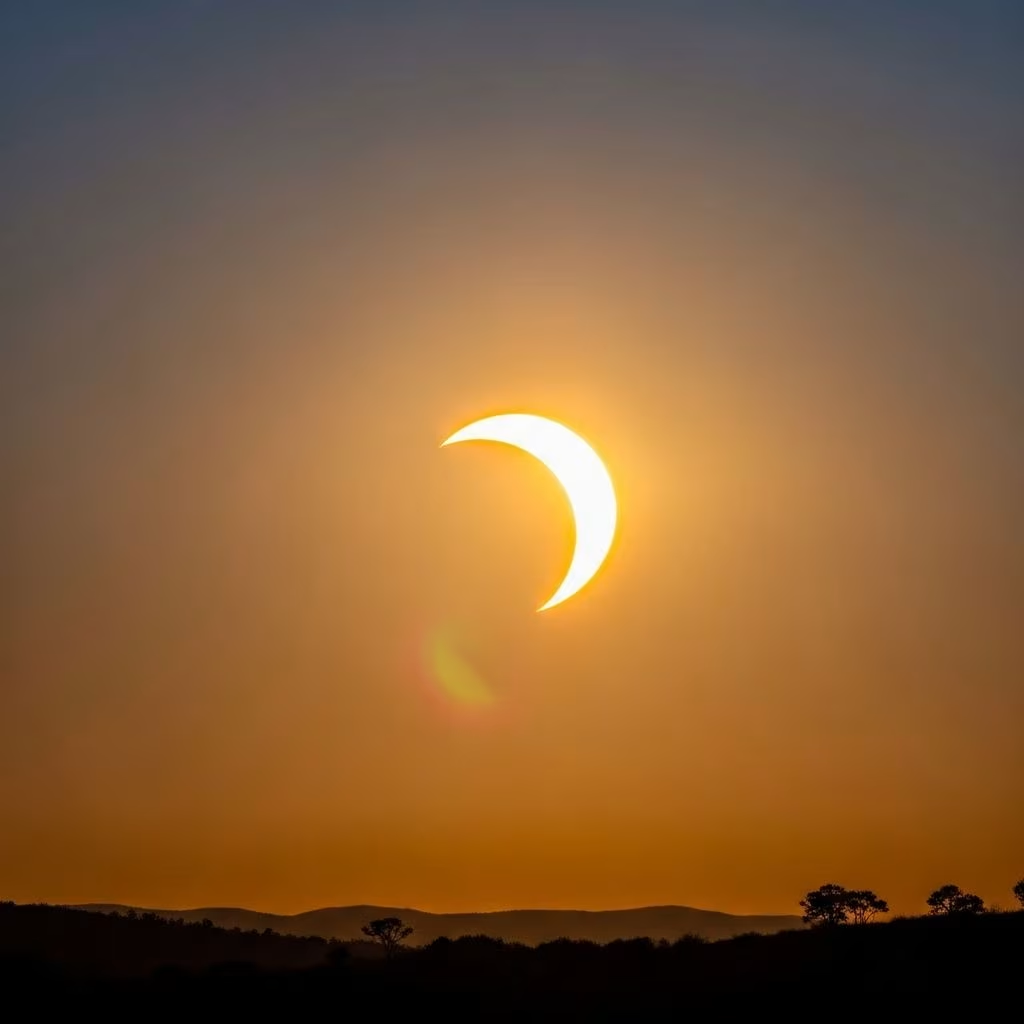
The partial solar eclipse on September 21, 2025, marks a notable celestial event observable over parts of the Southern Hemisphere, offering viewers a chance to witness the Moon partially cover the Sun. This article is a comprehensive real-time guide, providing verified timings, visibility zones, expert commentary, and essential tips for safely experiencing and understanding the eclipse.
Contents
- Introduction
- Eclipse Key Timings
- Where and When to See the Eclipse
- Visibility Maps and Interactive Tools
- Live Coverage and Streaming
- Expert Insights: The Science Behind the Eclipse
- Safe Viewing Tips
- Upcoming Eclipses
- Frequently Asked Questions
Introduction: What Is Happening Today?
On September 21, 2025, a significant partial solar eclipse will be visible from various regions, notably the southern Pacific and New Zealand as the day begins on September 22 local time. During a partial solar eclipse, the Moon passes between Earth and the Sun but only obscures part of the Sun’s disk, creating a dramatic celestial spectacle. This event, documented in real-time by astronomy platforms, is an ideal opportunity for enthusiasts and first-time observers alike to witness the dynamic interactions within our solar system.
Key Timings: From First Contact to Maximum Eclipse
| Event | UTC Time | Description |
|---|---|---|
| Start of Partial Eclipse | 00:10:24 | Observation begins as the Moon starts to move across the Sun’s disc. |
| Moon’s Progression | 00:36:24 | The Moon “eats away” at the Sun, increasing coverage. |
| Maximum Eclipse | 00:56:05 | The greatest coverage occurs—most dramatic visual effect. |
| Expert Interview | 01:17:17 | Live commentary with an eclipse expert, Warren Hurley (timeanddate.com). |
| End of Coverage | 01:50:14 | Transition to future eclipse previews for 2026. |
The exact local times of the eclipse phases may vary by viewer location—use interactive maps for precise timings.
Where and When to See the Partial Solar Eclipse
- New Zealand: Prime visibility on the morning of September 22 local time. Major cities including Auckland, Wellington, and Christchurch will experience the eclipse.
- Southern Pacific: Extensive coverage throughout islands and sea routes in the region.
- Other Areas: Use real-time visibility tools to check if your exact location is covered.
Regions outside the core visibility zone may miss the eclipse or experience only a slight dimming of sunlight. The event is not visible in much of the Northern Hemisphere.
Visibility Maps and Interactive Tools
Advanced eclipse maps allow users to pinpoint the visibility range and timing at specific locations. These tools function as follows:
- Interactive Map: Input any location to reveal local eclipse circumstances, including start, maximum, and end times.
- Eclipse Path: Visual overlay of the Moon’s shadow track across Earth, indicating regions of maximum coverage.
- Sky Chart: At maximum eclipse, observers can use real-time star maps to identify visible constellations and planets—especially useful if the eclipse darkens skies sufficiently.
Visit astronomy resources for detailed, interactive eclipse maps and animations to enhance your viewing experience.
Live Coverage and Streaming: Where to Watch
For those not in the path of visibility, a variety of live streams and real-time reports are available:
- timeanddate.com: LIVE stream: Provides continuous coverage from initial contact to maximum eclipse, featuring expert narration and interviews.
- Video Commentary: Live chat and Q&A with eclipse experts, including an exclusive interview with Warren Hurley explaining eclipse science.
- Post-event Highlights: Replays and highlight clips ensure no one misses the key moments and can re-experience the eclipse.
Streaming platforms publish schedules for upcoming eclipses, so enthusiasts can prepare for future events.
Expert Insights: The Science Behind the Eclipse
Eclipse scientists provide valuable context to understand the mechanics, effects, and significance of partial solar eclipses:
- Celestial Mechanics: The Moon’s orbit periodically aligns with the Sun and Earth, causing solar and lunar eclipses. During this event, the Moon only partially covers the Sun due to orbital geometry.[10]
- Maximum Eclipse Explained: At maximum coverage, sunlight dips significantly, temperature may drop slightly, and shadows become sharper and distorted.
- Visible Planets and Stars: In cases of deeper partial eclipses, bright planets (such as Venus and Jupiter) and prominent stars might be visible in daytime—check sky charts at time of maximum obscuration.
Expert interviews during live coverage answer audience questions about eclipse phenomena and astronomy best practices.
Safe Viewing Tips: Protecting Your Eyes
Direct viewing of the Sun can cause permanent eye damage. Always follow these precautions:
- Use ISO-certified solar viewing glasses at all times—never remove them until the event is completely over.
- Do not look at the Sun through regular sunglasses, telescopes, binoculars, or cameras without solar filters.
- Build a pinhole projector or use solar-filtered telescopes for indirect viewing.
Responsible viewing ensures you enjoy the event safely and protect your eyesight.
What’s Next? Upcoming Solar and Lunar Eclipses
This partial solar eclipse is one of several celestial events in the 2025–2026 period:
- Annular Solar Eclipse: February 2026, visible in select regions, featuring a “ring of fire” effect.
- Partial Solar Eclipse: March 29, 2025, visible from the Northern Hemisphere.[10]
- Lunar Eclipses: Multiple lunar eclipses will also occur, some visible worldwide.
Consult eclipse calendars for dates, locations, and visibility conditions to plan your next sky-watching adventure.
Frequently Asked Questions (FAQ)
Q: What is a partial solar eclipse?
A: A partial solar eclipse occurs when the Moon passes between Earth and the Sun, but only blocks a portion of the Sun’s disk. This results in a noticeable darkening of the sky, but day does not turn to night.
Q: Will the eclipse be visible from my location?
A: The September 21, 2025 eclipse is best observed from New Zealand and portions of the southern Pacific. Use eclipse visibility maps online to check your local circumstances.
Q: How do I observe the eclipse safely?
A: Use ISO-certified solar viewing glasses, solar-filtered telescopes, or indirect viewing techniques like a pinhole projector. Never look directly at the Sun without proper safety gear.
Q: What causes a solar eclipse?
A: Solar eclipses occur due to the alignment of the Moon, Earth, and Sun. When the Moon passes directly between the Sun and Earth, it casts a shadow on Earth’s surface. A partial eclipse results when the alignment is not perfectly centered.[10]
Q: Can eclipses affect the environment or animals?
A: Significant eclipses briefly alter light and temperature, potentially causing unusual animal behavior or changes in environmental conditions during the event.
Additional Resources and Streaming Schedules
- Visit specialized sites such as timeanddate.com for current and future eclipse live streams, expert guides, and interactive maps for planning your observations.
- Use NASA’s and astronomical organizations’ eclipse calendars for authoritative forecasts.[10]
- Watch educational interviews with scientists and eclipse photographers for further insights and best practices.
Top Tips: Making the Most of Your Eclipse Day
- Prepare your gear in advance: solar viewers, cameras with solar filters, and comfortable seating at your chosen location.
- Check local weather forecasts and cloud cover to maximize your chances of clear views.
- Share the event with friends and communities online via social media using official hashtags and livestream portals.
- Document the eclipse with photos or notes, but prioritize eye safety over image quality.
Conclusion: Why Eclipses Matter
Solar eclipses are among the most dramatic astronomical events visible from Earth, providing a direct glimpse at celestial mechanics in action. The September 21, 2025 partial solar eclipse combines accessible viewing opportunities with a globally shared sense of wonder, bringing together experts, enthusiasts, and the casually curious. Proper preparation ensures a memorable and safe experience for all participants—don’t miss this extraordinary event!
References
- https://www.space.com/stargazing/solar-eclipses/dont-miss-the-partial-solar-eclipse-today-sept-21-2025-where-when-and-how-to-see-it
- https://www.space.com/news/live/solar-eclipse-live-updates
- https://www.timeanddate.com/eclipse/2025
- https://www.timeanddate.com/live/
- https://www.youtube.com/watch?v=frOkEPoP1C4
- https://theskylive.com/solar-eclipse?id=2025-09-21
- https://en.wikipedia.org/wiki/Solar_eclipse_of_September_21,_2025
- https://en.wikipedia.org/wiki/Solar_eclipse_of_March_29,_2025
- https://science.nasa.gov/eclipses/future-eclipses/mar-29-2025-eclipse/
- https://science.nasa.gov/eclipses/future-eclipses/
- https://theskylive.com/solar-eclipse?id=2025-03-29
- https://www.youtube.com/watch?v=50WPe5mz7x8
- https://nationaleclipse.com
- https://www.eclipsewise.com/oh/ec2025.html
- https://eclipsewise.com/solar/SEprime/2001-2100/SE2025Sep21Pprime.html
- https://www.farmersalmanac.com/lunar-and-solar-eclipses
- https://www.spacetv.net/live/category/eclipse/
- https://preventblindness.org/solar-eclipses/september-21-2025-partial-solar-eclipse/