


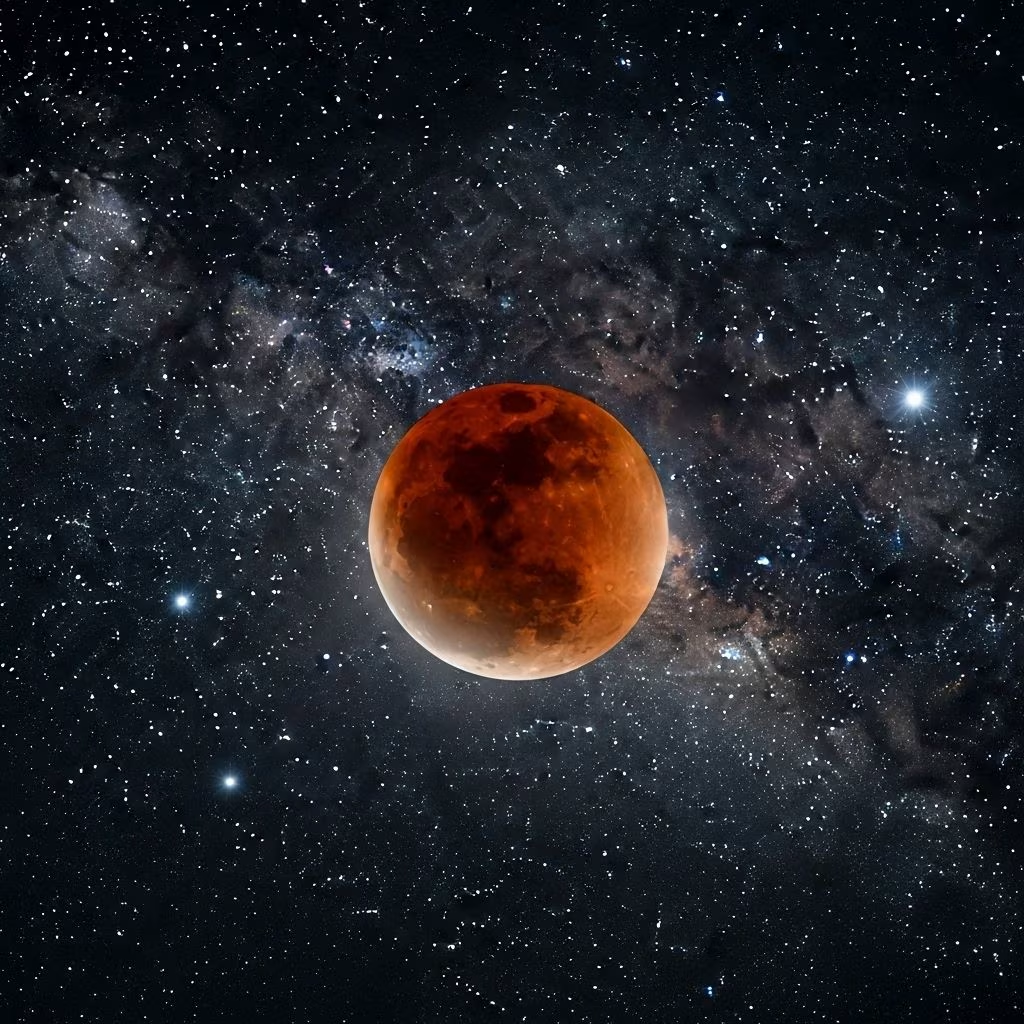
Lunar Eclipses: Nature’s Celestial Shadow Show
Lunar eclipses have fascinated skywatchers for millennia, inspiring myths, scientific study, and awe. Unlike solar eclipses, these events are accessible to millions and can be observed with the unaided eye from anywhere the Moon is above the horizon at the time of the eclipse. This guide covers the types and mechanics of lunar eclipses, their scientific and cultural significance, how to view them, and the secrets behind the famed blood moon effect.
What Is a Lunar Eclipse?
A lunar eclipse occurs when the Earth passes directly between the Sun and the Moon, casting its shadow onto the lunar surface. This phenomenon only happens during a full moon, when the Sun, Earth, and Moon form a straight (or nearly straight) line, a configuration astronomers call syzygy. Since the Moon’s orbit is tilted about 5 degrees relative to Earth’s orbit, such precise alignment does not happen every month.
- The shadow cast consists of two regions: the umbra (central, darkest part) and the penumbra (outer, lighter part).
- Lunar eclipses are safe to watch without protective equipment, unlike solar eclipses.
- These events are visible from anywhere on Earth where the Moon is above the horizon during the eclipse.
Types of Lunar Eclipses
Not all lunar eclipses are equal. Astronomers classify them into three main types, based on how the Moon traverses Earth’s shadow.
Total Lunar Eclipse
During a total lunar eclipse, the entire Moon passes through the Earth’s umbra:
- The Moon grows dim and typically takes on a dramatic red or copper hue, an effect known as the ‘blood moon’.
- Totality can last from a few seconds to over an hour, depending on the geometry of alignment.
- The eclipse is visible from all points on the night side of Earth.
Partial Lunar Eclipse
In a partial lunar eclipse, only part of the Moon enters Earth’s umbra. The remaining portion stays illuminated by the Sun:
- The shadow appears to take a bite out of the Moon.
- Although less dramatic than a total eclipse, it offers a striking visual contrast between the shadowed and sunlit parts of the lunar disk.
Penumbral Lunar Eclipse
The most subtle type, a penumbral lunar eclipse occurs when the Moon passes only through the Earth’s outer penumbral shadow:
- There is a slight, often hard-to-detect dimming of the lunar surface.
- Penumbral eclipses typically go unnoticed unless observed under excellent viewing conditions with careful attention.
The Science Behind Lunar Eclipses
Lunar eclipses are celestial demonstrations of orbital mechanics. Understanding them requires some basic knowledge of the Moon’s path and Earth’s shadow geometry.
- The Moon’s orbit is inclined to the plane of Earth’s orbit (the ecliptic) by about five degrees. Eclipses only occur when the Moon, Earth, and Sun align near the line of nodes—the points where the Moon’s path crosses the ecliptic.
- Lunar eclipses are less common than full moons; typically, 0–3 occur each year.
- The phases of a lunar eclipse closely follow the Moon’s motion into and out of Earth’s shadow.
Phases of a Lunar Eclipse
- Penumbral Eclipse Begins: The Moon starts to enter Earth’s penumbra, producing a very faint shading.
- Partial Eclipse Begins: The first portion of the Moon enters the umbra, causing a notable dark shadow to appear.
- Total Eclipse Begins: The Moon is completely within the umbra, displaying its blood-red coloration.
- Maximum Eclipse: The midpoint of the eclipse, when the Moon is closest to the center of Earth’s shadow.
- Total Eclipse Ends: The Moon starts to exit the umbra, brightening as it does.
- Partial Eclipse Ends: Only a segment of the Moon remains shadowed, then leaves the umbra entirely.
- Penumbral Eclipse Ends: The Moon exits the penumbra, concluding the eclipse event.
Why Does the Moon Appear Red During a Total Lunar Eclipse?
The reddish hue of a total lunar eclipse, often described as a blood moon, is the result of Rayleigh scattering:
- Earth’s atmosphere scatters blue light more than red.
- During an eclipse, sunlight passing through the atmosphere is filtered and bent, allowing only the longer red wavelengths to reach the Moon.
- This scattered light bathes the Moon in a rusty or coppery glow, varying in intensity depending on atmospheric conditions (like the presence of dust, smoke, or volcanic ash).
Lunar Eclipse vs. Solar Eclipse: Key Differences
| Aspect | Lunar Eclipse | Solar Eclipse |
|---|---|---|
| Occurs When | Earth blocks sunlight from reaching the Moon (full moon) | Moon blocks sunlight from reaching Earth (new moon) |
| Visibility | Visible to anyone on nighttime side of Earth | Visible only along a narrow path on Earth |
| Safety | Safe to view with unprotected eyes | Eye protection required to avoid damage |
| Frequency | 0–3 times a year | 2–5 times a year |
When and How Often Do Lunar Eclipses Occur?
Because the Moon’s path is slightly tilted relative to Earth’s orbit, lunar eclipses do not happen every month. They require the full Moon to be near a node at the time of perfect alignment:
- Most years have at least two lunar eclipses, but the number and type vary.
- Every year, there can be a mix of total, partial, or exclusively penumbral eclipses.
- Lunar eclipses are predictable decades in advance due to precise understanding of orbital mechanics.
History and Cultural Significance
Throughout history, lunar eclipses have been woven into legends and beliefs. Ancient civilizations often interpreted the blood-red Moon as an omen:
- Some cultures believed eclipses foretold disaster or change; others saw them as battles between celestial beings.
- In many traditions, drums, bells, or songs were used in rituals to end the eclipse.
- Today, eclipses retain their sense of wonder, but are understood as predictable and harmless astronomical events.
How to Observe a Lunar Eclipse
Lunar eclipses are among the most accessible celestial events. No special optical aids or protective glasses are necessary. Here’s how to maximize your viewing experience:
- Find a spot with a clear, unobstructed view of the Moon rising or high in the sky.
- Check local timing: Eclipses often begin or end before the Moon rises or after it sets in your location. Consult astronomy calendars or apps.
- If you plan to photograph the event, scout your location in advance. Include interesting foregrounds for dramatic eclipse images.
- Bring binoculars or a small telescope for a closer view of lunar features during the eclipse’s phases.
Tips for Observing and Photographing a Lunar Eclipse
- Use a tripod for stable images if photographing the Moon.
- Early in the eclipse, note the subtle shading of the penumbral phase—challenging to capture but rewarding for keen observers.
- During totality, experiment with longer exposure times to capture the Moon’s red hue and the stars that become visible in the darkened sky.
- For urban observers, minimize light pollution by seeking out parks or open spaces.
- Record your impressions or sketches; each eclipse is unique!
Upcoming Lunar Eclipses: Celestial Calendars
Lunar eclipses can be forecast years in advance. Astronomical organizations such as NASA and national observatories regularly publish eclipse calendars. Notably, the September 7–8, 2025 total lunar eclipse will offer a stunning blood moon spectacle visible across large portions of the globe. Mark your calendar and check your region’s timing for this can’t-miss event.
Frequently Asked Questions (FAQs)
Q: Why don’t we see a lunar eclipse every month?
A: The Moon’s orbit is inclined about 5 degrees to Earth’s orbit. Most months, the full moon passes above or below the shadow cast by Earth. Only when the full moon aligns closely with the nodes—the points at which its orbit crosses Earth’s—does an eclipse occur.
Q: Can I safely watch a lunar eclipse without any eye protection?
A: Yes. Lunar eclipses are safe to view with the naked eye, binoculars, or telescopes. The Moon is only reflecting sunlight, not emitting or focusing it directly.
Q: Why does the Moon turn red during a total lunar eclipse?
A: Earth’s atmosphere scatters blue light, allowing mostly red and orange wavelengths to reach the Moon during totality—a process called Rayleigh scattering.
Q: Are lunar eclipses rare?
A: While not as frequent as full moons, lunar eclipses occur at least twice most years, with roughly one total eclipse every 2.5 years. All points on the night side of Earth where the Moon is visible can observe an eclipse.
Q: What’s the difference between a lunar and a solar eclipse?
A: A lunar eclipse happens when Earth’s shadow falls on the Moon (during full moon) and is visible to anyone on the night side. A solar eclipse occurs when the Moon blocks the Sun’s light from reaching Earth (during new moon), visible along a narrow path.
Q: Where can I find the next lunar eclipse dates?
A: Major astronomy websites, like NASA’s eclipse portal and timeanddate.com, publish lists and interactive maps of all upcoming lunar and solar eclipses for your location.
Quick Lunar Eclipse Facts
- Lunar eclipses can last for several hours, while totality (when the Moon is deepest in the umbra) can last up to 1 hour and 40 minutes.
- Everyone on the night side of Earth during a lunar eclipse has a chance to see it, weather permitting.
- The shadow moves gradually, so the progression of the eclipse is easy to observe and photograph.
- Lunar eclipses helped confirm key aspects of celestial mechanics and the roundness of Earth, as the Earth’s shadow seen on the Moon is always round.
- Some years contain supermoon eclipses, when the Moon is at its closest point to Earth, appearing larger and brighter during the event.
Further Resources
- Check local astronomy clubs or observatories for viewing events and eclipse parties.
- Use interactive sky-mapping apps to plan your eclipse night.
- Consult published eclipse predictions years in advance for astrotourism planning.
- Explore photography tutorials to capture memorable images of the blood moon.
References
- https://www.space.com/stargazing/lunar-eclipses/one-week-until-blood-moon-total-lunar-eclipse-sept-7-2025
- https://www.space.com/stargazing/lunar-eclipses/blood-moon-1st-pictures-september-7-2025-total-lunar-eclipse
- https://www.timeanddate.com/eclipse/total-lunar-eclipse.html
- https://en.wikipedia.org/wiki/Lunar_eclipse
- https://science.nasa.gov/moon/eclipses/
- https://science.nasa.gov/resource/lunar-eclipse-essentials/
- https://www.nhm.ac.uk/discover/lunar-eclipse-guide-what-they-are-when-to-see-them-and-where.html
- https://starwalk.space/en/news/what-is-a-lunar-eclipse
- https://newspaceeconomy.ca/2024/10/24/lunar-eclipses-a-guide-for-space-enthusiasts/
- https://www.celestron.com/blogs/knowledgebase/the-ultimate-guide-to-observing-lunar-eclipses
- https://www.timeanddate.com/eclipse/viewing-lunar-eclipse.html
- https://space.rice.edu/eclipse/lunar_eclipse_faq.html
- https://www.britannica.com/science/lunar-eclipse
- https://www.thesuntoday.org/eclipses/lunar/
- https://www.rmg.co.uk/stories/topics/lunar-eclipse-guide
- https://www.asc-csa.gc.ca/eng/astronomy/eclipses/lunar-eclipses.asp
- https://skyandtelescope.org/observing/useful-projects-for-a-lunar-eclipse/
- https://edterra.com/observe-lunar-eclipse/
- https://en.wikipedia.org/wiki/List_of_lunar_eclipses_in_the_21st_century
- https://www.vedantu.com/physics/lunar-eclipse


