


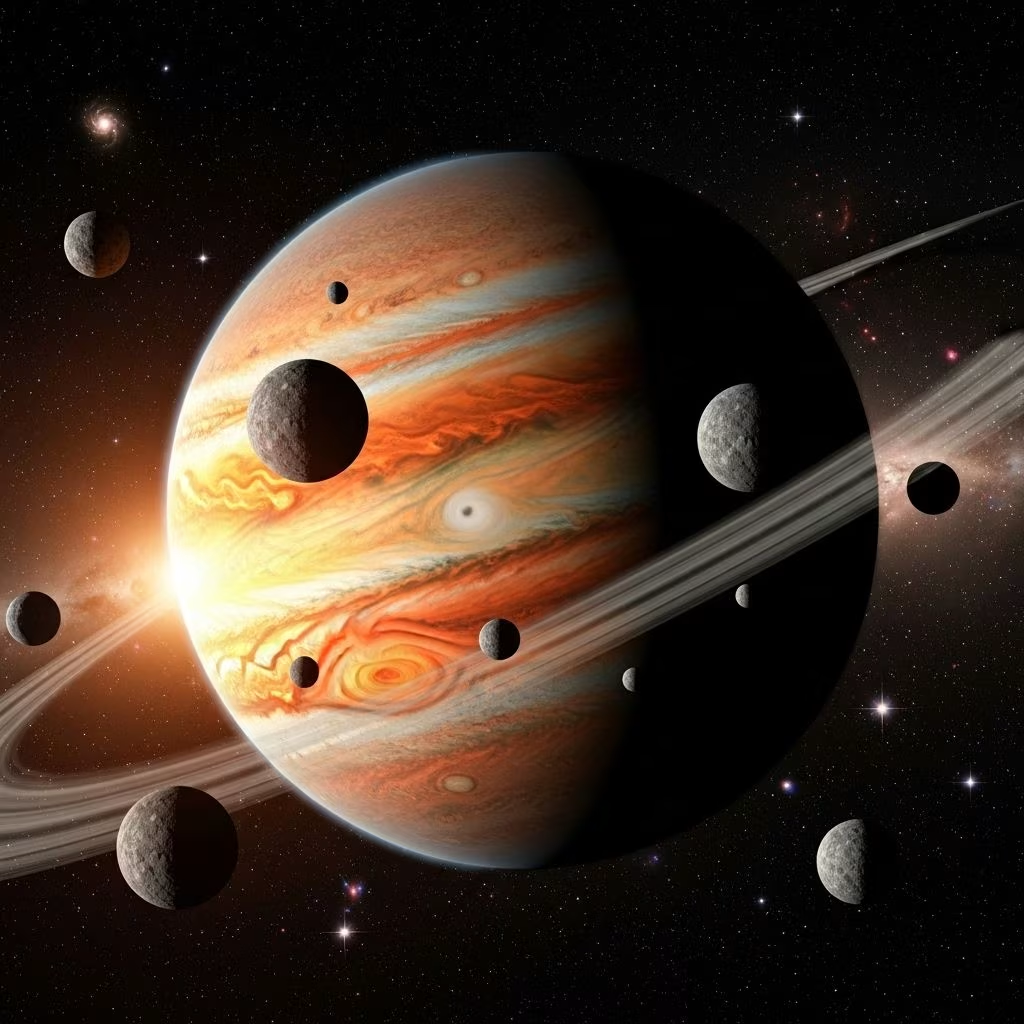
Gas Giants: The Colossal Worlds of Our Solar System
Our solar system is home to four gas giants—Jupiter, Saturn, Uranus, and Neptune. These planets, also called Jovian planets, contrast sharply with the smaller, rocky worlds of the inner solar system. Dominated by hydrogen, helium, and, in some cases, icy compounds, gas giants are massive, dynamic, and essential to understanding the formation and evolution of planetary systems both at home and across the galaxy.
What Are Gas Giants?
A gas giant is a planet made primarily of hydrogen and helium, lacking a well-defined solid surface. Their name reflects their enormous size and composition, with the bulk of their mass in a gaseous or liquid state rather than a rocky one. Jupiter and Saturn are the true gas giants, while Uranus and Neptune, due to distinct compositional differences, are often classified as ice giants.
Key Features of Gas Giants:
- Massive sizes—many times the diameter and mass of Earth
- Dominant hydrogen and helium atmospheres
- Absence of a solid surface (as found on terrestrial planets)
- Rapid rotational speeds leading to dramatic atmospheric effects
- Complex magnetospheres and ring systems
- Numerous moons, some of which may harbor subsurface oceans
Table: Comparison of Gas Giants
| Planet | Diameter (Earth = 1) | Major Components | Type | Number of Moons* | Rings |
|---|---|---|---|---|---|
| Jupiter | ~11 | Hydrogen, Helium | Gas Giant | ~80 | Yes |
| Saturn | ~9 | Hydrogen, Helium | Gas Giant | ~80 | Prominent |
| Uranus | ~4 | Hydrogen, Helium, Water, Methane, Ammonia | Ice Giant | 27 | Yes |
| Neptune | ~4 | Hydrogen, Helium, Water, Methane, Ammonia | Ice Giant | 14 | Yes |
*As of 2024; new moons are still being discovered as telescope technology advances.
Jovian Planets: Jupiter, Saturn, Uranus, and Neptune
The term Jovian references the Roman god Jupiter and denotes the similarity among the largest planets in our solar system. While they share many characteristics, each gas giant has unique features, compositions, and mysteries yet to be fully unraveled.
Jupiter
Jupiter is the largest planet in the solar system—so massive it could fit more than 1,300 Earths inside. Its atmosphere is marked by iconic bands, storms like the Great Red Spot, and fierce winds surging around the planet at high speeds.
- Primarily composed of hydrogen and helium
- No solid surface; outer layers blend into deeper, denser interiors
- Rapid rotation: completes a day in about 10 hours
- Over 80 known moons, including volcanic Io and icy Europa
- Narrow, faint ring system
Jupiter’s immense gravity profoundly impacted the solar system’s early development, influencing the formation and positioning of other planets and countless smaller bodies.
Saturn
Saturn stands out for its dazzling, extensive ring system—one of the most spectacular sights in the solar system.
- Second-largest planet
- Hydrogen and helium dominate its composition
- Possesses a less dense overall structure than Jupiter
- Rotates rapidly, completing one spin in just over 10 hours
- At least 80 moons, including Titan, with a substantial nitrogen atmosphere
- Famed rings composed largely of water ice, some dust and rocky material
Saturn’s rings, though enormous, are astonishingly thin—sometimes just tens of meters thick. The processes underlying ring formation and longevity are an active area of research.
Uranus and Neptune: The Ice Giants
Unlike Jupiter and Saturn, Uranus and Neptune contain a higher proportion of “ices”—volatile compounds such as water, methane, and ammonia. Astronomers now refer to them as ice giants to emphasize their compositional differences.
- Roughly four times Earth’s diameter
- Atmospheres: hydrogen, helium, plus methane (gives Neptune its blue tint)
- Interiors: rocks, water, ammonia, and methane in ‘slushy’ or icy forms
- Relatively subdued ring systems
- Many moons; some display potential signs of subsurface oceans
Uranus is unique for its extreme axial tilt, rotating almost on its side, creating unusual seasonal variations. Neptune, the most distant planet, exhibits supersonic winds and storms, with the fastest wind speeds observed in the solar system.
Structure and Composition
Gas and ice giants exhibit deep, multi-layered structures, dominated by massive atmospheres and exotic forms of matter.
Internal Layers
- Atmosphere: Comprised mainly of hydrogen and helium, with layered clouds of water, ammonia, and other compounds.
- Metallic Hydrogen Layer: In Jupiter and Saturn, immense pressures compress hydrogen into a metallic form, conducting electricity and generating magnetic fields.
- Slushy Mantles: Uranus and Neptune’s mantles contain mixtures of water, ammonia, and methane, existing in exotic states under high pressure.
- Core: All gas giants are believed to have small rocky or metal-rich cores, but the exact sizes and compositions remain largely theoretical.
Atmospheric Dynamics
The atmospheres of gas giants vary dramatically with latitude and depth. Key phenomena include:
- Zonal Wind Bands: Distinct east-west stripes caused by rapid rotation and convection, especially visible on Jupiter and Saturn
- Giant Storms: Jupiter’s Great Red Spot, Saturn’s hexagonal polar storm, and Neptune’s dark spots
- Coloration: Produced by trace gases such as ammonia, phosphine, and methane, combined with sunlight-driven chemical reactions
- Rapid Rotation: Short planetary days distort shapes into oblate spheroids (flattened at the poles)
Moons and Rings of the Gas Giants
Gas giants boast complex systems of satellites and rings:
- All four have multiple rings; Saturn’s being the most visible and extensive
- Hundreds of known moons, with gas giants hosting the solar system’s most intriguing natural satellites
- Some moons—like Europa (Jupiter) and Enceladus (Saturn)—are prime candidates for the search for extraterrestrial life due to evidence of subsurface oceans
Ring systems are made up of countless particles, mostly ice and dust. While Saturn’s rings are bright and expansive, the others are fainter and harder to study. The moons, ranging from captured asteroids to planetary-sized bodies, often have unique geology, atmospheres, orbits, and histories.
Formation and Evolution
The gas giants are believed to have formed far from the Sun, where it was cold enough for volatile compounds to condense and accrete. Several theories address their formation, including the core accretion model and the disk instability model. Their strong gravity influenced the early solar system, affecting asteroid belts, the distribution of comets, and the survival of smaller planets.
Why Are Gas Giants Far from the Sun?
- Only beyond the so-called “frost line” could light gases and ices accumulate in sufficient amounts for gas giants to form
- The “grand tack hypothesis” suggests that Jupiter and Saturn migrated during the solar system’s youth, affecting inner planet formation and asteroid belt placement
Beyond the Solar System: Exoplanetary Gas Giants
With modern telescopes, astronomers have discovered gas giants orbiting other stars, including so-called “hot Jupiters”—massive gas giants extremely close to their stars, experiencing scorching temperatures. These discoveries have expanded our understanding of planet formation and migration, suggesting tremendous diversity among planetary systems across the galaxy.
- Many exoplanet gas giants are much more massive than Jupiter
- Orbits vary, with some circling very close to their stars, producing exotic atmospheric phenomena
The Distinction Between Gas Giants, Ice Giants, and Brown Dwarfs
The boundary between gas giants and the much more massive brown dwarfs is not always clear. Brown dwarfs are objects too massive to be planets, yet not quite stars. Debate continues as to whether the distinction lies more in formation process or internal physics—mainly whether the core ever underwent fusion reactions.
Sudarsky’s Classification System
In planetary science, the Sudarsky classification sorts gas giants by temperature and atmospheric appearance. From cold, cloudless worlds to sweltering, feature-rich planets, this system reflects the diversity of giant planets both in our solar system and beyond.
Outstanding Mysteries and Ongoing Research
Despite centuries of study and exploration by missions such as Voyager, Galileo, Cassini, and Juno, gas giants still hold many puzzles. Open questions include:
- The precise composition and structure of their cores
- The origin and fate of their ring systems
- The processes driving their atmospheric colors and weather systems
- How common gas giants are around other stars, and how they form in different environments
Why Study Gas Giants?
- Gas giants shape planetary systems—determining the architecture and habitability zones for other planets
- Their moons offer environments for possible extraterrestrial life
- Understanding their atmospheres and magnetic fields informs both planetary science and astrophysics
- Gas giant exploration drives technological innovation in robotics, remote sensing, and data analysis
Frequently Asked Questions (FAQs)
Q: Why are Jupiter and Saturn called gas giants while Uranus and Neptune are called ice giants?
A: Jupiter and Saturn are rich in hydrogen and helium, with thick metallic hydrogen interiors, while Uranus and Neptune contain higher amounts of water, ammonia, and methane ‘ices’ beneath their atmospheres.
Q: Do gas giants have solid surfaces?
A: No, gas giants lack well-defined solid surfaces; they transition smoothly from a gaseous to a liquid state, becoming denser toward an inaccessible core.
Q: What gives the gas giants their colors and bands?
A: The colors and atmospheric bands result from high-speed winds, chemical compositions, and sunlight-driven reactions among clouds of ammonia, water, phosphine, and other compounds.
Q: Do other planetary systems have gas giants?
A: Yes, astronomers have detected thousands of exoplanetary gas giants—including “hot Jupiters” orbiting close to their stars—revealing a remarkable diversity of planetary types.
Q: Which gas giant has the most moons?
A: As of 2024, both Jupiter and Saturn are tied with around 80 known moons each, though these numbers continue to grow with improved discovery techniques.
References
- https://en.wikipedia.org/wiki/Gas_giant
- https://science.nasa.gov/solar-system/planets/
- https://science.nasa.gov/exoplanets/gas-giant/
- https://www.lpi.usra.edu/education/space_days/activities/gasGiants/aboutGasGiants.pdf
- https://en.wikipedia.org/wiki/Sudarsky’s_gas_giant_classification
- https://www.youtube.com/watch?v=odOLMtylyT4
- https://lasp.colorado.edu/outerplanets/giantplanets_whatandwhere.php
- https://www.astronomy.com/science/why-do-astronomers-call-uranus-and-neptune-ice-giants/
- https://www.universetoday.com/articles/gas-giants
- https://courses.lumenlearning.com/suny-astronomy/chapter/the-giant-planets/
- http://csep10.phys.utk.edu/OJTA2dev/ojta/c1c/jupiter/overview/gasgiants_tl.html
- https://commons.wikimedia.org/wiki/File:Gas_planet_size_comparisons.jpg
- https://courses.lumenlearning.com/suny-earthscience/chapter/outer-planets/
- https://creation.com/cfk-gas-giants
- https://www.open.edu/openlearn/mod/oucontent/view.php?id=66947§ion=3
- https://testbook.com/question-answer/which-of-the-following-planets-is-known-as-a-gas-g–6047362ad7b5a670b588aed7
- https://theplanets.org/gas-giants/
- https://solar-system-planets.org/news/understanding-the-gas-giants-of-the-solar-system


