The Sun is the centerpiece of our solar system—vital to life on Earth, yet its own origins are shrouded in cosmic drama. This article delves into the science behind the Sun’s formation, from its birth in a giant molecular cloud to its dynamic presence today.
Genesis: The Solar Nebula
Approximately 4.6 billion years ago, our solar system began as a vast, cold, and diffuse cloud of gas and dust, called the solar nebula.
This interstellar cloud comprised mostly hydrogen, with some helium and trace heavier elements [11][12].
- The birth site: a giant molecular cloud, often found in spiral arms of galaxies.
- The cloud was hundreds of light-years across and contained clumps of denser material.
- Nearby supernovae or the gravitational influence of a passing star may have triggered the collapse of a section of this cloud [11][12].
Collapse and Contraction: Gravity Takes Charge
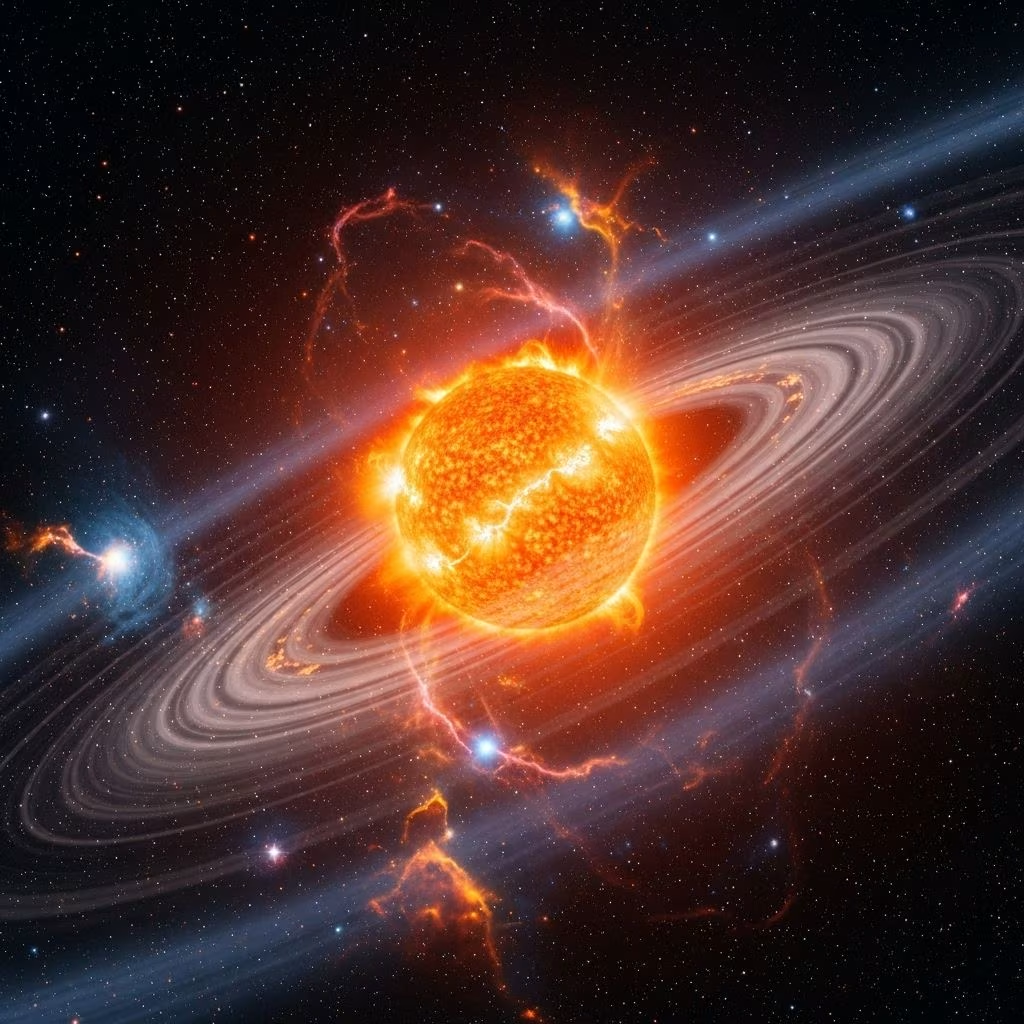
Under the relentless pull of gravity, a region within the cloud began to contract. As the material condensed, it formed a flattened spinning disk known as a protoplanetary disk. The majority of mass rushed toward the center, eventually becoming the embryonic Sun.
- Gravitational collapse generated heat as particles accelerated inward.
- Most material accumulated at the center, surrounded by a swirling disk of dust and gas [11][12].
Table: Steps in the Sun’s Birth
| Stage | Main Event |
|---|---|
| Interstellar Cloud | Vast, cool gas and dust; initial collapse begins. |
| Protostar | Central mass heats, contracts, starts to glow. |
| Ignition | Nuclear fusion triggers; a star is born. |
| Main Sequence | Fusion balances gravity; stable Sun shines. |
Ignition: Nuclear Fusion Begins
The temperature and pressure at the collapsing core soared to millions of degrees. At around 10 million Kelvin, nuclear fusion reactions ignited: hydrogen atoms fused to form helium, releasing prodigious amounts of energy. Our Sun was born as a new star [11].
- Fusion: 4 hydrogen nuclei → 1 helium nucleus + energy
- The outward pressure from fusion balanced inward gravity — stabilizing the newborn star
Formation of the Solar System
Leftover gas and dust remained in the disk surrounding the Sun. This material clumped together to form the planets, moons, asteroids, and comets we observe today [11][12].
- Inner disk: High temperatures prevented ices from forming, creating rocky planets (Mercury, Venus, Earth, Mars).
- Outer disk: Cooler temperatures allowed ices and gases to form, resulting in giant planets (Jupiter, Saturn, Uranus, Neptune).
Protoplanetary Disks: Insights from Observation
Modern telescopes have imaged young stars surrounded by protoplanetary disks, such as HL Tauri. These provide direct evidence for the processes hypothesized to have occurred during the Sun’s own formative days [11][12].
The Sun’s Characteristics: From Protostar to Main Sequence Star
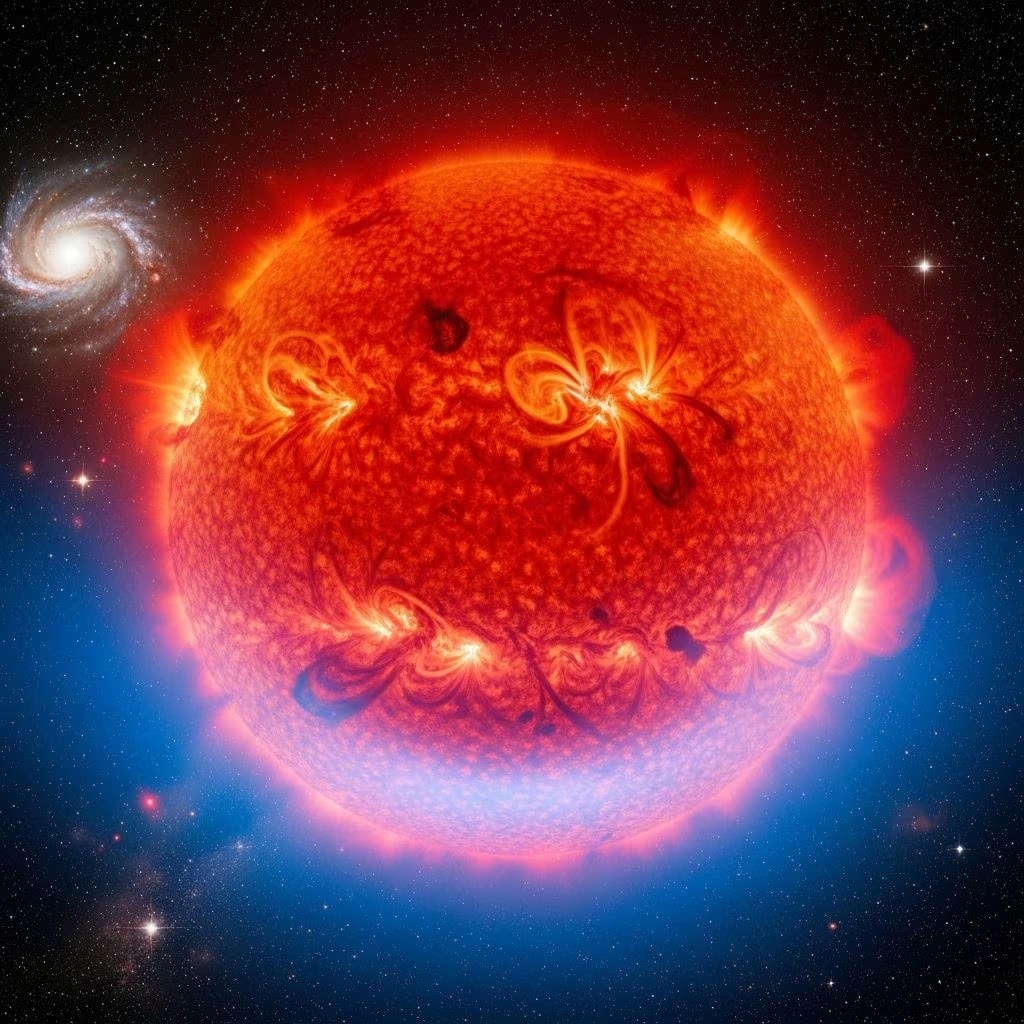
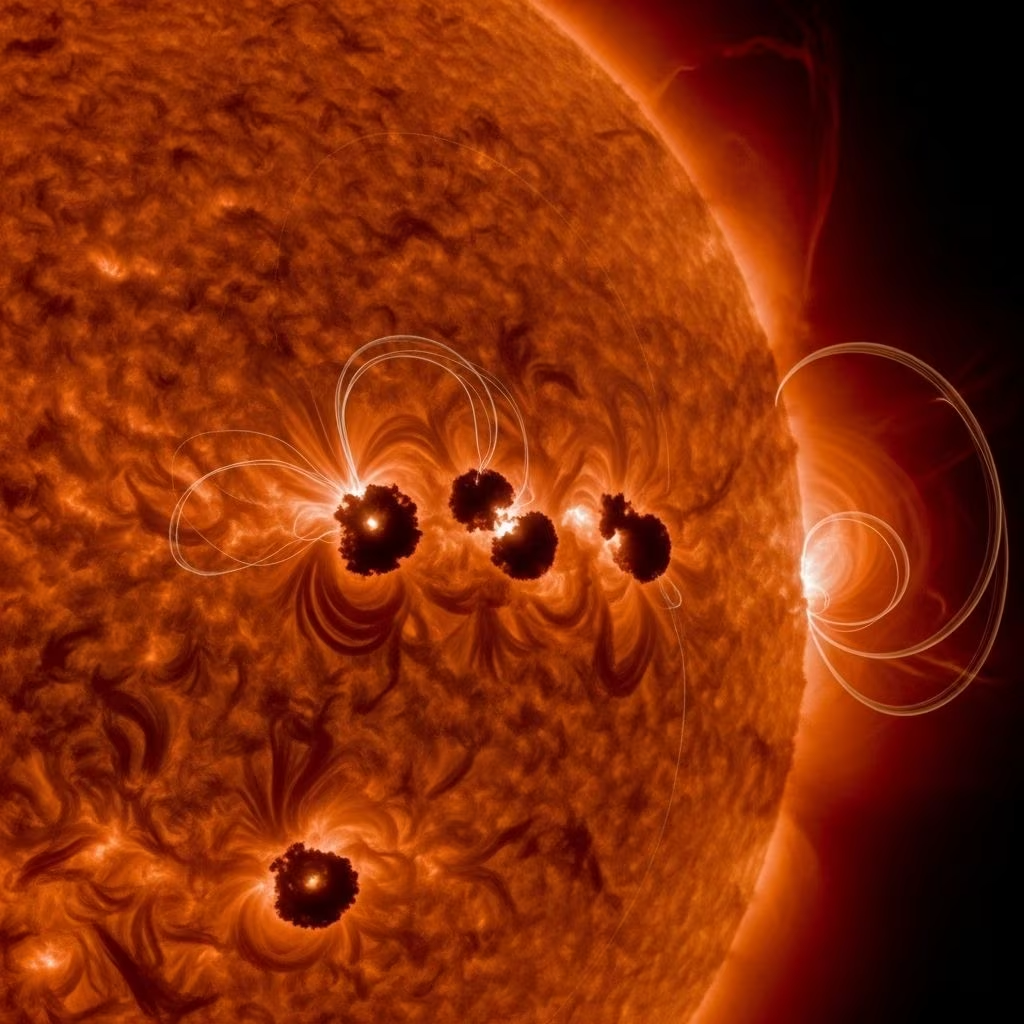
The Sun is classified as a G-type main-sequence star (G2V): a yellow dwarf, though it shines white. Its life as a main-sequence star is powered by the fusion of hydrogen in its core .
- Radius: ~1.39 million km (109 Earths across)
- Mass: ~330,000 times that of Earth
- Composition: ~73% hydrogen, ~25% helium, small traces of heavier elements
- Age: ~4.6 billion years (about halfway through its expected main-sequence lifespan)
Main Sequence: The Sun’s Long Stable Era
For approximately 10 to 11 billion years, the Sun remains in the main-sequence phase, steadily fusing hydrogen to helium. Currently, the Sun is about halfway through this stage, emitting a stable output of energy vital for life on Earth [10].
- Every second, about 600 billion kg of hydrogen are fused in its core.
- This creates the sunlight and heat that sustain our planet.
- The Sun gradually grows brighter and larger as it ages due to changes in its core composition.
How the Sun’s Energy Powers Life
The energy radiated by the Sun drives Earth’s weather, climate, and supports photosynthesis in plants, which in turn sustains nearly all life.
The Sun’s Future: Red Giant to White Dwarf
Billions of years from now, after most of the hydrogen is fused to helium, the Sun’s fate will change dramatically :
- Red Giant Phase: The Sun will expand vastly, engulfing the inner planets as it fuses heavier elements.
- Planetary Nebula: The outer layers will shed, creating a shell of gas in space.
- White Dwarf: The core that remains will cool and fade over extraordinary timescales.
Impact on the Solar System
- The formation of the Sun ignited the process of planet formation and dictated the architecture of the solar system.
- Its gravity holds the solar system together, influencing planetary orbits for eons .
- Solar radiation and the solar wind shape planetary atmospheres and the conditions for life.
Common Questions about the Sun’s Birth and Evolution
Q: What was the solar nebula, and how did it lead to the Sun?
A: The solar nebula was a broad cloud of gas and dust left over from previous star generations. Gravity caused a part of this nebula to collapse and spin, forming a disk. Material in the center grew dense enough to start nuclear fusion — creating the Sun.
Q: How do we know how the Sun and solar system formed?
A: Scientists use computer simulations, astronomical observations, and evidence from meteorites and ice samples. Observations of young stars and disks in other parts of our galaxy bolster models of solar system formation [11][12].
Q: Was our Sun always alone?
A: It likely formed in a cluster with other stars, many of which have since drifted away.
Q: Will the Sun ever explode as a supernova?
A: No. The Sun’s mass is too low. It will become a red giant, then a white dwarf, not a supernova.
Q: How much longer will the Sun continue to shine?
A: Approximately 5 billion more years, as it fuses hydrogen in its core. The Sun is halfway through its main-sequence “lifetime.”
Key Takeaways about the Sun’s Formation
- The Sun formed about 4.6 billion years ago from a collapsing cloud of gas and dust.
- Nuclear fusion in the core was triggered by extreme pressures, marking the Sun’s true ‘birth.’
- Leftover material formed planets, moons, and smaller bodies in the solar system.
- The Sun will persist for billions of years, shaping the evolution of our solar system until its transition to a white dwarf.
Resources and Further Reading
- NASA Solar Science
- Royal Museums Greenwich: Origin of the Solar System
- Natural History Museum: How Our Solar System Was Born
Frequently Asked Questions (FAQs)
Q: What is the most abundant element in the Sun?
A: Hydrogen, making up about 73% of the Sun’s mass .
Q: Has humanity ever observed a star in the process of forming?
A: Yes, astronomers have observed many protoplanetary disks and forming stars, such as HL Tauri, with powerful telescopes [11][12].
Q: Will Earth survive when the Sun becomes a red giant?
A: It is likely that Earth’s surface will be scorched or engulfed as the Sun swells during its red giant phase.
Q: Why is studying the Sun’s formation important?
A: Understanding the Sun’s birth helps us comprehend the origins of planets, life, and solar systems throughout the universe.
References
- https://en.wikipedia.org/wiki/Sun
- https://science.nasa.gov/sun/facts/
- https://en.wikipedia.org/wiki/Formation_and_evolution_of_the_Solar_System
- https://www.lpi.usra.edu/education/skytellers/sun/
- https://www.amnh.org/exhibitions/permanent/the-universe/planets/formation-of-our-solar-system
- https://www.youtube.com/watch?v=VSKSyZh3FOU
- https://www.space.com/58-the-sun-formation-facts-and-characteristics.html
- https://science.nasa.gov/sun/
- https://www.rmg.co.uk/stories/space-astronomy/origin-solar-system
- https://science.howstuffworks.com/sun.htm
- https://www.ndtv.com/world-news/explained-how-sun-was-formed-4-6-billion-years-ago-5399524
- https://www.nhm.ac.uk/discover/how-our-solar-system-was-born.html
- https://www.youtube.com/watch?v=L_3rsArLhks
- https://cimss.ssec.wisc.edu/sage/geology/lesson1/solar_system_birth.html
- https://www.sciencenewstoday.org/how-was-the-sun-formed-the-fiery-birth-of-our-star
- https://consensus.app/questions/formation-of-the-sun/
- https://solarstory.net/objects/sun