SpaceX Starship Test-Stand Explosion: Nitrogen Tank Failure Traced
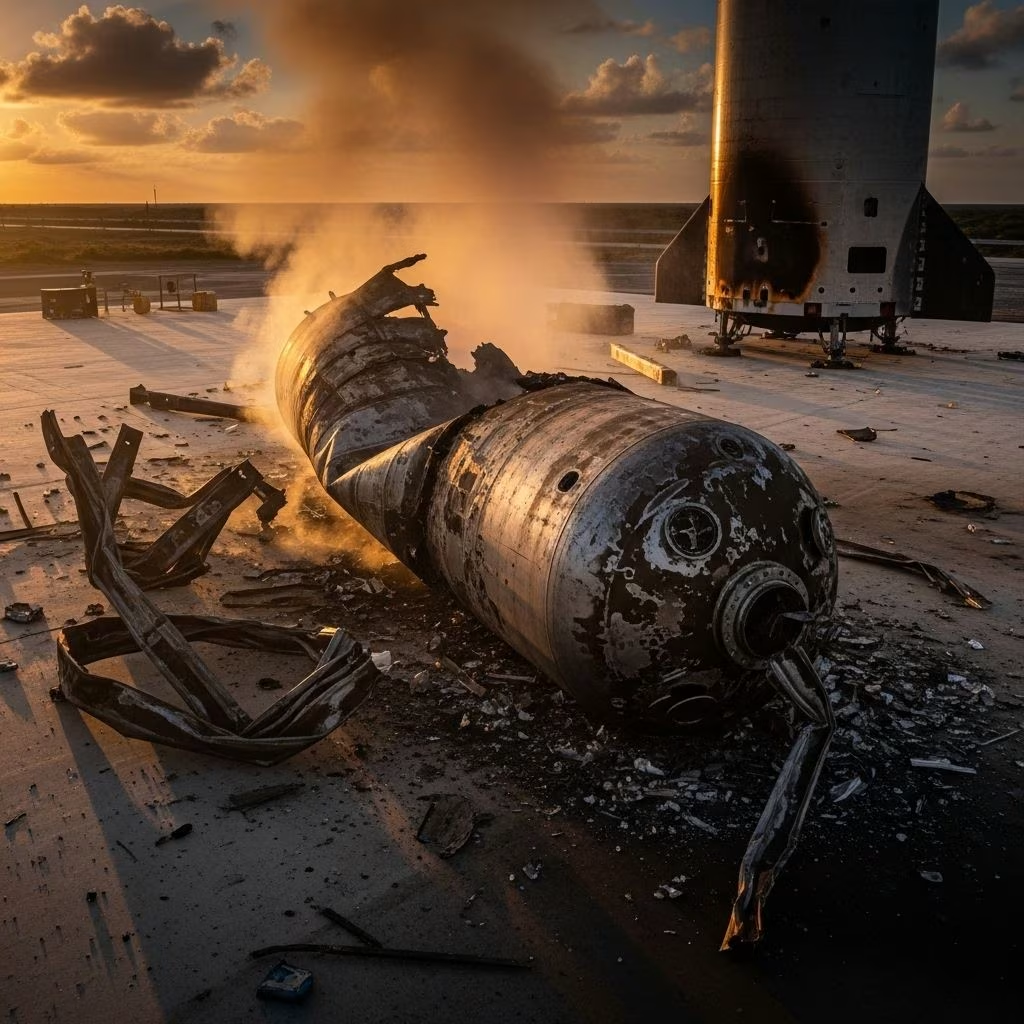
On the night of June 18, 2025, SpaceX’s much-anticipated Starship test vehicle was destroyed in a dramatic explosion on its Texas test stand. Preliminary investigations have traced the cause of this catastrophic event to the failure of a pressurized nitrogen tank, marking a significant setback in SpaceX’s progress toward operational deep-space launches.The incident did not result in any injuries, thanks to stringent safety protocols, but has prompted a wide-ranging technical and organizational review.
Background: Starship’s Role in SpaceX’s Vision
The Starship is SpaceX’s next-generation, fully reusable launch vehicle, designed to carry both crew and cargo to destinations including the Moon, Mars, and beyond. A centerpiece of Elon Musk’s long-term ambitions, Starship represents a leap in payload capacity and operational flexibility. The Texas Gulf Coast Starbase facility has become the focal point for rapid prototyping, iterative testing, and launch preparation as the company hustles toward Starship’s 10th integrated flight test.
Timeline of the Test-Stand Explosion
- June 18, 2025 (Late Evening): Ship 36, Starship’s current test vehicle, was being prepared for a critical static fire test at SpaceX’s Massey test stand near Starbase, Texas.
- Liquid methane and oxygen loading: The vehicle was being loaded with propellants, a standard prelude to firing its six Raptor engines.
- Large fireball: Suddenly, Ship 36 erupted in a colossal explosion, visible in livestreams and widely shared social media footage.
- Immediate aftermath: A safety perimeter ensured that all personnel remained uninjured. No risk to nearby communities was reported, with clear instructions issued to keep residents clear of the site[11].
- Initial analysis: SpaceX’s engineering team quickly began combing through sensor data and reviewing video footage for clues.
Technical Details: The Nitrogen COPV Failure
The explosion’s suspected root cause involves a Composite Overwrapped Pressure Vessel (COPV) used to hold gaseous nitrogen in the nosecone area[11]. Musk noted that preliminary data suggested the nitrogen COPV failed below its proof pressure—a behavior never before observed in this COPV design. This tank is distinct from the helium COPVs that previously failed on a Falcon 9 rocket in 2016, which led to another significant SpaceX setback; the company insists that there is “no commonality” in the tank technology between Falcon 9 and Starship.
- COPVs: Lightweight tanks wrapped in carbon composites, designed for high-pressure storage, are mission-critical in SpaceX’s launch systems.
- Nitrogen’s role: Pressurized gaseous nitrogen is used in Starship for pre-pressurization, systems purging, and thermal management.
- Failure scenario: The tank rupture likely caused an uncontrolled release of pressurized gases. This in turn may have triggered ignition of nearby methane, resulting in the huge fireball and debris shower observed.
Comparative Table: Starship vs. Falcon 9 COPV Incidents
| Rocket | Failure Date | COPV Type | Stored Gas | Impact | Similarity |
|---|---|---|---|---|---|
| Falcon 9 | August 2016 | Carbon Overwrap | Helium | Loss of rocket and satellite | None claimed by SpaceX |
| Starship | June 2025 | Carbon Overwrap | Nitrogen | Loss of test vehicle | Distinct design, first observed issue |
Safety Protocols and Community Impact
- Swept Clear Area: A robust safety perimeter was established early in the operation, ensuring that all personnel were safe and accounted for after the incident[12].
- Local cooperation: SpaceX coordinated immediately with local officials and emergency responders to secure the site and monitor for hazards. Residents were reassured of no ongoing risks, but urged to remain clear during the ongoing investigation[12].
- Facility damage: The full extent of the damage to the Massey test stand and surrounding infrastructure is still under review, though no additional hazards have surfaced so far.
SpaceX’s Official Response and Investigation
SpaceX’s first official statement confirmed a “major anomaly” experienced during standardized test operations[12]. Subsequent communication emphasized the early identification of a pressurized nitrogen tank failure within the nosecone area.
- Safety ensured: “All personnel are safe and accounted for. Our Starbase team is actively working to safe the test site and the immediate surrounding area in conjunction with local officials.”
- No hazard: “There are no hazards to residents in nearby communities but please stay away while we work to safe the test site.”[12]
Musk’s own statements on social media acknowledged the uniqueness of the tank failure mode and stressed that it was the first incident involving this specific COPV design. SpaceX has committed to an exhaustive review of the sensor logs, tank fabrication records, and operational timeline, aiming to identify the precise trigger and any design flaws that may have contributed.
Implications for Future Starship Testing
This explosion marks a significant learning moment for SpaceX, whose culture emphasizes rapid iteration—accepting failure as a route to robust engineering solutions. Every anomaly and mishap feeds into a feedback loop driving design, testing, and operational improvements.
- Root cause analysis: Engineering teams are now focusing on stress testing COPVs and reviewing proof pressures to ensure no repetition of failure modes.
- Test schedule: The timeline for Starship flight test 10, previously expected soon, will likely be adjusted pending the investigation and retrofits[10].
- Design modifications: If a systemic issue with COPV manufacturing or installation is found, subsequent vehicles may see design enhancements across pressure vessel geometries, materials, and proofing procedures.
- Regulatory oversight: SpaceX is anticipated to provide full reports to the FAA and participate in multi-agency reviews as part of standard launch licensing and test safety protocols.
What Are Composite Overwrapped Pressure Vessels (COPVs)?
COPVs are a staple in aerospace engineering for high-pressure gas storage. Constructed from a lightweight metallic liner (usually aluminum) encased in filament-wound carbon fiber composites, COPVs offer superior strength-to-weight ratios over traditional tanks. COPVs are extensively used to store pressurants for rocket engines, environmental control systems, and emergency shutdowns.
- Advantages: Lightweight, high strength, corrosion-resistant
- Risks: Manufacturing defects, suboptimal quality control, and unexpected stress conditions can trigger failures
Starship: Technical Overview
- Height: ~120 meters (with booster)
- Payload capacity: Up to 150 metric tons to low Earth orbit (LEO)
- Engine configuration: 6 Raptor engines on upper stage
- Propellants: Liquid Methane (CH4), Liquid Oxygen (LOX)
- Pressure systems: COPVs for nitrogen and other gases, critical for various operational roles
Past Explosions: Lessons Learned and Progress
- Early test failures: Starship has a history of dramatic tank and engine failures tied to rapid iterative cycles but each incident has produced valuable data for future improvements.
- Falcon 9 lessons: Falcon 9’s 2016 helium COPV failure resulted in a major redesign and increased safety focus. Starship COPV failures, though distinct, evoke similar calls for enhanced quality assurance.
A Community on Edge—Reaction in Texas
The Starbase launch site has drawn local, national, and international attention, not only as a high-tech showcase but also as a symbol of SpaceX’s ambitions. The recent explosion was felt across the region, but swift communication and safety protocols minimized direct impact.
- Local government: Actively supporting SpaceX’s investigation, monitoring for potential air quality effects, and advising residents.
- Public interest: Social media, livestreams, and independent analysts have documented the incident, driving heightened scrutiny of SpaceX’s test procedures.
Frequently Asked Questions (FAQs)
Q: What caused the Starship explosion in June 2025?
A: Preliminary data points to the failure of a nitrogen COPV (composite overwrapped pressure vessel) in the vehicle’s nosecone, causing an uncontrolled release of pressurized gases and subsequent ignition of methane propellant.
Q: Was anyone injured in the blast?
A: No injuries were reported. SpaceX maintained safety perimeters and coordinated with local authorities to secure the site and keep personnel safe[12].
Q: Is the COPV failure related to Falcon 9’s 2016 incident?
A: SpaceX maintains there is “no commonality” between the design of Starship’s nitrogen COPV and Falcon 9’s failed helium COPV, though lessons from earlier incidents continue to shape engineering approaches.
Q: How will this affect Starship’s launch timeline?
A: The ongoing investigation may delay the 10th test flight as SpaceX reviews COPV design, proof pressures, and tank manufacturing; safety is expected to take priority over speed[10].
Q: What steps is SpaceX taking to prevent future failures?
A: SpaceX is enhancing root cause analysis, retrofitting COPV systems, reviewing design and manufacturing procedures, and collaborating with regulatory authorities to ensure test safety and reliability moving forward.
Conclusion: A Setback and an Opportunity
SpaceX’s Starship test-stand explosion highlights the perils and promise of prototype rocket engineering. The failure of a pressurized nitrogen tank may be a first for this particular design, but the response—rapid investigation, safety assurance, and open communication—demonstrates SpaceX’s commitment to continuous improvement. As Starship edges closer to operational status, each mishap carves another lesson into the annals of space exploration, forging a resilient path toward humanity’s next giant leap.
References
- https://www.space.com/space-exploration/launches-spacecraft/spacex-traces-starship-test-stand-explosion-to-failure-of-pressurized-nitrogen-tank
- https://www.space.com/space-exploration/launches-spacecraft/spacexs-starship-explodes-in-texas-during-preparations-for-10th-test-flight
- https://www.cbsnews.com/news/spacex-starship-upper-stage-explosion-expected-engine-test-firing/
- https://spaceflightnow.com/2025/06/19/next-starship-explodes-on-test-stand/
- https://www.youtube.com/watch?v=0C_L-qgHsE0&vl=en
- https://www.youtube.com/watch?v=C0t6o2nqdSE
- https://www.theregister.com/2025/06/19/spacexs_starship_explodes_again/
- https://www.livescience.com/space/space-exploration/spacexs-starship-explodes-on-texas-launch-pad-in-catastrophic-failure-during-routine-test
- https://www.foxbusiness.com/economy/spacex-starship-explodes-texas-launch-site
- https://techcrunch.com/2025/06/19/spacexs-starship-blows-up-ahead-of-10th-test-flight/
- https://www.clickorlando.com/news/space-news/2025/06/20/pressurized-tank-failure-spacex-narrows-down-cause-of-latest-starship-explosion/
- https://www.engadget.com/science/space/spacexs-starship-explodes-on-the-ground-during-a-routine-test-130025133.html
- https://www.aerotime.aero/articles/spacex-starship-explosion-musk
- https://www.latimes.com/business/story/2025-06-19/spacexs-starship-explodes-on-test-stand-in-yet-another-setback
- https://www.cbsnews.com/news/spacex-starship-upper-stage-explosion-expected-engine-test-firing/?ftag=CNM-00-10aac3a
- https://nationalpost.com/news/spacexs-starship-explodes-on-test-stand-in-yet-another-setback