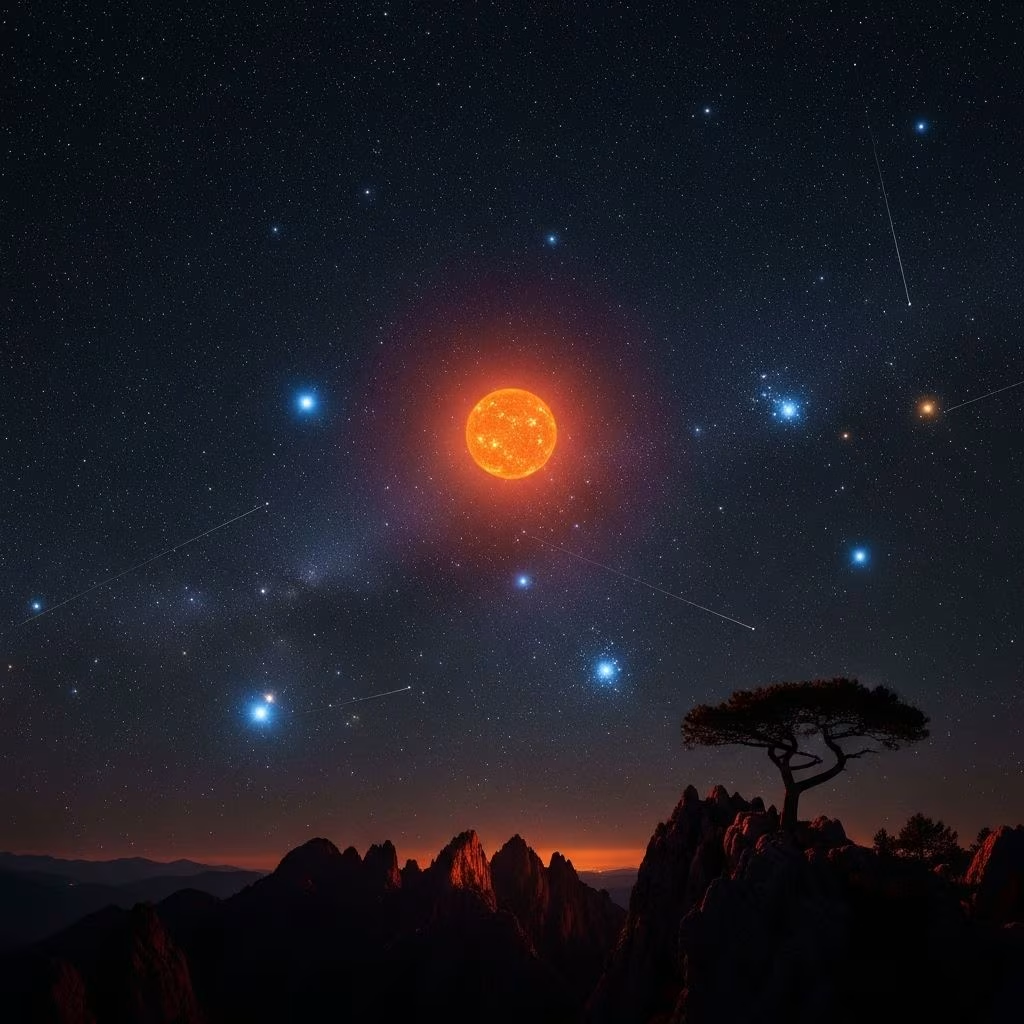
Arcturus: The Shining Beacon of the Northern Celestial Hemisphere
Arcturus, known scientifically as Alpha Boötis (α Boötis), is a red giant star renowned for its brilliance and place of honor among the stars of the northern sky. As the most luminous star in the constellation Boötes and the fourth brightest in the entire night sky, Arcturus has inspired astronomers, navigators, and storytellers for millennia.
This article delves into the history, science, significance, and observational wonder that make Arcturus a key fixture in the spring and summer skies.
Quick Facts About Arcturus
- Constellation: Boötes
- Apparent Magnitude: −0.05 (4th brightest star overall)
- Type: Red giant (K1.5 IIIpe)
- Distance from Earth: 36.7 light-years
- Luminosity: ~170 times that of the Sun (in visible light); 180 times the Sun (overall, including infrared)
- Surface Temperature: About 4,286 K
- Diameter: Roughly 25 times the Sun’s diameter
- Coordinates (J2000): Right Ascension: 14h 15m 39.7s | Declination: +19° 10′ 56″
- Traditional Name: From Greek, meaning “Guardian of the Bear”
Where Is Arcturus Located?
Arcturus sits prominently in the northern constellation Boötes, which can be found by following the arc of the Big Dipper’s handle across the sky—a classic astronomical catchphrase: “Arc to Arcturus.” From there, extending the arc further leads skywatchers to Spica, in Virgo.
Visibility: Arcturus shines brightest in the northern hemisphere’s spring and summer evenings, often sparkling with an orange-red hue. It forms a pivotal point in three well-known asterisms:
- The Spring Triangle (with Spica and Regulus or Denebola)
- The Great Diamond (Arcturus, Spica, Denebola, and Cor Caroli)
- The Kite of Boötes
The star’s position near 19° north declination makes it visible to observers from both hemispheres, though it reaches its highest point in the sky for those at northern latitudes.
The Name and Its Meaning
The name Arcturus is derived from the ancient Greek Ἀρκτοῦρος (Arktouros), best translated as “Guardian of the Bear.” This nomenclature reflects Arcturus’s proximity to the constellations Ursa Major (Great Bear) and Ursa Minor (Little Bear) in the sky, positioning the star as a celestial sentinel. In Greek myth and literature—dating back to Hesiod—the name alludes to the star’s apparent role in watching over the bears as they circle the pole.
The Bayer designation Alpha Boötis was assigned in the early 17th century by Johann Bayer. The International Astronomical Union (IAU) officially recognized the star’s name as Arcturus in 2016.
Physical Characteristics
Arcturus exemplifies the class of red giant stars, presenting striking differences from our Sun:
- Stellar Classification: K1.5 IIIpe denotes a cool, evolved giant with peculiar spectral features.
- Mass: Slightly greater than the Sun—estimated at 1.08 to 1.2 times solar mass.
- Radius: About 25-27 times the Sun’s radius (~35 million km).
- Luminosity: Arcturus emits 110 times the visible light of the Sun and nearly 180 times more total power when infrared wavelengths are included.
- Surface Temperature: Approximately 4,200–4,300 K, much cooler than the Sun’s 5,778 K, giving Arcturus its pronounced orange hue.
- Metallicity: Only about 1/3 the Sun’s abundance of heavy elements (“metals”), but a higher ratio of alpha elements (like oxygen and silicon) compared to iron.
Physically, although Arcturus is only slightly more massive than the Sun, its advanced evolutionary stage has caused it to swell enormously, now spanning about 25 times the Sun’s diameter. This expansion, coupled with a cooler surface, results in its striking color and intense infrared output.
| Property | Arcturus | The Sun |
|---|---|---|
| Spectral Type | K1.5 IIIpe | G2 V |
| Mass | 1.1 M☉ | 1.0 M☉ |
| Radius | 25–27 R☉ | 1 R☉ |
| Luminosity | 110× (visible); 180× (total) | 1× |
| Surface Temperature | ~4,286 K | ~5,778 K |
| Age | 6–8.5 billion years | ~4.6 billion years |
Stellar Evolution and Age
Arcturus is a textbook example of a star in the red giant phase. Having exhausted hydrogen in its core, it now fuses hydrogen in a shell around a helium core. This transformation is marked by:
- Expansion and cooling of the outer layers
- Increased brightness and mass loss due to strong stellar winds
Estimates suggest Arcturus is between 6 and 8.5 billion years old. Its ultimate fate will involve continued expansion along the red giant branch and, ultimately, a “helium flash” event—an explosive but brief onset of helium fusion in the core, if it has not already occurred.
There is some scientific debate about its precise evolutionary state:
- Some researchers believe it is still climbing the red giant branch, approaching the helium flash.
- Others, based on color and observational data, suggest Arcturus has already completed the helium flash and now resides above the horizontal branch, burning helium in its core (similar to a “red clump” star).
Population II Star: An Ancient Relic
Arcturus belongs to the rare population known as Population II stars. These are older, low-metallicity stars believed to have formed during the early history of the universe, from primordial gas. Such stars are rare in the solar neighborhood—comprising only about 4% of the local stellar population.
The star’s low heavy element (metal) content supports this identification, offering astronomers insights into the conditions of the early universe and the chemical evolution of the Milky Way.
Is Arcturus a Binary Star?
While Arcturus has long been a target for searches for faint stellar companions, no companion star has been directly detected as of current research. Statistical models hint at the possibility of a cool, dim companion, but conclusive observational evidence is lacking.
Magnetic Activity and Stellar Winds
Despite its age, Arcturus still demonstrates:
- Magnetic activity: A weak field has been detected, with a strength around 0.5 gauss (about 1/1000th of the Sun’s average field).
- Magnetic Cycles: Suggestive evidence points to cycles shorter than 14 years—akin to the Sun’s 11-year cycle.
- Stellar winds and mass loss: Expected for a red giant, as outer layers are loosely bound and gradually lost to space.
Such activity, along with the star’s advanced age, offers astronomers a unique laboratory for studying late-phase stellar evolution and the aging process of sunlike stars.
How to Find and Observe Arcturus
Skywatchers cherish Arcturus for its accessibility and beauty. Here’s how to spot it:
- Best Time: Late spring through summer, rising in the east after sunset and reaching high in the southern sky by midnight.
- Star Hopping: Follow the curve of the Big Dipper’s handle—the popular instruction, “Arc to Arcturus.”
- Asterisms: Arcturus forms points in the Spring Triangle, the Great Diamond, and the Kite of Boötes.
- Color: Easily identified by its warm, orange-to-reddish tint visible to the naked eye.
- Urban and Rural Skies: Bright enough to be seen from cities but best admired under dark, rural skies.
Arcturus is only outshined in the night sky by Sirius, Canopus, and Alpha Centauri—all southern stars, making it the brightest star in the northern celestial hemisphere.
Cultural and Historical Significance
Arcturus has played a significant role throughout human history, guiding farmers, sailors, and storytellers alike:
- In Greek mythology, the star’s name marks it as the guardian of the celestial bears.
- Mentioned in the works of Hesiod (c. 8th century BCE), Arcturus heralded the coming of spring and was used to calculate agricultural calendars.
- Cultural associations: Appears in Chinese, Polynesian, Hawaiian, and various Native American traditions as a weather sign, seasonal marker, or spirit guide.
- In modern history: Its light was famously used to help open the 1933 Chicago World’s Fair, with photoelectric sensors detecting Arcturus’s rays to trigger the ceremony. At the time, Arcturus was believed to be 40 light-years from Earth, marking the World’s Fair anniversary of its 1893 predecessor.
The Importance of Arcturus in Modern Astronomy
- Arcturus is a key celestial navigation star, one of only 58 with this status, aiding night navigation for centuries.
- Its brightness and proximity have made it a calibration standard in astronomical studies, especially for infrared detectors and stellar models.
- Because of its low metallicity and advanced age, Arcturus provides a vital window on the evolution of our galaxy’s older populations and the chemical enrichment history of the Milky Way.
Frequently Asked Questions (FAQs)
Q: Why is Arcturus orange?
A: Arcturus is a red giant with a surface temperature of about 4,300 K, cooler than the Sun. The lower temperature means that it emits more light in the red and infrared parts of the spectrum, giving it a distinctly orange hue when seen from Earth.
Q: How can I locate Arcturus in the sky?
A: Extend the arc of the Big Dipper’s handle across the sky to the next bright star. That star is Arcturus. This technique is memorably described as “arc to Arcturus.”
Q: Is Arcturus part of a binary system?
A: Although there have been theories about Arcturus having a companion star, no direct evidence has been found. It is generally considered a single star.
Q: What will happen to Arcturus in the future?
A: Arcturus will eventually shed its outer layers, forming a planetary nebula, and leave behind a white dwarf remnant—similar to what is expected for the Sun in billions of years.
Q: Why is Arcturus important to astronomers?
A: Its proximity, brightness, unique chemistry, and evolutionary status make it an ideal reference star and laboratory for studies of old, evolved stars. It has fueled countless discoveries in astrophysics and galactic archaeology.
Conclusion: The Legacy of Arcturus
Arcturus is far more than an astronomical showpiece—it is a living link to the origin of our galaxy, the history of our sciences, and the rhythms of Earth’s seasons. By studying Arcturus, scientists unlock secrets about the life cycles of stars, the chemistry of the cosmos, and the ancient traditions embedded within the starry sky.
Whether you are a seasoned observer or a stargazing newcomer, this red giant’s warm glow blazes with the stories of our universe—and reminds us of the enduring wonder found overhead, every clear spring and summer night.
References
- https://www.space.com/5277-arc-arcturus.html
- https://www.space.com/11459-bright-star-arcturus-skywatching-guide.html
- https://en.wikipedia.org/wiki/Arcturus
- https://astrobackyard.com/arcturus-star/
- https://www.star-facts.com/arcturus/
- https://www.britannica.com/place/Arcturus
- https://theplanets.org/stars/arcturus-star/
- https://www.constellation-guide.com/arcturus/
- https://universemagazine.com/en/arcturus-interesting-facts-about-the-dying-red-giant/
- https://science.howstuffworks.com/arcturus.htm
- https://astrologyking.com/arcturus-star/
- https://www.astronomytrek.com/stars/arcturus/
- https://somethinginterestingeachday.locals.com/post/2560271/arcturus-scintillating-facts-about-the-4th-brightest-star-in-the-night-sky-part-1
- https://creatrixmag.com/arcturus-the-star-of-ascension-of-earth/
- https://skyandtelescope.org/astronomy-news/meet-arcturus-guardian/
- https://theskylive.com/sky/stars/arcturus-alpha-bootis-star
- https://www.solarsystemquick.com/universe/arcturus-star
- https://freestarcharts.com/arcturus