The question of the Sun’s color often sparks confusion. Most children instinctively choose a yellow crayon to draw the Sun, and midday skies seem to confirm this impression. Yet, the Sun’s true color is more complex—a fascinating topic where physics, atmospheric science, and human perception collide. This in-depth article explores what determines the Sun’s color, how it changes from space to our sky, and why those fiery sunsets dazzle us with their rich hues.
Why Do People Think the Sun Is Yellow?
When asked about the Sun’s color, many reply “yellow.” This belief is so common that it’s reflected in art, pop culture, and even education. The roots of this association are found in everyday experience:
- Yellow appearance in the sky: Most of the time, when we look upward on a clear day, the Sun seems to have a yellowish disc.
- Cultural depiction: For generations, the Sun in drawings and media has been overwhelmingly shown as yellow or gold.
- Sun at sunset or sunrise: The Sun often appears orange or red during these times, reinforcing the idea that its intrinsic color is warm and fiery.
But is this truly the Sun’s color, or an artifact of how Earth’s atmosphere filters and bends sunlight?
Understanding Sunlight: The Nature of White Light
To determine the Sun’s real color, we start with the science of sunlight. The Sun produces electromagnetic radiation over a broad range of wavelengths, spanning:
- Infrared, which is invisible and carries heat
- Visible light, which the human eye can detect and interpret as color
- Ultraviolet, which is invisible and can cause sunburn
Visible light itself is composed of all colors, ranging from deep violet (~400 nm) to red (~700 nm). When all these colors combine with near-equal intensity, the brain interprets the blend as white. This phenomenon is easily observed when sunlight passes through a prism or appears as a rainbow—a display of all the constituent wavelengths splitting apart.
Key Point: A balanced mixture of all visible wavelengths appears white to the human eye. The Sun emits light in just such a blend.
What Is the Sun’s True Color in Space?
If you were to venture outside of Earth’s atmosphere—say, aboard the International Space Station or a lunar base—and look directly at the Sun (wearing heavy-duty protection!), you wouldn’t see a yellow or orange orb. Instead, the Sun would look white.
Astronauts, scientists, and NASA’s own imagery confirm this fact. Without Earth’s atmospheric interference, the full spectrum of sunlight reaches the eye, blending into a pure, almost dazzling white.
| Location | Perceived Sun Color | Reason |
|---|---|---|
| In Space | White | No atmosphere to scatter or filter light; all visible wavelengths received |
| From Earth (Midday) | Yellowish-white | Some blue light scattered by atmosphere, leaving more yellow |
| Sunrise/Sunset | Red/Orange | Light passes through more atmosphere, most blue and green scattered, longer wavelengths dominate |
The Sun’s Surface Temperature and Color Emission
The Sun is classified as a G-type main-sequence star (G2V), with a surface temperature of about 5,800°C (10,500°F). At this temperature, the peak emission of radiation is near the middle of the visible spectrum, in the green portion (around 500 nanometers). However, the Sun doesn’t emit light at just this single wavelength—its radiation covers the full visible range.
Therefore, the Sun does not truly appear green, nor does it look yellow—its emissions combine to create white light. This property is why sunlight cast on a white surface, or seen via a prism or through pure clouds, appears almost white to the human eye.
How Earth’s Atmosphere Changes the Sun’s Apparent Color
Despite the Sun’s white emission, we perceive it differently from the ground. This is chiefly due to the effects of Rayleigh scattering:
- Scattering of shorter wavelengths: Molecules and tiny particles in the atmosphere scatter shorter-wavelength blue and violet light more efficiently than longer-wavelength red or yellow light.
- Direct sunlight appears yellow: The scattered blue light is “removed” from the direct beam, making sunlight seem slightly yellow to an observer on the ground.
- Blue sky, white clouds: The scattered blue wavelengths illuminate the sky overhead, giving it the classic blue color, while clouds appear white as they scatter all wavelengths nearly evenly.
- Time of day effect: When the Sun is low on the horizon (at sunrise or sunset), sunlight passes through greater thickness of the atmosphere. Almost all the blue and much of the green light is scattered out, so the Sun and its surrounding sky appear orange, pink, or red.
Other Atmospheric Factors
- Weather conditions, such as dust, smog, and humidity, can further redden the Sun’s appearance.
- Major volcanic eruptions inject particulates into the upper atmosphere, producing dramatic red and orange sunsets around the world for weeks or months.
Why Is the Sun Sometimes Orange or Red?
Rayleigh scattering is especially pronounced during sunrise and sunset. At these times:
- The Sun’s light slices through a much thicker layer of atmosphere compared to noon.
- This extended path removes nearly all the blue and green wavelengths.
- What remains are the longer-wavelength red and orange hues, creating vibrant, picturesque skies that are beloved by photographers and artists alike.
It’s important to remember that the Sun isn’t changing color—our viewpoint, filtered through atmosphere, is responsible.
Is the Sun Really White According to Scientists?
Astronomers and physicists overwhelmingly agree: The Sun, when observed from outside the atmosphere, is white. NASA, the European Space Agency, and countless astronomers describe the Sun as emitting a broad, balanced spectrum, with its visible light portion blending into white.
When specialized instruments (like spectroscopes) break down sunlight, all the colors of the rainbow appear in roughly equal measure. This is direct evidence that white is the true color of sunlight in space.
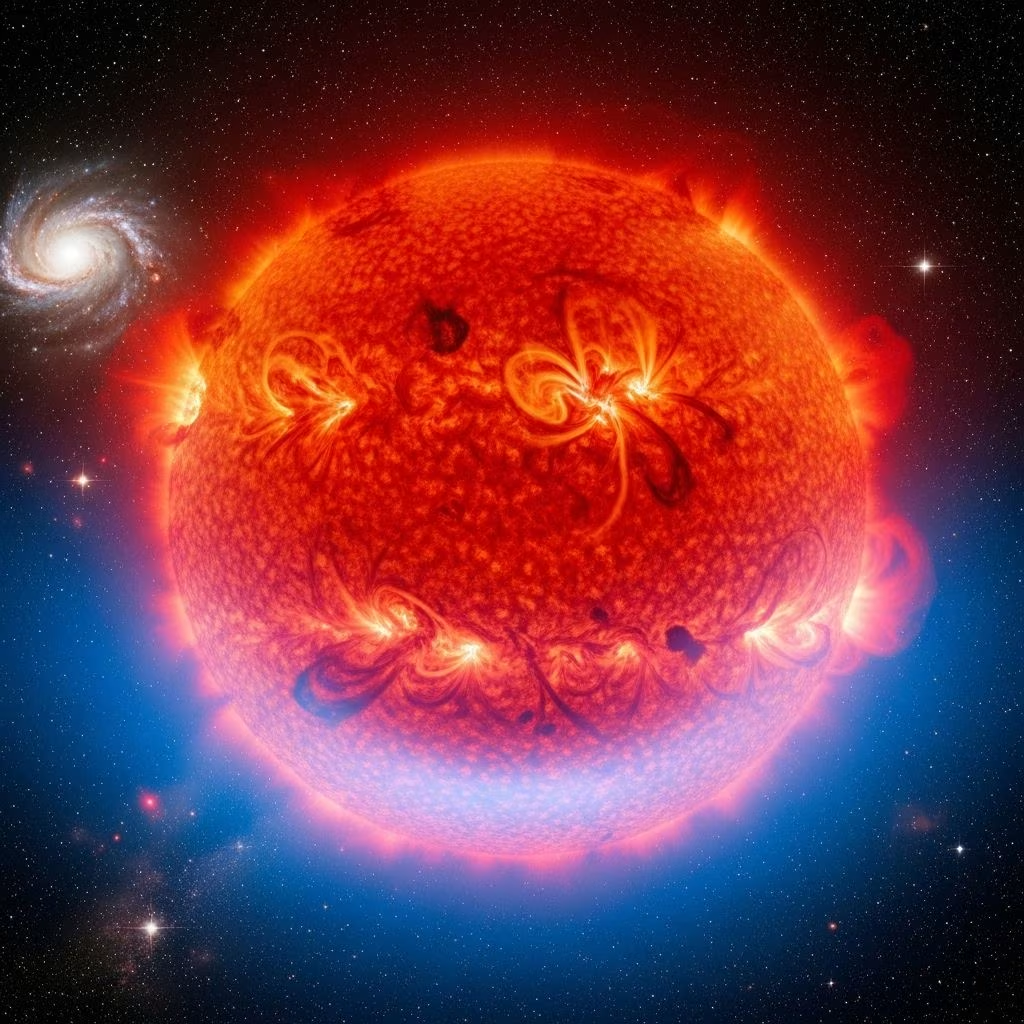
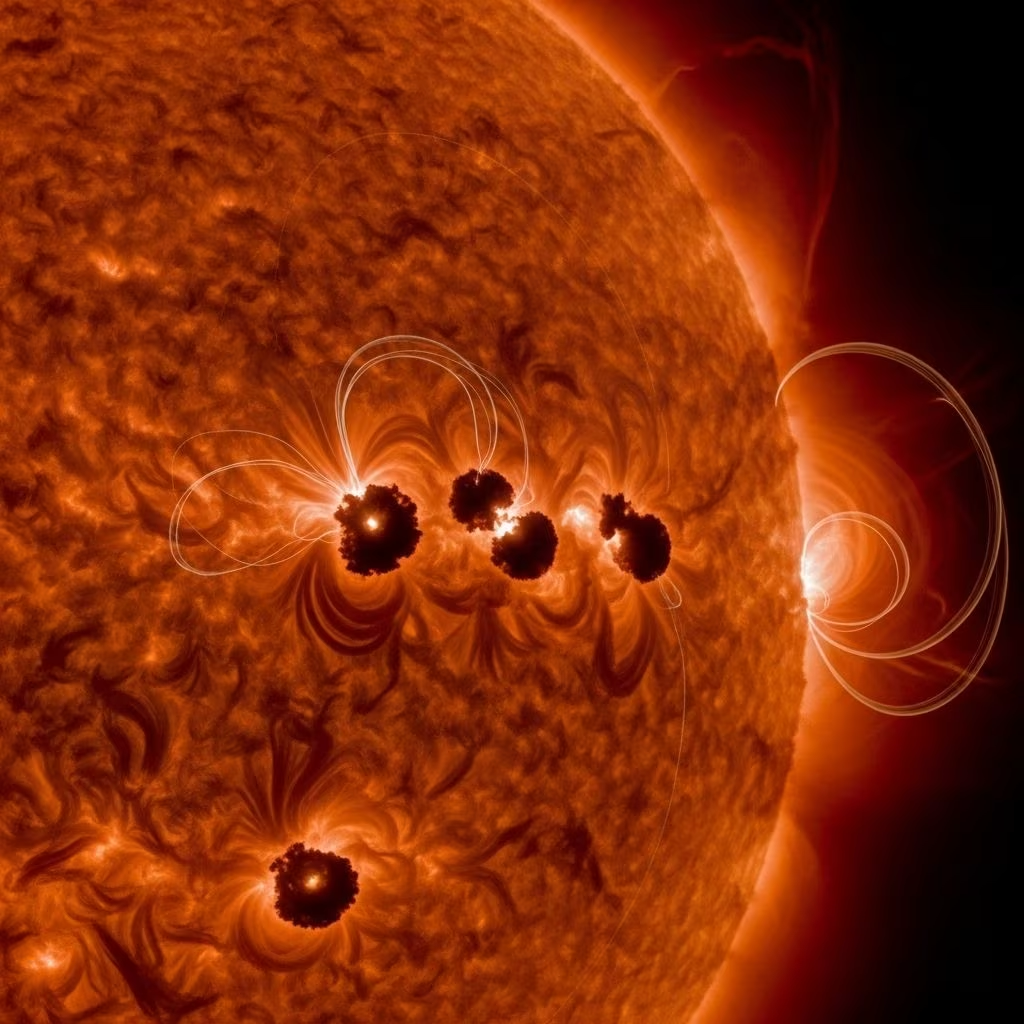
Key Point: Images of the Sun in false color (such as SDO, SOHO, or other astronomical cameras) are not what the human eye would see. These are typically generated to highlight specific wavelengths corresponding to solar phenomena, such as flares or prominences, for research purposes.
The Science Behind Sunlight and Human Perception
Human color vision is sensitive to the proportions of red, green, and blue light entering the eye. White, as perceived biologically, results only when all these types of photoreceptor cells (cones) are stimulated nearly equally.Light sources with strong emission at particular wavelengths (like neon “red” signs) appear colored, while those like the Sun, which provide a blend across the visual spectrum, appear white under typical viewing conditions.
Table: Comparison of Solar Color Perception
| Scenario | Observed Color | Description |
|---|---|---|
| Space (no atmosphere) | White | Full visible spectrum, no filtering or scattering |
| Ground, midday | Yellowish-white | Some blue/violet scattered, direct sunlight slightly yellowish |
| Sunrise/Sunset | Deep orange/red | Long path through atmosphere, blue/green filtered out |
Common Misconceptions About the Sun’s Color
- “The Sun shines yellow always:” The yellowish appearance from Earth is a result of atmospheric filtering—not a difference in the Sun’s own light output.
- “Sunlight is strongest in yellow light:” The Sun’s energy distribution peaks in green, but the sum of all visible wavelengths looks white—not green.
- “NASA’s Sun images show its real color:” Most scientific solar images are in false color, representing selected wavelengths far beyond what our eyes see.
Frequently Asked Questions (FAQs)
Q: What is the Sun’s true color in space?
A: The Sun is white in space, as it emits nearly all visible wavelengths evenly and there is no atmospheric filtering to skew its color.
Q: Why does the Sun appear yellow to us on Earth?
A: The Earth’s atmosphere scatters away some of the blue and violet wavelengths before sunlight reaches your eyes directly, making the remaining light look slightly yellow.
Q: Why does the Sun look red or orange at sunrise and sunset?
A: At these times, sunlight passes through a longer slice of atmosphere, scattering out blue and green light more thoroughly, leaving mostly red and orange wavelengths to reach your eyes.
Q: Does the Sun ever actually emit green light?
A: The Sun’s spectrum peaks in green, but because it emits a continuous spectrum across all visible wavelengths, the net result is white—not green.
Q: What do astronauts see when they look at the Sun?
A: Astronauts in orbit, using appropriate eye protection, would see the Sun as dazzling white because there is no atmospheric scattering or filtering.
Q: Why do science images of the Sun look blue, red, or purple?
A: These images use false colors to represent different ultraviolet or X-ray wavelengths to enhance details for research, not what the human eye perceives naturally.
Further Reading and Resources
- NASA Solar Science Pages
- Stanford Solar Center: Sunlight and Color Science
- Royal Astronomical Society: Light and Color in Astronomy
- Publications on Atmospheric Optics
Understanding the subtle science of the Sun’s color enriches our appreciation for the dynamic view above us, and the interplay of cosmic and earthly forces that shape the tapestry of our daylight sky.
References
- https://www.skyatnightmagazine.com/space-science/what-colour-sun
- https://www.youtube.com/watch?v=P_i_brAKGfo
- https://www.youtube.com/watch?v=iQlSsHNSdAo
- https://en.wikipedia.org/wiki/Sun
- https://bigthink.com/starts-with-a-bang/what-color-is-the-sun/
- https://eclipse2017.nasa.gov/what-color-sun
- https://forums.space.com/threads/newsweek-fact-checks-suns-color.57674/
- https://www.space.com/sky-colors-explained-blue-and-beyond
- https://solar-center.stanford.edu/sid/activities/GreenSun.html
- https://www.discovermagazine.com/if-the-color-of-the-sun-is-white-then-why-does-it-appear-yellow-47841
- https://science.nasa.gov/sun/facts/
- https://spaceiusa.com/what-color-is-the-sun/
- https://www.worldatlas.com/space/what-color-is-the-sun.html
- https://www.ndtv.com/world-news/the-sun-is-actually-white-ex-nasa-astronaut-confirms-space-fact-3340514
- https://www.snexplores.org/article/color-sun-light-green-yellow
- https://www.wtamu.edu/~cbaird/sq/2013/07/03/what-is-the-color-of-the-sun/
- https://www.scienceabc.com/nature/universe/whats-the-colour-of-the-sun-at-noon-in-space.html
- https://www.uniladtech.com/science/space/real-color-sun-mind-blown-reddit-green-777968-20250508