Giant Alien Planet Discovered Hiding in a Known Star System
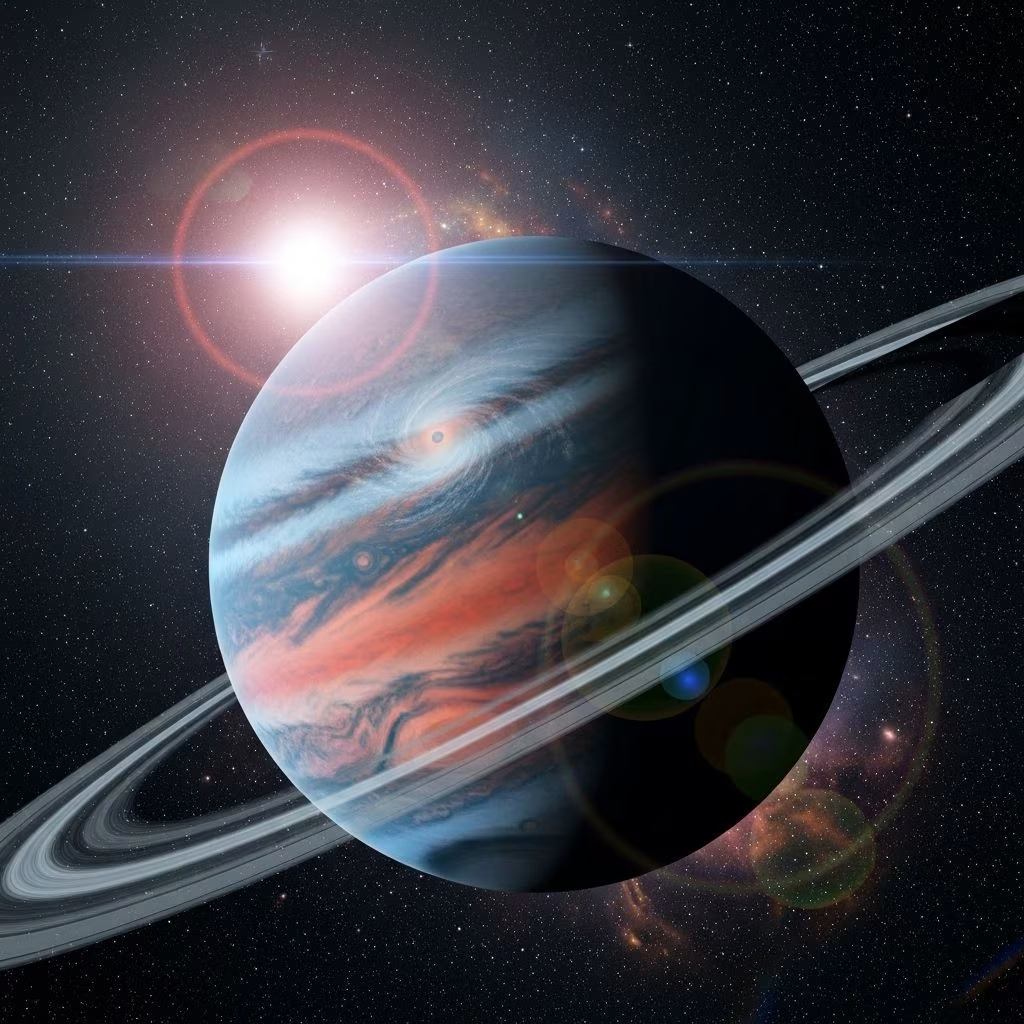
Astronomers have announced the discovery of Kepler-139f, a massive exoplanet orbiting the familiar Kepler-139 star system. This newfound celestial body is about 35 times the mass of Earth and roughly twice the mass of Neptune, making it one of the largest known exoplanets to have evaded detection for years. Its remarkable size and orbital characteristics are prompting fresh insights into planetary formation and the limitations of previous detection techniques.
Background: The Kepler-139 Star System
The Kepler-139 system has long been a scientific focal point due to its diverse planetary family. Prior to this latest discovery, astronomers identified:
- Three rocky super-Earths known to transit their host star, providing valuable data for exoplanet studies.
- One gas giant found later, supporting theories of mixed planet types within a single system.
Despite careful scrutiny, astronomers observed unexplained gaps in the orbits of these planets, which hinted at the existence of an additional, hidden world. The complex architecture of Kepler-139 continues to challenge and enrich our understanding of planetary systems.
The Challenges of Exoplanet Detection
Most exoplanets have been discovered using the transit method—watching for dips in starlight as planets pass between their star and Earth. NASA’s Kepler Space Telescope detected nearly 3,000 exoplanets over a nine-year mission using this approach. However, this method has key limitations:
- Only planets whose orbits align with our line of sight create detectable dimming.
- Planets whose orbits are angled above or below the telescope’s direct line remain undetected, regardless of size.
These constraints allowed Kepler-139f to remain hidden for years despite its significant mass and influence on its star system.
Discovery of Kepler-139f: How It Was Found
Scientists turned to a combination of orbital analysis and careful observation of gaps between the known planets in the Kepler-139 system. The key steps included:
- Analyzing orbital gaps and deviations in the paths of existing planets.
- Inferring the gravitational influence of an unseen massive object—Kepler-139f.
- Testing models and cross-referencing data from previous observations and computational simulations.
This innovative approach led to confirmation of Kepler-139f’s existence, as reported in The Astrophysical Journal Letters in May 2025.
Physical Characteristics of Kepler-139f
| Property | Value |
|---|---|
| Mass | ~35 Earth masses |
| Comparative Mass | ~2x Neptune |
| Orbital Period | ~355 days |
| Status | Gas giant |
Kepler-139f’s substantial mass gives it a strong gravitational influence in its system, explaining the orbital gaps and unusual motion observed among neighboring planets. Its year (one complete orbit of its star) is remarkably similar to that of Earth, approximately 355 days, though its composition is far different—as a gas giant, it lacks a solid surface.
Limitations of Early Detection Technology
Kepler-139f exemplifies how limitations in technology can mask even massive worlds from view:
- The Kepler Telescope was designed primarily for detecting transiting planets. Many non-transiting worlds, regardless of their size, went unnoticed.
- Kepler’s focus was on detecting brightness changes; it couldn’t reveal planets that stayed outside the narrow band between the star and Earth.
These constraints highlight the necessity for new methods and more comprehensive analysis of planetary systems, expanding the reach of future missions and telescopes.
Implications for Planetary Science and Future Searches
The discovery of Kepler-139f has wide-ranging implications:
- Proves that massive hidden planets may exist undetected in many familiar systems.
- Promotes the use of orbital mechanics and gravitational modeling as vital tools for future discoveries.
- Encourages astronomers to re-examine data from past missions for potential hidden worlds.
This approach can extend to other star systems hosting multiple planets, suggesting the possibility of additional undiscovered worlds beyond Kepler-139f.
Kepler-139f Compared to Other Giant Exoplanets
| Exoplanet | Mass (Earth Masses) | Type | Detection Method |
|---|---|---|---|
| Kepler-139f | 35 | Gas Giant | Orbital Gap Analysis |
| TOI-2498 b (Super-Neptune) | 35 | Gas Giant | Transit Method (TESS) |
| Typical Super-Earths | 2–10 | Rocky | Transit/Direct Imaging |
Kepler-139f stands alongside other giant planets like TOI-2498 b in terms of mass and classification, but its detection method sets it apart as a pioneer among hidden world discoveries.
The Evolution of Planet-Hunting Techniques
The Kepler-139f breakthrough reflects a shift in astronomers’ strategies:
- Moving beyond transits, scientists are using simulated models and gravitational effects to infer unseen planets.
- Multi-planet system analysis encourages collaboration and data sharing to maximize discovery rates.
- Future missions, like the James Webb Space Telescope and extended surveys with TESS, will build on these new methods to explore both known and unknown systems.
What Makes Kepler-139f Scientific News?
Kepler-139f’s discovery resonates with astronomers and the public for several reasons:
- Its sheer mass—35 times Earth’s—defies expectations for hidden exoplanets in known systems.
- The detection represents a victory for the power of indirect analysis, proving the effectiveness of orbital gap studies.
- It supports the idea that planetary systems are dynamically interactive, with multiple planets affecting each other’s orbits—even when not directly observable.
- This case pushes astronomers to rethink models of planetary formation and migration, including the creation of gas giants in crowded star systems.
Expert Commentary: The Search for the Unseen
Astrophysicists emphasize the importance of broadening search strategies. Dr. Subodh Sharma, an exoplanetary researcher, notes:
“Kepler-139f’s identification is a testament to both the perseverance and ingenuity of the astronomical community. It reminds us that the universe still holds many secrets, even in ‘well-studied’ corners.”
Frequently Asked Questions (FAQs)
Q: Why did Kepler-139f remain hidden for so long despite its massive size?
A: Kepler-139f’s orbit does not cross directly between its star and Earth, so traditional transit methods could not detect it. Only by studying anomalies in the detected planets’ orbits could its existence be inferred.
Q: How does the discovery of Kepler-139f change planet hunting going forward?
A: It underscores the need for multi-method searches—including orbital mechanics and gravitational modeling—and encourages astronomers to revisit data sets from previous telescope missions in search of similar hidden worlds.
Q: Is Kepler-139f potentially habitable or Earth-like?
A: No. Kepler-139f is a gas giant, lacking a solid surface and likely having extreme atmospheric conditions unsuitable for life as we know it.
Q: What impact does this discovery have on our understanding of the Kepler-139 system?
A: It reveals that the system is more dynamically complex and massive than previously thought. Kepler-139f’s gravitational influence helps explain the orbital gaps and movements of its planetary neighbors.
Q: Could other systems host similar hidden giants?
A: Yes. Multi-planet systems, especially those with unexplained orbital patterns or mass discrepancies, may host additional giant planets waiting to be discovered using indirect methods.
Conclusion: A New Era in Exoplanetary Science
The uncovering of Kepler-139f highlights the evolution of exoplanet research, blending observational techniques with theoretical physics to reveal the universe’s deeper mysteries. As planet hunters refine their tools and expand their analyses, many more hidden worlds may come to light, reshaping our view of planetary formation, star system architectures, and the possibilities for life elsewhere in the cosmos.
- Kepler-139f is just the beginning—many more discoveries may await in the dark gaps of known star systems.
- Interdisciplinary tools and persistent observation remain essential for exploring the vast diversity of planets beyond our solar system.
References
- https://www.space.com/astronomy/astronomers-discover-giant-alien-planet-35-times-more-massive-than-earth-hiding-in-a-known-star-system
- https://www.arabtimesonline.com/news/astronomers-discover-hidden-alien-planet-35-times-heavier-than-earth/
- https://www.denisonforum.org/current-events/science-technology/astronomers-discover-a-planet-35-times-larger-than-earth/
- https://en.wikipedia.org/wiki/List_of_largest_exoplanets
- https://www.youtube.com/watch?v=tG6aWENfzVw
- https://phys.org/news/2023-05-super-neptune-exoplanet-tess.html
- https://en.wikipedia.org/wiki/Super-Earth
- https://www.spacelive.in/2025/07/astronomers-uncover-hidden-giant.html
- https://www.space.com/astronomy/exoplanets/astronomers-discover-monster-exoplanet-hiding-in-stellar-fog-around-young-star
- https://tech.news.am/eng/news/5806/astronomers-discover-a-giant-exoplanet-35-times-more-massive-than-earth-%E2%80%94-why-was-it-hidden-so-long.html
- https://theaquilareport.com/astronomers-discover-a-planet-35-times-larger-than-earth/
- https://science.nasa.gov/exoplanets/super-earth/
- https://science.nasa.gov/universe/exoplanets/discovery-alert-super-earth-swings-from-super-heated-to-super-chill/
- https://www.livescience.com/space/exoplanets/ginormous-planet-discovered-around-tiny-red-star-challenges-our-understanding-of-solar-systems
- https://phys.org/news/2023-08-massive-brown-dwarf.html
- https://www.gbnews.com/science/space-news-super-earth-planet-discovered-signal
- https://www.youtube.com/watch?v=7kHP0rFmVg0
- https://news.unm.edu/news/unm-astronomers-confirm-new-gas-giant-exoplanet-with-help-from-citizen-scientists-worldwide
- https://timesofindia.indiatimes.com/science/scientists-discover-a-second-earth-twice-the-size-of-our-planet-near-a-red-dwarf-star-154-light-years-away/articleshow/122291798.cms