What Are Pulsars?
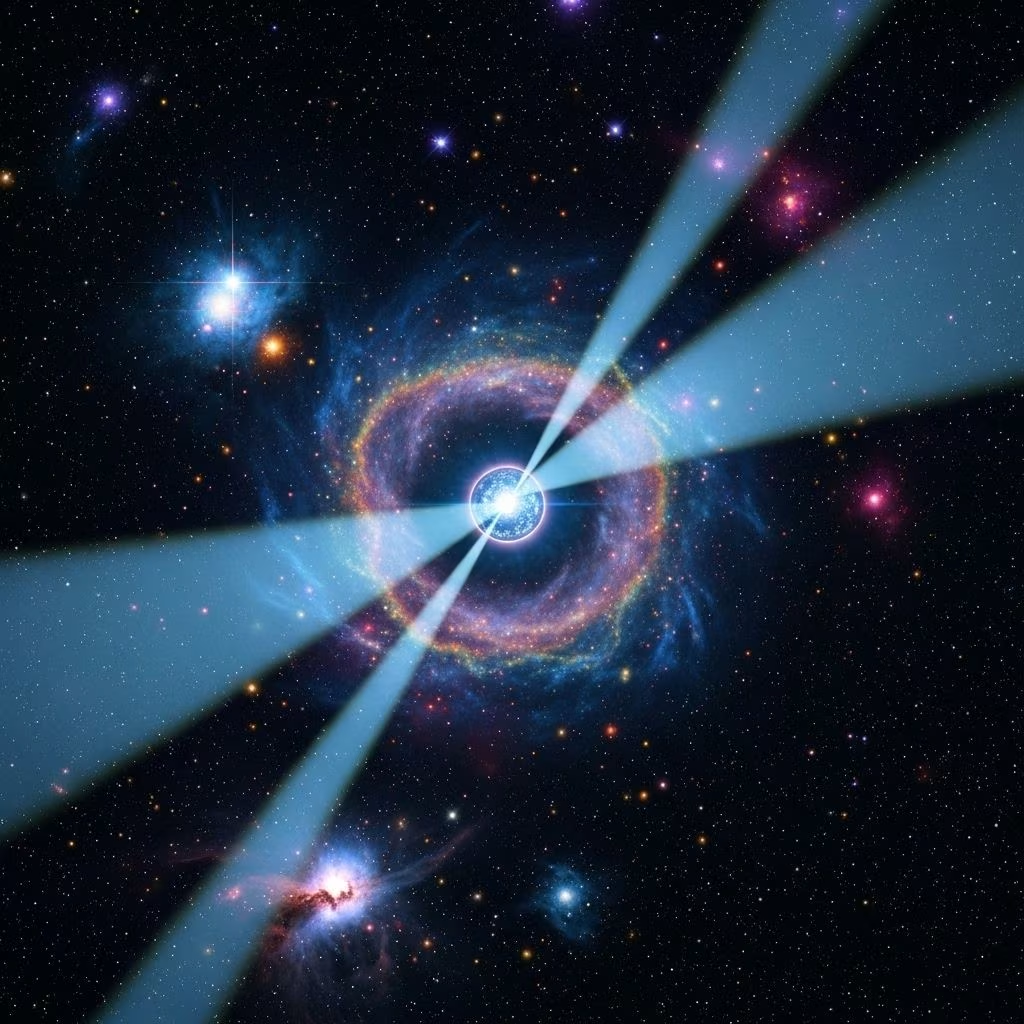
Pulsars are among the universe’s most fascinating and extreme objects, acting as nature’s stellar clocks. At their core, pulsars are highly magnetized, rapidly rotating neutron stars. When massive stars die in explosive supernovae, their cores collapse under gravity to form ultra-dense objects—neutron stars. Some of these neutron stars emit focused beams of electromagnetic radiation from their magnetic poles. As the neutron star spins, these beams sweep across space. If Earth happens to lie in the path of these beams, astronomers detect them as regular pulses, giving pulsars their name—short for pulsating stars.
- Density: A typical pulsar packs more mass than the sun into a sphere just 12-20 miles (20-30 km) wide.
- Rotation: Some pulsars spin dozens or even hundreds of times per second.
- Magnetic Fields: Pulsars can have magnetic fields trillions of times stronger than Earth’s.
Pulsars emit radiation across the electromagnetic spectrum, but they are most commonly detected in the radio, X-ray, and gamma-ray bands.
How Do Pulsars Work?
The mechanism behind pulsar emissions is extreme. When a massive star goes supernova, its core collapses into a neutron star—a dense ball of neutrons. If the rotation and magnetic axes of the neutron star are misaligned, powerful magnetic fields accelerate charged particles along the poles, emitting beams of electromagnetic energy. These beams act like the beacon of a lighthouse: only when the beam sweeps over Earth do telescopes record a pulse.
- Pulse Regularity: The steady spinning creates precisely timed pulses, allowing some pulsars to rival atomic clocks in their consistency.
- Types of Pulses:
- Radio Pulsars: Emitting primarily in radio frequencies; most common and discovered first.
- X-ray Pulsars: Often found in binary systems where material from a companion star triggers X-ray emissions.
- Gamma-ray Pulsars: Emit high-energy radiation, often from particularly fast or energetic objects.
History of Pulsar Discovery
The story of pulsars begins with a stroke of scientific curiosity. In 1967, Jocelyn Bell Burnell, a graduate student at Cambridge University, noticed a strange, regular signal in radio telescope data. These regular “pulses” were so precise that the discovery team jokingly dubbed the source “LGM-1″—for Little Green Men.
Subsequent observations ruled out artificial origins, and the discovery was formally announced in 1968. The term “pulsar” soon entered scientific vocabulary, revolutionizing our understanding of stellar remnants and extreme physics.
- First detected in 1967; public announcement in 1968.
- Scientific community quickly realized the implications for astrophysics and gravity research.
Types of Pulsars
- Normal Pulsars: Spin between 1 and 30 times per second; typically young neutron stars.
- Millisecond Pulsars: Rotate hundreds of times per second (up to 716 times per second); believed to be “recycled” by accreting matter from a companion star.
- X-ray Pulsars: Form in binary systems where a neutron star collects matter from a close stellar companion, releasing intense X-ray bursts.
- Magnetars: Have extraordinarily powerful magnetic fields and emit strong X-rays and gamma rays rather than radio waves. Their emissions are less regular and may exhibit outbursts.
| Type | Rotation Rate | Main Observed Emission | Special Features |
|---|---|---|---|
| Normal Pulsar | 1–30 Hz | Radio | Young stars in supernova remnants |
| Millisecond Pulsar | 100–716 Hz | Radio/X-ray | “Recycled” via accretion |
| X-ray Pulsar | Varied | X-ray | Binary accretion |
| Magnetar | 0.1–1 Hz | X-ray/Gamma-ray | Extremely strong magnetic fields |
How Were Pulsars Found?
The first pulsar was a scientific surprise. Jocelyn Bell Burnell’s discovery involved painstakingly analyzing photorecorded radio signals for unusual periodicities. The precise pulses, measured in milliseconds to seconds, stood out from other cosmic sources. Over time, improved radio telescopes and detectors have discovered thousands of pulsars across the Milky Way (and a few in other galaxies).
- The original detection: regular, repeating radio pulses far too precise for terrestrial origin.
- Advanced observation: Today, astronomers employ space-based X-ray observatories (like NASA’s NICER on the ISS) to find even faster or more exotic pulsars.
Pulsars in Binary Systems
Many pulsars exist in binary star systems. In these pairs, the pulsar’s powerful gravity can draw matter from a companion star, leading to changes in observed emissions. Some unique pulsars alternate between different types of behavior based on the flow of matter from their companion.
For example, the pulsar PSR J1824-2452I, about 18,000 light-years away, can switch between X-ray and radio emissions depending on how much material its companion star donates. Astronomers have described this as a “missing link” in pulsar behavior, as it changes from one type to another and back—similar to a caterpillar turning into a butterfly.
- Accretion-powered X-ray bursts: Occur when a companion star feeds gas onto the pulsar, channeled by intense magnetic fields.
- Switching behavior: Theoretical models suggest that the influx of material can overwhelm, and then later be shielded by, the pulsar’s magnetic field.
- Impact on Physics: Binary pulsars have enabled confirmation of gravitational radiation—an essential prediction of Einstein’s Theory of General Relativity.
Millisecond Pulsars: Nature’s Atomic Clocks
Millisecond pulsars are the speed demons among neutron stars, rotating up to 716 times per second. This rapid rotation is usually gained by accreting matter from a close companion over millions of years, “spinning up” the pulsar like a flywheel.
Why are millisecond pulsars important?
- Extreme precision: Their pulses arrive so regularly that they can be used as natural time-keepers, sometimes surpassing the accuracy of atomic clocks.
- Navigation: NASA has experimented using millisecond pulsars for future space navigation, much like GPS satellites use atomic clocks. By triangulating the arrival times of pulsar pulses, spacecraft could autonomously calculate their positions even far from Earth.
Using Pulsars: Tools for Science and Technology
Pulsars have proven essential far beyond their initial discovery. Their rock-steady pulses serve as astronomical tools for exploring some of the biggest questions in astrophysics:
- Timing and Navigation: Pulsars offer the potential for interstellar navigation, with future spacecraft using their signals like a “galactic GPS”.
- Gravitational Waves: Binary pulsar systems have allowed indirect confirmation of gravitational waves by revealing that their orbits decay precisely in accordance with Einstein’s General Relativity.
- Exoplanets: The first planets beyond our solar system were found orbiting a pulsar (PSR B1257+12), paving the way for today’s exoplanet studies.
- Extreme Physics: Pulsars allow astronomers to study matter at densities, pressures, and magnetic fields unachievable in Earth-bound laboratories.
Pulsar Mysteries and Recent Discoveries
Despite decades of research, pulsars continue to challenge astronomers with new mysteries. Key puzzles include:
- How do the fastest millisecond pulsars form? Evidence shows many have companion stars but the precise mechanisms are an active research area.
- How do magnetars generate such colossal magnetic fields?
- What’s behind the odd, dramatic variations in pulse timing in some objects?
- Changing states: The existence of objects like PSR J1824-2452I, which switches pulsar mode, helps scientists understand how neutron stars evolve over time.
Fun Facts and Records About Pulsars
- Fastest pulsar: PSR J1748-2446ad spins at 716 times per second.
- First exoplanets: Circled the millisecond pulsar PSR B1257+12, not a normal star.
- Incredible stability: Some pulsars lose just one second of spin period over millions of years, rivaling atomic clocks for precision.
- Cosmic yardsticks: By measuring arrival time variations of pulses, astronomers can map the interstellar medium between stars.
Frequently Asked Questions (FAQs)
Q: What exactly is a pulsar?
A: A pulsar is a type of neutron star—the collapsed core of a massive star—that emits beams of electromagnetic radiation from its magnetic poles. If these beams cross Earth, astronomers detect a pulse.
Q: Why do pulsars emit pulses?
A: The pulses are observed when Earth lies in the path of radiation beams produced near the star’s magnetic poles, which sweep across space with the star’s rotation (similar to a lighthouse beam).
Q: How dense is a typical pulsar?
A: Incredibly dense—a single teaspoon of pulsar material would weigh billions of tons, thanks to gravity compressing its matter in a tiny space after a supernova.
Q: Can pulsars be used for navigation?
A: Yes. Current NASA experiments and future space missions aim to use millisecond pulsar signals as interstellar navigation beacons, much like GPS but on a vastly larger scale.
Q: Have planets ever been found orbiting pulsars?
A: Yes, the first confirmed exoplanets were actually discovered around a pulsar (PSR B1257+12), not a regular star.
Conclusion: Why Pulsars Matter
Pulsars are both cosmic laboratories and universal timekeepers. They illuminate the physics of gravity, matter, and energetic particles at their most extreme, while offering practical uses such as possible galactic navigation. With every new discovery—from exotic magnetars to shape-shifting binary pulsars—these stellar remnants continue to illuminate the mysteries of the universe, reinforcing their status as both wonders and workhorses of modern astronomy.
References
- https://www.space.com/39419-nasa-instrument-navigate-space-by-pulsars.html
- https://www.space.com/22935-strange-star-missing-link-pulsars.html
- https://en.wikipedia.org/wiki/Pulsar
- https://pulsarfusion.com
- https://www.astronomy.com/science/pulsars-the-universes-gift-to-physics/
- https://www.astronomycast.com/2009/11/ep-158-pulsars/
- https://www.discovery.com/space/pulsar-waves
- https://www.livescience.com/what-are-pulsars
- https://academic.oup.com/mnras/article/422/2/1294/1034885?login=false
- https://www.cam.ac.uk/stories/journeysofdiscovery-pulsars
- https://pulsarfusion.com/sunbird-fusion-propulsion/
- https://arxiv.org/html/2506.08056v1
- https://www.astronomy.com/science/baffling-pulsar-leaves-astronomers-in-the-dark/
- https://astronomerguide.com/what-are-pulsars/
- https://www.encyclopedia.com/science/science-magazines/astronomy-and-space-science-pulsars-quasars-and-distant-questions
- https://escholarship.org/content/qt5dg2h7t1/qt5dg2h7t1.pdf?t=q58pzm
- https://arxiv.org/pdf/1704.03316.pdf
- https://www.britannica.com/science/pulsar