How Big Is the Moon?
The Moon, Earth’s only natural satellite, is an enchanting fixture in our night sky. To the naked eye, its size can be deceiving—sometimes it appears enormous on the horizon, and at other times surprisingly small and distant. But what is the Moon’s actual size, and how does it compare to the Earth and other objects in our solar system?
A Brief Overview of the Moon’s Size
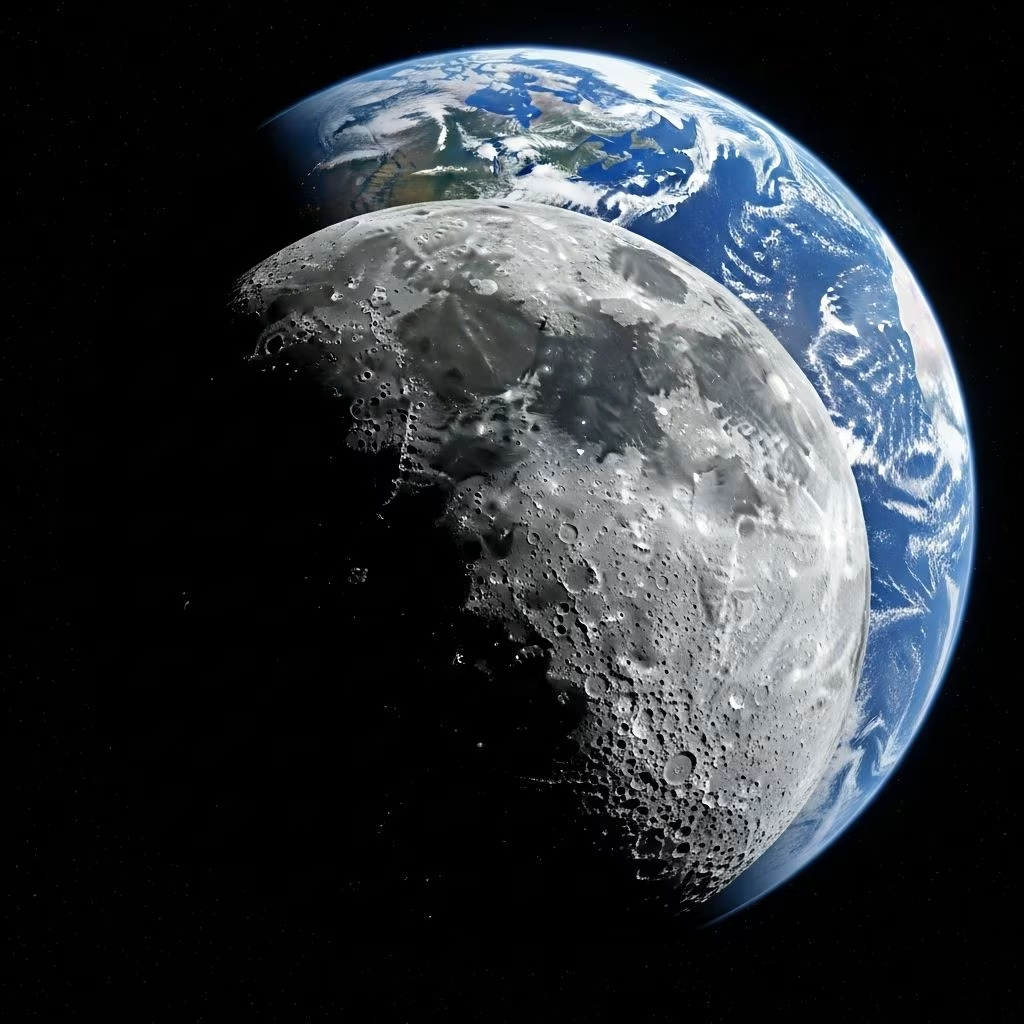
- Diameter: Approximately 3,474 kilometers (2,159 miles). This makes the Moon just over a quarter the diameter of Earth, which measures about 12,742 kilometers (7,918 miles).
- Radius: About 1,737 kilometers (1,079 miles).
- Mass: Roughly 7.35 x 10²² kilograms; only 1/81st the mass of Earth.
- Surface Area: 38 million square kilometers (14.6 million square miles)—comparable to the total area covered by Africa or all the Americas combined.
The Moon’s Place Among Solar System Moons
The Moon is the fifth largest moon in the solar system. It is larger than any dwarf planet—including Pluto—and even bigger than some full-fledged planets like Mercury in terms of diameter.
| Celestial Body | Diameter (km) | Diameter as % of Earth | Notes |
|---|---|---|---|
| Earth | 12,742 | 100% | Reference |
| Moon | 3,474 | ~27% | Fifth largest Solar System moon |
| Mercury | 4,879 | ~38% | Smallest planet (diameter) |
| Ganymede (Jupiter) | 5,268 | ~41% | Largest moon |
| Pluto (Dwarf Planet) | 2,377 | ~19% | Dwarf planet |
Understanding Perspective: Looking Up from Earth
Why does the Moon sometimes appear so large—and sometimes so small?
- Optical Illusion: When the Moon is low on the horizon, our brain compares it to terrestrial objects, making it seem larger. This is the well-known “Moon illusion.”
- Distance from Earth: The Moon’s average distance is about 384,400 kilometers (238,855 miles) from Earth[13].
- Angular Size: Though the Moon’s distance varies due to its elliptical orbit, its apparent size is about 0.5 degrees in the sky, similar to the apparent size of the Sun from Earth[10].
Historical Context: Early Measurements
Ancient astronomers like Aristarchus of Samos and Hipparchus of Nicaea attempted to measure the Moon’s distance and diameter as early as the third century BC, utilizing geometry and eclipses to make their calculations[13]. Their work laid the groundwork for today’s more precise measurements using spacecraft, radar, and laser ranging.
Comparing the Moon to Earth: Size and Mass
Although the Moon is the closest celestial body to our planet, its relative size remains one of the most striking facts about our solar system.
- Diameter Ratio: The Moon’s diameter is approximately one-fourth that of Earth.
- Mass Ratio: About 1/81 of Earth’s mass, making it relatively massive compared to its planet—only Pluto and Charon (dwarf planet and moon) have a closer ratio between moon and primary body.
Why is this significant? Most planetary moons are much smaller in relation to their parent planet. The Moon’s relatively large size gives it a noteworthy influence on Earth’s tides and rotation.
If the Moon Were on Earth: Fun Comparisons
- The Moon is as wide as the continental United States. You could travel coast-to-coast, and it would be no further than traversing the Moon.
- If laid flat, the Moon’s surface could fit Europe, China, the United States, Brazil, and South Africa—all at once.
The Moon’s Influence on Earth
The Moon is not merely a fixture in our sky; it plays a critical role in Earth’s natural phenomena.
- Gravitational Effects: Its gravitational pull gives us ocean tides and helps stabilize Earth’s axial tilt, which in turn regulates climate over long timescales.
- Barycenter: The Moon-Earth system is unique: both bodies orbit a common center of mass (the barycenter) located inside Earth but not at its center.
Without the Moon’s mass and proximity, the length of our days, our tides, and even our planet’s habitability could be very different.
The Solar System’s Five Largest Moons
- Ganymede (Jupiter): Largest moon in the solar system (diameter 5,268 km)
- Titan (Saturn): Second largest (diameter 5,151 km)
- Callisto (Jupiter): Third (diameter 4,821 km)
- Io (Jupiter): Fourth (diameter 3,643 km)
- Moon (Earth): Fifth (diameter 3,474 km)
Why Does the Moon’s Size Matter?
The Moon’s size has far-reaching implications for life and science on Earth, and is critical in ongoing space exploration.
- Stability: The Moon’s gravity stabilizes Earth’s rotation and tilt, directly impacting seasons and climate.
- Tides: Ocean tides—vital for many ecosystems—are primarily driven by the Moon’s gravitational pull.
- Future Bases: Its large surface area and proximity make the Moon an ideal location for human bases, staging for Mars missions, and interplanetary exploration[13].
- Cultural Impact: The Moon’s prominence in human culture is closely tied to its impressive relative size and brightness.
Measuring the Moon: Modern Techniques
From ancient geometry to laser ranging and spacecraft flybys, scientists have used increasingly sophisticated methods to measure the Moon’s dimensions and refine our understanding.
- Radar and Laser Ranging: Scientists bounce signals off lunar reflectors to measure its distance and dimensions with remarkable precision.
- Lunar Missions: Robotic and crewed missions, like NASA’s Apollo landings and current Artemis program, have provided detailed measurements and surface mapping[13].
Comparing the Moon to the Sun: Apparent Size and Eclipses
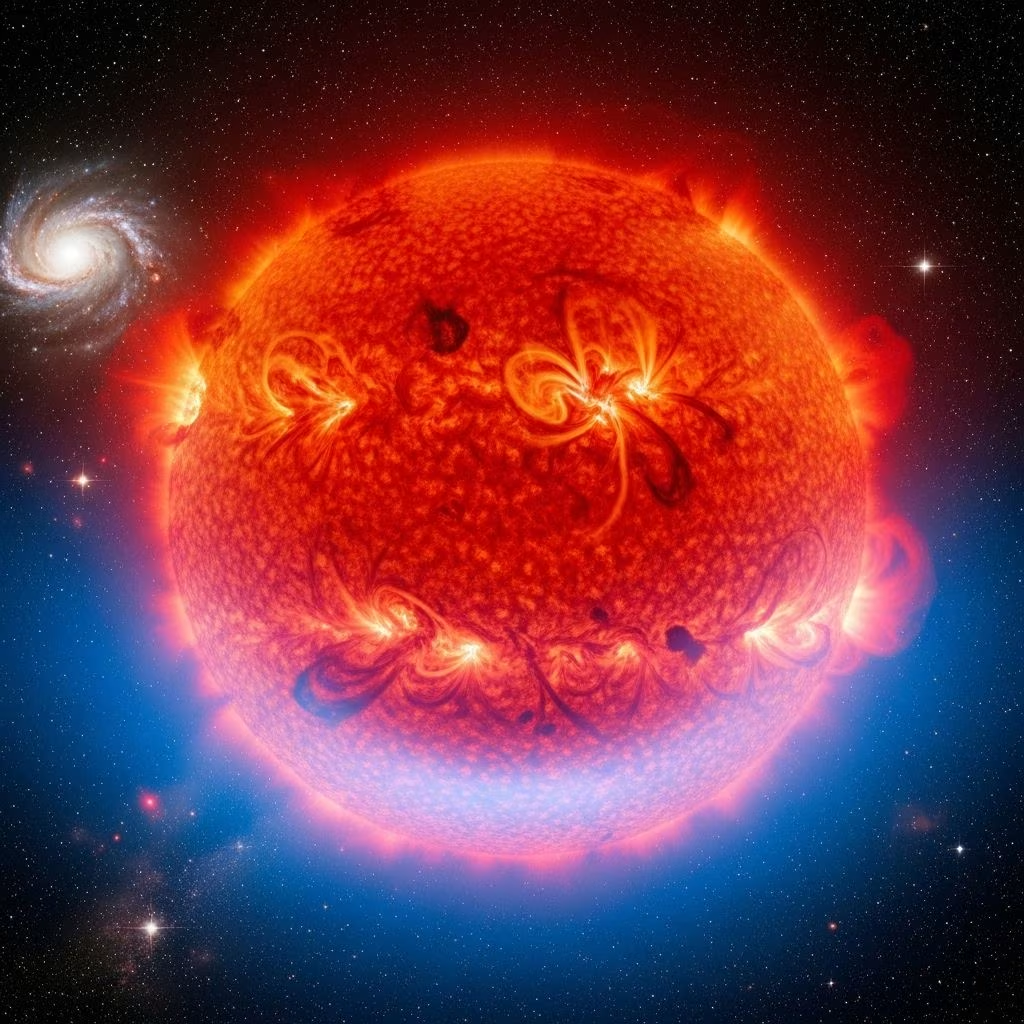
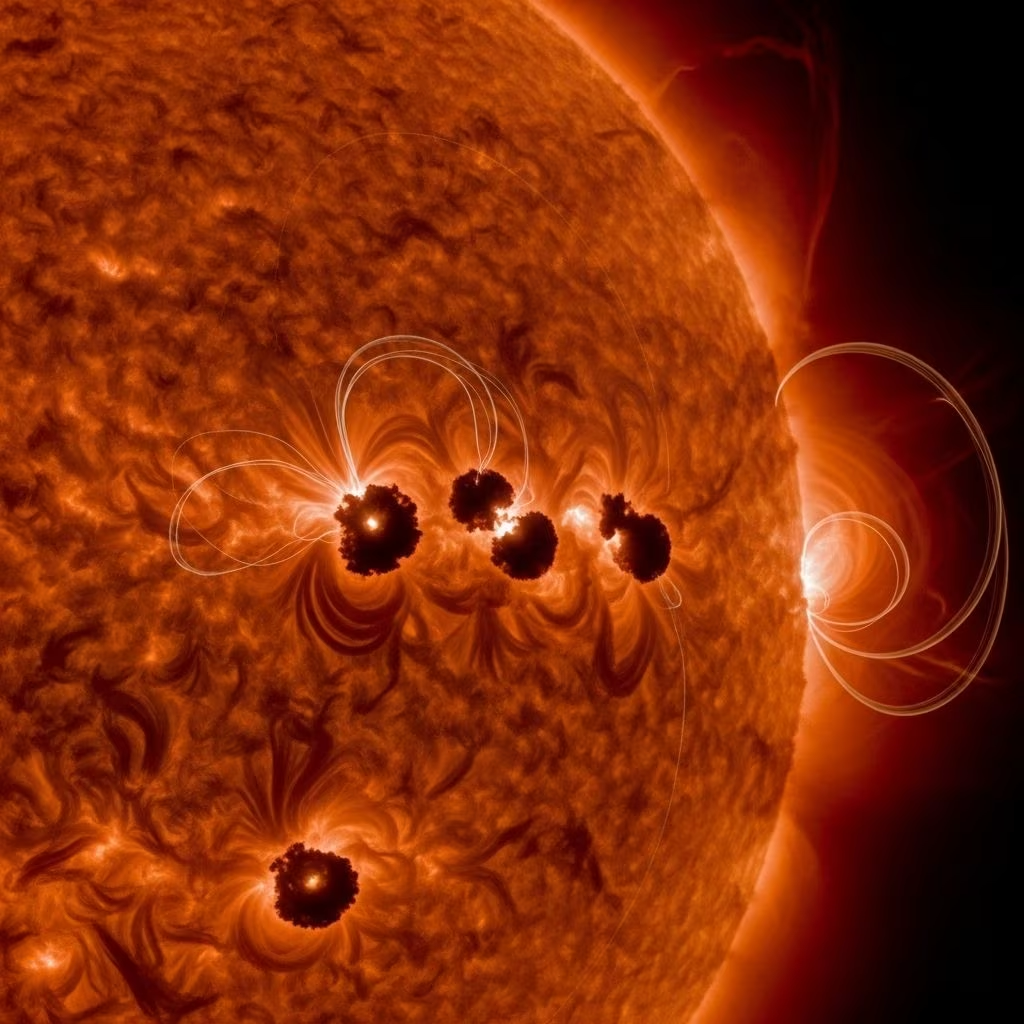
One of the most intriguing facts is that, while the Sun is about 400 times larger in diameter than the Moon, it’s also about 400 times farther from Earth. This coincidence means that from our perspective, the Moon and Sun appear the same size in the sky, allowing for spectacular total solar eclipses when the Moon precisely covers the Sun’s disk[10].
Moon Size FAQ
- Is the Moon perfectly round? The Moon is almost spherical—its slight bulge comes from rotational forces, but it’s quite close to round.
- How does the Moon compare to other moons? It’s the fifth largest in the Solar System and is unusually large relative to Earth.
- Is the Moon bigger than Pluto? Yes, the Moon is significantly larger than the dwarf planet Pluto.
- Can you fit the Moon inside the United States? Yes; the width of the Moon is similar to the width of the United States.
Frequently Asked Questions (FAQs)
Q: Why is the Moon so much larger (relative to Earth) than most moons?
A: Most large planetary moons are tiny relative to their host worlds; Earth’s Moon likely formed after a giant impact and is proportionally larger compared to its planet than any other large moon.
Q: How does the Moon’s size affect life on Earth?
A: The Moon’s mass creates stable tides, which help regulate coastal ecosystems. Its gravity stabilizes Earth’s axial tilt, affecting climate stability and the length of day.
Q: Has the Moon’s size changed over time?
A: No, the Moon’s physical size remains the same, though its waking* distance from Earth is increasing at a rate of about 3.8 centimeters per year due to tidal interactions.
Q: Could the Moon ever become a base for space travel?
A: Due to its stable surface, proximity to Earth, and sufficient size, the Moon is considered a promising candidate for future human settlements and as a staging point for missions to Mars and beyond[13].
The Future: Artemis and Lunar Exploration
In the 21st century, the Moon’s size is proving vital for exploration. NASA’s Artemis program aims to establish a permanent presence on the lunar surface, using the Moon’s substantial area and resources as a springboard for crewed Mars exploration[13].
- Resource Potential: A base on the Moon could utilize its minerals, ice, and location for launching missions deeper into the Solar System[13].
- Scientific Opportunity: The Moon’s geological makeup can help unlock secrets about the early history of Earth and the Solar System.
Summary Table: The Moon by the Numbers
| Fact | Value |
|---|---|
| Diameter | 3,474 km (2,159 miles) |
| Radius | 1,737 km (1,079 miles) |
| Surface Area | 38,000,000 km2 (14,600,000 mi2) |
| Mass | 7.35 × 10²² kg |
| Average Distance from Earth | 384,400 km (238,855 miles) |
| Diameter as % of Earth | ~27% |
| Rank Among Solar System Moons | 5th largest |
Conclusion: Small but Significant
Though modest in cosmic terms, the Moon’s true size is vital for Earth’s stability, ecosystems, and exploration. Its large proportions relative to Earth make it a unique satellite, not just in our solar system, but in the story of life and the future of humankind’s journey to the stars.
References
- https://en.wikipedia.org/wiki/Moon
- https://www.space.com/smaller-planets-large-moons
- https://www.space.com/23507-bigger-moon-craters-size-surprise.html
- https://www.britannica.com/science/How-Big-Is-the-Moon
- https://science.nasa.gov/moon/facts/
- https://www.space.fm/astronomy/earthmoonsun/shapesizedistance.html
- https://earthhow.com/how-big-is-the-moon/
- https://lco.global/spacebook/sky/using-angles-describe-positions-and-apparent-sizes-objects/
- https://www.youtube.com/watch?v=OQh0aP-pClE
- https://www.skyatnightmagazine.com/space-science/sun-vs-moon-size
- https://www.youtube.com/watch?v=6K6DFmaS-W0
- https://lovethenightsky.com/moon-facts/
- https://orbitaltoday.com/2023/05/29/small-but-significant-how-big-is-the-moon-and-why-does-it-matter/
- https://universewatcher.com/understanding-the-size-of-the-moon-in-relation-to-earth/
- https://profmattstrassler.com/2022/02/17/how-to-figure-out-the-size-of-the-moon-yourself/
- https://en.wikipedia.org/wiki/Ganymede_(moon)
- https://scaleofuniverse.com/en/universe/moon
- https://astrobackyard.com/sun-moon-size/