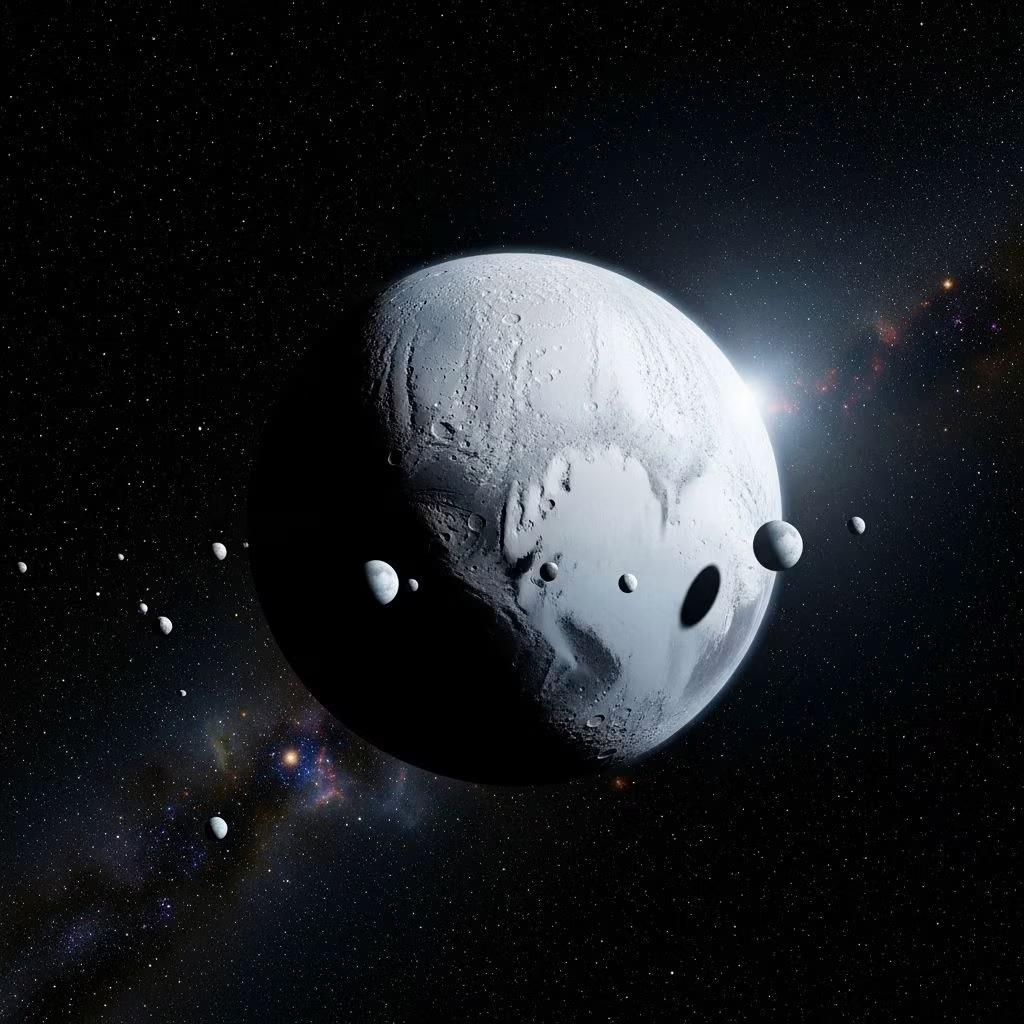
Eris: Pluto’s Twin at the Solar System’s Edge
Deep in the frozen outskirts of our solar system lies Eris, a dwarf planet whose discovery in the early 21st century forever changed how astronomers view—and define—planets. Often called Pluto’s twin, Eris is slightly smaller in diameter but denser and more massive, orbiting three times farther from the Sun than Pluto itself. Its unexpected emergence not only triggered a cosmic controversy but also led to the infamous demotion of Pluto to a dwarf planet. This article explores Eris’s characteristics, discovery, impact, and ongoing significance in planetary science.
Where Is Eris?
Located at approximately 95.6 astronomical units (AU) from the Sun—a staggering 8 billion miles (14 billion kilometers)—Eris resides at the solar system’s edge in the Kuiper Belt, an icy realm beyond the orbit of Neptune. At this distance, the Sun appears as a faint, small star, illuminating Eris with a weak glow that takes 13 hours to reach its glistening surface of methane and nitrogen ices. Currently, Eris is positioned in the southern constellation Cetus the Whale, barely detectable even by the world’s most powerful telescopes due to its faint magnitude of 18.7.
Quick Facts Table: Eris
| Feature | Detail |
|---|---|
| Distance from Sun | 95.6 AU (approx. 8 billion miles / 14 billion km) |
| Orbital Period | 559 years |
| Diameter | 2,326 kilometers |
| Mass | 27% greater than Pluto |
| Surface Composition | Methane & Nitrogen Ices |
| Moon | Dysnomia |
| Apparent Magnitude | 18.7 |
| Orbital Eccentricity | Highly elliptical |
The Discovery of Eris: A Celestial Surprise
The story of Eris began in 2003, when astronomers at the California Institute of Technology gathered telescope data that hinted at a distant object in the Kuiper Belt. Initially, Eris slipped through detection algorithms, its slow movement falling below the speed threshold set to identify objects. It wasn’t until 2005 that a re-examination of earlier data, prompted by discoveries of other trans-Neptunian objects, revealed Eris’s true identity.
- Discoverers: Michael E. Brown, Chad Trujillo, and David Rabinowitz
- Date of Discovery: January 5, 2005
- Site: Palomar Observatory, California
The new object was larger than Pluto, and its discovery quickly sent shockwaves through the astronomical community, forcing a re-examination of longstanding planetary definitions. Named for the Greek goddess of discord, Eris lived up to its mythological reputation by stirring debate around the world and ultimately prompting a planetary reclassification.
What Makes Eris Unique?
- Size & Mass: Eris is slightly smaller in diameter than Pluto, but it has a greater mass, making it one of the largest known dwarf planets in the solar system.
- Reflective Surface: Eris possesses a highly reflective surface (albedo), rivalling that of Saturn’s moon Enceladus, due to its icy methane and nitrogen composition.
- Orbit: With a highly eccentric, tilted orbit, Eris travels around the Sun once every 559 years. Its path takes it from 38 AU at closest approach to 97 AU at farthest, extending well beyond the region of Pluto.
- Moon: Eris has a single, faint moon named Dysnomia, which helps scientists estimate the planet’s mass through gravitational studies[12].
Table: Eris vs. Pluto
| Property | Eris | Pluto |
|---|---|---|
| Diameter (km) | 2,326 | 2,376 |
| Mass (1021 kg) | 16.7 | 13.0 |
| Orbital Period (years) | 559 | 248 |
| Distance from Sun (AU) | 38–97 | 30–49 |
| Number of Moons | 1 | 5 |
The Great Planet Debate: Eris and Pluto’s Demotion
The discovery of Eris forced astronomers to reckon with a troubling reality: if Eris was considered a planet due to its size, then many other Kuiper Belt objects might also qualify. This dilemma led the International Astronomical Union (IAU) in 2006 to redefine the term “planet.” The new definition required a planet to:
- Orbit the Sun.
- Be spherical due to its own gravity.
- Clear its orbital neighborhood of other debris.
Because neither Eris nor Pluto cleared its orbit, both were officially classified as dwarf planets. This decision remains controversial among scientists and enthusiasts, with advocates still debating whether Pluto and Eris deserve planetary status or not[11].
Physical Characteristics and Interior Composition
Recent studies reveal that Eris possesses a rocky core surrounded by a thick shell of ice. Unlike Pluto, whose icy layer is mostly rigid, Eris’s ice shell is convecting, meaning it actively moves and churns as heat escapes from radioactive decay in its rocky interior[12]. This process gives Eris a “squishier” structure—less like solid stone and more akin to a slowly flowing, soft material.
Key Properties of Eris’s Internal Structure:
- Rocky core: Rich in radioactive elements.
- Ice shell: Dynamic, churning, and convecting.
- Tidal locking: Eris and Dysnomia always face each other due to tidal interactions.
This unexpected squishiness suggests that Eris’s heat generation and escape mechanisms differ from Pluto, offering clues to the evolutionary history of both objects.
Eris’s Surface Features
The surface of Eris reflects about 96% of the sunlight it receives, appearing bright and icy. Its composition includes:
- Methane ice: Confers Eris its reflective properties.
- Nitrogen ice: Contributes to volatile surface chemistry.
- No atmosphere: Eris’s weak gravity and cold temperature prevent the retention of an appreciable atmosphere.
Moon Dysnomia: Eris’s Companion
Eris’s only known moon, Dysnomia, is small, dark, and challenging to observe directly. Dysnomia’s orbit around Eris is highly regular, and studies of its motion allow scientists to precisely calculate Eris’s mass. Tidal interactions between Eris and Dysnomia have tidally locked the pair, meaning both always keep the same face toward one another[12].
How Eris Is Observed
Due to its extreme distance and faintness, Eris is nearly impossible to observe with amateur telescopes. Professional astronomers use large ground-based observatories and space telescopes for:
- Tracking its slow movement across the sky.
- Studying its brightness variations to infer rotation and composition.
- Analyzing gravitational interactions with Dysnomia.
Over time, continued monitoring refines our knowledge of Eris’s orbit, surface, and internal properties.
Future Missions and Scientific Importance
Although no spacecraft has yet explored Eris directly, proposed fly-by missions could launch in 2032 or 2044 to study the dwarf planet up close. Such missions would help resolve lingering questions about its geology and cosmic history. Eris remains a crucial part of planetary science for several reasons:
- Testing planetary definitions: Eris’s discovery led to the IAU’s revised planet classification.
- Comparative planetology: Contrasts Eris, Pluto, and other distant worlds.
- Kuiper Belt exploration: Provides insights into the solar system’s formation and migration.
- Search for new worlds: Motivates ongoing surveys of the Kuiper Belt and beyond.
Why Is Eris Important?
Eris is more than a distant chunk of ice and rock. Its discovery, physical properties, and the uproar it ignited have enriched our understanding of the solar system:
- Redefining planets: Eris forced astronomers to reassess the basic definition of a planet—one of astronomy’s deepest questions.
- Understanding planetary formation: Eris’s composition and orbit provide clues to how objects form and evolve in the Kuiper Belt.
- Public engagement: The Pluto-Eris controversy remains a widely discussed scientific and cultural topic, highlighting the importance of continually questioning established knowledge.
Frequently Asked Questions (FAQs)
Q: Is Eris bigger than Pluto?
A: Eris is slightly smaller in diameter than Pluto but has a higher mass, making it denser.
Q: Why did the discovery of Eris lead to Pluto’s demotion?
A: Eris’s discovery forced astronomers to reconsider what qualifies as a planet, resulting in the IAU’s 2006 creation of the dwarf planet category, which included both Eris and Pluto[15].
Q: How long does it take Eris to orbit the Sun?
A: Eris completes one orbit in approximately 559 Earth years.
Q: Does Eris have an atmosphere?
A: Eris is not known to have a significant atmosphere due to its small size, weak gravity, and cold temperatures[13].
Q: Can Eris be seen through telescopes?
A: Eris’s extreme distance and faintness make it nearly invisible to amateur telescopes; only major observatories can resolve its light.
Conclusion: The Ongoing Legacy of Eris
Eris’s discovery marked a turning point in the history of planetary science. Its physical attributes, orbital behavior, and the moon Dysnomia continue to offer vital clues about the Kuiper Belt and the nature of planetary bodies at the solar system’s edge. As future missions contemplate visiting this distant world, Eris’s legacy—controversy and all—will persist as a testament to the complexities and wonders awaiting discovery in our cosmic backyard.
References
- https://www.space.com/28379-eris-dwarf-planet.html
- https://en.wikipedia.org/wiki/Eris_(dwarf_planet)
- https://science.nasa.gov/dwarf-planets/eris/
- https://www.astronomy.com/science/20-years-ago-the-discovery-of-eris-changed-everything/
- https://www.space.com/pluto-twin-dwarf-planet-eris-squishy
- https://www.youtube.com/watch?v=MKBG4AwPpBY
- https://web.gps.caltech.edu/~mbrown/planetlila/
- https://space-facts.com/eris/
- https://www.britannica.com/place/Eris-astronomy
- https://science.nasa.gov/dwarf-planets/
- https://spaceexplored.com/2022/01/05/astronomers-discover-dwarf-planet-eris-sparking-pluto-debate-this-day-in-space-5-jan-2005/
- https://phys.org/news/2023-11-dwarf-planet-eris-squishier.html
- https://www.planetsforkids.org/dwarf-planet/eris.html
- http://www.spaceopedia.com/solar-system/planets/minor-planets/eris/
- https://en.wikipedia.org/wiki/Dwarf_planet
- https://theplanets.org/eris/
- https://www.sciencetimes.com/articles/35412/20220105/discovery-of-eris-17-years-ago-reignites-pluto-planet-debate-again.htm
- https://www.spacereference.org/asteroid/136199-eris-2003-ub313