A Partial Solar Eclipse Is Coming: Everything You Need to Know for September 21
On September 21, skywatchers around the world will have a chance to witness a partial solar eclipse, when the Moon slides between Earth and the Sun, taking a dazzling ‘bite’ out of the Sun’s disk. This astronomical event promises a memorable view—provided you’re prepared to watch it safely with proper equipment and knowledge. In this guide, learn about eclipse timings, locations, safe viewing practices, scientific background, and answers to frequently asked eclipse safety questions.
What Is a Partial Solar Eclipse?
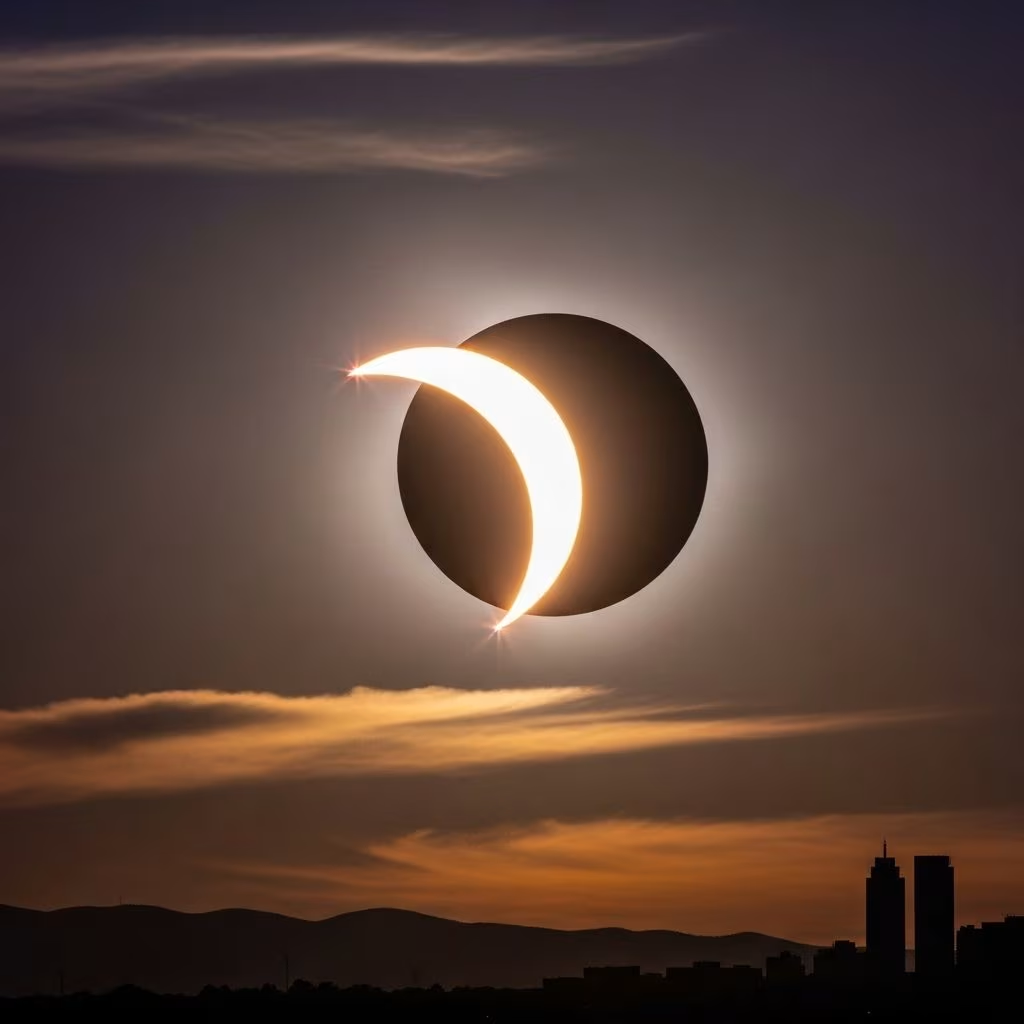
An eclipse occurs when the Moon passes between the Earth and the Sun, casting a shadow that temporarily dims our daylight. A partial solar eclipse happens when the Moon covers only part of the Sun’s face, creating a crescent-shaped Sun visible from Earth. Unlike total eclipses, during a partial eclipse, some sunlight always reaches us—meaning special safety precautions are essential throughout the event.
- Partial Solar Eclipse: Moon covers part of the Sun; some sunlight is always visible.
- Total Solar Eclipse: Moon fully covers the Sun, creating temporary midday darkness over a narrow path.
- Annular Solar Eclipse: Moon appears slightly smaller than the Sun, forming a ‘ring of fire’ at maximum eclipse.
Partial eclipses are commonly visible over a larger portion of Earth’s surface compared to total eclipses, which have a far more restricted viewing path.
When and Where to See the September 21 Eclipse
The September 21, 2025 partial solar eclipse will be visible in select regions, depending on local geography and time zones. Observers in certain states and countries will see a significant portion of the Sun covered, while others may witness only a minor sliver. Always refer to official astronomical maps for your area’s specifics.
- Time: The eclipse starts during local morning or afternoon hours, depending on location.
- Locations: Most of North America, Europe, and parts of Asia will experience the partial eclipse, but coverage varies by region.
- Peak Visibility: Areas closer to the path’s center see the deepest coverage—the ‘bite’ out of the Sun is more pronounced.
| Region | Type | Coverage | Best Viewing Time |
|---|---|---|---|
| North America (Eastern parts) | Partial | Up to 40% | Late Morning |
| Europe | Partial | Up to 30% | Afternoon |
| Asia | Partial | 10-20% | Midday |
Check your local observatory or astronomy club for exact timings and coverage in your area. Meteorological conditions may affect visibility, so prepare for clouds or changing weather.
How to Watch the Eclipse Safely
The most important aspect of eclipse viewing is eye safety. Never look directly at the Sun with naked eyes, regular sunglasses, or homemade filters—this can cause permanent eye damage or even blindness. Always use proper solar filters designed for eclipse viewing.
- Safe Viewing Tools:
- Eclipse glasses compliant with ISO 12312-2:2015.
- Handheld solar viewers from reputable manufacturers.
- Indirect viewing methods using pinhole projectors or solar projection boxes.
- Unsafe Methods (never use):
- Regular sunglasses, no matter how dark.
- Homemade filters.
- Viewing through cameras, telescopes, or binoculars without approved solar filters.
Before you view, thoroughly inspect your filter for scratches, damage, or missing ISO information. Defective or counterfeit filters can fail, exposing your eyes to dangerous rays.
Steps for Safe Viewing:
- Check your eclipse glasses or viewer for ISO certification and signs of damage before use.
- Put on your solar filter before looking at the Sun.
- Supervise children and help them use their glasses or viewer correctly.
- Never remove your filter while looking at the Sun. Only take it off after turning away.
- If you are within a path where a total eclipse occurs, remove filters only during totality then put them back on immediately when the Sun reappears. During a partial eclipse, the filter stays on at all times.
Why Is Solar Eclipse Safety Critical?
The Sun’s energy is so intense that even a sliver of direct sunlight—blocked only partly by the Moon during a partial eclipse—can cause severe and irreversible damage to the retina (solar retinopathy). This damage is painless but can result in permanent blind spots or vision loss. Using properly certified solar viewers is not optional—it is absolutely essential for safe enjoyment of any solar eclipse.
- Permanent eye damage risk: Exposure to direct sunlight can destroy retinal tissue.
- Invisible injury: The damage occurs silently and painlessly, but is irreversible.
- No safe exposure: Only during totality in a total eclipse, for a few minutes, is it safe to view the Sun without a solar filter.
For further reading on solar eclipse safety, consult guidelines provided by organizations such as NASA, American Astronomical Society, and the American Academy of Ophthalmology. When in doubt, contact a licensed eye care professional.
Tips for Planning Your Eclipse Viewing Experience
- Locate the best viewing sites ahead of time using online maps and local astronomy organizations.
- Consider weather forecasts; clouds will obscure the view.
- Bring proper eclipse glasses or viewers for everyone in your group.
- Arrive early to find a clear vantage point and set up safely away from busy roads.
- Organize a group event with friends, family, or local skywatching societies for shared learning and enjoyment.
- Capture the moment with photos—only if your camera/telescope uses properly fitted solar filters.
Families with children should supervise youngsters especially closely. Ensure kids never look directly at the Sun and use their eclipse glasses correctly throughout the event.
The Science Behind Solar Eclipses
Solar eclipses occur due to perfect alignment between the Sun, Moon, and Earth. While partial eclipses are common, total and annular eclipses require more precise conditions. Understanding solar eclipses offers insight into celestial mechanics and the dynamics of our solar system.
| Eclipse Type | How It Occurs | What You’ll See |
|---|---|---|
| Partial | Moon covers only part of Sun | Crescent Sun, never darkness |
| Total | Moon covers entire Sun for a few minutes | Darkness, stars, solar corona visible |
| Annular | Moon smaller than Sun, forms bright ring | ‘Ring of Fire’ surrounds Moon |
- Partial eclipses: Most common, widely visible.
- Total eclipses: Rare, visible only within narrow path.
- Annular eclipses: Occur when Moon is farthest from Earth.
Ancient cultures often regarded eclipses as supernatural or omens. Now, eclipses serve as valuable opportunities for public engagement and scientific research, especially in solar physics.
Frequently Asked Questions (FAQs)
Q: Is it safe to view a partial solar eclipse with regular sunglasses?
A: No. Regular sunglasses—even very dark ones—do not provide adequate protection against solar rays and cannot prevent eye damage during an eclipse. Always use ISO-certified eclipse glasses.
Q: How can I tell if my eclipse glasses are safe?
A: Look for ISO 12312-2:2015 certification printed on the glasses, the manufacturer’s information, and discard any with scratches, tears, or that are made before 2015.
Q: Can I watch the eclipse through my phone, camera, or telescope?
A: You can only watch through these devices if they are equipped with a proper solar filter. Never use an unfiltered device—even with eclipse glasses—because concentrated sunlight can burn through filters and harm your eyes.
Q: Is it safe for children to watch the eclipse?
A: Yes, if supervised closely and using certified eclipse viewers. Help children put on glasses before looking up, and keep them on throughout the eclipse.
Q: What should I do if my solar viewer is damaged?
A: Do not use any viewer that is scratched, torn, wrinkled, or compromised in any way. Acquire a new ISO-certified solar filter to safely observe the eclipse.
Key Takeaways for September 21 Partial Eclipse
- September 21 offers a rare opportunity for skywatchers to observe a partial solar eclipse.
- Visibility depends on location, so check local astronomy resources for exact timings.
- Never look directly at the Sun without ISO-certified eclipse glasses or solar viewers.
- Plan ahead—view from a safe spot, check weather, and supervise children closely.
- Use photo equipment only with proper solar filters to capture this celestial spectacle.
Follow safety guidelines and savor this cosmic event as the Moon takes a dramatic bite out of the Sun on September 21. Whether you’re a lifelong astronomy fan or a curious first-time observer, the experience can be unforgettable—and completely safe—with the right preparations.
References
- https://science.nasa.gov/eclipses/safety/
- https://science.nasa.gov/eclipses/future-eclipses/eclipse-2024/safety/
- https://www.nps.gov/articles/eclipsesafety.htm
- https://www.nsc.org/community-safety/safety-topics/seasonal-safety/how-to-watch-a-solar-eclipse
- https://eclipse.aas.org/eye-safety
- https://www.mayoclinichealthsystem.org/hometown-health/speaking-of-health/how-to-watch-the-solar-eclipse-safely
- https://www.dukehealth.org/blog/view-eclipse-safely-these-expert-tips
- https://www.texaschildrens.org/content/wellness/5-tips-safely-viewing-great-american-solar-eclipse
- https://www.nyc.gov/site/doh/about/press/pr2024/solar-eclipse-safety-precautions.page
- https://www.aoa.org/healthy-eyes/caring-for-your-eyes/solar-eclipses
- https://huhs.harvard.edu/2024/03/15/how-to-safely-view-the-solar-eclipse/
- https://www.timeanddate.com/eclipse/eclipse-tips-safety.html
- https://www.aahealth.org/news/solar-eclipse-safety
- https://dam.assets.ohio.gov/image/upload/ohio.org/uploads/pdfs/solar_eclipse_safety_tips_one_pager.pdf