Brightest Ever Fast Radio Burst Sheds New Light on Cosmic Mysteries
In March 2025, astronomers detected the most powerful fast radio burst (FRB) ever observed, fundamentally challenging existing theories about these enigmatic cosmic events. This breakthrough—enabling researchers to accurately trace the burst’s origin—ushers in a new era for FRB science and deepens humankind’s understanding of the universe’s most extreme phenomena.
Contents
- What Are Fast Radio Bursts?
- Discovery of RBFLOAT: The Brightest FRB Ever Recorded
- Pinpointing the Source: CHIME’s Breakthrough
- Rewriting Scientific Assumptions
- Implications for the Origins of FRBs
- The Environment Around RBFLOAT
- Looking Towards the Future
- Frequently Asked Questions (FAQs)
What Are Fast Radio Bursts?
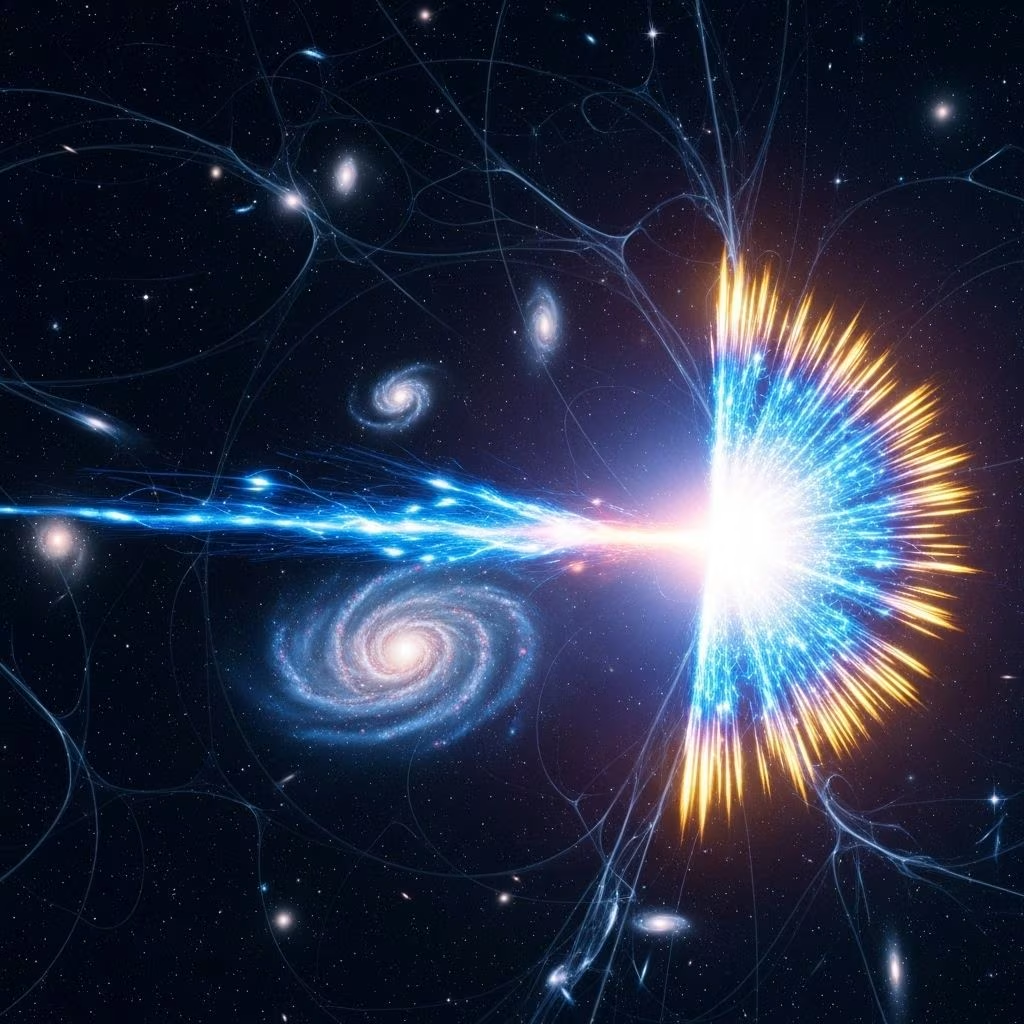
Fast radio bursts (FRBs) are intense, millisecond-long flashes of radio waves originating far beyond our galaxy. Since their unexpected discovery in 2007, FRBs have puzzled astronomers due to their sheer power and fleeting nature. In a fraction of a second, an FRB can emit as much energy as Earth’s sun produces in an entire year, with some bursts rivaling the energy output of whole galaxies during their brief lifespans.
- Mysterious origin: No conclusive explanation yet exists for what produces these short-lived but ultra-powerful radio bursts.
- Difficult to study: Their short duration and unpredictability make FRBs challenging to detect and even harder to trace back to their cosmic sources.
- Rare repeaters: Most known FRBs have only been observed once, with a rare minority repeating at unpredictable intervals, allowing more in-depth follow-up studies.
FRBs have quickly become one of the universe’s greatest astronomical enigmas due to:
- Their ability to be observed across billions of light-years.
- Their provision of a unique tool for probing the structure of space between galaxies.
Discovery of RBFLOAT: The Brightest FRB Ever Recorded
In March 2025, astronomers using the Canadian Hydrogen Intensity Mapping Experiment (CHIME) detected a record-breaking FRB—officially designated FRB 20250316A and nicknamed “RBFLOAT” (Radio Brightest Flash Of All Time). This extraordinary event is not only the most luminous fast radio burst ever recorded but also one of the closest, hailing from just 130 million light-years away in the nearby galaxy NGC 4141.
- Date of detection: March 2025
- Instrument used: CHIME, a cutting-edge radio telescope array in Canada, renowned for its significant contributions to FRB discovery
- Burst nickname: RBFLOAT
- Brightness: The brightest and closest FRB detected to date—so intense that its millisecond flash briefly outshone its entire host galaxy at radio wavelengths
Of special note is that CHIME managed to both detect and localize RBFLOAT on its own, marking a first for the instrument and highlighting advances in radio astronomy’s technical capabilities.
Pinpointing the Source: CHIME’s Breakthrough
Astronomers used CHIME’s 1,024 radio antennas and sophisticated signal-processing pipelines to trace RBFLOAT to an area merely 45 light-years across in the spiral arm on the edge of the spiral galaxy NGC 4141. This unprecedented precision has been compared to identifying the exact coin in a parking lot from 62 miles away.
- Host galaxy: NGC 4141
- Location within galaxy: Outer spiral arm, in a region much smaller than typical star clusters
- Technical achievement: First localization by CHIME alone, without needing additional observatories
- Significance of precision: Opened up the immediate neighborhood of the burst for detailed study, enabling astronomers to survey the population and age of nearby stars for the first time.
Prior to this, exact locations for FRBs were difficult to obtain, limiting our understanding of their environments and origins. The successful localization of RBFLOAT therefore represents a major leap forward, providing critical data for unraveling FRB mysteries.
Rewriting Scientific Assumptions
RBFLOAT’s unprecedented intensity and proximity have upended expectations and assumptions about how and where fast radio bursts can form.
| Factor | What Was Assumed | How RBFLOAT Challenges It |
|---|---|---|
| Typical energy output | FRBs might have a rough upper energy limit, set by the most extreme models for magnetars or neutron star mergers | RBFLOAT’s immense power exceeds many past theoretical bounds, pushing models to their limits or beyond |
| Host environments | High variability in host galaxy types, but burst environments not well resolved | RBFLOAT’s localization to a well-defined, star-forming region lets astronomers examine the local stellar population and galactic context for the first time |
| Repetition | Repeating FRBs are uncommon and may form a distinct sub-population | Early monitoring of RBFLOAT shows no repeats (yet), potentially connecting it with one-off bursts—but detailed study ongoing |
| Physical mechanism | Magnetars widely favored, but details uncertain due to lack of high-resolution environmental data | Direct study of the stars near RBFLOAT’s origin offers the first clues on progenitor ages and types |
Such a powerful event, observed so closely and in such detail, offers a corrective lens for theorists and modelers, prompting a reexamination of physical limits and the environments capable of creating FRBs.
Implications for the Origins of FRBs
For years, virtually all explanatory models for FRBs have centered around neutron stars—the ultra-dense remains of massive stars—and, in particular, magnetars—a subclass with magnetic fields trillions of times stronger than any found on Earth.
- Leading model: FRBs are likely produced by magnetars, though the exact emission mechanism is still under debate.
- Alternative ideas: Black hole-neutron star mergers, active galactic nuclei, cosmic string interactions, and other exotic explanations are still under investigation, especially in light of rare or extreme FRB events.
RBFLOAT’s extreme brightness combined with its precisely mapped origin has provided a rare opportunity to:
- Study the stellar neighborhood where the FRB occurred, including the presence of massive young stars, remnants of supernovae, and the possible history of magnetar formation.
- Assess local star-formation activity, which may be essential for producing the progenitor stars required for FRBs.
- Connect the burst’s properties with its immediate physical environment, something previously impossible for bursts at such cosmological distances.
This is especially significant because the vast energy output of RBFLOAT may challenge conventional ideas about how much energy even highly magnetic neutron stars can unleash, prompting a revision of the physics underpinning these models.
The Environment Around RBFLOAT
What makes the discovery of RBFLOAT particularly groundbreaking is not only its intensity and localization, but also the insights it provides into the area of the universe where this event occurred. For the first time, astronomers have been able to:
- Observe the stars and stellar clusters in the immediate vicinity of an FRB’s origin.
- Analyze the age, composition, and dynamics of this particular region of NGC 4141.
- Seek connections between recent supernova activity, star formation, and potential magnetar creation.
Initial observations indicate that the burst originated from a star-forming region in a spiral arm—an area not unlike sites of prolific star birth in our own Milky Way. Understanding these local conditions offers fresh clues regarding what progenitor systems are necessary for producing the universe’s most energetic radio signals.
Looking Towards the Future
The detection of RBFLOAT is considered a pivotal moment for fast radio burst astronomy, inaugurating a new era of focused, detailed study on FRB origins and mechanisms. Here’s what researchers expect moving forward:
- Enhanced observing campaigns: With tools like CHIME now proven capable of both detection and localization, astronomers plan to pursue more frequent, deeper surveys of bright and nearby FRBs.
- Multi-wavelength coordination: Optical, X-ray, and potentially even gravitational-wave observatories may be trained on precise FRB locations, seeking correlated phenomena or clues to the progenitor systems.
- Testing theoretical limits: The immense energy emitted in RBFLOAT pushes physical models to new extremes, spurring efforts to update or rethink basic assumptions about magnetars and their explosive behavior.
- Statistical studies: As more FRBs are precisely localized, researchers can begin to infer population-level trends, variation in host environments, and evolutionary patterns among burst sources.
The astronomical community considers RBFLOAT’s study a “template” for future in-depth FRB investigations, with the hope of moving the field from speculative theorizing to observable, testable science. Each newly discovered and mapped FRB brings closer the day when the sequence of cosmic events leading to these extraordinary bursts is understood in detail.
Frequently Asked Questions (FAQs)
Q: What exactly is a fast radio burst?
A: A fast radio burst (FRB) is a very brief (millisecond-scale) but tremendously energetic pulse of radio waves originating from far outside our solar system—sometimes even billions of light-years away. Their origins remain one of astronomy’s biggest unsolved mysteries.
Q: Why is the discovery of RBFLOAT so important?
A: RBFLOAT is the brightest FRB ever recorded and is unusually close by cosmic standards, allowing researchers for the first time to clearly trace its origin and study the burst’s environment in unprecedented detail.
Q: How do astronomers detect and locate FRBs?
A: Instruments like CHIME detect transient radio signals across the sky and use complex signal processing to identify characteristic FRB signals. Localization requires either a very advanced instrument or coordination between many telescopes, but CHIME managed to localize RBFLOAT on its own.
Q: What causes FRBs according to current theories?
A: The leading explanation is that FRBs are generated by highly magnetic young neutron stars called magnetars. However, there remain other possibilities, particularly for especially powerful or unusual events like RBFLOAT.
Q: Why is it so hard to determine the source of FRBs?
A: Because FRBs are extremely short-lived, rare, and occur randomly across the sky, the precise pinpointing of their origins is technologically challenging. RBFLOAT’s localization is a major accomplishment in this field.
Q: What new insights have been gained from studying the area around RBFLOAT?
A: For the first time, astronomers have observed the population and type of stars around a localized FRB, helping them assess whether recent star formation or magnetar creation events took place in that region.
Q: Are all FRBs similar to RBFLOAT?
A: RBFLOAT is exceptional in both its brightness and proximity; most FRBs are fainter and detected at much greater distances. Each discovery adds nuance to our understanding of these diverse and puzzling cosmic flashes.
References
- https://news.mit.edu/2025/astronomers-detect-all-time-brightest-fast-radio-burst-0821
- https://www.sciencenews.org/article/brightest-fast-radio-burst-energy
- https://news.ucsc.edu/2025/08/frb-rbfloat/
- https://www.space.com/astronomy/brightest-ever-fast-radio-burst-challenges-assumptions-about-mysterious-blasts-of-energy-this-marks-the-beginning-of-a-new-era
- https://en.wikipedia.org/wiki/Fast_radio_burst
- https://phys.org/news/2025-08-brightest-fast-radio.html
- https://physics.mit.edu/news/astronomers-detect-the-brightest-fast-radio-burst-of-all-time/
- https://www.innovationnewsnetwork.com/brightest-fast-radio-burst-ever-detected-130-million-light-years-away/61094/
- https://www.smithsonianmag.com/smart-news/astronomers-spot-the-brightest-fast-radio-burst-ever-detected-and-observe-stars-around-its-origin-for-the-first-time-180987233/
- https://phys.org/news/2025-09-astronomers-brightest-fast-radio-date.html
- https://icmglt.org/astronomers-spot-the-brightest-fast-radio-burst-ever-detected-and-observe-stars-around-its-origin-for-the-first-time/
- https://aui.edu/brightest-ever-fast-radio-burst-allows-researchers-to-identify-its-origin/
- https://www.sci.news/astronomy/brightest-fast-radio-burst-14158.html
- https://www.youtube.com/watch?v=-x4hyyrIEXU
- https://www.earth.com/news/astronomers-spot-the-brightest-fast-radio-burst-on-record/
- https://greenbankobservatory.org/news/brightest-ever-fast-radio-burst-allows-researchers-to-identify-its-origin/
- https://www.youtube.com/watch?v=KPIIt-j2T6Q
- https://science.nasa.gov/missions/hubble/hubble-finds-weird-home-of-farthest-fast-radio-burst/
- https://www.sciencedaily.com/releases/2025/08/250821224603.htm